WORKING WITH STUDENTS WITH
SPECIAL NEEDS
Assistive Technology
OVERVIEW
 A special need may be either a learning or
functioning disability. The list of conditions that may
designate a student as having a special need
includes the following:
 Hearing or visual impairment
 Emotional disorder
 Physical limb impairment
 Attention deficit hyperactivity disorder (ADHD)
 Cognitive challenges
 Autism
 Speech or language impairment
 Developmental delay
WAYS TO ENHANCE THE STUDENT
EXPERIENCE
 Individualized Education Plan (IEP)
 Assistive Technology
 Hearing Assistive Technology
 Optical Character Recognition
 Speech-Recognition Technology
 Non-Technology options
 Graphic Organizers
 Clickers,
 Smart Pens
 Timers
Examples of Resources and Instructional Strategies
THE INDIVIDUALIZED EDUCATION PLAN (IEP)
 An official, educational plan of action that identifies
and addresses the unique needs of individual
students with special needs and disabilities.
 The IEP includes the following:
 Statement of current performance of the student
 Any special education or services provided to the student
 An annual performance goal for the student
 The recommended and approved accommodations to meet
goals
 Evaluation of performance measures
THE INDIVIDUALIZED EDUCATION PLAN (IEP)
 The purpose is to improve educational results of
these students by creating specific educational
goals and plans.
 The IEP is created in partnership with
parents, teachers, and other
administrators, including counselors.
 Most services and accommodations are
completed in the regular classroom as much as
possible; however, special school environments
may be provided to allow more individualized
attention.
HEARING ASSISTIVE TECHNOLOGY (HATS) OR
ASSISTIVE LISTENING DEVICE (ALD)
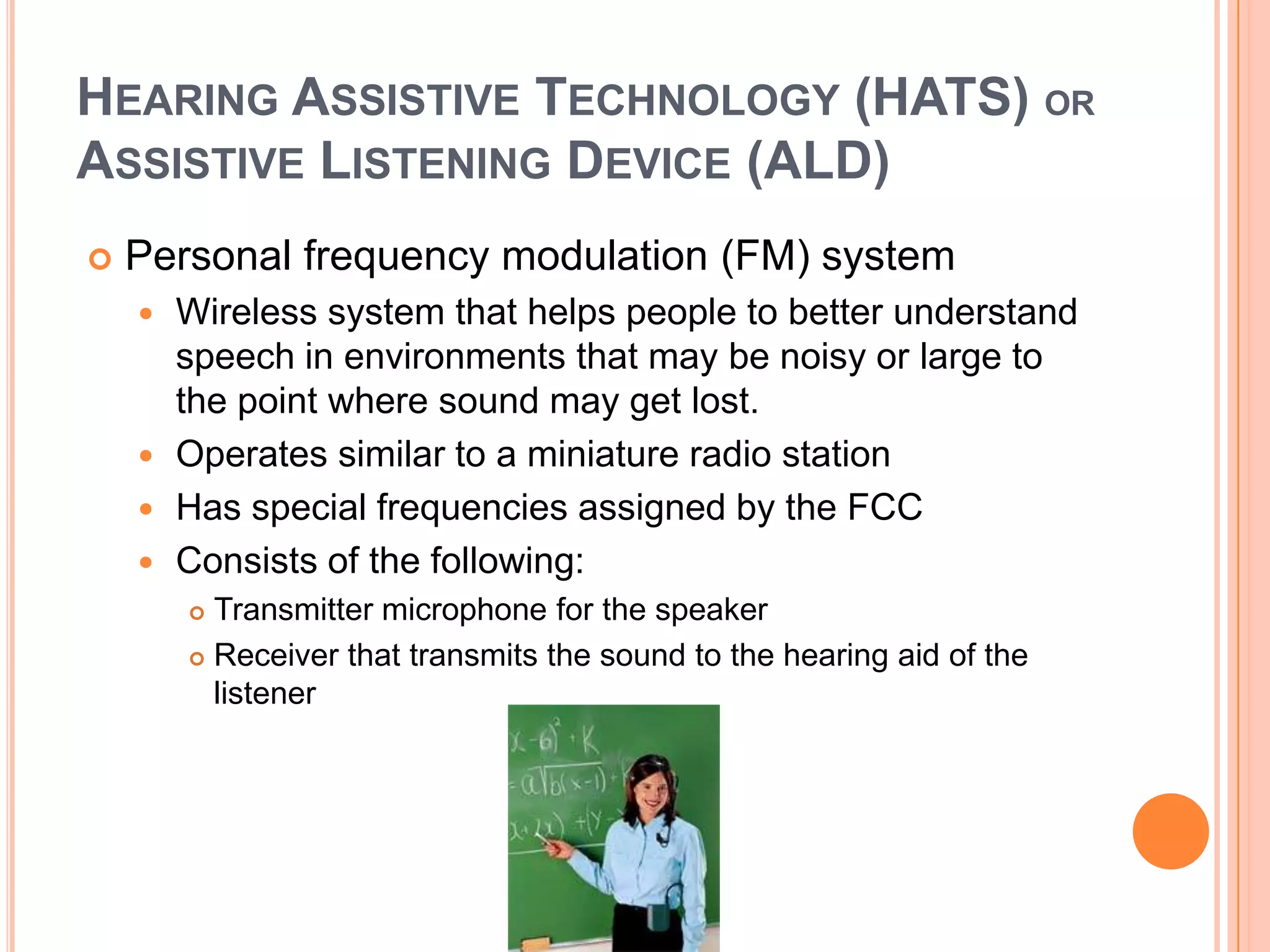
 Personal frequency modulation (FM) system
 Wireless system that helps people to better understand
speech in environments that may be noisy or large to
the point where sound may get lost.
 Operates similar to a miniature radio station
 Has special frequencies assigned by the FCC
 Consists of the following:
 Transmitter microphone for the speaker
 Receiver that transmits the sound to the hearing aid of the
listener
OPTICAL CHARACTER RECOGNITION
FOR READING & WRITING
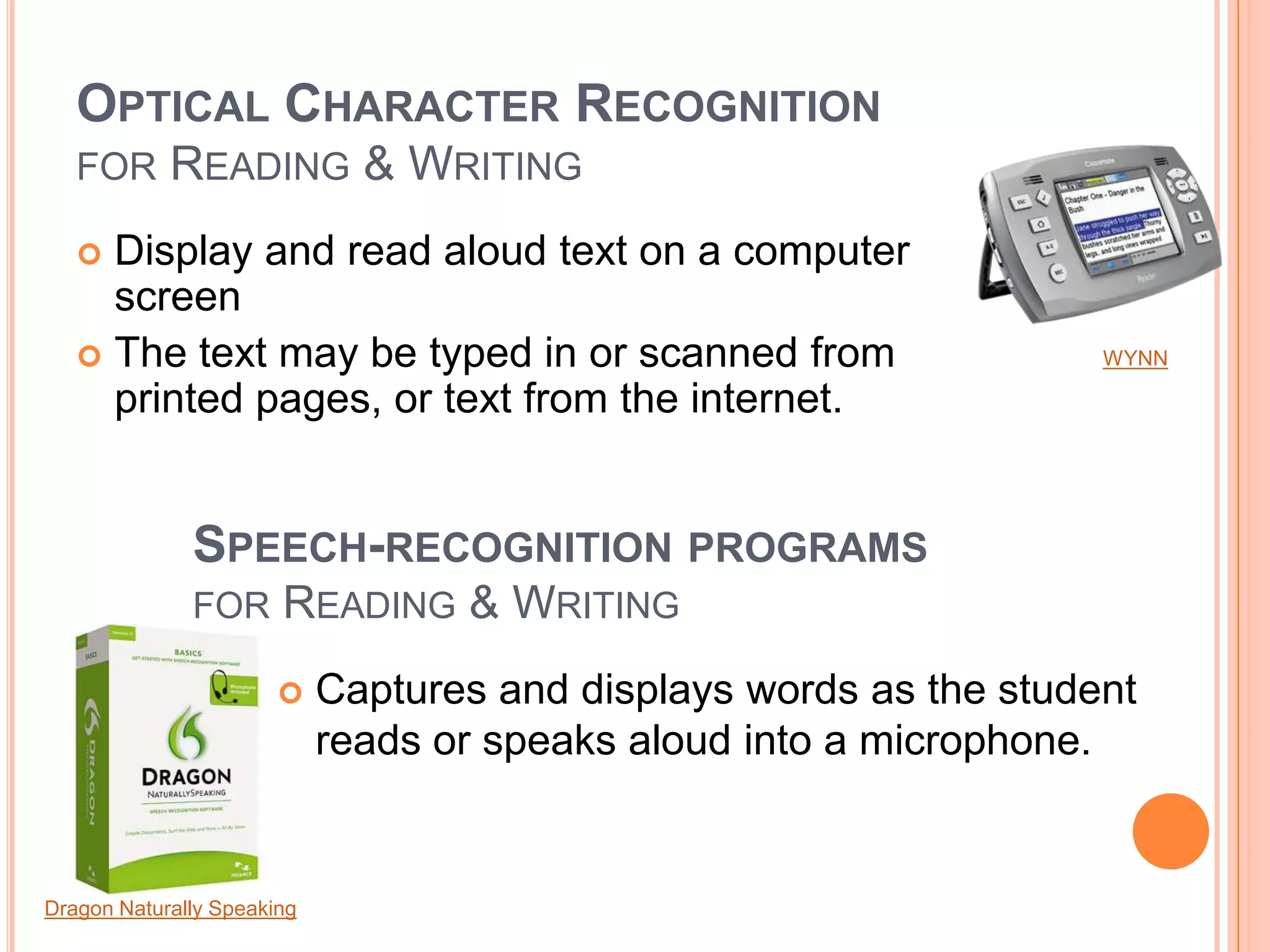
 Display and read aloud text on a computer
screen
 The text may be typed in or scanned from
printed pages, or text from the internet.
SPEECH-RECOGNITION PROGRAMS
FOR READING & WRITING
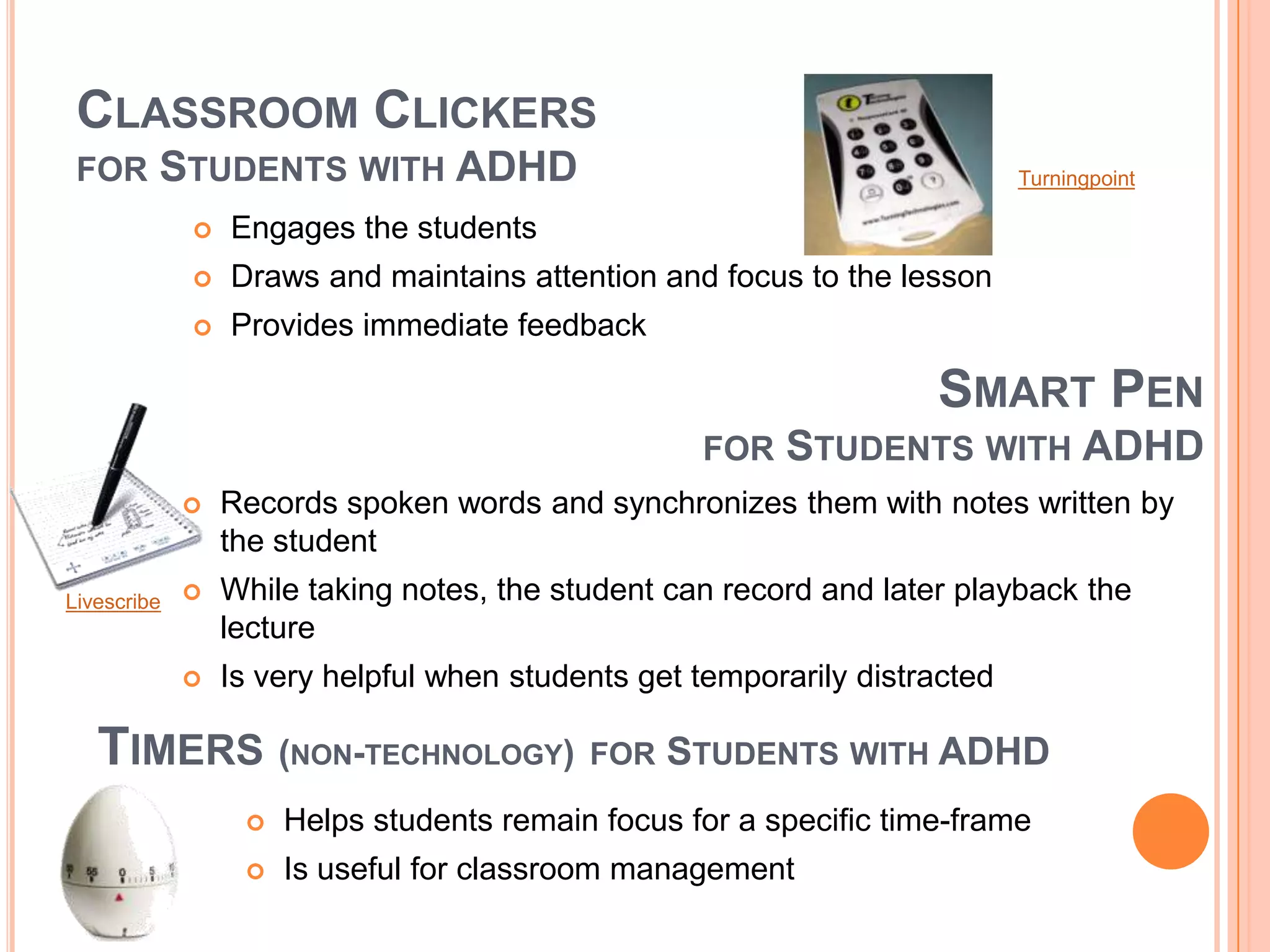
 Captures and displays words as the student
reads or speaks aloud into a microphone.
Dragon Naturally Speaking
WYNN
CLASSROOM CLICKERS
FOR STUDENTS WITH ADHD
 Engages the students
 Draws and maintains attention and focus to the lesson
 Provides immediate feedback
TIMERS (NON-TECHNOLOGY) FOR STUDENTS WITH ADHD
SMART PEN
FOR STUDENTS WITH ADHD
 Records spoken words and synchronizes them with notes written by
the student
 While taking notes, the student can record and later playback the
lecture
 Is very helpful when students get temporarily distracted
 Helps students remain focus for a specific time-frame
 Is useful for classroom management
Livescribe
Turningpoint
GRAPHIC ORGANIZERS FOR LEARNING
DISABILITIES
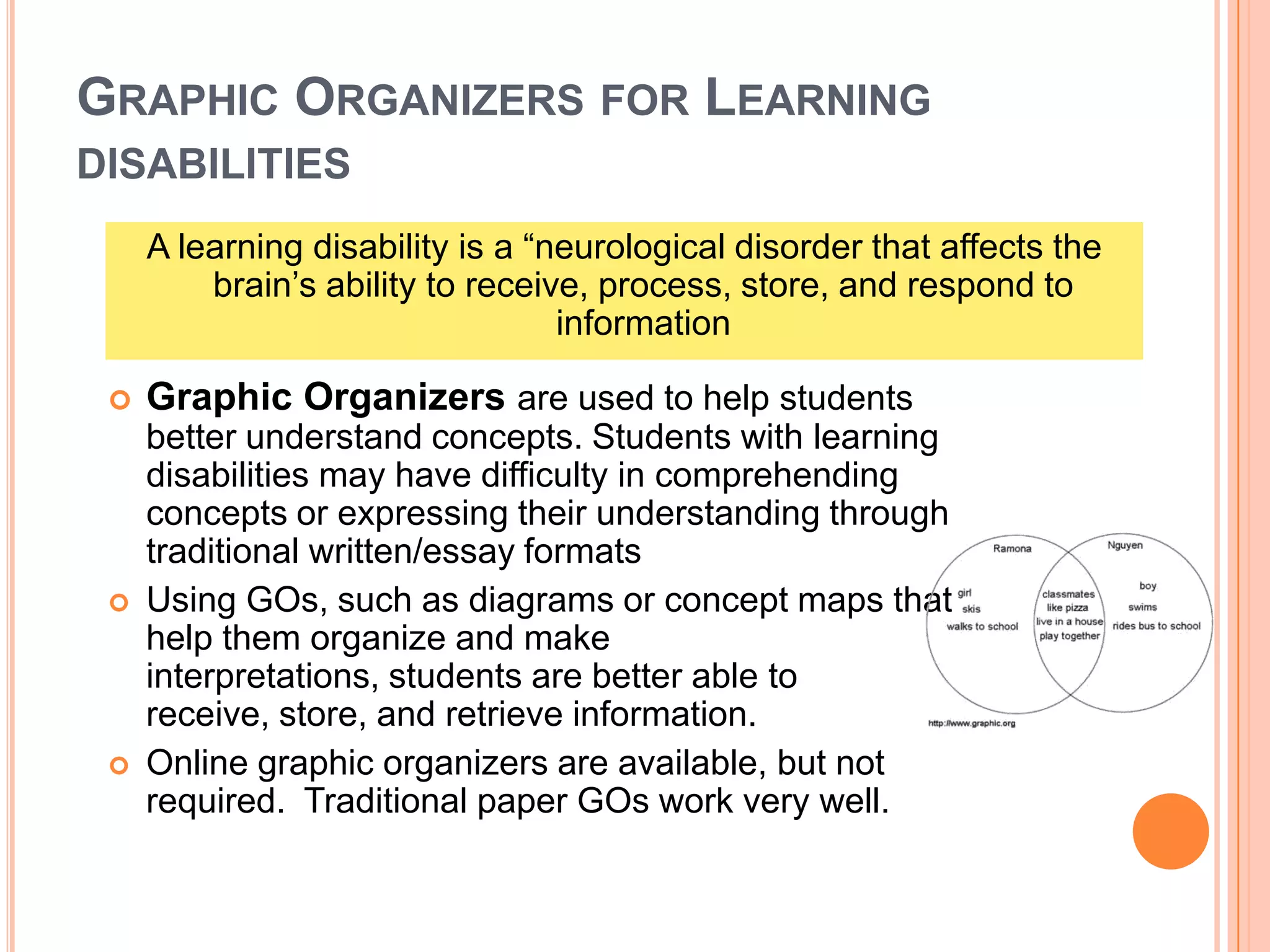
 Graphic Organizers are used to help students
better understand concepts. Students with learning
disabilities may have difficulty in comprehending
concepts or expressing their understanding through
traditional written/essay formats
 Using GOs, such as diagrams or concept maps that
help them organize and make
interpretations, students are better able to
receive, store, and retrieve information.
 Online graphic organizers are available, but not
required. Traditional paper GOs work very well.
A learning disability is a “neurological disorder that affects the
brain’s ability to receive, process, store, and respond to
information
REFERENCES
 American Speech-Language-Hearing Association. (n.d.). Fm systems. Retrieved from
http://www.asha.org/public/hearing/FM-Systems/
 Duffy, F. (2012). The write tools for adhd students. Retrieved from
http://www.additudemag.com/adhd/article/9365.html
 Ketcham, L. (2010, April 16). Online graphic organizers for use with special education
students. Retrieved from http://www.mangomon.com/online- graphic-organizers-for-use-
with-special-education-students/
 Levy, J. (n.d.). What is an iep?. Retrieved from http://www.ncld.org/students- disabilities/iep-
504-plan/what-is-iep
 Nemour Foundation. (n.d.). Individualized education programs (ieps). Retrieved from
http://kidshealth.org/parent/positive/learning/iep.html
 Raskind, M., & Stanberry, K. (2009). The best software and gadgets for adhd students.
Retrieved from http://www.additudemag.com/adhd/article/6585.html
 Shelton, K., Procailo, M., & Miller, A. (n.d.). Technology for adhd students. Retrieved from
http://kerryshelton.weebly.com/technology-for-adhd-students.html

Working with Students with Special Needs

  • 1.
    WORKING WITH STUDENTSWITH SPECIAL NEEDS Assistive Technology
  • 2.
    OVERVIEW  A specialneed may be either a learning or functioning disability. The list of conditions that may designate a student as having a special need includes the following:  Hearing or visual impairment  Emotional disorder  Physical limb impairment  Attention deficit hyperactivity disorder (ADHD)  Cognitive challenges  Autism  Speech or language impairment  Developmental delay
  • 3.
    WAYS TO ENHANCETHE STUDENT EXPERIENCE  Individualized Education Plan (IEP)  Assistive Technology  Hearing Assistive Technology  Optical Character Recognition  Speech-Recognition Technology  Non-Technology options  Graphic Organizers  Clickers,  Smart Pens  Timers Examples of Resources and Instructional Strategies
  • 4.
    THE INDIVIDUALIZED EDUCATIONPLAN (IEP)  An official, educational plan of action that identifies and addresses the unique needs of individual students with special needs and disabilities.  The IEP includes the following:  Statement of current performance of the student  Any special education or services provided to the student  An annual performance goal for the student  The recommended and approved accommodations to meet goals  Evaluation of performance measures
  • 5.
    THE INDIVIDUALIZED EDUCATIONPLAN (IEP)  The purpose is to improve educational results of these students by creating specific educational goals and plans.  The IEP is created in partnership with parents, teachers, and other administrators, including counselors.  Most services and accommodations are completed in the regular classroom as much as possible; however, special school environments may be provided to allow more individualized attention.
  • 6.
    HEARING ASSISTIVE TECHNOLOGY(HATS) OR ASSISTIVE LISTENING DEVICE (ALD)  Personal frequency modulation (FM) system  Wireless system that helps people to better understand speech in environments that may be noisy or large to the point where sound may get lost.  Operates similar to a miniature radio station  Has special frequencies assigned by the FCC  Consists of the following:  Transmitter microphone for the speaker  Receiver that transmits the sound to the hearing aid of the listener
  • 7.
    OPTICAL CHARACTER RECOGNITION FORREADING & WRITING  Display and read aloud text on a computer screen  The text may be typed in or scanned from printed pages, or text from the internet. SPEECH-RECOGNITION PROGRAMS FOR READING & WRITING  Captures and displays words as the student reads or speaks aloud into a microphone. Dragon Naturally Speaking WYNN
  • 8.
    CLASSROOM CLICKERS FOR STUDENTSWITH ADHD  Engages the students  Draws and maintains attention and focus to the lesson  Provides immediate feedback TIMERS (NON-TECHNOLOGY) FOR STUDENTS WITH ADHD SMART PEN FOR STUDENTS WITH ADHD  Records spoken words and synchronizes them with notes written by the student  While taking notes, the student can record and later playback the lecture  Is very helpful when students get temporarily distracted  Helps students remain focus for a specific time-frame  Is useful for classroom management Livescribe Turningpoint
  • 9.
    GRAPHIC ORGANIZERS FORLEARNING DISABILITIES  Graphic Organizers are used to help students better understand concepts. Students with learning disabilities may have difficulty in comprehending concepts or expressing their understanding through traditional written/essay formats  Using GOs, such as diagrams or concept maps that help them organize and make interpretations, students are better able to receive, store, and retrieve information.  Online graphic organizers are available, but not required. Traditional paper GOs work very well. A learning disability is a “neurological disorder that affects the brain’s ability to receive, process, store, and respond to information
  • 10.
    REFERENCES  American Speech-Language-HearingAssociation. (n.d.). Fm systems. Retrieved from http://www.asha.org/public/hearing/FM-Systems/  Duffy, F. (2012). The write tools for adhd students. Retrieved from http://www.additudemag.com/adhd/article/9365.html  Ketcham, L. (2010, April 16). Online graphic organizers for use with special education students. Retrieved from http://www.mangomon.com/online- graphic-organizers-for-use- with-special-education-students/  Levy, J. (n.d.). What is an iep?. Retrieved from http://www.ncld.org/students- disabilities/iep- 504-plan/what-is-iep  Nemour Foundation. (n.d.). Individualized education programs (ieps). Retrieved from http://kidshealth.org/parent/positive/learning/iep.html  Raskind, M., & Stanberry, K. (2009). The best software and gadgets for adhd students. Retrieved from http://www.additudemag.com/adhd/article/6585.html  Shelton, K., Procailo, M., & Miller, A. (n.d.). Technology for adhd students. Retrieved from http://kerryshelton.weebly.com/technology-for-adhd-students.html