Working Capital Management
Mr. Vijay R. Joshi, Assistant Professor
Department Of Business Administration
(UG)
Dhanwate National College-NAGPUR
Working Capital Management
Content:-
• 4.1 Introduction & Meaning
• 4.2 Concept of Working Capital
• 4.3 Working Capital Cycle/Operating Cycle
• 4.4 Types of Working Capital
• 4.5 Financing of Working Capital
• 4.6 Approaches to Finance Working Capital
• 4.7 Estimation/Calculation Of Working Capital
• 4.8 Other Theory
What is required to start
and run a business?
4.1 Introduction & Meaning
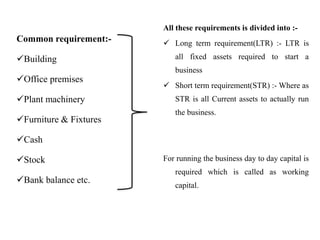
All these requirements is divided into :-
 Long term requirement(LTR) :- LTR is
all fixed assets required to start a
business
 Short term requirement(STR) :- Where as
STR is all Current assets to actually run
the business.
For running the business day to day capital is
required which is called as working
capital.
Common requirement:-
Building
Office premises
Plant machinery
Furniture & Fixtures
Cash
Stock
Bank balance etc.
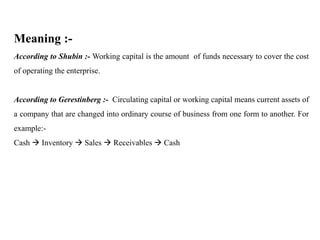
Meaning :-
According to Shubin :- Working capital is the amount of funds necessary to cover the cost
of operating the enterprise.
According to Gerestinberg :- Circulating capital or working capital means current assets of
a company that are changed into ordinary course of business from one form to another. For
example:-
Cash  Inventory  Sales  Receivables  Cash
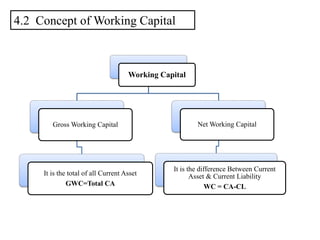
4.2 Concept of Working Capital
Working Capital
Gross Working Capital
It is the total of all Current Asset
GWC=Total CA
Net Working Capital
It is the difference Between Current
Asset & Current Liability
WC = CA-CL
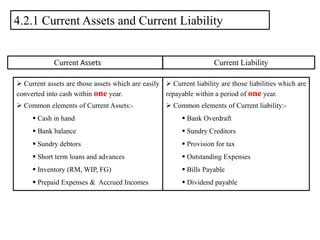
4.2.1 Current Assets and Current Liability
Current Assets Current Liability
 Current assets are those assets which are easily
converted into cash within one year.
 Common elements of Current Assets:-
 Cash in hand
 Bank balance
 Sundry debtors
 Short term loans and advances
 Inventory (RM, WIP, FG)
 Prepaid Expenses & Accrued Incomes
 Current liability are those liabilities which are
repayable within a period of one year.
 Common elements of Current liability:-
 Bank Overdraft
 Sundry Creditors
 Provision for tax
 Outstanding Expenses
 Bills Payable
 Dividend payable
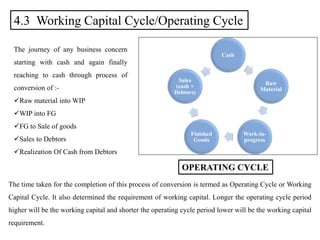
4.3 Working Capital Cycle/Operating Cycle
Cash
Raw
Material
Work-in-
progress
Finished
Goods
Sales
(cash +
Debtors)
The journey of any business concern
starting with cash and again finally
reaching to cash through process of
conversion of :-
Raw material into WIP
WIP into FG
FG to Sale of goods
Sales to Debtors
Realization Of Cash from Debtors
The time taken for the completion of this process of conversion is termed as Operating Cycle or Working
Capital Cycle. It also determined the requirement of working capital. Longer the operating cycle period
higher will be the working capital and shorter the operating cycle period lower will be the working capital
requirement.
OPERATING CYCLE
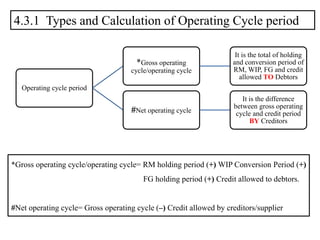
4.3.1 Types and Calculation of Operating Cycle period
Operating cycle period
*Gross operating
cycle/operating cycle
It is the total of holding
and conversion period of
RM, WIP, FG and credit
allowed TO Debtors
#Net operating cycle
It is the difference
between gross operating
cycle and credit period
BY Creditors
*Gross operating cycle/operating cycle= RM holding period (+) WIP Conversion Period (+)
FG holding period (+) Credit allowed to debtors.
#Net operating cycle= Gross operating cycle (–) Credit allowed by creditors/supplier
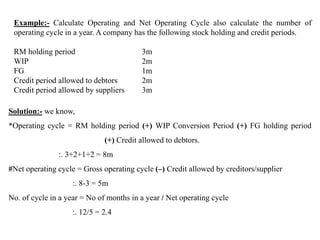
Solution:- we know,
*Operating cycle = RM holding period (+) WIP Conversion Period (+) FG holding period
(+) Credit allowed to debtors.
:. 3+2+1+2 = 8m
#Net operating cycle = Gross operating cycle (–) Credit allowed by creditors/supplier
:. 8-3 = 5m
No. of cycle in a year = No of months in a year / Net operating cycle
:. 12/5 = 2.4
Example:- Calculate Operating and Net Operating Cycle also calculate the number of
operating cycle in a year. A company has the following stock holding and credit periods.
RM holding period 3m
WIP 2m
FG 1m
Credit period allowed to debtors 2m
Credit period allowed by suppliers 3m
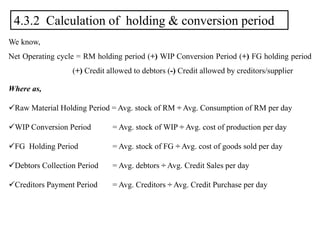
4.3.2 Calculation of holding & conversion period
We know,
Net Operating cycle = RM holding period (+) WIP Conversion Period (+) FG holding period
(+) Credit allowed to debtors (-) Credit allowed by creditors/supplier
Where as,
Raw Material Holding Period = Avg. stock of RM ÷ Avg. Consumption of RM per day
WIP Conversion Period = Avg. stock of WIP ÷ Avg. cost of production per day
FG Holding Period = Avg. stock of FG ÷ Avg. cost of goods sold per day
Debtors Collection Period = Avg. debtors ÷ Avg. Credit Sales per day
Creditors Payment Period = Avg. Creditors ÷ Avg. Credit Purchase per day
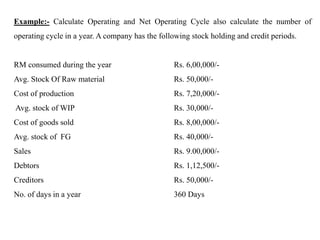
Example:- Calculate Operating and Net Operating Cycle also calculate the number of
operating cycle in a year. A company has the following stock holding and credit periods.
RM consumed during the year Rs. 6,00,000/-
Avg. Stock Of Raw material Rs. 50,000/-
Cost of production Rs. 7,20,000/-
Avg. stock of WIP Rs. 30,000/-
Cost of goods sold Rs. 8,00,000/-
Avg. stock of FG Rs. 40,000/-
Sales Rs. 9.00,000/-
Debtors Rs. 1,12,500/-
Creditors Rs. 50,000/-
No. of days in a year 360 Days
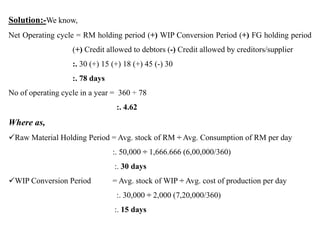
Solution:-We know,
Net Operating cycle = RM holding period (+) WIP Conversion Period (+) FG holding period
(+) Credit allowed to debtors (-) Credit allowed by creditors/supplier
:. 30 (+) 15 (+) 18 (+) 45 (-) 30
:. 78 days
No of operating cycle in a year = 360 ÷ 78
:. 4.62
Where as,
Raw Material Holding Period = Avg. stock of RM ÷ Avg. Consumption of RM per day
:. 50,000 ÷ 1,666.666 (6,00,000/360)
:. 30 days
WIP Conversion Period = Avg. stock of WIP ÷ Avg. cost of production per day
:. 30,000 ÷ 2,000 (7,20,000/360)
:. 15 days
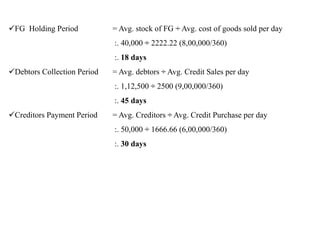
FG Holding Period = Avg. stock of FG ÷ Avg. cost of goods sold per day
:. 40,000 ÷ 2222.22 (8,00,000/360)
:. 18 days
Debtors Collection Period = Avg. debtors ÷ Avg. Credit Sales per day
:. 1,12,500 ÷ 2500 (9,00,000/360)
:. 45 days
Creditors Payment Period = Avg. Creditors ÷ Avg. Credit Purchase per day
:. 50,000 ÷ 1666.66 (6,00,000/360)
:. 30 days
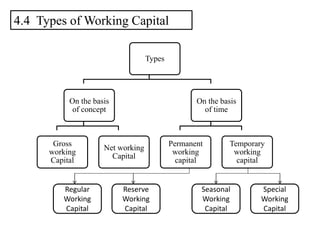
4.4 Types of Working Capital
Types
On the basis
of concept
Gross
working
Capital
Net working
Capital
On the basis
of time
Permanent
working
capital
Temporary
working
capital
Regular
Working
Capital
Reserve
Working
Capital
Seasonal
Working
Capital
Special
Working
Capital
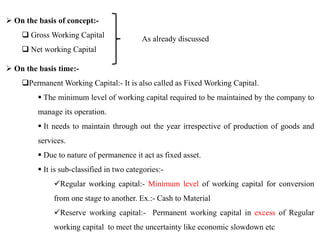
 On the basis of concept:-
 Gross Working Capital
 Net working Capital
As already discussed
 On the basis time:-
Permanent Working Capital:- It is also called as Fixed Working Capital.
 The minimum level of working capital required to be maintained by the company to
manage its operation.
 It needs to maintain through out the year irrespective of production of goods and
services.
 Due to nature of permanence it act as fixed asset.
 It is sub-classified in two categories:-
Regular working capital:- Minimum level of working capital for conversion
from one stage to another. Ex.:- Cash to Material
Reserve working capital:- Permanent working capital in excess of Regular
working capital to meet the uncertainty like economic slowdown etc
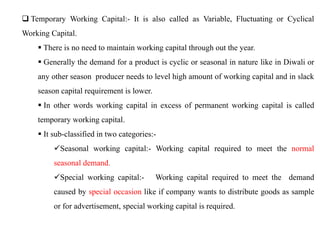
 Temporary Working Capital:- It is also called as Variable, Fluctuating or Cyclical
Working Capital.
 There is no need to maintain working capital through out the year.
 Generally the demand for a product is cyclic or seasonal in nature like in Diwali or
any other season producer needs to level high amount of working capital and in slack
season capital requirement is lower.
 In other words working capital in excess of permanent working capital is called
temporary working capital.
 It sub-classified in two categories:-
Seasonal working capital:- Working capital required to meet the normal
seasonal demand.
Special working capital:- Working capital required to meet the demand
caused by special occasion like if company wants to distribute goods as sample
or for advertisement, special working capital is required.
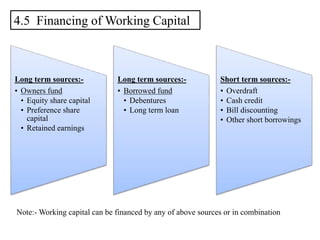
4.5 Financing of Working Capital
Long term sources:-
• Owners fund
• Equity share capital
• Preference share
capital
• Retained earnings
Long term sources:-
• Borrowed fund
• Debentures
• Long term loan
Short term sources:-
• Overdraft
• Cash credit
• Bill discounting
• Other short borrowings
Note:- Working capital can be financed by any of above sources or in combination
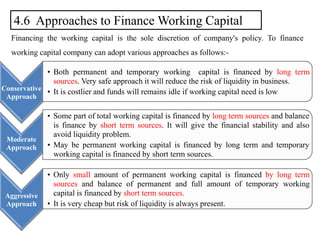
4.6 Approaches to Finance Working Capital
Financing the working capital is the sole discretion of company's policy. To finance
working capital company can adopt various approaches as follows:-
Conservative
Approach
• Both permanent and temporary working capital is financed by long term
sources. Very safe approach it will reduce the risk of liquidity in business.
• It is costlier and funds will remains idle if working capital need is low
Moderate
Approach
• Some part of total working capital is financed by long term sources and balance
is finance by short term sources. It will give the financial stability and also
avoid liquidity problem.
• May be permanent working capital is financed by long term and temporary
working capital is financed by short term sources.
Aggressive
Approach
• Only small amount of permanent working capital is financed by long term
sources and balance of permanent and full amount of temporary working
capital is financed by short term sources.
• It is very cheap but risk of liquidity is always present.
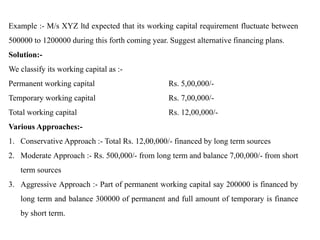
Example :- M/s XYZ ltd expected that its working capital requirement fluctuate between
500000 to 1200000 during this forth coming year. Suggest alternative financing plans.
Solution:-
We classify its working capital as :-
Permanent working capital Rs. 5,00,000/-
Temporary working capital Rs. 7,00,000/-
Total working capital Rs. 12,00,000/-
Various Approaches:-
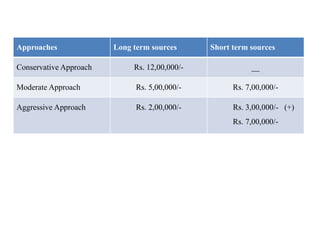
1. Conservative Approach :- Total Rs. 12,00,000/- financed by long term sources
2. Moderate Approach :- Rs. 500,000/- from long term and balance 7,00,000/- from short
term sources
3. Aggressive Approach :- Part of permanent working capital say 200000 is financed by
long term and balance 300000 of permanent and full amount of temporary is finance
by short term.
Approaches Long term sources Short term sources
Conservative Approach Rs. 12,00,000/- __
Moderate Approach Rs. 5,00,000/- Rs. 7,00,000/-
Aggressive Approach Rs. 2,00,000/- Rs. 3,00,000/- (+)
Rs. 7,00,000/-
THANK YOU

Working capital Management Part-1

  • 1.
    Working Capital Management Mr.Vijay R. Joshi, Assistant Professor Department Of Business Administration (UG) Dhanwate National College-NAGPUR
  • 2.
    Working Capital Management Content:- •4.1 Introduction & Meaning • 4.2 Concept of Working Capital • 4.3 Working Capital Cycle/Operating Cycle • 4.4 Types of Working Capital • 4.5 Financing of Working Capital • 4.6 Approaches to Finance Working Capital • 4.7 Estimation/Calculation Of Working Capital • 4.8 Other Theory
  • 3.
    What is requiredto start and run a business? 4.1 Introduction & Meaning
  • 4.
    All these requirementsis divided into :-  Long term requirement(LTR) :- LTR is all fixed assets required to start a business  Short term requirement(STR) :- Where as STR is all Current assets to actually run the business. For running the business day to day capital is required which is called as working capital. Common requirement:- Building Office premises Plant machinery Furniture & Fixtures Cash Stock Bank balance etc.
  • 5.
    Meaning :- According toShubin :- Working capital is the amount of funds necessary to cover the cost of operating the enterprise. According to Gerestinberg :- Circulating capital or working capital means current assets of a company that are changed into ordinary course of business from one form to another. For example:- Cash  Inventory  Sales  Receivables  Cash
  • 6.
    4.2 Concept ofWorking Capital Working Capital Gross Working Capital It is the total of all Current Asset GWC=Total CA Net Working Capital It is the difference Between Current Asset & Current Liability WC = CA-CL
  • 7.
    4.2.1 Current Assetsand Current Liability Current Assets Current Liability  Current assets are those assets which are easily converted into cash within one year.  Common elements of Current Assets:-  Cash in hand  Bank balance  Sundry debtors  Short term loans and advances  Inventory (RM, WIP, FG)  Prepaid Expenses & Accrued Incomes  Current liability are those liabilities which are repayable within a period of one year.  Common elements of Current liability:-  Bank Overdraft  Sundry Creditors  Provision for tax  Outstanding Expenses  Bills Payable  Dividend payable
  • 8.
    4.3 Working CapitalCycle/Operating Cycle Cash Raw Material Work-in- progress Finished Goods Sales (cash + Debtors) The journey of any business concern starting with cash and again finally reaching to cash through process of conversion of :- Raw material into WIP WIP into FG FG to Sale of goods Sales to Debtors Realization Of Cash from Debtors The time taken for the completion of this process of conversion is termed as Operating Cycle or Working Capital Cycle. It also determined the requirement of working capital. Longer the operating cycle period higher will be the working capital and shorter the operating cycle period lower will be the working capital requirement. OPERATING CYCLE
  • 9.
    4.3.1 Types andCalculation of Operating Cycle period Operating cycle period *Gross operating cycle/operating cycle It is the total of holding and conversion period of RM, WIP, FG and credit allowed TO Debtors #Net operating cycle It is the difference between gross operating cycle and credit period BY Creditors *Gross operating cycle/operating cycle= RM holding period (+) WIP Conversion Period (+) FG holding period (+) Credit allowed to debtors. #Net operating cycle= Gross operating cycle (–) Credit allowed by creditors/supplier
  • 10.
    Solution:- we know, *Operatingcycle = RM holding period (+) WIP Conversion Period (+) FG holding period (+) Credit allowed to debtors. :. 3+2+1+2 = 8m #Net operating cycle = Gross operating cycle (–) Credit allowed by creditors/supplier :. 8-3 = 5m No. of cycle in a year = No of months in a year / Net operating cycle :. 12/5 = 2.4 Example:- Calculate Operating and Net Operating Cycle also calculate the number of operating cycle in a year. A company has the following stock holding and credit periods. RM holding period 3m WIP 2m FG 1m Credit period allowed to debtors 2m Credit period allowed by suppliers 3m
  • 11.
    4.3.2 Calculation ofholding & conversion period We know, Net Operating cycle = RM holding period (+) WIP Conversion Period (+) FG holding period (+) Credit allowed to debtors (-) Credit allowed by creditors/supplier Where as, Raw Material Holding Period = Avg. stock of RM ÷ Avg. Consumption of RM per day WIP Conversion Period = Avg. stock of WIP ÷ Avg. cost of production per day FG Holding Period = Avg. stock of FG ÷ Avg. cost of goods sold per day Debtors Collection Period = Avg. debtors ÷ Avg. Credit Sales per day Creditors Payment Period = Avg. Creditors ÷ Avg. Credit Purchase per day
  • 12.
    Example:- Calculate Operatingand Net Operating Cycle also calculate the number of operating cycle in a year. A company has the following stock holding and credit periods. RM consumed during the year Rs. 6,00,000/- Avg. Stock Of Raw material Rs. 50,000/- Cost of production Rs. 7,20,000/- Avg. stock of WIP Rs. 30,000/- Cost of goods sold Rs. 8,00,000/- Avg. stock of FG Rs. 40,000/- Sales Rs. 9.00,000/- Debtors Rs. 1,12,500/- Creditors Rs. 50,000/- No. of days in a year 360 Days
  • 13.
    Solution:-We know, Net Operatingcycle = RM holding period (+) WIP Conversion Period (+) FG holding period (+) Credit allowed to debtors (-) Credit allowed by creditors/supplier :. 30 (+) 15 (+) 18 (+) 45 (-) 30 :. 78 days No of operating cycle in a year = 360 ÷ 78 :. 4.62 Where as, Raw Material Holding Period = Avg. stock of RM ÷ Avg. Consumption of RM per day :. 50,000 ÷ 1,666.666 (6,00,000/360) :. 30 days WIP Conversion Period = Avg. stock of WIP ÷ Avg. cost of production per day :. 30,000 ÷ 2,000 (7,20,000/360) :. 15 days
  • 14.
    FG Holding Period= Avg. stock of FG ÷ Avg. cost of goods sold per day :. 40,000 ÷ 2222.22 (8,00,000/360) :. 18 days Debtors Collection Period = Avg. debtors ÷ Avg. Credit Sales per day :. 1,12,500 ÷ 2500 (9,00,000/360) :. 45 days Creditors Payment Period = Avg. Creditors ÷ Avg. Credit Purchase per day :. 50,000 ÷ 1666.66 (6,00,000/360) :. 30 days
  • 15.
    4.4 Types ofWorking Capital Types On the basis of concept Gross working Capital Net working Capital On the basis of time Permanent working capital Temporary working capital Regular Working Capital Reserve Working Capital Seasonal Working Capital Special Working Capital
  • 16.
     On thebasis of concept:-  Gross Working Capital  Net working Capital As already discussed  On the basis time:- Permanent Working Capital:- It is also called as Fixed Working Capital.  The minimum level of working capital required to be maintained by the company to manage its operation.  It needs to maintain through out the year irrespective of production of goods and services.  Due to nature of permanence it act as fixed asset.  It is sub-classified in two categories:- Regular working capital:- Minimum level of working capital for conversion from one stage to another. Ex.:- Cash to Material Reserve working capital:- Permanent working capital in excess of Regular working capital to meet the uncertainty like economic slowdown etc
  • 17.
     Temporary WorkingCapital:- It is also called as Variable, Fluctuating or Cyclical Working Capital.  There is no need to maintain working capital through out the year.  Generally the demand for a product is cyclic or seasonal in nature like in Diwali or any other season producer needs to level high amount of working capital and in slack season capital requirement is lower.  In other words working capital in excess of permanent working capital is called temporary working capital.  It sub-classified in two categories:- Seasonal working capital:- Working capital required to meet the normal seasonal demand. Special working capital:- Working capital required to meet the demand caused by special occasion like if company wants to distribute goods as sample or for advertisement, special working capital is required.
  • 18.
    4.5 Financing ofWorking Capital Long term sources:- • Owners fund • Equity share capital • Preference share capital • Retained earnings Long term sources:- • Borrowed fund • Debentures • Long term loan Short term sources:- • Overdraft • Cash credit • Bill discounting • Other short borrowings Note:- Working capital can be financed by any of above sources or in combination
  • 19.
    4.6 Approaches toFinance Working Capital Financing the working capital is the sole discretion of company's policy. To finance working capital company can adopt various approaches as follows:- Conservative Approach • Both permanent and temporary working capital is financed by long term sources. Very safe approach it will reduce the risk of liquidity in business. • It is costlier and funds will remains idle if working capital need is low Moderate Approach • Some part of total working capital is financed by long term sources and balance is finance by short term sources. It will give the financial stability and also avoid liquidity problem. • May be permanent working capital is financed by long term and temporary working capital is financed by short term sources. Aggressive Approach • Only small amount of permanent working capital is financed by long term sources and balance of permanent and full amount of temporary working capital is financed by short term sources. • It is very cheap but risk of liquidity is always present.
  • 20.
    Example :- M/sXYZ ltd expected that its working capital requirement fluctuate between 500000 to 1200000 during this forth coming year. Suggest alternative financing plans. Solution:- We classify its working capital as :- Permanent working capital Rs. 5,00,000/- Temporary working capital Rs. 7,00,000/- Total working capital Rs. 12,00,000/- Various Approaches:- 1. Conservative Approach :- Total Rs. 12,00,000/- financed by long term sources 2. Moderate Approach :- Rs. 500,000/- from long term and balance 7,00,000/- from short term sources 3. Aggressive Approach :- Part of permanent working capital say 200000 is financed by long term and balance 300000 of permanent and full amount of temporary is finance by short term.
  • 21.
    Approaches Long termsources Short term sources Conservative Approach Rs. 12,00,000/- __ Moderate Approach Rs. 5,00,000/- Rs. 7,00,000/- Aggressive Approach Rs. 2,00,000/- Rs. 3,00,000/- (+) Rs. 7,00,000/-
  • 22.