Investment Appraisal
Investment AppraisalA means of assessing whether an investment project is worthwhile or notInvestment project could be the purchase of a new PC for a small firm, a new piece of equipment in a manufacturing plant, a whole new factory, etcUsed in both public and private sector
Investment AppraisalTypes of investment appraisal:Payback PeriodAccounting Rate of Return (ARR)Internal Rate of Return (IRR)Profitability IndexNet Present Value (discounted cash flow)What factors need to be considered before investing in equipment such as this?Copyright: Gergely Erno, stock.xchng
Investment AppraisalWhy do companies invest?Importance of remembering investment as the purchase of productive capacity NOT buying stocks and shares or investing in a bank!Buy equipment/machinery or build new plant to:Increase capacity (amount that can be produced) which means:Demand can be met and this generates sales revenueIncreased efficiency and productivity
Investment AppraisalInvestment therefore assumes that the investment will yield future income streamsInvestment appraisal is all about assessing these income streams against the cost of the investmentNot a precise science!A fork lift may be an important item but what does it contribute to overall sales?  How long and how much work would it have to do to repay its initial cost?Copyright: Loisjune, stock.xchng
Payback Period
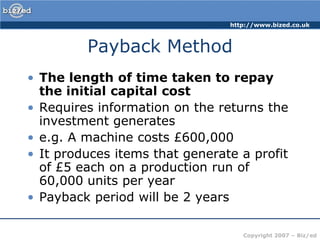
Payback MethodThe length of time taken to repay the initial capital costRequires information on the returns the investment generatese.g. A machine costs £600,000It produces items that generate a profit of £5 each on a production run of 60,000 units per yearPayback period will be 2 years
Payback methodPayback could occur during a year Can take account of this by reducing the cash inflows from the investment to days, weeks or yearsDays/Weeks/Months x Initial Investment    Payback = ------------------------------------------Total Cash Received
Payback Methode.g.Cost of machine = £600,000Annual income streams from investment = £255,000 per yearPayback = 36 x 600,000/765,000= 28.23 months (2 yrs, 6¾ months)
Accounting Rate of Return
Accounting Rate of ReturnA comparison of the profit generated by the investment with the cost of the investmentAverage annual return or annual profit      ARR = --------------------------------------------			        Initial cost of investment
Accounting Rate of Returne.g.An investment is expected to yield cash flows of £10,000 annually for the next 5 years The initial cost of the investment is £20,000Total profit therefore is: £30,000Annual profit = £30,000 / 5				= £6,000ARR = 6,000/20,000 x 100= 30%A worthwhile return?
Investment AppraisalTo make a more informed decision, more sophisticated techniques need to be used.Importance of time-value of money£ now £ in 5 years timeWhich is worth more?
Net Present Value (NPV)
Net Present ValueTakes into account the fact that money values change with timeHow much would you need to invest today to earn x amount in x years time?Value of money is affected by interest ratesNPV helps to take these factors into considerationShows you what your investment would have earned in an alternative investment regime
Net Present Valuee.g.Project A costs £1,000,000After 5 years the cash returns = £100,000 (10%)If you had invested the £1 million into a bank offering interest at 12% the returns would be greaterYou might be better off re-considering your investment!
Net Present ValueThe principle:How much would you have to invest now to earn £100 in one year’s time if the interest rate was 5%?The amount invested would need to be: £95.24Allows comparison of an investment by valuing cash payments on the project and cash receipts expected to be earned over the lifetime of the investment at the same point in time, i.e the present.
Net Present ValueFuture ValuePV = -----------------              (1 + i)nWhere i = interest rate          n = number of yearsThe PV of £1 @ 10% in 1 years time is 0.9090If you invested 0.9090p today and the interest rate was 10% you would have £1 in a year’s timeProcess referred to as:‘Discounting Cash Flow’
Net Present ValueCash flow x discount factor = present valuee.g. PV of £500 in 10 years time at a rate of interest of 4.25% = 500 x .6595373 = £329.77£329.77  is what you would have to invest today at a rate of interest of 4.25% to earn £500 in 10 years timePVs can be found through valuation tables (e.g. Parry’s Valuation Tables)
Cash Flows
Discounted Cash FlowAn example:A firm is deciding on investing in an energy efficiency system. Two possible systems are under investigationOne yields quicker results in terms of energy savings than the other but the second may be more efficient laterWhich should the firm invest in?
Discounted Cash Flow – System A
Discounted Cash Flow – System B
Discounted Cash FlowSystem A represents the better investmentSystem B yields the same return after six years but the returns of System A occur faster and are worth more to the firm than returns occurring in future years even though those returns are greater
Internal Rate of Return (IRR)
Internal Rate of ReturnAllows the risk associated with an investment project to be assessedThe IRR is the rate of interest (or discount rate) that makes the net present value = to zeroHelps measure the worth of an investment Allows the firm to assess whether an investment in the machine, etc. would yield a better return based on internal standards of returnAllows comparison of projects with different initial outlays Set the cash flows to different discount ratesSoftware or simple graphing allows the IRR to be found
Profitability Index
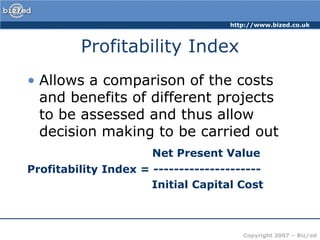
Profitability IndexAllows a comparison of the costs and benefits of different projects to be assessed and thus allow decision making to be carried outNet Present ValueProfitability Index = ---------------------                                  Initial Capital Cost
Investment AppraisalKey considerations for firms in considering use:Ease of use/degree of simplicity requiredDegree of accuracy requiredExtent to which future cash flows can be measured accuratelyExtent to which future interest rate movements can be factored in and predictedNecessity of factoring in effects of inflation

Investment Appraisals

  • 1.
  • 2.
  • 3.
    Investment AppraisalA meansof assessing whether an investment project is worthwhile or notInvestment project could be the purchase of a new PC for a small firm, a new piece of equipment in a manufacturing plant, a whole new factory, etcUsed in both public and private sector
  • 4.
    Investment AppraisalTypes ofinvestment appraisal:Payback PeriodAccounting Rate of Return (ARR)Internal Rate of Return (IRR)Profitability IndexNet Present Value (discounted cash flow)What factors need to be considered before investing in equipment such as this?Copyright: Gergely Erno, stock.xchng
  • 5.
    Investment AppraisalWhy docompanies invest?Importance of remembering investment as the purchase of productive capacity NOT buying stocks and shares or investing in a bank!Buy equipment/machinery or build new plant to:Increase capacity (amount that can be produced) which means:Demand can be met and this generates sales revenueIncreased efficiency and productivity
  • 6.
    Investment AppraisalInvestment thereforeassumes that the investment will yield future income streamsInvestment appraisal is all about assessing these income streams against the cost of the investmentNot a precise science!A fork lift may be an important item but what does it contribute to overall sales? How long and how much work would it have to do to repay its initial cost?Copyright: Loisjune, stock.xchng
  • 7.
  • 8.
    Payback MethodThe lengthof time taken to repay the initial capital costRequires information on the returns the investment generatese.g. A machine costs £600,000It produces items that generate a profit of £5 each on a production run of 60,000 units per yearPayback period will be 2 years
  • 9.
    Payback methodPayback couldoccur during a year Can take account of this by reducing the cash inflows from the investment to days, weeks or yearsDays/Weeks/Months x Initial Investment Payback = ------------------------------------------Total Cash Received
  • 10.
    Payback Methode.g.Cost ofmachine = £600,000Annual income streams from investment = £255,000 per yearPayback = 36 x 600,000/765,000= 28.23 months (2 yrs, 6¾ months)
  • 11.
  • 12.
    Accounting Rate ofReturnA comparison of the profit generated by the investment with the cost of the investmentAverage annual return or annual profit ARR = -------------------------------------------- Initial cost of investment
  • 13.
    Accounting Rate ofReturne.g.An investment is expected to yield cash flows of £10,000 annually for the next 5 years The initial cost of the investment is £20,000Total profit therefore is: £30,000Annual profit = £30,000 / 5 = £6,000ARR = 6,000/20,000 x 100= 30%A worthwhile return?
  • 14.
    Investment AppraisalTo makea more informed decision, more sophisticated techniques need to be used.Importance of time-value of money£ now £ in 5 years timeWhich is worth more?
  • 15.
  • 16.
    Net Present ValueTakesinto account the fact that money values change with timeHow much would you need to invest today to earn x amount in x years time?Value of money is affected by interest ratesNPV helps to take these factors into considerationShows you what your investment would have earned in an alternative investment regime
  • 17.
    Net Present Valuee.g.ProjectA costs £1,000,000After 5 years the cash returns = £100,000 (10%)If you had invested the £1 million into a bank offering interest at 12% the returns would be greaterYou might be better off re-considering your investment!
  • 18.
    Net Present ValueTheprinciple:How much would you have to invest now to earn £100 in one year’s time if the interest rate was 5%?The amount invested would need to be: £95.24Allows comparison of an investment by valuing cash payments on the project and cash receipts expected to be earned over the lifetime of the investment at the same point in time, i.e the present.
  • 19.
    Net Present ValueFutureValuePV = ----------------- (1 + i)nWhere i = interest rate n = number of yearsThe PV of £1 @ 10% in 1 years time is 0.9090If you invested 0.9090p today and the interest rate was 10% you would have £1 in a year’s timeProcess referred to as:‘Discounting Cash Flow’
  • 20.
    Net Present ValueCashflow x discount factor = present valuee.g. PV of £500 in 10 years time at a rate of interest of 4.25% = 500 x .6595373 = £329.77£329.77 is what you would have to invest today at a rate of interest of 4.25% to earn £500 in 10 years timePVs can be found through valuation tables (e.g. Parry’s Valuation Tables)
  • 21.
  • 22.
    Discounted Cash FlowAnexample:A firm is deciding on investing in an energy efficiency system. Two possible systems are under investigationOne yields quicker results in terms of energy savings than the other but the second may be more efficient laterWhich should the firm invest in?
  • 23.
  • 24.
  • 25.
    Discounted Cash FlowSystemA represents the better investmentSystem B yields the same return after six years but the returns of System A occur faster and are worth more to the firm than returns occurring in future years even though those returns are greater
  • 26.
    Internal Rate ofReturn (IRR)
  • 27.
    Internal Rate ofReturnAllows the risk associated with an investment project to be assessedThe IRR is the rate of interest (or discount rate) that makes the net present value = to zeroHelps measure the worth of an investment Allows the firm to assess whether an investment in the machine, etc. would yield a better return based on internal standards of returnAllows comparison of projects with different initial outlays Set the cash flows to different discount ratesSoftware or simple graphing allows the IRR to be found
  • 28.
  • 29.
    Profitability IndexAllows acomparison of the costs and benefits of different projects to be assessed and thus allow decision making to be carried outNet Present ValueProfitability Index = --------------------- Initial Capital Cost
  • 30.
    Investment AppraisalKey considerationsfor firms in considering use:Ease of use/degree of simplicity requiredDegree of accuracy requiredExtent to which future cash flows can be measured accuratelyExtent to which future interest rate movements can be factored in and predictedNecessity of factoring in effects of inflation