Staff Training and
   Certification
  Rizka Marsa Pramadani
Objectives
O To develop the knowledge and skills new staff need to
    perform software development and maintenance tasks at
    an adequate level of efficiency and effectiveness. Such
    training facilitates integration of new team members.
O   To assure conformity to the organization’s standards for
    software products (documents and code) by transmitting
    style and structure procedures together with work
    instructions.
O   To update the knowledge and skills of veteran staff in
    response to developments in the organization, and to
    assure efficient and effective performance of tasks as well
    as conformity to the organization’s style and structure
    procedures and work instructions.
O   To transmit knowledge of SQA procedures.
O   To assure that candidates for key software development
    and maintenance positions are adequately qualified.
The training and certification
            process
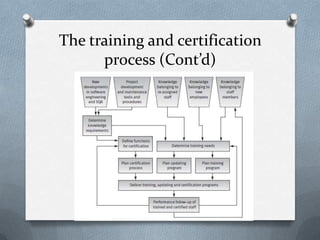
The operation of a successful training and certification
system demands thatthe following activities be regularly
performed:
O Determine the professional knowledge requirements
  for each position
O Determine the professional training and updating
  needs
O Plan the professional training program
O Plan the professional updating program
O Define positions requiring certification
O Plan certification processes
O Deliver training, updating and certification programs
O Perform follow-up of trained and certified staff.
The training and certification
      process (Cont’d)
Training and certification activities are
meant to fill the needs of veteran staff and
new employees. Comprehensive follow-up
of the outcomes of current programs as well
as keeping track of developments in the
profession are required to make sure that
programs are adequately up-to-date.
The training and certification
      process (Cont’d)
Determining professional
 knowledge requirements
The most common positions in a software
development and maintenance organization are:
O systems analyst,
O programmer,
O software development team leader,
O programming team leader,
O software maintenance technician,
O Software tester, and
O software testing team leader
Determining professional
      knowledge requirements (Cont’d)
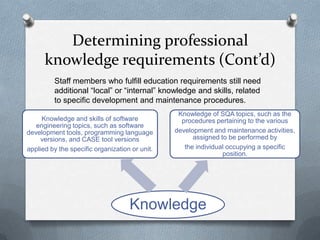
         Staff members who fulfill education requirements still need
         additional “local” or “internal” knowledge and skills, related
         to specific development and maintenance procedures.
                                                 Knowledge of SQA topics, such as the
     Knowledge and skills of software             procedures pertaining to the various
   engineering topics, such as software
development tools, programming language         development and maintenance activities,
     versions, and CASE tool versions                 assigned to be performed by
applied by the specific organization or unit.      the individual occupying a specific
                                                                position.


                                    Knowledge
Determining training and
       updating needs
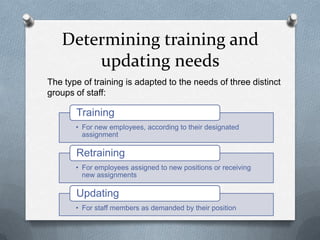
The type of training is adapted to the needs of three distinct
groups of staff:

       Training
       • For new employees, according to their designated
         assignment

       Retraining
       • For employees assigned to new positions or receiving
         new assignments

       Updating
       • For staff members as demanded by their position
Planning training and
     updating programs
There are two basic programs should be
devised : one for software engineering
topics and one for SQA topics
Planning training and updating
programs for software engineering
              topics

The timing of many training and retraining
activities cannot be determined in advance
because new personnel are recruited and
veteran staff are shifted often after relatively
short notice. However, updating activities
can be scheduled well, with contents
finalized close to the date of their
implementation.
Planning training and updating
   programs for SQA topics
The general characteristics of SQA training
programs allow them to be organized
periodically, every one or two months, and
delivered to all new staff recruited in the
interim. Typical SQA updating programs are
carried out once a year or once every six
months, depending on the pace of change.
The SQA unit or others responsible for SQA
issues in the organization usually prepare
these training andupdating programs.
Planning the certification
           processes
Certification is intended to provide a framework
for the thorough investigation of a candidate’s
qualifications and a demonstration of his or her
professional knowledge and skills. The
certification process, in every detail and for
every position, requires approval as defined in
the certification procedure.
Typical certification requirements
 O Professional education: academic or technical degrees and
     in some cases certification by a professional organization or
     by a leading commercial software producer
 O   Internal training courses
 O   Professional experience in the organization (may be
     partially or completely replaced by experience in other
     organizations)
 O   Assessment of achievements and ability as noted in
     periodic performance appraisals
 O   Evaluation by the candidate’s direct superior (often by
     completion of a special questionnaire)
 O   Demonstration of knowledge and skills by means of a test
     or a project
 O   Mentor’s supervision for a specified period of time.
Functions of the certification
         committee
O To perform the certification process on the
  basis of requests made by individual
  applicants or units and grant certification to
  those who qualify
O To follow up certification activities (such as
  mentoring) carried out by others
O To update certification requirements in
  response to developments in the organization
  as well as the profession
O To revise the list of positions requiring
  certification.

Staff training and certification

  • 1.
    Staff Training and Certification Rizka Marsa Pramadani
  • 2.
    Objectives O To developthe knowledge and skills new staff need to perform software development and maintenance tasks at an adequate level of efficiency and effectiveness. Such training facilitates integration of new team members. O To assure conformity to the organization’s standards for software products (documents and code) by transmitting style and structure procedures together with work instructions. O To update the knowledge and skills of veteran staff in response to developments in the organization, and to assure efficient and effective performance of tasks as well as conformity to the organization’s style and structure procedures and work instructions. O To transmit knowledge of SQA procedures. O To assure that candidates for key software development and maintenance positions are adequately qualified.
  • 3.
    The training andcertification process The operation of a successful training and certification system demands thatthe following activities be regularly performed: O Determine the professional knowledge requirements for each position O Determine the professional training and updating needs O Plan the professional training program O Plan the professional updating program O Define positions requiring certification O Plan certification processes O Deliver training, updating and certification programs O Perform follow-up of trained and certified staff.
  • 4.
    The training andcertification process (Cont’d) Training and certification activities are meant to fill the needs of veteran staff and new employees. Comprehensive follow-up of the outcomes of current programs as well as keeping track of developments in the profession are required to make sure that programs are adequately up-to-date.
  • 5.
    The training andcertification process (Cont’d)
  • 6.
    Determining professional knowledgerequirements The most common positions in a software development and maintenance organization are: O systems analyst, O programmer, O software development team leader, O programming team leader, O software maintenance technician, O Software tester, and O software testing team leader
  • 7.
    Determining professional knowledge requirements (Cont’d) Staff members who fulfill education requirements still need additional “local” or “internal” knowledge and skills, related to specific development and maintenance procedures. Knowledge of SQA topics, such as the Knowledge and skills of software procedures pertaining to the various engineering topics, such as software development tools, programming language development and maintenance activities, versions, and CASE tool versions assigned to be performed by applied by the specific organization or unit. the individual occupying a specific position. Knowledge
  • 8.
    Determining training and updating needs The type of training is adapted to the needs of three distinct groups of staff: Training • For new employees, according to their designated assignment Retraining • For employees assigned to new positions or receiving new assignments Updating • For staff members as demanded by their position
  • 9.
    Planning training and updating programs There are two basic programs should be devised : one for software engineering topics and one for SQA topics
  • 10.
    Planning training andupdating programs for software engineering topics The timing of many training and retraining activities cannot be determined in advance because new personnel are recruited and veteran staff are shifted often after relatively short notice. However, updating activities can be scheduled well, with contents finalized close to the date of their implementation.
  • 11.
    Planning training andupdating programs for SQA topics The general characteristics of SQA training programs allow them to be organized periodically, every one or two months, and delivered to all new staff recruited in the interim. Typical SQA updating programs are carried out once a year or once every six months, depending on the pace of change. The SQA unit or others responsible for SQA issues in the organization usually prepare these training andupdating programs.
  • 12.
    Planning the certification processes Certification is intended to provide a framework for the thorough investigation of a candidate’s qualifications and a demonstration of his or her professional knowledge and skills. The certification process, in every detail and for every position, requires approval as defined in the certification procedure.
  • 13.
    Typical certification requirements O Professional education: academic or technical degrees and in some cases certification by a professional organization or by a leading commercial software producer O Internal training courses O Professional experience in the organization (may be partially or completely replaced by experience in other organizations) O Assessment of achievements and ability as noted in periodic performance appraisals O Evaluation by the candidate’s direct superior (often by completion of a special questionnaire) O Demonstration of knowledge and skills by means of a test or a project O Mentor’s supervision for a specified period of time.
  • 14.
    Functions of thecertification committee O To perform the certification process on the basis of requests made by individual applicants or units and grant certification to those who qualify O To follow up certification activities (such as mentoring) carried out by others O To update certification requirements in response to developments in the organization as well as the profession O To revise the list of positions requiring certification.