Repetition Structure
Chapter - 4
Introduction to Repetition Structures
Concept:
The repetition structure causes a
statement or set of statements to
execute repeatedly.
Introduction to Repetition Structures
Condition-Controlled and Count-Controlled
Loops
A condition-controlled loop uses a true/false
condition to control the number of times that it
repeats.
A count-controlled loop repeats a specific
number of times.
The while Loop:
a Condition-Controlled Loop
Concept:
A condition-controlled loop causes a
statement or set of statements to repeat
as long as a condition is true. In Python
you use the while statement to write a
condition-controlled loop.
The while Loop:
a Condition-Controlled Loop
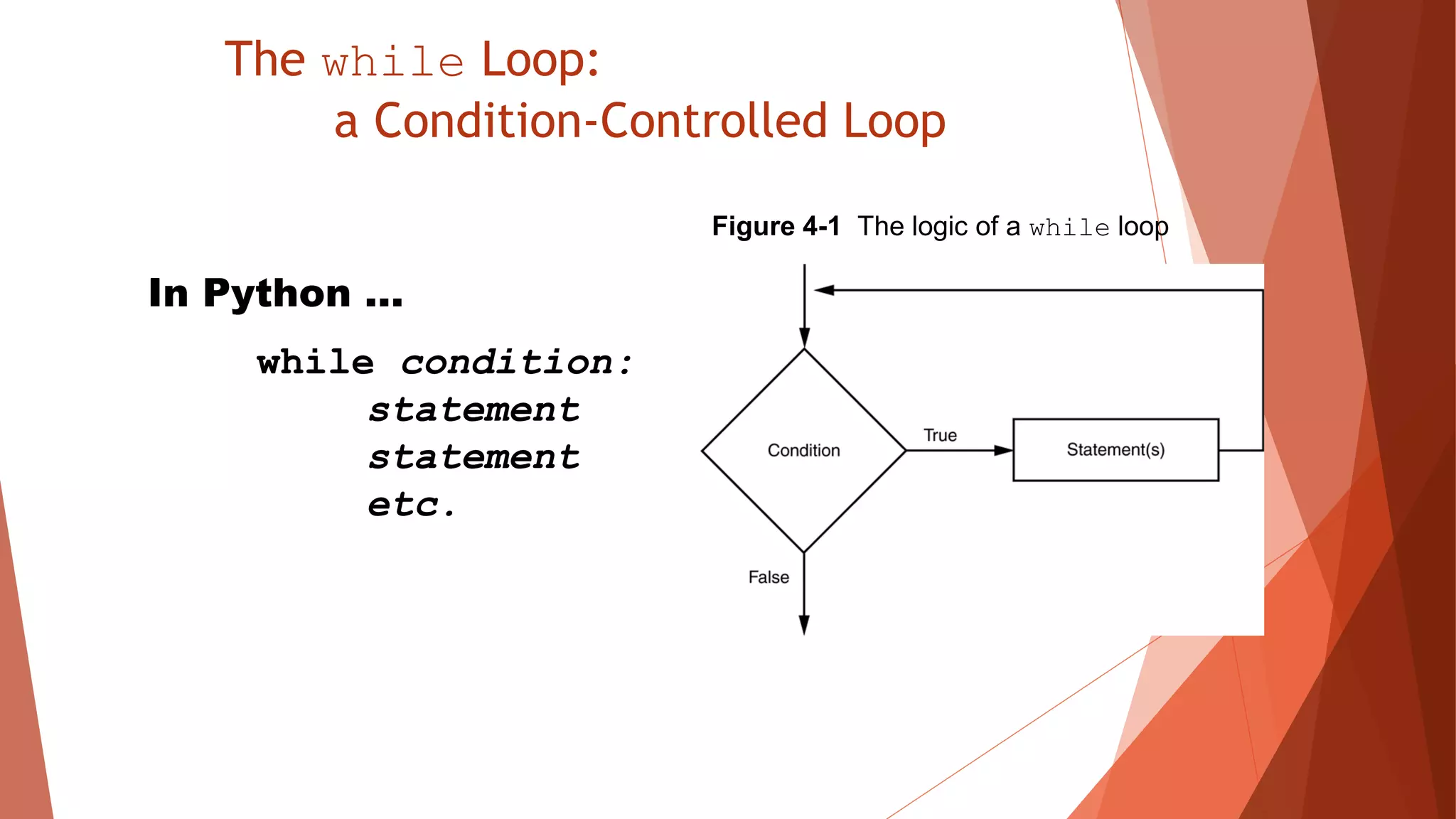
In Python …
while condition:
statement
statement
etc.
Figure 4-1 The logic of a while loop
The while Loop:
a Condition-Controlled Loop
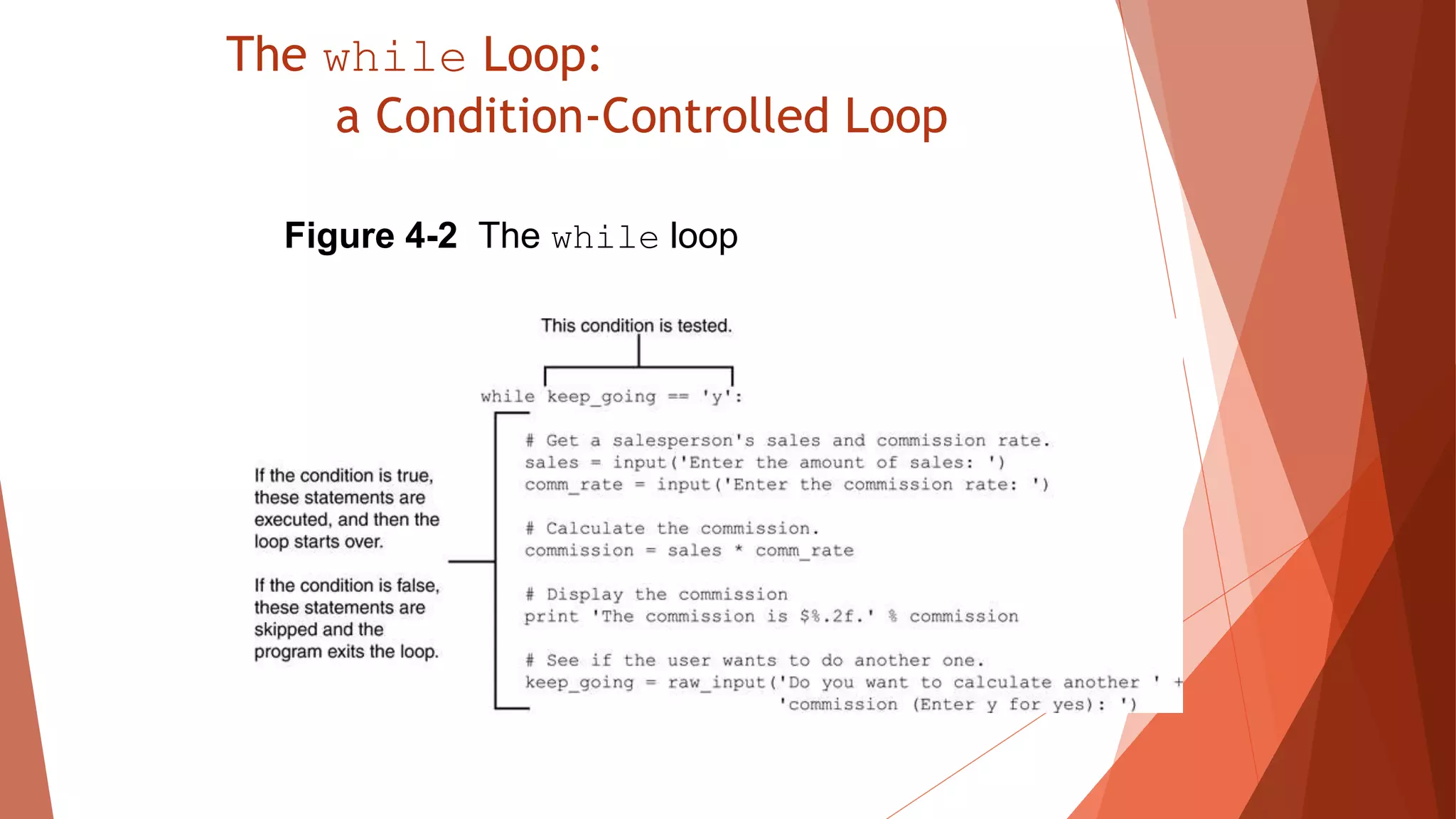
Figure 4-2 The while loop
The while Loop:
a Condition-Controlled Loop
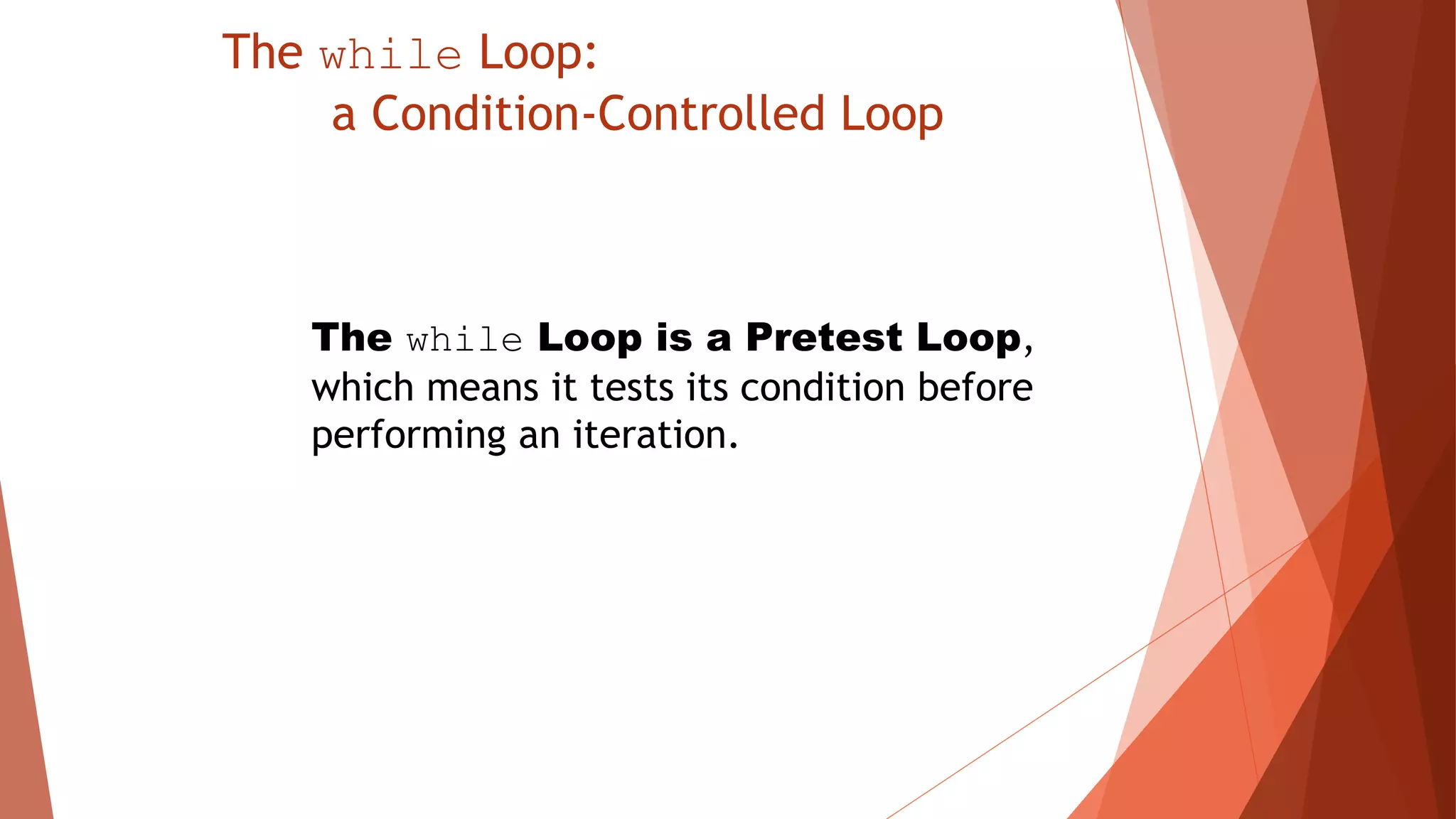
The while Loop is a Pretest Loop,
which means it tests its condition before
performing an iteration.
The for Loop:
a Count-Controlled Loop
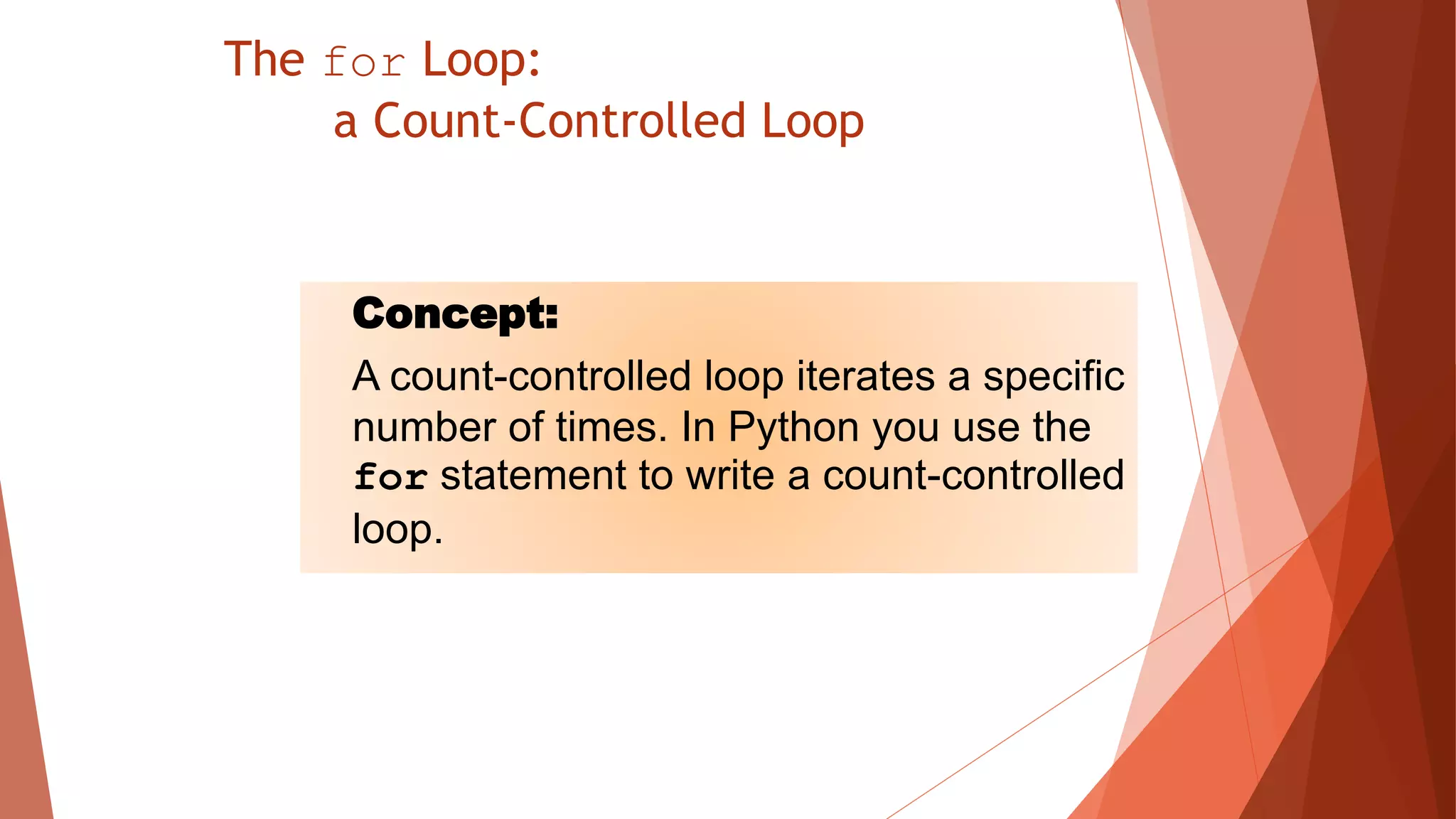
Concept:
A count-controlled loop iterates a specific
number of times. In Python you use the
for statement to write a count-controlled
loop.
The for Loop:
a Count-Controlled Loop
In Python …
for variable in [value1, value2, etc.]:
statement
statement
etc.
The for Loop:
a Count-Controlled Loop
Using the range Function with the for Loop
for num in [0, 1, 2, 3, 4]:
print num
for num in range(5):
print num
The for Loop:
a Count-Controlled Loop
Using the range Function with the for Loop
• First argument, 1, is the starting value for the list
• Second argument, 10, is the ending limit of the list
• Third argument, 2, is the step value
for num in range(1, 10, 2):
print num
The for Loop:
a Count-Controlled Loop
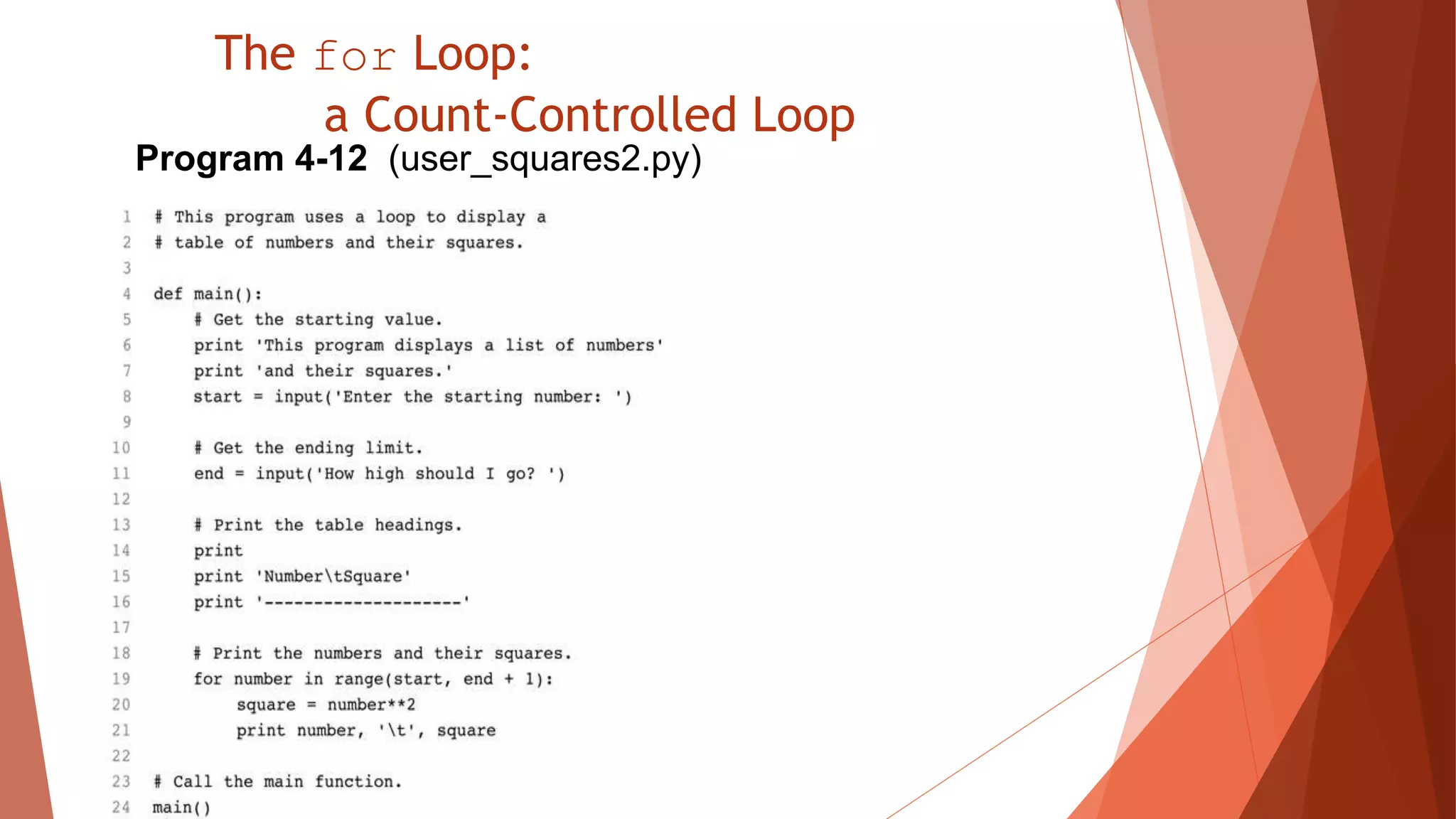
Program 4-12 (user_squares2.py)
The for Loop:
a Count-Controlled Loop
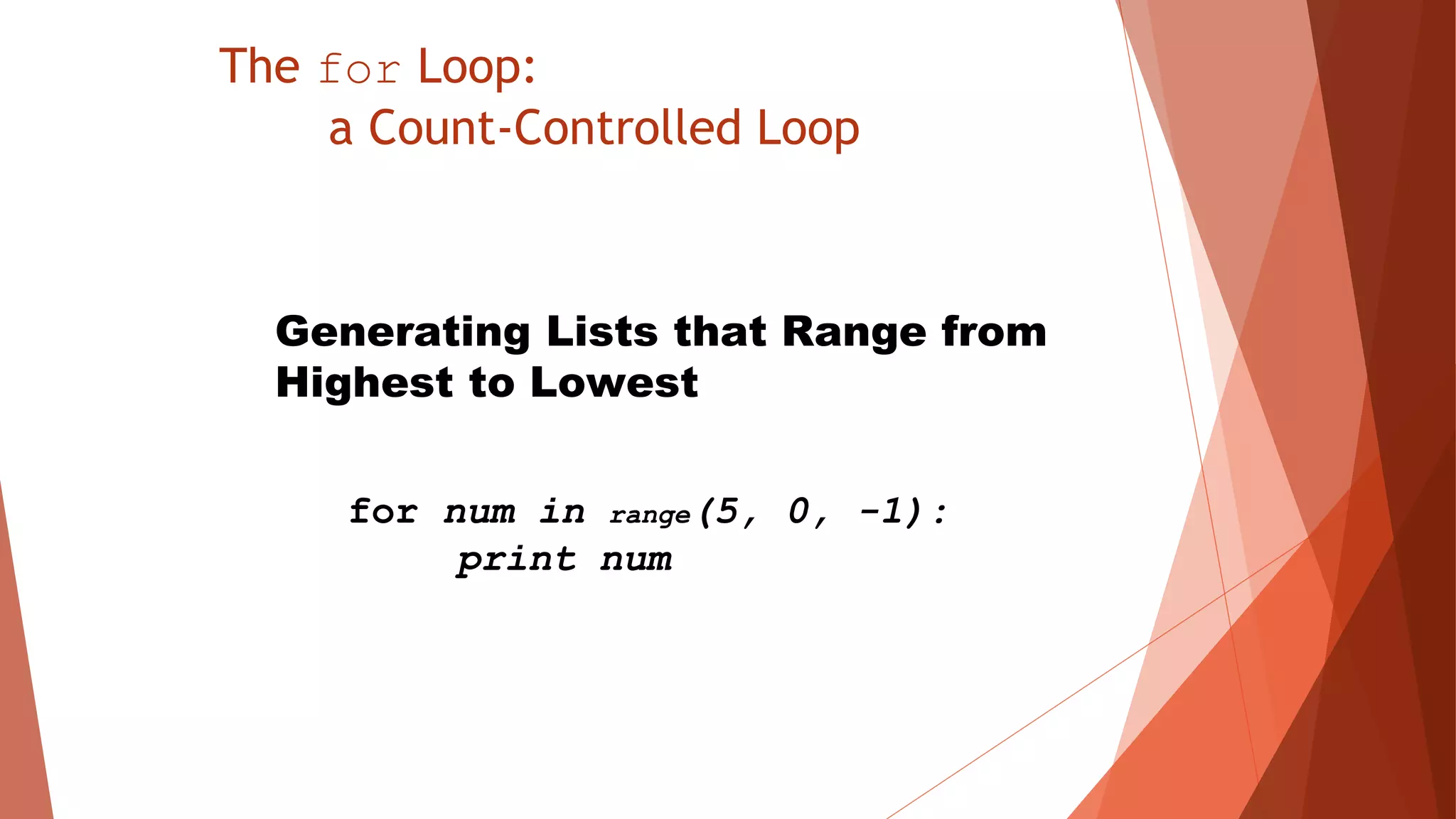
Generating Lists that Range from
Highest to Lowest
for num in range(5, 0, -1):
print num
Calculating a Running Total
Concept:
A running total is a sum of numbers that
accumulates with each iteration of a
loop. The variable used to keep the
running total is called an accumulator.
Calculating a Running Total
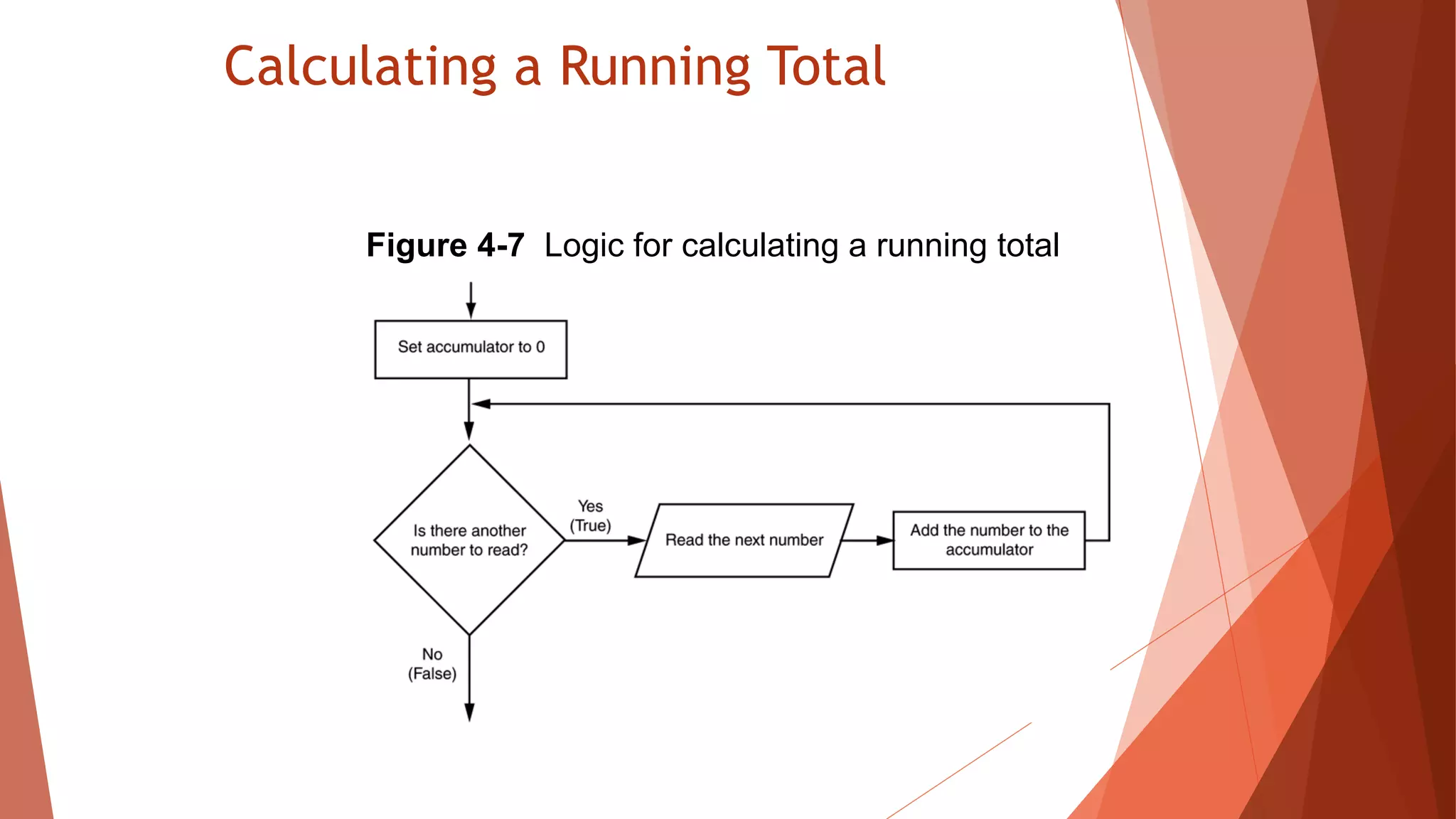
Programs that calculate the total of a series of
numbers typically use two elements:
•A loop that reads each number in the series
•A variable that accumulates the total of the
numbers as they are read.
Calculating a Running Total
Figure 4-7 Logic for calculating a running total
Calculating a Running Total
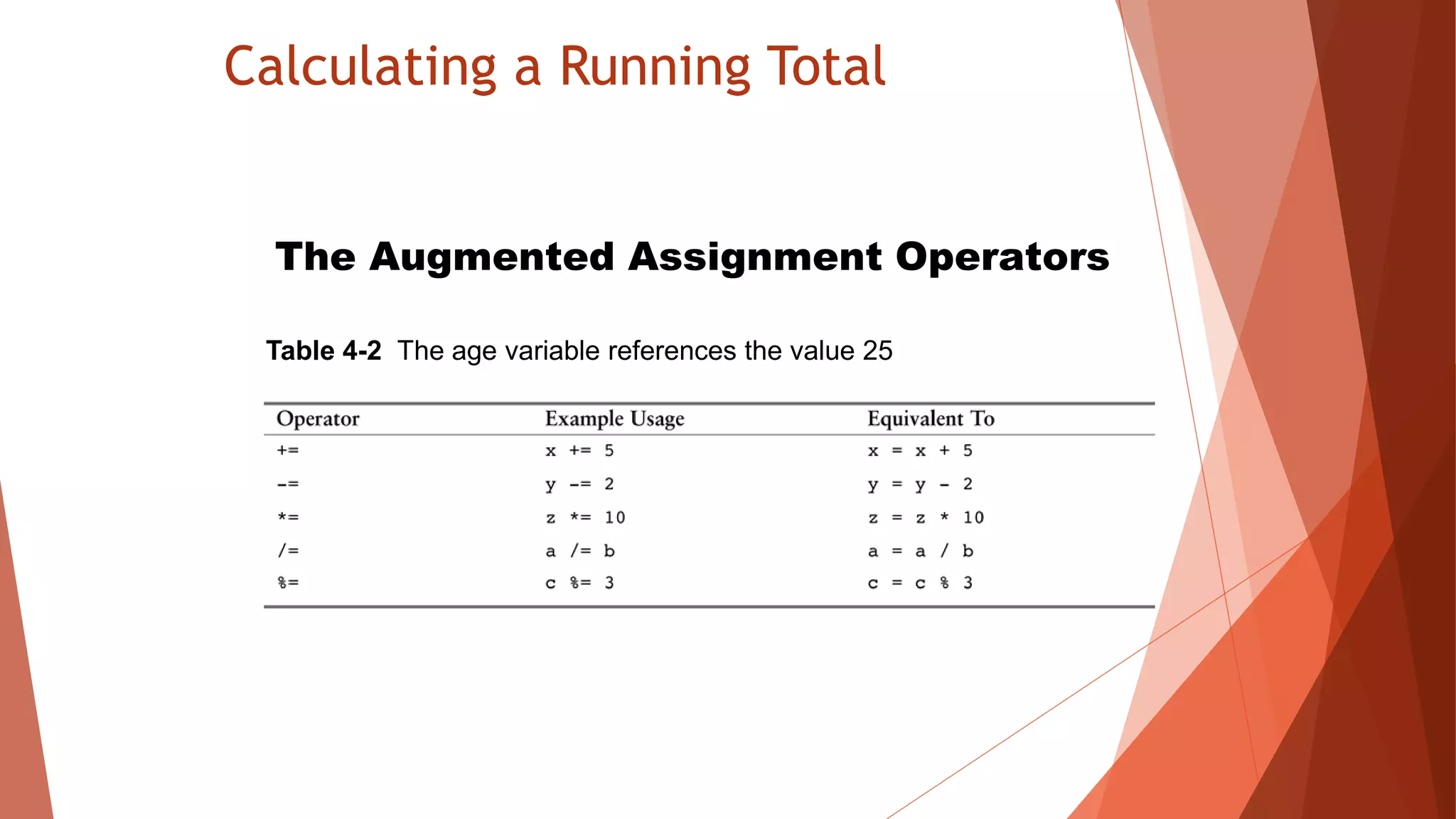
The Augmented Assignment Operators
Table 4-2 The age variable references the value 25
Sentinels
Concept:
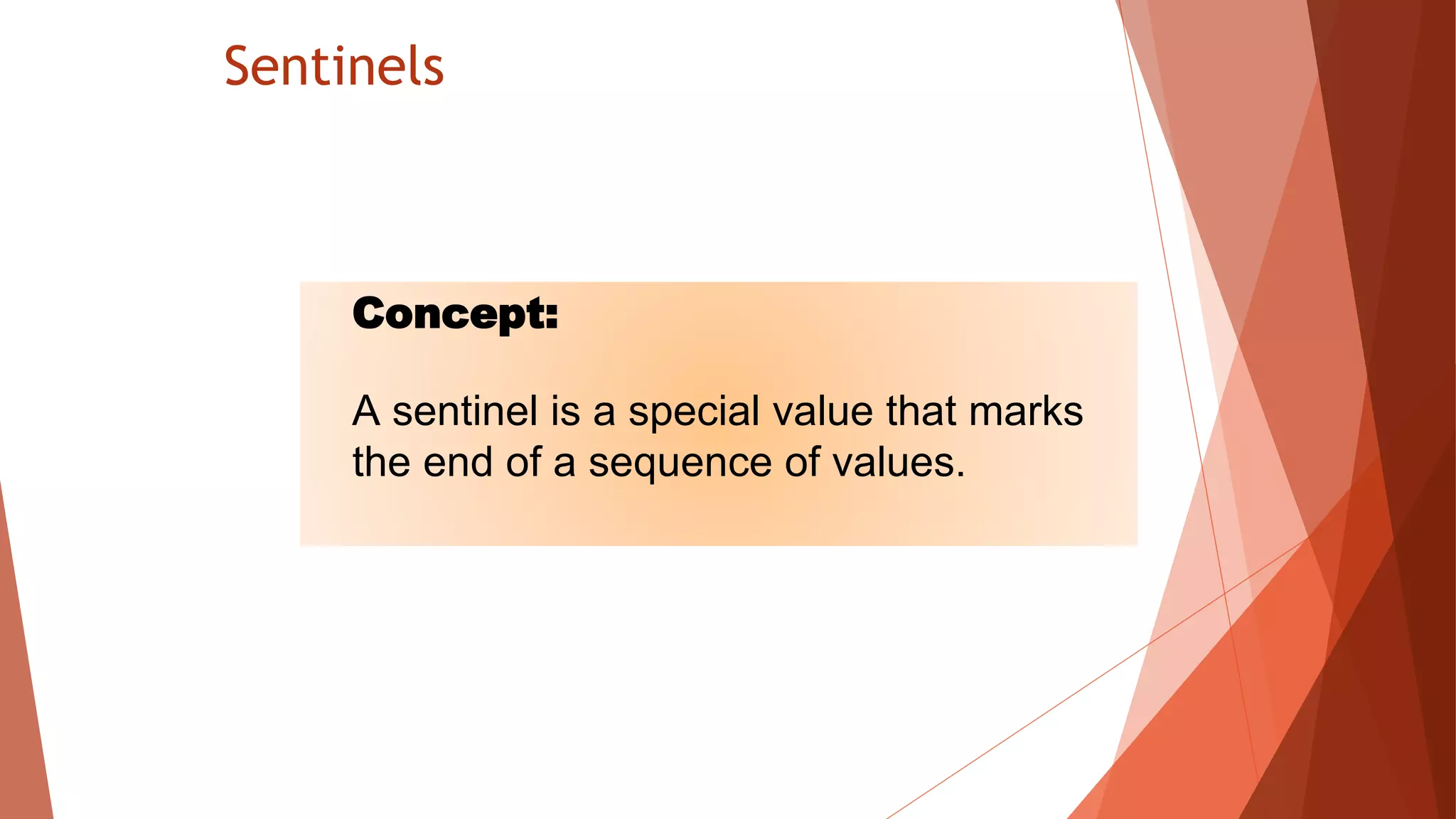
A sentinel is a special value that marks
the end of a sequence of values.
Input Validation Loops
Concept:
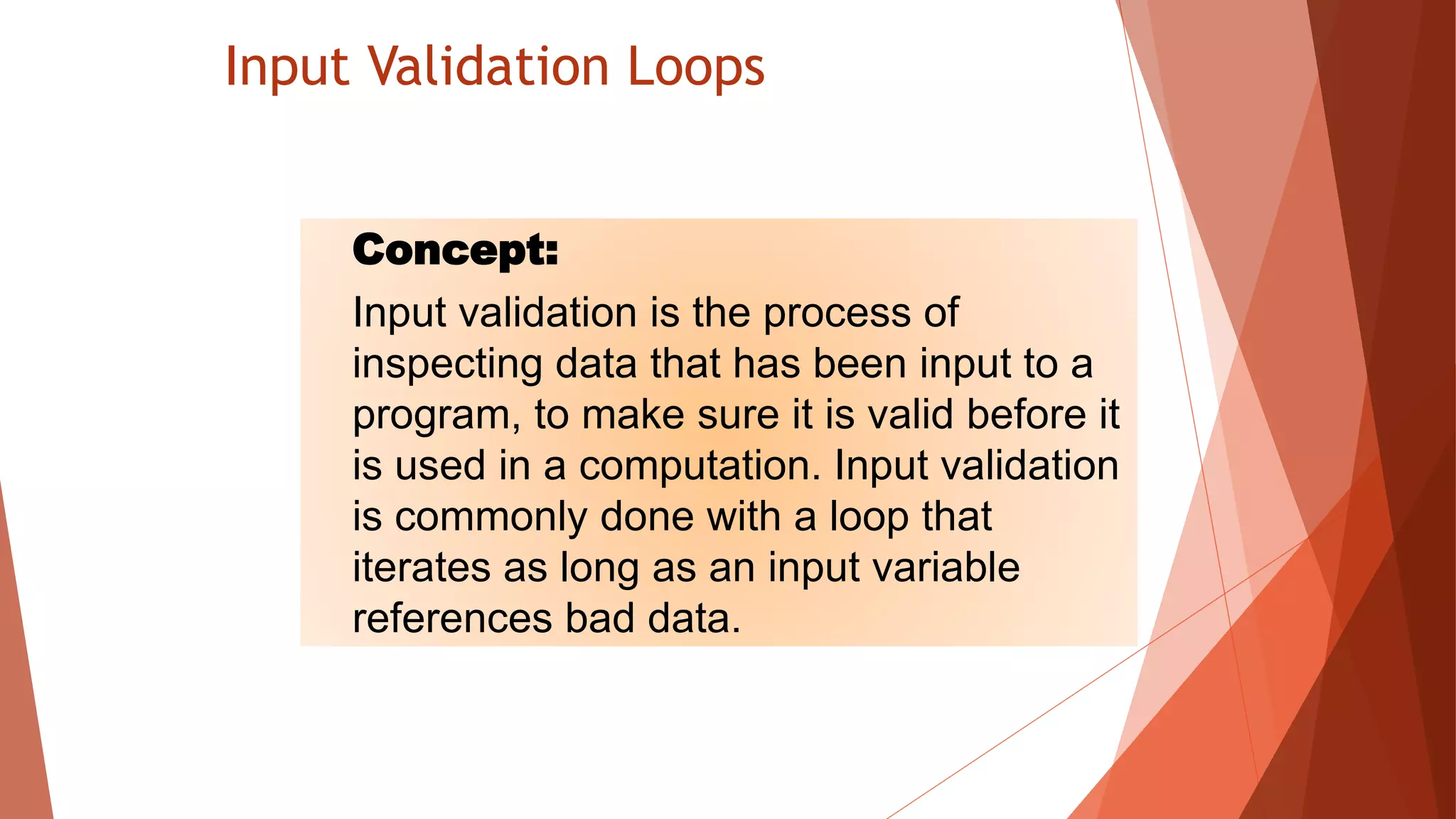
Input validation is the process of
inspecting data that has been input to a
program, to make sure it is valid before it
is used in a computation. Input validation
is commonly done with a loop that
iterates as long as an input variable
references bad data.
Input Validation Loops
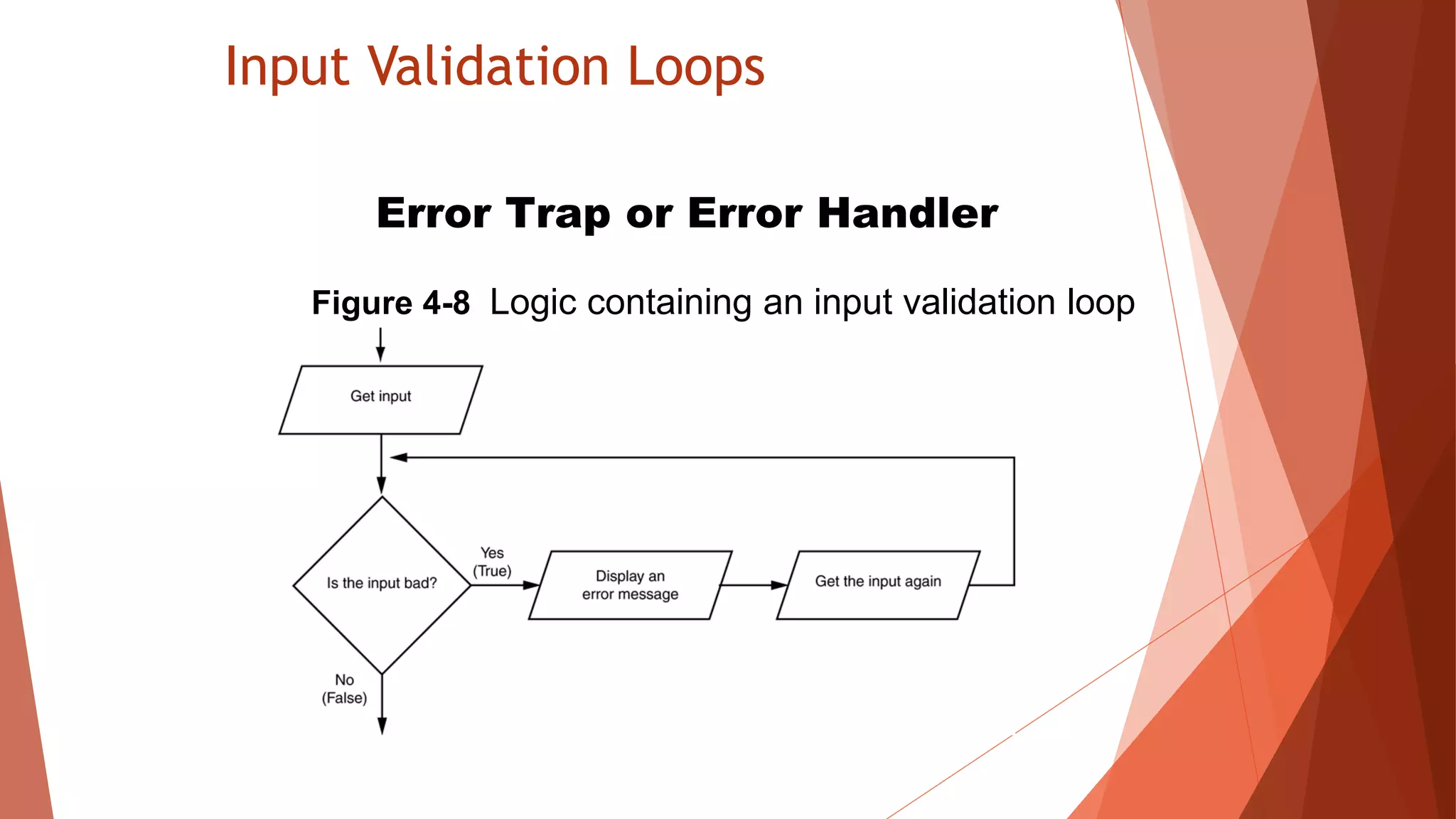
Error Trap or Error Handler
Figure 4-8 Logic containing an input validation loop
Input Validation Loops
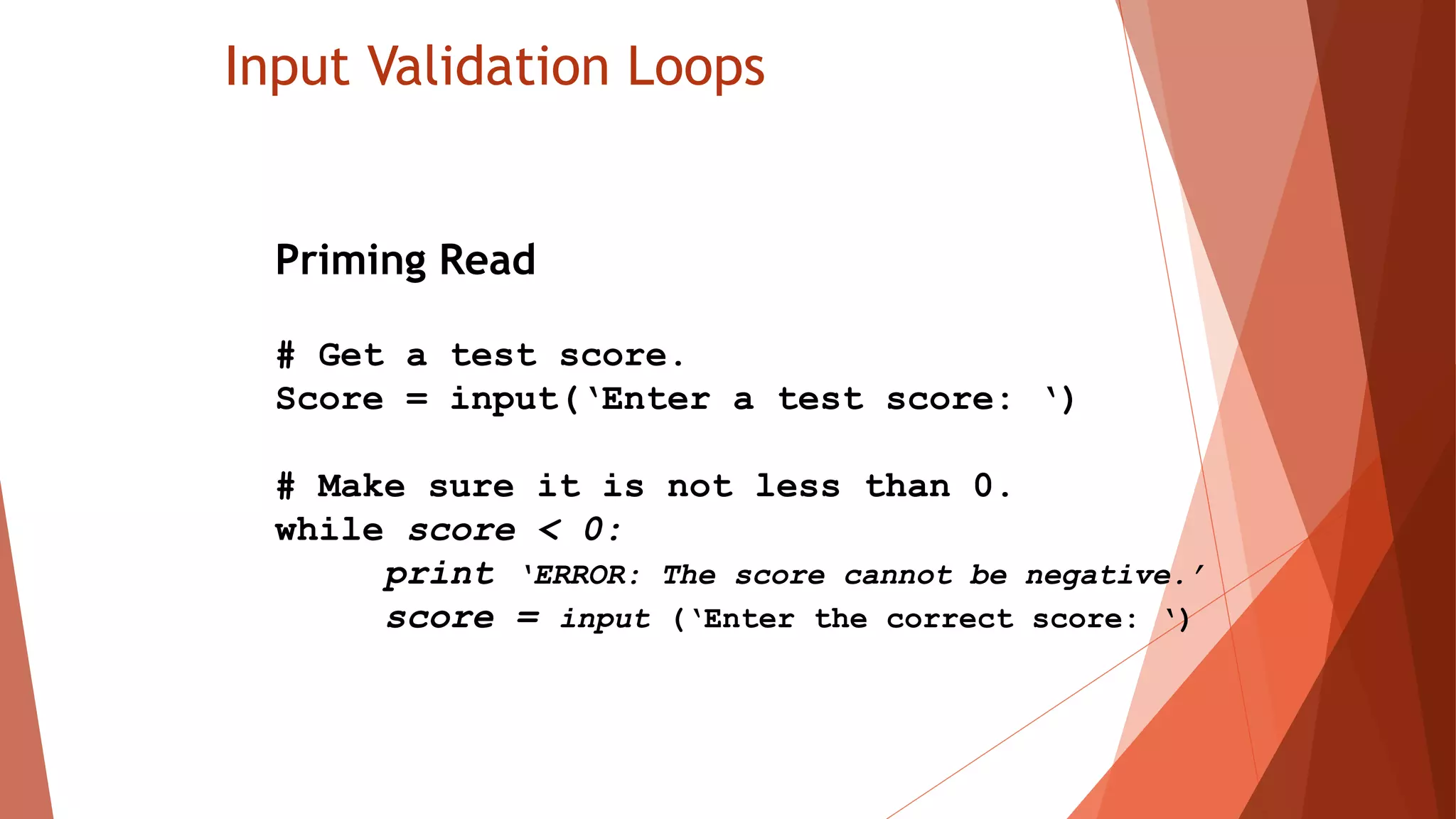
Priming Read
# Get a test score.
Score = input(‘Enter a test score: ‘)
# Make sure it is not less than 0.
while score < 0:
print ‘ERROR: The score cannot be negative.’
score = input (‘Enter the correct score: ‘)
Nested Loops
Concept:
A loop that is inside another loop is
called a nested loop.
Nested Loops
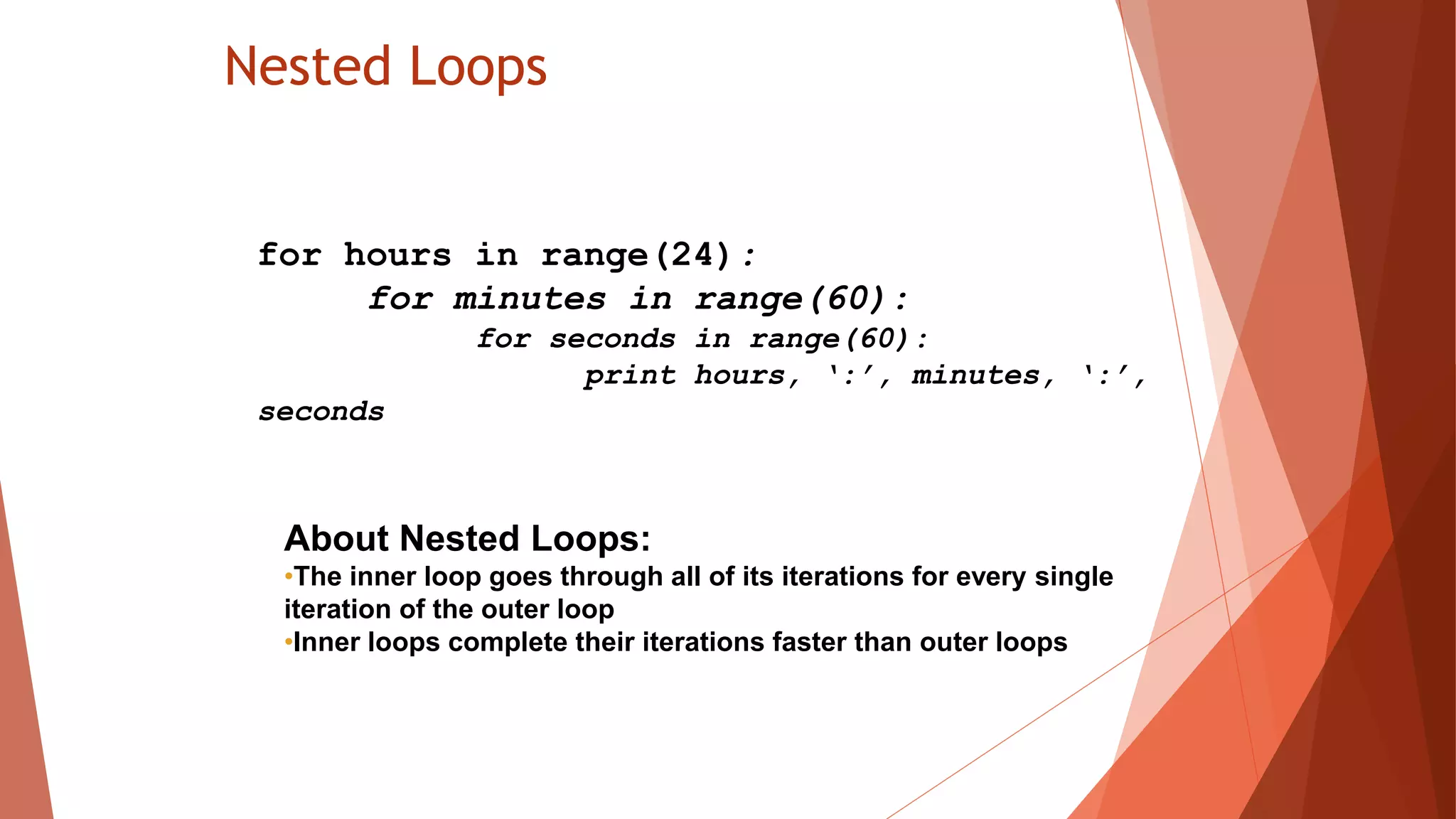
About Nested Loops:
•The inner loop goes through all of its iterations for every single
iteration of the outer loop
•Inner loops complete their iterations faster than outer loops
for hours in range(24):
for minutes in range(60):
for seconds in range(60):
print hours, ‘:’, minutes, ‘:’,
seconds

Repitition Structure

  • 1.
  • 2.
    Introduction to RepetitionStructures Concept: The repetition structure causes a statement or set of statements to execute repeatedly.
  • 3.
    Introduction to RepetitionStructures Condition-Controlled and Count-Controlled Loops A condition-controlled loop uses a true/false condition to control the number of times that it repeats. A count-controlled loop repeats a specific number of times.
  • 4.
    The while Loop: aCondition-Controlled Loop Concept: A condition-controlled loop causes a statement or set of statements to repeat as long as a condition is true. In Python you use the while statement to write a condition-controlled loop.
  • 5.
    The while Loop: aCondition-Controlled Loop In Python … while condition: statement statement etc. Figure 4-1 The logic of a while loop
  • 6.
    The while Loop: aCondition-Controlled Loop Figure 4-2 The while loop
  • 7.
    The while Loop: aCondition-Controlled Loop The while Loop is a Pretest Loop, which means it tests its condition before performing an iteration.
  • 8.
    The for Loop: aCount-Controlled Loop Concept: A count-controlled loop iterates a specific number of times. In Python you use the for statement to write a count-controlled loop.
  • 9.
    The for Loop: aCount-Controlled Loop In Python … for variable in [value1, value2, etc.]: statement statement etc.
  • 10.
    The for Loop: aCount-Controlled Loop Using the range Function with the for Loop for num in [0, 1, 2, 3, 4]: print num for num in range(5): print num
  • 11.
    The for Loop: aCount-Controlled Loop Using the range Function with the for Loop • First argument, 1, is the starting value for the list • Second argument, 10, is the ending limit of the list • Third argument, 2, is the step value for num in range(1, 10, 2): print num
  • 12.
    The for Loop: aCount-Controlled Loop Program 4-12 (user_squares2.py)
  • 13.
    The for Loop: aCount-Controlled Loop Generating Lists that Range from Highest to Lowest for num in range(5, 0, -1): print num
  • 14.
    Calculating a RunningTotal Concept: A running total is a sum of numbers that accumulates with each iteration of a loop. The variable used to keep the running total is called an accumulator.
  • 15.
    Calculating a RunningTotal Programs that calculate the total of a series of numbers typically use two elements: •A loop that reads each number in the series •A variable that accumulates the total of the numbers as they are read.
  • 16.
    Calculating a RunningTotal Figure 4-7 Logic for calculating a running total
  • 17.
    Calculating a RunningTotal The Augmented Assignment Operators Table 4-2 The age variable references the value 25
  • 18.
    Sentinels Concept: A sentinel isa special value that marks the end of a sequence of values.
  • 19.
    Input Validation Loops Concept: Inputvalidation is the process of inspecting data that has been input to a program, to make sure it is valid before it is used in a computation. Input validation is commonly done with a loop that iterates as long as an input variable references bad data.
  • 20.
    Input Validation Loops ErrorTrap or Error Handler Figure 4-8 Logic containing an input validation loop
  • 21.
    Input Validation Loops PrimingRead # Get a test score. Score = input(‘Enter a test score: ‘) # Make sure it is not less than 0. while score < 0: print ‘ERROR: The score cannot be negative.’ score = input (‘Enter the correct score: ‘)
  • 22.
    Nested Loops Concept: A loopthat is inside another loop is called a nested loop.
  • 23.
    Nested Loops About NestedLoops: •The inner loop goes through all of its iterations for every single iteration of the outer loop •Inner loops complete their iterations faster than outer loops for hours in range(24): for minutes in range(60): for seconds in range(60): print hours, ‘:’, minutes, ‘:’, seconds