Work &
ENERGY
Energy
• The ability to do work
Work
• Using energy to exert a force to
move an object
Work = Energy
&
Energy = Work
• The work done is equal to the energy
used to do the work.
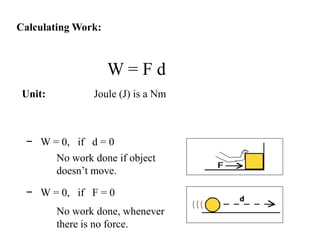
Calculating Work:
W = 0, if F = 0
W = F d
W = 0, if d = 0
No work done if object
doesn’t move.
No work done, whenever
there is no force.
Unit: Joule (J) is a Nm
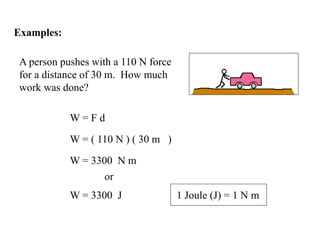
A person pushes with a 110 N force
for a distance of 30 m. How much
work was done?
Examples:
W = F d
W = ( 110 N ) ( 30 m )
W = 3300 N m
or
W = 3300 J 1 Joule (J) = 1 N m
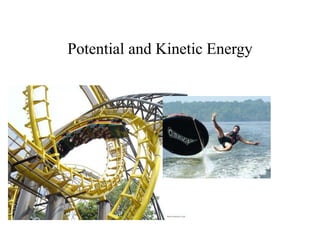
Potential and
Kinetic Energy
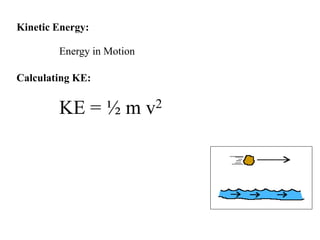
Kinetic Energy:
Energy in Motion
Calculating KE:
KE = ½ m v2
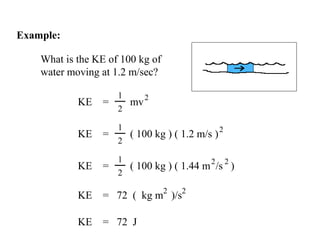
KE = 72 J
Example:
What is the KE of 100 kg of
water moving at 1.2 m/sec?
KE = 72 ( kg m )/s
22
KE = mv
2
2
1
KE = ( 100 kg ) ( 1.2 m/s )
2
2
1
KE = ( 100 kg ) ( 1.44 m /s )
22
2
1
KE = mvKinetic Energy Fact:
2
2
1
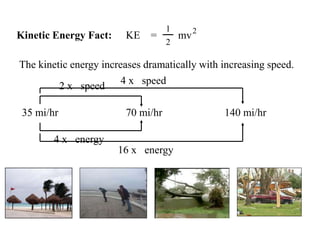
The kinetic energy increases dramatically with increasing speed.
35 mi/hr
4 x speed
16 x energy
140 mi/hr70 mi/hr
2 x speed
4 x energy
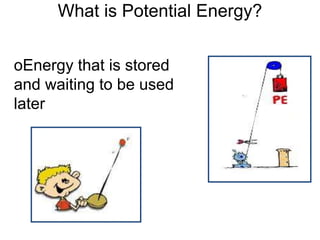
What is Potential Energy?
oEnergy that is stored
and waiting to be
used later
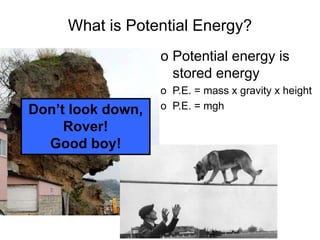
What is Potential Energy?
o Potential energy is
stored energy
o P.E. = mass x gravity x height
o P.E. = mghDon’t look down,
Rover!
Good boy!
Law of Conservation of Energy
• Energy cannot be created or destroyed
• Energy can be transferred from one type or
state to another
Work and energy

Work and energy

  • 1.
  • 2.
    Energy • The abilityto do work Work • Using energy to exert a force to move an object
  • 3.
    Work = Energy & Energy= Work • The work done is equal to the energy used to do the work.
  • 4.
    Calculating Work: W =0, if F = 0 W = F d W = 0, if d = 0 No work done if object doesn’t move. No work done, whenever there is no force. Unit: Joule (J) is a Nm
  • 5.
    A person pusheswith a 110 N force for a distance of 30 m. How much work was done? Examples: W = F d W = ( 110 N ) ( 30 m ) W = 3300 N m or W = 3300 J 1 Joule (J) = 1 N m
  • 6.
  • 7.
    Kinetic Energy: Energy inMotion Calculating KE: KE = ½ m v2
  • 8.
    KE = 72J Example: What is the KE of 100 kg of water moving at 1.2 m/sec? KE = 72 ( kg m )/s 22 KE = mv 2 2 1 KE = ( 100 kg ) ( 1.2 m/s ) 2 2 1 KE = ( 100 kg ) ( 1.44 m /s ) 22 2 1
  • 9.
    KE = mvKineticEnergy Fact: 2 2 1 The kinetic energy increases dramatically with increasing speed. 35 mi/hr 4 x speed 16 x energy 140 mi/hr70 mi/hr 2 x speed 4 x energy
  • 10.
    What is PotentialEnergy? oEnergy that is stored and waiting to be used later
  • 11.
    What is PotentialEnergy? o Potential energy is stored energy o P.E. = mass x gravity x height o P.E. = mghDon’t look down, Rover! Good boy!
  • 12.
    Law of Conservationof Energy • Energy cannot be created or destroyed • Energy can be transferred from one type or state to another