Work
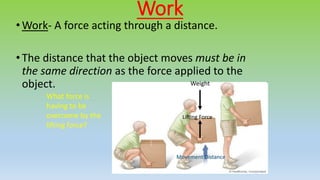
•Work- A force acting through a distance.
•The distance that the object moves must be in
the same direction as the force applied to the
object.
Lifting Force
Movement Distance
What force is
having to be
overcome by the
lifting force?
Weight
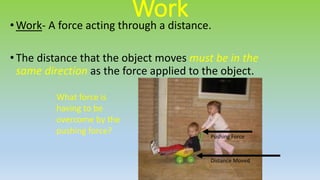
Work• Work- A force acting through a distance.
• The distance that the object moves must be in the
same direction as the force applied to the object.
Pushing Force
Distance Moved
What force is
having to be
overcome by the
pushing force?
Lifting Force
Movement Distance
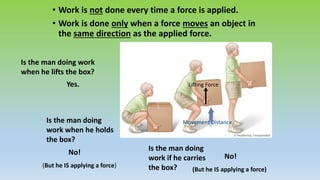
• Work is not done every time a force is applied.
• Work is done only when a force moves an object in
the same direction as the applied force.
Is the man doing work
when he lifts the box?
Yes.
Is the man doing
work when he holds
the box?
No!
Is the man doing
work if he carries
the box?
No!
(But he IS applying a force)
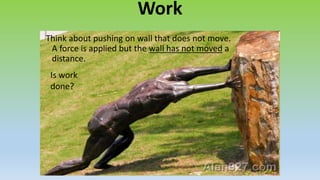
Work
Think about pushing on wall that does not move.
A force is applied but the wall has not moved a
distance.
Is work
done?
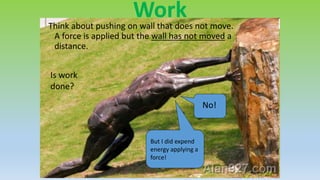
WorkThink about pushing on wall that does not move.
A force is applied but the wall has not moved a
distance.
Is work
done?
No!
But I did expend
energy applying a
force!
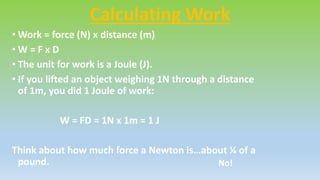
Calculating Work
• Work = force (N) x distance (m)
• W = F x D
• The unit for work is a Joule (J).
• If you lifted an object weighing 1N through a distance
of 1m, you did 1 Joule of work:
W = FD = 1N x 1m = 1 J
Think about how much force a Newton is…about ¼ of a
pound. No!
Calculating Work
•If you lifted an object weighing 200 N
through a distance of 0.5m, how much
work would you do?
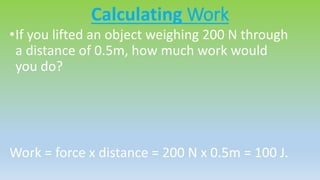
Calculating Work
•If you lifted an object weighing 200 N through
a distance of 0.5m, how much work would
you do?
Work = force x distance = 200 N x 0.5m = 100 J.
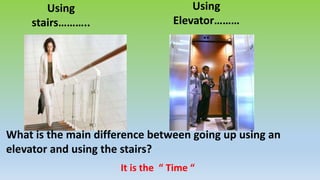
Using
stairs………..
Using
Elevator………
..
What is the main difference between going up using an
elevator and using the stairs?
It is the “ Time “
When work done is related to time …….
WE call it
Power
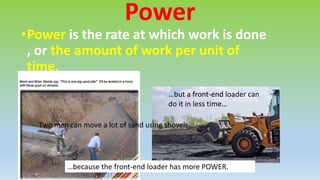
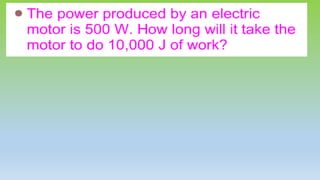
•Power is the rate at which work is done
, or the amount of work per unit of
time.
Two men can move a lot of sand using shovels…
…but a front-end loader can
do it in less time…
…because the front-end loader has more POWER.
Power
•Power is the rate at which work is
done , or the amount of work per unit
of time.
•Power = work / time or
•Power = force x distance / time
Because work = force x distance
Power
•The unit for power is watt (W). One watt is equal
to 1 joule per second (1 J/sec).
•Large quantities of power are measured in
kilowatts (kW).
•One kilowatt equals _____ watts.1000
Problems
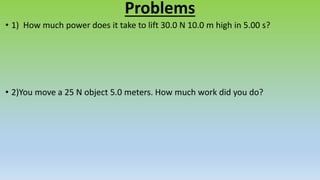
• 1) How much power does it take to lift 30.0 N 10.0 m high in 5.00 s?
• 2)You move a 25 N object 5.0 meters. How much work did you do?
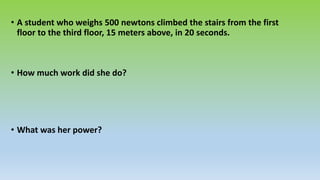
• A student who weighs 500 newtons climbed the stairs from the first
floor to the third floor, 15 meters above, in 20 seconds.
• How much work did she do?
• What was her power?
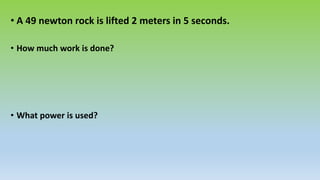
• A 49 newton rock is lifted 2 meters in 5 seconds.
• How much work is done?
• What power is used?
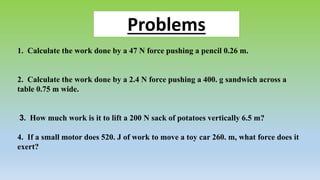
1. Calculate the work done by a 47 N force pushing a pencil 0.26 m.
2. Calculate the work done by a 2.4 N force pushing a 400. g sandwich across a
table 0.75 m wide.
3. How much work is it to lift a 200 N sack of potatoes vertically 6.5 m?
4. If a small motor does 520. J of work to move a toy car 260. m, what force does it
exert?
Problems

Work and power class

  • 2.
    Work •Work- A forceacting through a distance. •The distance that the object moves must be in the same direction as the force applied to the object. Lifting Force Movement Distance What force is having to be overcome by the lifting force? Weight
  • 3.
    Work• Work- Aforce acting through a distance. • The distance that the object moves must be in the same direction as the force applied to the object. Pushing Force Distance Moved What force is having to be overcome by the pushing force?
  • 4.
    Lifting Force Movement Distance •Work is not done every time a force is applied. • Work is done only when a force moves an object in the same direction as the applied force. Is the man doing work when he lifts the box? Yes. Is the man doing work when he holds the box? No! Is the man doing work if he carries the box? No! (But he IS applying a force) (But he IS applying a force)
  • 5.
    Work Think about pushingon wall that does not move. A force is applied but the wall has not moved a distance. Is work done?
  • 6.
    WorkThink about pushingon wall that does not move. A force is applied but the wall has not moved a distance. Is work done? No! But I did expend energy applying a force!
  • 7.
    Calculating Work • Work= force (N) x distance (m) • W = F x D • The unit for work is a Joule (J). • If you lifted an object weighing 1N through a distance of 1m, you did 1 Joule of work: W = FD = 1N x 1m = 1 J Think about how much force a Newton is…about ¼ of a pound. No!
  • 8.
    Calculating Work •If youlifted an object weighing 200 N through a distance of 0.5m, how much work would you do?
  • 9.
    Calculating Work •If youlifted an object weighing 200 N through a distance of 0.5m, how much work would you do? Work = force x distance = 200 N x 0.5m = 100 J.
  • 10.
    Using stairs……….. Using Elevator……… .. What is themain difference between going up using an elevator and using the stairs? It is the “ Time “
  • 11.
    When work doneis related to time ……. WE call it
  • 12.
    Power •Power is therate at which work is done , or the amount of work per unit of time. Two men can move a lot of sand using shovels… …but a front-end loader can do it in less time… …because the front-end loader has more POWER.
  • 13.
    Power •Power is therate at which work is done , or the amount of work per unit of time. •Power = work / time or •Power = force x distance / time Because work = force x distance
  • 14.
    Power •The unit forpower is watt (W). One watt is equal to 1 joule per second (1 J/sec). •Large quantities of power are measured in kilowatts (kW). •One kilowatt equals _____ watts.1000
  • 17.
    Problems • 1) Howmuch power does it take to lift 30.0 N 10.0 m high in 5.00 s? • 2)You move a 25 N object 5.0 meters. How much work did you do?
  • 18.
    • A studentwho weighs 500 newtons climbed the stairs from the first floor to the third floor, 15 meters above, in 20 seconds. • How much work did she do? • What was her power?
  • 19.
    • A 49newton rock is lifted 2 meters in 5 seconds. • How much work is done? • What power is used?
  • 20.
    1. Calculate thework done by a 47 N force pushing a pencil 0.26 m. 2. Calculate the work done by a 2.4 N force pushing a 400. g sandwich across a table 0.75 m wide. 3. How much work is it to lift a 200 N sack of potatoes vertically 6.5 m? 4. If a small motor does 520. J of work to move a toy car 260. m, what force does it exert? Problems