

W ord  O rder
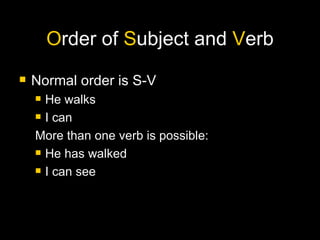
O rder of  S ubject and  V erb Normal order is S-V He walks  I can  More than one verb is possible: He has walked  I can see
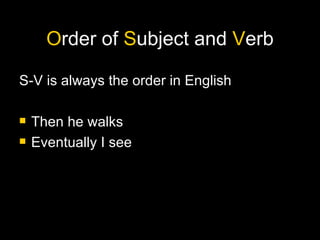
O rder of  S ubject and  V erb S-V is always the order in English  Then he walks Eventually I see
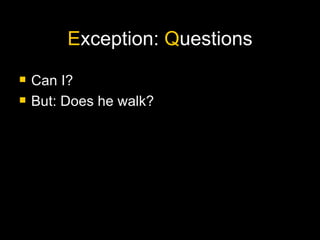
E xception:  Q uestions Can I?  But: Does he walk?
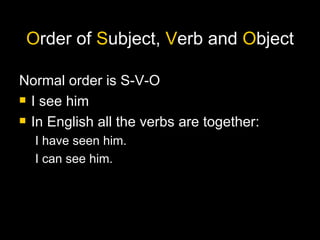
O rder of  S ubject,  V erb and  O bject Normal order is S-V-O  I see him In English all the verbs are together: I have seen him. I can see him.
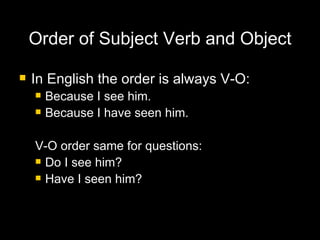
Order of Subject Verb and Object In English the order is always V-O: Because I see him.  Because I have seen him. V-O order same for questions: Do I see him?  Have I seen him?
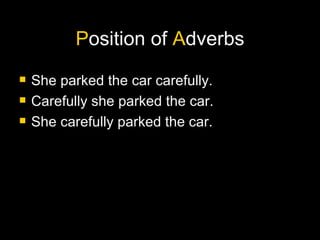
P osition of  A dverbs She parked the car carefully.  Carefully she parked the car.  She carefully parked the car.
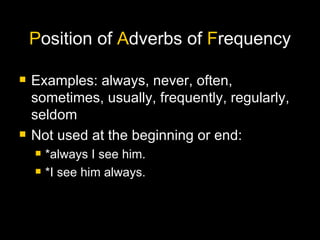
P osition of  A dverbs of  F requency Examples: always, never, often, sometimes, usually, frequently, regularly, seldom Not used at the beginning or end: *always I see him. *I see him always.
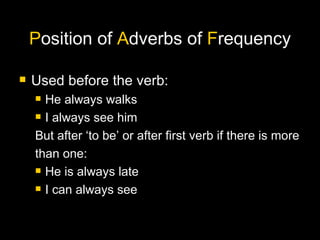
P osition of  A dverbs of  F requency Used before the verb: He always walks  I always see him  But after ‘to be’ or after first verb if there is more than one: He is always late  I can always see
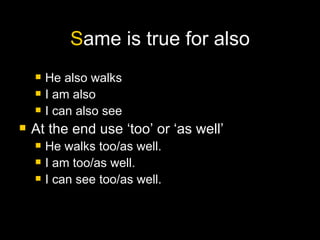
S ame is true for also He also walks  I am also I can also see At the end use ‘too’ or ‘as well’ He walks too/as well. I am too/as well. I can see too/as well.
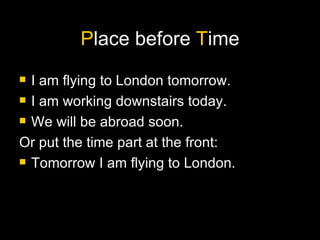
P lace before  T ime I am flying to London tomorrow. I am working downstairs today. We will be abroad soon.  Or put the time part at the front: Tomorrow I am flying to London.
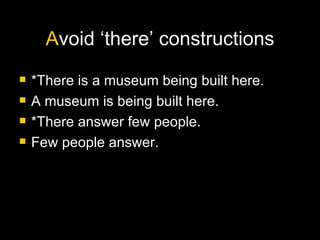
A void ‘there’ constructions *There is a museum being built here.  A museum is being built here.  *There answer few people.  Few people answer.
Q uestions?

Word Order

  • 1.
    W ord O rder
  • 2.
    O rder of S ubject and V erb Normal order is S-V He walks I can More than one verb is possible: He has walked I can see
  • 3.
    O rder of S ubject and V erb S-V is always the order in English Then he walks Eventually I see
  • 4.
    E xception: Q uestions Can I? But: Does he walk?
  • 5.
    O rder of S ubject, V erb and O bject Normal order is S-V-O I see him In English all the verbs are together: I have seen him. I can see him.
  • 6.
    Order of SubjectVerb and Object In English the order is always V-O: Because I see him. Because I have seen him. V-O order same for questions: Do I see him? Have I seen him?
  • 7.
    P osition of A dverbs She parked the car carefully. Carefully she parked the car. She carefully parked the car.
  • 8.
    P osition of A dverbs of F requency Examples: always, never, often, sometimes, usually, frequently, regularly, seldom Not used at the beginning or end: *always I see him. *I see him always.
  • 9.
    P osition of A dverbs of F requency Used before the verb: He always walks I always see him But after ‘to be’ or after first verb if there is more than one: He is always late I can always see
  • 10.
    S ame istrue for also He also walks I am also I can also see At the end use ‘too’ or ‘as well’ He walks too/as well. I am too/as well. I can see too/as well.
  • 11.
    P lace before T ime I am flying to London tomorrow. I am working downstairs today. We will be abroad soon. Or put the time part at the front: Tomorrow I am flying to London.
  • 12.
    A void ‘there’constructions *There is a museum being built here. A museum is being built here. *There answer few people. Few people answer.
  • 13.