Context Clues – What Are They?
• Context clues are bits of information from
  the text that, when combined with prior
  knowledge, allow you to decide the
  meaning of unknown words in the story or
  article you are reading.
• As a reader you must act similar to a
  detective and put together clues from
  sentences surrounding an unknown word
  in order to make an intelligent “guess” as
  to what the definition of a word is.
Context Clues – How Do They Help
     You Read New Words?
• Textbook writers and authors include words or
  phrases to help their readers understand the
  meaning of a new or difficult word.
• These words or phrases are built into the
  sentences around the new or difficult word. By
  becoming more aware of the words around a
  difficult word, readers can make logical guesses
  about the meanings of many words.
• Check out more information about 3 of the 5
  types of context clues on the following slides!
Definition context clues are words that
  say, “Stop - don’t touch that dictionary.
    The definition of the word you don’t
      know is right here in the text!"
EXAMPLES:
-There are many theories, or ideas, about
  what made the Ice Ages happen.
-In this sentence the word “ideas” tells us
  that theories are different thoughts people
  have about something.

-After a time, glaciers, or slowly moving
  rivers of ice, formed over many parts of the
  Earth.
-In this sentence the words “slowly moving
  rivers of ice” tell us what glaciers are.
Synonym context clues are words around a
     difficult word that mean the same or nearly
                the same as the word.
EXAMPLES:
   After seeing the picture of the starving children,
    we felt compassion or pity for their suffering.
   In this sentence the word “pity” tells us that
    compassion means to have understanding for.

   Mary admonished her students and they knew
    they were in hot water for their actions.
   In this sentence the words “in hot water” tell us
    that admonished means cautioned or scolded.
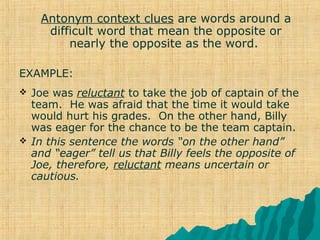
Antonym context clues are words around a
      difficult word that mean the opposite or
          nearly the opposite as the word.

EXAMPLE:
   Joe was reluctant to take the job of captain of the
    team. He was afraid that the time it would take
    would hurt his grades. On the other hand, Billy
    was eager for the chance to be the team captain.
   In this sentence the words “on the other hand”
    and “eager” tell us that Billy feels the opposite of
    Joe, therefore, reluctant means uncertain or
    cautious.
Source:
www.woodland.k12.mo.us/faculty/rgarner
 /Context%20Clues.ppt
Source:
www.woodland.k12.mo.us/faculty/rgarner
 /Context%20Clues.ppt

Types of context clues

  • 1.
    Context Clues –What Are They? • Context clues are bits of information from the text that, when combined with prior knowledge, allow you to decide the meaning of unknown words in the story or article you are reading. • As a reader you must act similar to a detective and put together clues from sentences surrounding an unknown word in order to make an intelligent “guess” as to what the definition of a word is.
  • 2.
    Context Clues –How Do They Help You Read New Words? • Textbook writers and authors include words or phrases to help their readers understand the meaning of a new or difficult word. • These words or phrases are built into the sentences around the new or difficult word. By becoming more aware of the words around a difficult word, readers can make logical guesses about the meanings of many words. • Check out more information about 3 of the 5 types of context clues on the following slides!
  • 3.
    Definition context cluesare words that say, “Stop - don’t touch that dictionary. The definition of the word you don’t know is right here in the text!" EXAMPLES: -There are many theories, or ideas, about what made the Ice Ages happen. -In this sentence the word “ideas” tells us that theories are different thoughts people have about something. -After a time, glaciers, or slowly moving rivers of ice, formed over many parts of the Earth. -In this sentence the words “slowly moving rivers of ice” tell us what glaciers are.
  • 4.
    Synonym context cluesare words around a difficult word that mean the same or nearly the same as the word. EXAMPLES:  After seeing the picture of the starving children, we felt compassion or pity for their suffering.  In this sentence the word “pity” tells us that compassion means to have understanding for.  Mary admonished her students and they knew they were in hot water for their actions.  In this sentence the words “in hot water” tell us that admonished means cautioned or scolded.
  • 5.
    Antonym context cluesare words around a difficult word that mean the opposite or nearly the opposite as the word. EXAMPLE:  Joe was reluctant to take the job of captain of the team. He was afraid that the time it would take would hurt his grades. On the other hand, Billy was eager for the chance to be the team captain.  In this sentence the words “on the other hand” and “eager” tell us that Billy feels the opposite of Joe, therefore, reluctant means uncertain or cautious.
  • 6.
  • 7.