1
TIMBER:
The wood which is suitable or fit for
engineering construction or engineering
purpose is called timber.
WOOD:
The organic matter obtained from
trees is called wood.
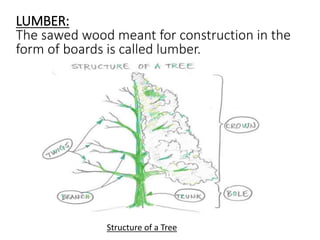
LUMBER:
The sawed wood meant for construction in the
form of boards is called lumber.
Structure of a Tree
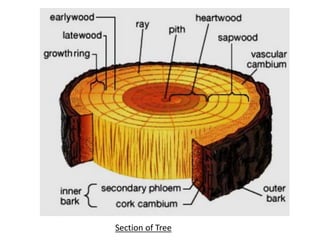
Section of Tree
TYPES OF TREES:
Trees are classified into two groups
depending upon growth pattern.
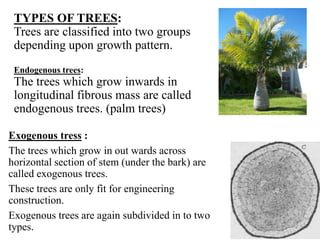
Endogenous trees:
The trees which grow inwards in
longitudinal fibrous mass are called
endogenous trees. (palm trees)
Exogenous tress :
The trees which grow in out wards across
horizontal section of stem (under the bark) are
called exogenous trees.
These trees are only fit for engineering
construction.
Exogenous trees are again subdivided in to two
types.
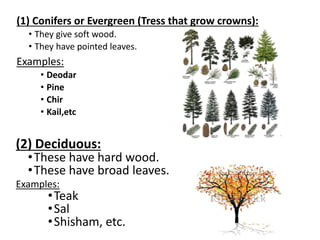
(1) Conifers or Evergreen (Tress that grow crowns):
• They give soft wood.
• They have pointed leaves.
Examples:
• Deodar
• Pine
• Chir
• Kail,etc
(2) Deciduous:
•These have hard wood.
•These have broad leaves.
Examples:
•Teak
•Sal
•Shisham, etc.
SEASONING OF TIMBER:
As fresh timber which is obtained from
trees contains about 30 to 40 % sap or
moisture. This sap is very harmful for the
life of a timber. Therefore, it is necessary
to remove that sap by applying some
special methods.
All those methods which are used for
removing the sap from timber are
collectively termed as seasoning of
timber.
Advantages of seasoned timber:
• It has reduced weight,
• It is strong and durable,
• It has resistance to decay or rot,
• It is easier to work,
• Its life is more.
Types of Timber Seasoning:
The main types of timber seasoning are as under.
(1)Natural Seasoning,
(2)Artificial Seasoning,
(a) Kiln Seasoning,
(b) Chemical Seasoning,
(c) Electric Seasoning,
(d) Water Seasoning,
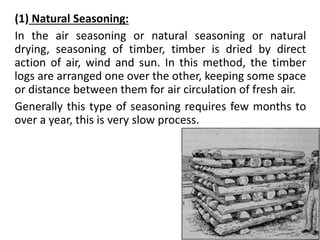
(1) Natural Seasoning:
In the air seasoning or natural seasoning or natural
drying, seasoning of timber, timber is dried by direct
action of air, wind and sun. In this method, the timber
logs are arranged one over the other, keeping some space
or distance between them for air circulation of fresh air.
Generally this type of seasoning requires few months to
over a year, this is very slow process.
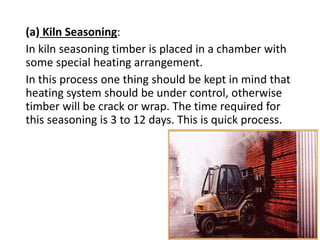
(a) Kiln Seasoning:
In kiln seasoning timber is placed in a chamber with
some special heating arrangement.
In this process one thing should be kept in mind that
heating system should be under control, otherwise
timber will be crack or wrap. The time required for
this seasoning is 3 to 12 days. This is quick process.
(b) Chemical Seasoning:
In chemical seasoning carbon dioxide,
ammonium carbonate or urea are
used as agents for seasoning, those
are applied in dry state, the inter
surface of timber dries first than outer
side.
This ensures uniform seasoning. The
time required for this seasoning is 30
to 40 days.
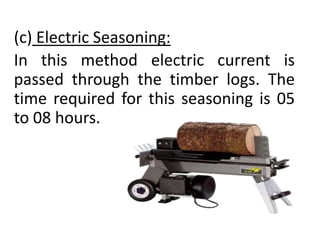
(c) Electric Seasoning:
In this method electric current is
passed through the timber logs. The
time required for this seasoning is 05
to 08 hours.
(3) Water Seasoning:
In water seasoning, timber logs are
kept immersed whole in the flowing
water. The sap present in timber is
washed away. After that logs are
taken out from water and are kept in
open air, so water present in timber
would be dried by air. The time
required for this type of seasoning is 2
to 4 weeks.
USES OF TIMEBR:
Timber is used in:
1. Building construction,
2. Construction of house posts,
3. Construction of beams,
4. Construction of rafters,
5. Construction of bridges,
6. Construction of piles, poles and railway sleepers
7. For furniture making,
8. For light packing cases,
9. For high packing cases (for machinery and similar
stores),
10. For making toys, etc.,
11. For manufacturing of veneers and ply woods.
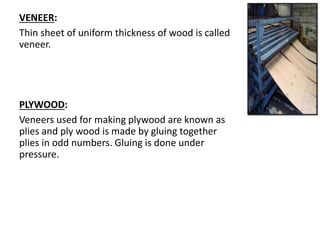
VENEER:
Thin sheet of uniform thickness of wood is called
veneer.
PLYWOOD:
Veneers used for making plywood are known as
plies and ply wood is made by gluing together
plies in odd numbers. Gluing is done under
pressure.
Advantages of Plywood
1. High uniform strength
2. Availability of relatively large sizes
3. Economical and effective utilization of figured wood
4. Freedom from shrinking, swelling and warping
5. Non-splitting qualities solid wood splits fairly readily along
the grain.
6. Ease of fabrication of curved surfaces
7. The conservation of timber by the elimination of the
waste which occurs in sawing (e.g. sawdust)
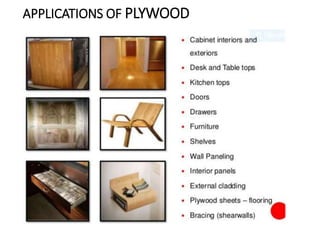
APPLICATIONS OF PLYWOOD
DEFECTS IN TIMBER:
Most common defects in timber are:
1. Heart Shakes
2. Star Shakes
3. Cup Shakes
4. Radial Shakes
5. Rind Galls
6. Wind Cracks
7. Knots
8. Dead Wood
(1) Heart Shakes:
These are splits occurring in the center of the tree and running
from the pith (inner most part) towards the sap wood from the
medullary (vascular tissues) rays.
In some timbers, these splits are hardly visible and in some
timbers these are quite permanent.
Heart shakes are caused due to shrinkage of interior parts due
to age. A heart shake straight across the trunk is not a serious
defect.
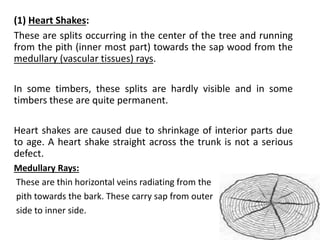
Medullary Rays:
These are thin horizontal veins radiating from the
pith towards the bark. These carry sap from outer
side to inner side.
(2) Star Shakes:
These are splits which radiate from the
center of the timber or from the bark
(outer side), running in the planes of
medullary rays.
These occur due to severe frost or
scorching heat of the sun.
(3) Cup Shakes:
These are curved splits which
separate the whole or part of
one annual ring from another.
These are caused due to the
unequal growth of the timber.
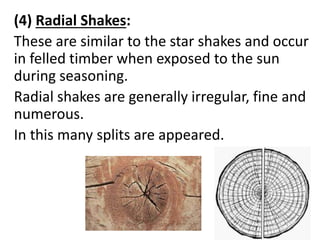
(4) Radial Shakes:
These are similar to the star shakes and occur
in felled timber when exposed to the sun
during seasoning.
Radial shakes are generally irregular, fine and
numerous.
In this many splits are appeared.
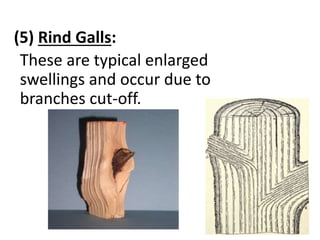
(5) Rind Galls:
These are typical enlarged
swellings and occur due to
branches cut-off.
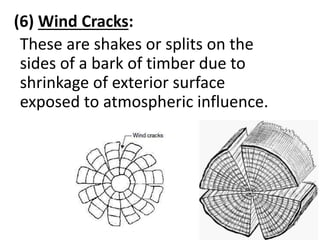
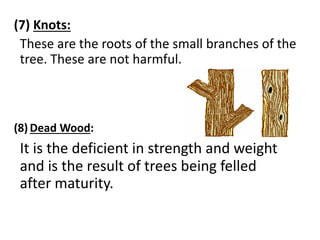
(6) Wind Cracks:
These are shakes or splits on the
sides of a bark of timber due to
shrinkage of exterior surface
exposed to atmospheric influence.
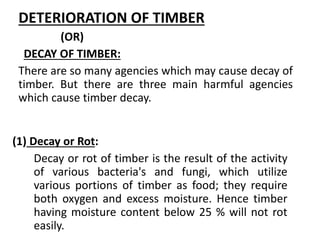
(7) Knots:
These are the roots of the small branches of the
tree. These are not harmful.
(8) Dead Wood:
It is the deficient in strength and weight
and is the result of trees being felled
after maturity.
DETERIORATION OF TIMBER
(OR)
DECAY OF TIMBER:
There are so many agencies which may cause decay of
timber. But there are three main harmful agencies
which cause timber decay.
(1) Decay or Rot:
Decay or rot of timber is the result of the activity
of various bacteria's and fungi, which utilize
various portions of timber as food; they require
both oxygen and excess moisture. Hence timber
having moisture content below 25 % will not rot
easily.
(2) Insects:
There are so many insects which attack the
wood, out of them termites (white ants) are
the main insects which are very dangerous
for timber. Termites of one class live under
ground and eat wood and forms tubes or
tunnels inside it.
(3) Fire:
Fire is also the damaging factor for
timber. As timber has tendency to burn,
so fire can damage it easily.
TIMBER PRESERVATION
TIMBER PRESERVATIVES:
There are two main classes of timber preservatives.
(1) Oily substances insoluble in water
(2) Water soluble salts
(1) Oily substances insoluble in water:
Coal tar oil is the best known and widely used
preservative material of this class. It is obtained
during the destructive distillation of bituminous
coal. It is available in many grades and types. It has
high degree of penetration. It has highly toxic
effect to wood destroying fungi.
(2) Water soluble salts:
Zinc chloride is the most extensively used
preservative of this type. It is clean and
odorless.
SPECIAL PAINTS TO SAVE TIMBER FROM FIRE:
Following paints are used to save timber from fire.
• Diammonium phosphate,
• Mono ammonium phosphate,
• Mono magnesium phosphate,
• Phosphoric acid.
METHODS OF APPLYING PRESERVATIVES:
Before applying preservatives, the timber
should be completely seasoned.
There are some important methods of
applying timber preservatives which are
given below.
1.Painting and dipping method
2.Pressure process or full cell process
3.Empty cell process
(1) Painting and dipping method:
This is the most common method in which the
preservative material is applied by means of a
brush several times. The timber is also
immersed in a tank full of liquid (preservative
material).
In both types the penetration hardly exceeds
1/16’’.
The duration of immersion and temperature
of solution is increased the penetration rate.
(2) Pressure process or full cell process:
In this process, the timber is placed in an air tight
chamber, from which air is with drawn by creating a
vacuum.
The cells are full emptied to receive preservative
material. After that preservative material is pumped
under pressure of 100 to 200 psi and at a
temperature of 48oC.
As the timber contains required quantity of
preservative a low vacuum is maintained to remove
excess preservative. Such a timber is generally used
in case of piles in salt water and railway sleepers.
(3) Empty cell process:
This method is similar to the full cell process
but initial vacuum is not to be maintained
and no attempt is to be made to remove the
air from cells. The preservative material is
applied under pressure of 200 psi.