Timber as
building
material
2
TIMBER
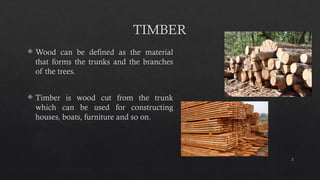
 Wood can be defined as the material
that forms the trunks and the branches
of the trees.
 Timber is wood cut from the trunk
which can be used for constructing
houses, boats, furniture and so on.
3
INTRODUCTION
 Timber is not only one of the oldest building materials, along with stone,
and earth material, but has remained until today the most versatile and, in
terms of indoor comfort and health aspects, most acceptable material.
 However, timber is an extremely complex material, available in a great
variety of species and forms, suitable for all kinds of applications.
 Although only a small proportion of the timber harvested is used for
building.
 Since timber cannot be completely replaced by other materials, it shall long
remain one of the most important building materials.
4
USES OF TIMBER
 Building construction
 House post-construction
 Beams and rafters
 Construction of bridges and boats
 Furniture and instruments
 Railway sleepers and packing cases
 Toys and engraving work
 Railway coach wagons
 Formwork of cement concrete
5
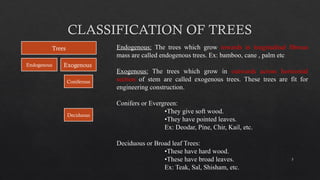
CLASSIFICATION OF TREES
Trees
Endogenous Exogenous
Coniferous
Deciduous
Endogenous: The trees which grow inwards in longitudinal fibrous
mass are called endogenous trees. Ex: bamboo, cane , palm etc
Exogenous: The trees which grow in outwards across horizontal
section of stem are called exogenous trees. These trees are fit for
engineering construction.
Conifers or Evergreen:
•They give soft wood.
•They have pointed leaves.
Ex: Deodar, Pine, Chir, Kail, etc.
Deciduous or Broad leaf Trees:
•These have hard wood.
•These have broad leaves.
Ex: Teak, Sal, Shisham, etc.
6
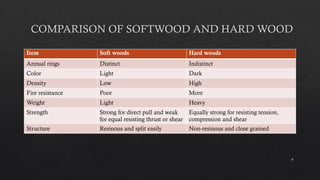
COMPARISON OF SOFTWOOD AND HARD WOOD
Item Soft woods Hard woods
Annual rings Distinct Indistinct
Color Light Dark
Density Low High
Fire resistance Poor More
Weight Light Heavy
Strength Strong for direct pull and weak
for equal resisting thrust or shear
Equally strong for resisting tension,
compression and shear
Structure Resinous and split easily Non-resinous and close grained
7
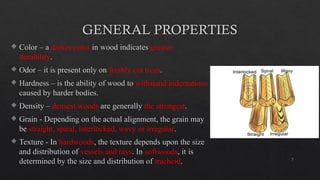
GENERAL PROPERTIES
 Color – a darker color in wood indicates greater
durability.
 Odor – it is present only on freshly cut trees.
 Hardness – is the ability of wood to withstand indentations
caused by harder bodies.
 Density – densest woods are generally the strongest.
 Grain - Depending on the actual alignment, the grain may
be straight, spiral, interlocked, wavy or irregular.
 Texture - In hardwoods, the texture depends upon the size
and distribution of vessels and rays. In softwoods, it is
determined by the size and distribution of tracheid.
8
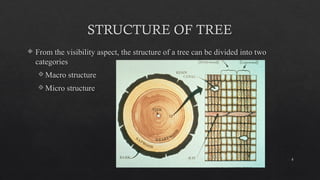
STRUCTURE OF TREE
 From the visibility aspect, the structure of a tree can be divided into two
categories
 Macro structure
 Micro structure
9
MACRO STRUCTURE OF WOOD
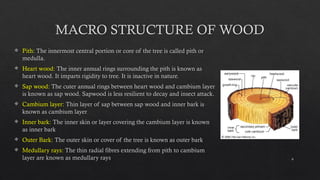
 Pith: The innermost central portion or core of the tree is called pith or
medulla.
 Heart wood: The inner annual rings surrounding the pith is known as
heart wood. It imparts rigidity to tree. It is inactive in nature.
 Sap wood: The cuter annual rings between heart wood and cambium layer
is known as sap wood. Sapwood is less resilient to decay and insect attack.
 Cambium layer: Thin layer of sap between sap wood and inner bark is
known as cambium layer
 Inner bark: The inner skin or layer covering the cambium layer is known
as inner bark
 Outer Bark: The outer skin or cover of the tree is known as outer bark
 Medullary rays: The thin radial fibres extending from pith to cambium
layer are known as medullary rays
10
MICRO STRUCTURE OF WOOD
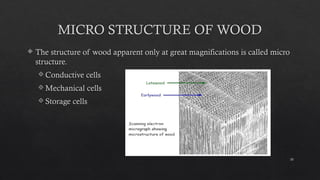
 The structure of wood apparent only at great magnifications is called micro
structure.
 Conductive cells
 Mechanical cells
 Storage cells
11
CHARACTERISTICS OF GOOD TIMBERS
 Appearance: A freshly cut surface of timber should exhibit hard and of shining appearance.
 Color: A color should preferably be dark.
 Defects: A good timber should be free from series defects such as knots, flaws, shakes etc.
 Durability: A good timber should be durable and capable of resisting the action of fungi,
insects, chemicals, physical agencies, and mechanical agencies.
 Elasticity: The timber returns to its original shape when load causing its deformation is
removed.
 Fire resistance: A dense wood offers good resistance to fire.
 Hardness: A good timber should be hard.
12
 Shape: A good timber should be capable of retaining its shape during conversion or
seasoning.
 Smell: A good timber should have sweet smell. Unpleasant smell indicates decayed timber.
 Sound: A good timber should give a clear ringing sound when struck.
 Strength: A good timber should be sufficiently strong for working as structural member
such as joist, beam, rafter etc.
 Structure: The structure should be uniform.
 Toughness: A good timber should be tough (i.e.) capable of offering resistance to shocks
due to vibration.
13
 Water permeability: A good timber should have low water permeability, which is measured
by the quantity of water filtered through unit surface area of specimen of wood.
 Weight: The timber with heavy weight is considered to be sound and strong.
 Working conditions: Timber should be easily workable. It should not clog the teeth of saw.
 Mechanical wear: A good timber should not deteriorate easily due to mechanical wear or
abrasion.
14
SEASONING OF TIMBER
 As fresh timber which is obtained from trees contains about 30 to 40 % sap or moisture.
 This sap is very harmful for the life of a timber. Therefore, it is necessary to remove that sap
by applying some special methods.
 All those methods which are used for removing the sap from timber are collectively termed
as seasoning of timber.
 Advantages of seasoned timber:
 It has reduced weight,
 It is strong and durable,
 It has resistance to decay or rot,
 It takes high polish,
 It is easier to work,
 Its life is more.
15
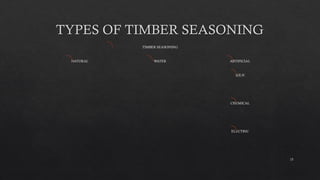
TYPES OF TIMBER SEASONING
TIMBER SEASONING
NATURAL WATER ARTIFICIAL
KILN
CHEMICAL
ELECTRIC
16
NATURAL SEASONING
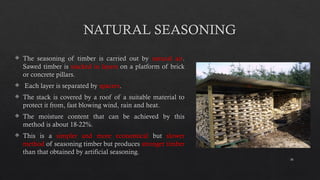
 The seasoning of timber is carried out by natural air.
Sawed timber is stacked in layers on a platform of brick
or concrete pillars.
 Each layer is separated by spacers.
 The stack is covered by a roof of a suitable material to
protect it from, fast blowing wind, rain and heat.
 The moisture content that can be achieved by this
method is about 18-22%.
 This is a simpler and more economical but slower
method of seasoning timber but produces stronger timber
than that obtained by artificial seasoning.
17
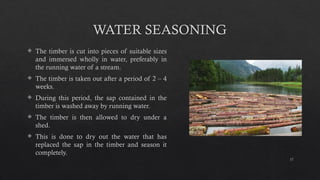
WATER SEASONING
 The timber is cut into pieces of suitable sizes
and immersed wholly in water, preferably in
the running water of a stream.
 The timber is taken out after a period of 2 – 4
weeks.
 During this period, the sap contained in the
timber is washed away by running water.
 The timber is then allowed to dry under a
shed.
 This is done to dry out the water that has
replaced the sap in the timber and season it
completely.
18
ARTIFICIAL SEASONING
 With artificial seasoning, the moisture content of the wood can be reduced to any desired
level and the timber produced is less liable to insect and fungi attacks.
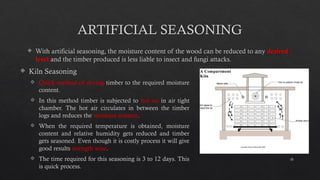
 Kiln Seasoning
 Quick method of drying timber to the required moisture
content.
 In this method timber is subjected to hot air in air tight
chamber. The hot air circulates in between the timber
logs and reduces the moisture content.
 When the required temperature is obtained, moisture
content and relative humidity gets reduced and timber
gets seasoned. Even though it is costly process it will give
good results strength wise.
 The time required for this seasoning is 3 to 12 days. This
is quick process.
19
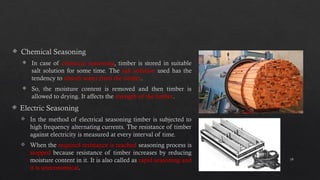
 Chemical Seasoning
 In case of chemical seasoning, timber is stored in suitable
salt solution for some time. The salt solution used has the
tendency to absorb water from the timber.
 So, the moisture content is removed and then timber is
allowed to drying. It affects the strength of the timber.
 Electric Seasoning
 In the method of electrical seasoning timber is subjected to
high frequency alternating currents. The resistance of timber
against electricity is measured at every interval of time.
 When the required resistance is reached seasoning process is
stopped because resistance of timber increases by reducing
moisture content in it. It is also called as rapid seasoning and
it is uneconomical.
20
TYPES OF TIMBER AND ITS USES
21
INDUSTRIAL TIMBER
 Scientifically prepared timber in a factory. They possesses desired shape, appearance,
strength, etc.
 Veneers
 Plywoods
 Compressed wood boards
 Compreg timbers
 Block board and lamin board
 Glulam
 Flushdoor shutters
 Hardboard
22
VENEERS
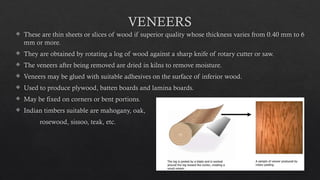
 These are thin sheets or slices of wood if superior quality whose thickness varies from 0.40 mm to 6
mm or more.
 They are obtained by rotating a log of wood against a sharp knife of rotary cutter or saw.
 The veneers after being removed are dried in kilns to remove moisture.
 Veneers may be glued with suitable adhesives on the surface of inferior wood.
 Used to produce plywood, batten boards and lamina boards.
 May be fixed on corners or bent portions.
 Indian timbers suitable are mahogany, oak,
rosewood, sissoo, teak, etc.
23
PLYWOOD
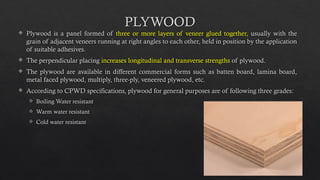
 Plywood is a panel formed of three or more layers of veneer glued together, usually with the
grain of adjacent veneers running at right angles to each other, held in position by the application
of suitable adhesives.
 The perpendicular placing increases longitudinal and transverse strengths of plywood.
 The plywood are available in different commercial forms such as batten board, lamina board,
metal faced plywood, multiply, three-ply, veneered plywood, etc.
 According to CPWD specifications, plywood for general purposes are of following three grades:
 Boiling Water resistant
 Warm water resistant
 Cold water resistant
24
 Followings are the uses and applications of plywood:
 To make light partition or external walls
 To make formwork, or a mould for wet concrete
 To make furniture, especially cupboards, kitchen cabinets, and office tables
 As part of flooring systems
 For packaging
 To make light doors and shutters
THICKNESS
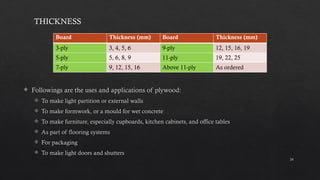
Board Thickness (mm) Board Thickness (mm)
3-ply 3, 4, 5, 6 9-ply 12, 15, 16, 19
5-ply 5, 6, 8, 9 11-ply 19, 22, 25
7-ply 9, 12, 15, 16 Above 11-ply As ordered
25
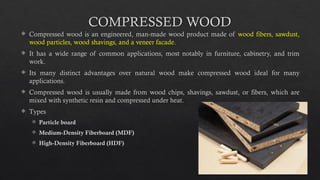
COMPRESSED WOOD
 Compressed wood is an engineered, man-made wood product made of wood fibers, sawdust,
wood particles, wood shavings, and a veneer facade.
 It has a wide range of common applications, most notably in furniture, cabinetry, and trim
work.
 Its many distinct advantages over natural wood make compressed wood ideal for many
applications.
 Compressed wood is usually made from wood chips, shavings, sawdust, or fibers, which are
mixed with synthetic resin and compressed under heat.
 Types
 Particle board
 Medium-Density Fiberboard (MDF)
 High-Density Fiberboard (HDF)
26
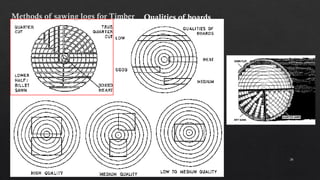
Methods of sawing logs for Timber Qualities of boards
27
THANK YOU…

Timber as construction material in civil engineering.pptx

  • 1.
  • 2.
    2 TIMBER  Wood canbe defined as the material that forms the trunks and the branches of the trees.  Timber is wood cut from the trunk which can be used for constructing houses, boats, furniture and so on.
  • 3.
    3 INTRODUCTION  Timber isnot only one of the oldest building materials, along with stone, and earth material, but has remained until today the most versatile and, in terms of indoor comfort and health aspects, most acceptable material.  However, timber is an extremely complex material, available in a great variety of species and forms, suitable for all kinds of applications.  Although only a small proportion of the timber harvested is used for building.  Since timber cannot be completely replaced by other materials, it shall long remain one of the most important building materials.
  • 4.
    4 USES OF TIMBER Building construction  House post-construction  Beams and rafters  Construction of bridges and boats  Furniture and instruments  Railway sleepers and packing cases  Toys and engraving work  Railway coach wagons  Formwork of cement concrete
  • 5.
    5 CLASSIFICATION OF TREES Trees EndogenousExogenous Coniferous Deciduous Endogenous: The trees which grow inwards in longitudinal fibrous mass are called endogenous trees. Ex: bamboo, cane , palm etc Exogenous: The trees which grow in outwards across horizontal section of stem are called exogenous trees. These trees are fit for engineering construction. Conifers or Evergreen: •They give soft wood. •They have pointed leaves. Ex: Deodar, Pine, Chir, Kail, etc. Deciduous or Broad leaf Trees: •These have hard wood. •These have broad leaves. Ex: Teak, Sal, Shisham, etc.
  • 6.
    6 COMPARISON OF SOFTWOODAND HARD WOOD Item Soft woods Hard woods Annual rings Distinct Indistinct Color Light Dark Density Low High Fire resistance Poor More Weight Light Heavy Strength Strong for direct pull and weak for equal resisting thrust or shear Equally strong for resisting tension, compression and shear Structure Resinous and split easily Non-resinous and close grained
  • 7.
    7 GENERAL PROPERTIES  Color– a darker color in wood indicates greater durability.  Odor – it is present only on freshly cut trees.  Hardness – is the ability of wood to withstand indentations caused by harder bodies.  Density – densest woods are generally the strongest.  Grain - Depending on the actual alignment, the grain may be straight, spiral, interlocked, wavy or irregular.  Texture - In hardwoods, the texture depends upon the size and distribution of vessels and rays. In softwoods, it is determined by the size and distribution of tracheid.
  • 8.
    8 STRUCTURE OF TREE From the visibility aspect, the structure of a tree can be divided into two categories  Macro structure  Micro structure
  • 9.
    9 MACRO STRUCTURE OFWOOD  Pith: The innermost central portion or core of the tree is called pith or medulla.  Heart wood: The inner annual rings surrounding the pith is known as heart wood. It imparts rigidity to tree. It is inactive in nature.  Sap wood: The cuter annual rings between heart wood and cambium layer is known as sap wood. Sapwood is less resilient to decay and insect attack.  Cambium layer: Thin layer of sap between sap wood and inner bark is known as cambium layer  Inner bark: The inner skin or layer covering the cambium layer is known as inner bark  Outer Bark: The outer skin or cover of the tree is known as outer bark  Medullary rays: The thin radial fibres extending from pith to cambium layer are known as medullary rays
  • 10.
    10 MICRO STRUCTURE OFWOOD  The structure of wood apparent only at great magnifications is called micro structure.  Conductive cells  Mechanical cells  Storage cells
  • 11.
    11 CHARACTERISTICS OF GOODTIMBERS  Appearance: A freshly cut surface of timber should exhibit hard and of shining appearance.  Color: A color should preferably be dark.  Defects: A good timber should be free from series defects such as knots, flaws, shakes etc.  Durability: A good timber should be durable and capable of resisting the action of fungi, insects, chemicals, physical agencies, and mechanical agencies.  Elasticity: The timber returns to its original shape when load causing its deformation is removed.  Fire resistance: A dense wood offers good resistance to fire.  Hardness: A good timber should be hard.
  • 12.
    12  Shape: Agood timber should be capable of retaining its shape during conversion or seasoning.  Smell: A good timber should have sweet smell. Unpleasant smell indicates decayed timber.  Sound: A good timber should give a clear ringing sound when struck.  Strength: A good timber should be sufficiently strong for working as structural member such as joist, beam, rafter etc.  Structure: The structure should be uniform.  Toughness: A good timber should be tough (i.e.) capable of offering resistance to shocks due to vibration.
  • 13.
    13  Water permeability:A good timber should have low water permeability, which is measured by the quantity of water filtered through unit surface area of specimen of wood.  Weight: The timber with heavy weight is considered to be sound and strong.  Working conditions: Timber should be easily workable. It should not clog the teeth of saw.  Mechanical wear: A good timber should not deteriorate easily due to mechanical wear or abrasion.
  • 14.
    14 SEASONING OF TIMBER As fresh timber which is obtained from trees contains about 30 to 40 % sap or moisture.  This sap is very harmful for the life of a timber. Therefore, it is necessary to remove that sap by applying some special methods.  All those methods which are used for removing the sap from timber are collectively termed as seasoning of timber.  Advantages of seasoned timber:  It has reduced weight,  It is strong and durable,  It has resistance to decay or rot,  It takes high polish,  It is easier to work,  Its life is more.
  • 15.
    15 TYPES OF TIMBERSEASONING TIMBER SEASONING NATURAL WATER ARTIFICIAL KILN CHEMICAL ELECTRIC
  • 16.
    16 NATURAL SEASONING  Theseasoning of timber is carried out by natural air. Sawed timber is stacked in layers on a platform of brick or concrete pillars.  Each layer is separated by spacers.  The stack is covered by a roof of a suitable material to protect it from, fast blowing wind, rain and heat.  The moisture content that can be achieved by this method is about 18-22%.  This is a simpler and more economical but slower method of seasoning timber but produces stronger timber than that obtained by artificial seasoning.
  • 17.
    17 WATER SEASONING  Thetimber is cut into pieces of suitable sizes and immersed wholly in water, preferably in the running water of a stream.  The timber is taken out after a period of 2 – 4 weeks.  During this period, the sap contained in the timber is washed away by running water.  The timber is then allowed to dry under a shed.  This is done to dry out the water that has replaced the sap in the timber and season it completely.
  • 18.
    18 ARTIFICIAL SEASONING  Withartificial seasoning, the moisture content of the wood can be reduced to any desired level and the timber produced is less liable to insect and fungi attacks.  Kiln Seasoning  Quick method of drying timber to the required moisture content.  In this method timber is subjected to hot air in air tight chamber. The hot air circulates in between the timber logs and reduces the moisture content.  When the required temperature is obtained, moisture content and relative humidity gets reduced and timber gets seasoned. Even though it is costly process it will give good results strength wise.  The time required for this seasoning is 3 to 12 days. This is quick process.
  • 19.
    19  Chemical Seasoning In case of chemical seasoning, timber is stored in suitable salt solution for some time. The salt solution used has the tendency to absorb water from the timber.  So, the moisture content is removed and then timber is allowed to drying. It affects the strength of the timber.  Electric Seasoning  In the method of electrical seasoning timber is subjected to high frequency alternating currents. The resistance of timber against electricity is measured at every interval of time.  When the required resistance is reached seasoning process is stopped because resistance of timber increases by reducing moisture content in it. It is also called as rapid seasoning and it is uneconomical.
  • 20.
    20 TYPES OF TIMBERAND ITS USES
  • 21.
    21 INDUSTRIAL TIMBER  Scientificallyprepared timber in a factory. They possesses desired shape, appearance, strength, etc.  Veneers  Plywoods  Compressed wood boards  Compreg timbers  Block board and lamin board  Glulam  Flushdoor shutters  Hardboard
  • 22.
    22 VENEERS  These arethin sheets or slices of wood if superior quality whose thickness varies from 0.40 mm to 6 mm or more.  They are obtained by rotating a log of wood against a sharp knife of rotary cutter or saw.  The veneers after being removed are dried in kilns to remove moisture.  Veneers may be glued with suitable adhesives on the surface of inferior wood.  Used to produce plywood, batten boards and lamina boards.  May be fixed on corners or bent portions.  Indian timbers suitable are mahogany, oak, rosewood, sissoo, teak, etc.
  • 23.
    23 PLYWOOD  Plywood isa panel formed of three or more layers of veneer glued together, usually with the grain of adjacent veneers running at right angles to each other, held in position by the application of suitable adhesives.  The perpendicular placing increases longitudinal and transverse strengths of plywood.  The plywood are available in different commercial forms such as batten board, lamina board, metal faced plywood, multiply, three-ply, veneered plywood, etc.  According to CPWD specifications, plywood for general purposes are of following three grades:  Boiling Water resistant  Warm water resistant  Cold water resistant
  • 24.
    24  Followings arethe uses and applications of plywood:  To make light partition or external walls  To make formwork, or a mould for wet concrete  To make furniture, especially cupboards, kitchen cabinets, and office tables  As part of flooring systems  For packaging  To make light doors and shutters THICKNESS Board Thickness (mm) Board Thickness (mm) 3-ply 3, 4, 5, 6 9-ply 12, 15, 16, 19 5-ply 5, 6, 8, 9 11-ply 19, 22, 25 7-ply 9, 12, 15, 16 Above 11-ply As ordered
  • 25.
    25 COMPRESSED WOOD  Compressedwood is an engineered, man-made wood product made of wood fibers, sawdust, wood particles, wood shavings, and a veneer facade.  It has a wide range of common applications, most notably in furniture, cabinetry, and trim work.  Its many distinct advantages over natural wood make compressed wood ideal for many applications.  Compressed wood is usually made from wood chips, shavings, sawdust, or fibers, which are mixed with synthetic resin and compressed under heat.  Types  Particle board  Medium-Density Fiberboard (MDF)  High-Density Fiberboard (HDF)
  • 26.
    26 Methods of sawinglogs for Timber Qualities of boards
  • 27.

Editor's Notes

  • #26 The density of wood is a reliable indicator of many of its structural n mechanical properties