II.WOOD AS A
CONSTRUCTION
MATERIALS
INTRODUCTION
• The "wood" used for building, carpentry or various other engineering purposes
is termed as "timber".
• Wood is used extensively for buildings, bridges, utility poles, piles, floor,
trusses, roofs
• Wood is used in the following forms:
• Natural form, and
• Engineered wood products (laminates, plywood, strand board, etc)
• Low cost, availability, ease of use, and renewable
• Wood is natural, renewable product from trees.There are more than 600
species of trees in the U.S alone
2 1/16/2025 Add a footer
INTRODUCTION
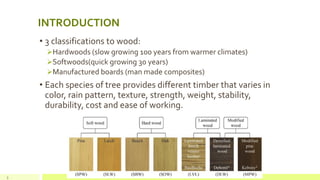
• 3 classifications to wood:
➢Hardwoods (slow growing 100 years from warmer climates)
➢Softwoods(quick growing 30 years)
➢Manufactured boards (man made composites)
• Each species of tree provides different timber that varies in
color, rain pattern, texture, strength, weight, stability,
durability, cost and ease of working.
3
INTRODUCTION
• Trees are classified into two types based on growth
-Exogenous: Growth from center out by adding concentric layer of wood
-Endogenous: Growth with intertwined fibers, such as bamboo
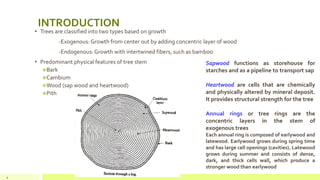
• Predominant physical features of tree stem
❖Bark
❖Cambium
❖Wood (sap wood and heartwood)
❖Pith
4
Sapwood functions as storehouse for
starches and as a pipeline to transport sap
Heartwood are cells that are chemically
and physically altered by mineral deposit.
It provides structural strength for the tree
Annual rings or tree rings are the
concentric layers in the stem of
exogenous trees
Each annual ring is composed of earlywood and
latewood. Earlywood grows during spring time
and has large cell openings (cavities). Latewood
grows during summer and consists of dense,
dark, and thick cells wall, which produce a
stronger wood than earlywood
Philippine Wood
It is estimated that there are about 3000 species of
Philippine wood that can attain a diameter of about 21 inches
that can be converted into logs and finally into lumber.
75% of the standing trees in the forests belongs to
LAUAN FAMILY
5
Species of Wood
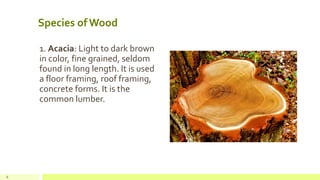
1. Acacia: Light to dark brown
in color, fine grained, seldom
found in long length. It is used
a floor framing, roof framing,
concrete forms. It is the
common lumber.
6
Species of Wood
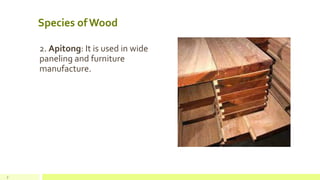
2. Apitong: It is used in wide
paneling and furniture
manufacture.
7
Species of Wood
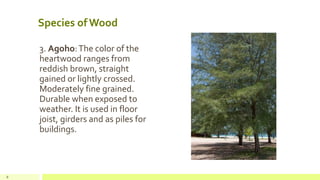
3. Agoho:The color of the
heartwood ranges from
reddish brown, straight
gained or lightly crossed.
Moderately fine grained.
Durable when exposed to
weather. It is used in floor
joist, girders and as piles for
buildings.
8
Species of Wood
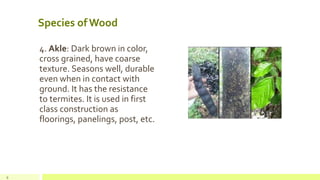
4. Akle: Dark brown in color,
cross grained, have coarse
texture. Seasons well, durable
even when in contact with
ground. It has the resistance
to termites. It is used in first
class construction as
floorings, panelings, post, etc.
9
Species of Wood
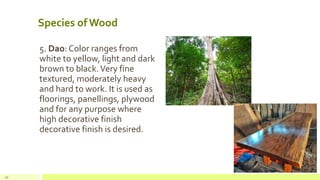
5. Dao: Color ranges from
white to yellow, light and dark
brown to black.Very fine
textured, moderately heavy
and hard to work. It is used as
floorings, panellings, plywood
and for any purpose where
high decorative finish
decorative finish is desired.
10
Species of Wood
6. Guijo: Brownish red in color,cross grained, hard and heavy. It
is used as floor joists, girders, trusses, floorings, and for any
purpose where structural strength is required
11
Species of Wood
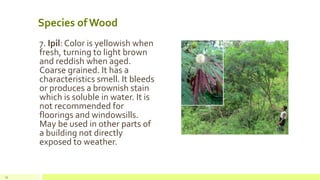
7. Ipil: Color is yellowish when
fresh, turning to light brown
and reddish when aged.
Coarse grained. It has a
characteristics smell. It bleeds
or produces a brownish stain
which is soluble in water. It is
not recommended for
floorings and windowsills.
May be used in other parts of
a building not directly
exposed to weather.
12
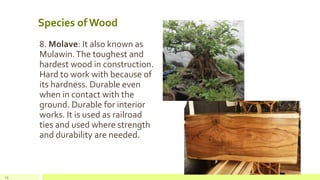
Species of Wood
8. Molave: It also known as
Mulawin.The toughest and
hardest wood in construction.
Hard to work with because of
its hardness. Durable even
when in contact with the
ground. Durable for interior
works. It is used as railroad
ties and used where strength
and durability are needed.
13
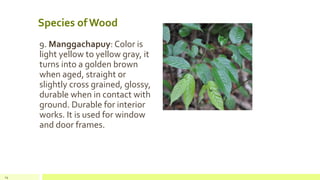
Species of Wood
9. Manggachapuy: Color is
light yellow to yellow gray, it
turns into a golden brown
when aged, straight or
slightly cross grained, glossy,
durable when in contact with
ground. Durable for interior
works. It is used for window
and door frames.
14
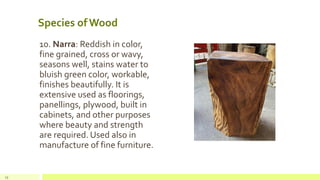
Species of Wood
10. Narra: Reddish in color,
fine grained, cross or wavy,
seasons well, stains water to
bluish green color, workable,
finishes beautifully. It is
extensive used as floorings,
panellings, plywood, built in
cabinets, and other purposes
where beauty and strength
are required. Used also in
manufacture of fine furniture.
15
Species of Wood
11. Palosapis: Color is light yellow with pink streaks, straight
grained, coarse textured, seasons well, needs careful seasoning
because it wraps easily. Not very workable but durable for interior
works. Used for interior finishing and plywood manufacture.
12. Yakal: It belongs to Lauan family although heavier and harder.
Color ranges from yellow to yellowish brown, cross grained, fine
textured, very durable even when exposed to the weather or in
contact with concrete. It is used in first class construction where
durability and strength are required. Commonly used as post and
beams.
16
ANISOTROPIC NATURE OF WOOD
• Wood is an anisotropic material because it has different properties in various
directions
• Three-axis orientation in wood are
-Longitudinal or parallel to the grain
-Radical or across the growth rings (perpendicular to the grain)
-Tangential or tangent to the growth rings
• An isotropic nature affects physical and mechanical properties of wood such as
shrinkage, stiffness, and strength
• The wood cells have a rectangular cross section.The center of the tubes is hollow.
The tube structure resists stresses parallel to its length, but it will deform when
loaded on its side
• Tubes are 100/1 (length to diameter)
17
CHEMICAL COMPOSITION OF WOOD
• Cellulose: 50% by weight
• Lignin:
-23-33% in softwoods, 16-26% in hardwoods
-It is the glue for the cells. It controls the shear strength.
• Hemicellulose:
-15-20% of softwood and 20-30% of hardwood.
-Polymeric units made from sugar molecules. Xylone in hardwoods, mannose in
softwood.
• Extractives:
-5-30% of the wood substance
-Include poly-phenolics, coloring material, oils and fats, resins, waxes, gums, starches.
-Soluble in water, alcohol, acetone, and benzene
• Ash-forming materials:
-0.1to 3.0% of the wood material
-Include calcium, potassium, phosphate, and silica
18
WATER IN WOOD
Types of water in wood:
• Bound water: held within the cell wall by absorption forces
• Free water exists as either condensed water or water vapor
Fiber Saturation Point (FSP):
• The level at which the cell walls are completely saturated, but no free water exists in the cell
cavities
• FSP varies among tree species, typically range in 21-32%
• Physical and mechanical properties are dependent on the FSP
Shrinkage:
• If the moisture content is higher than the FSP, the wood is dimensionally stable
• Shrinkage may result with the moisture content less than the FSP
• Occurs when moisture is lost from cell walls
• Swelling occurs when moisture is gained in the cell walls
• Shrinkage in the radial direction is generally one-half the change in the tangential direction
• Shrinkage in the longitudinal direction is usually minimal, ranging from 0.1 to 0.2% for a change
in the moisture content from FSP to oven dry
19
WOOD PRODUCTION PROCESSES
Wood is produced through following processes:
✓Harvesting
✓Sawing into desired shapes and sizes
✓Seasoning
✓Surfacing
✓Preservation
20
WOOD PRODUCTION PROCESSES:
Logs of wood are harvested during the fall or winter due to fire
hazards and also cutting the trees at the end of their non-tree plant
lives in the forest
21
WOOD PRODUCTION PROCESSES:
Sawing of wood into desired shapes and sizes
•Harvested logs are transported to sawmill where they are cut into
following useful dimensional shapes:
Lumber
•50 - 125 mm (2 - 5 inch) thick, sawing and surfacing on all four
sides remove 5-10 mm from the dimensions
•Sizes include 24, 26, 28, 210, 212, 44 referring to rough cut
dimensions in inches, actual sizes are less
•Lengths range from 8 to 24 ft
•Uses include studs, sill, and top plates, joists, beams, rafters,
trusses, and decking
22
WOOD PRODUCTION PROCESSES:
Sawing of wood into desired shapes and sizes
Heavy timber
•Rough sawn dimensions of 46, 66, 88 reduced by 10 mm per
side due to surfacing.
•Uses include heavy-frame construction, landscaping, railroad ties,
and marine construction
Round stock
•Poles and posts used for building, marine pilings, and utility poles
23
WOOD PRODUCTION PROCESSES:
Seasoning of wood
•Seasoning is the process of removing moisture from a harvested
wood
•Green wood contains 30 to 200% moisture by oven-dried weight,
this is lowered to 7% for dry areas or up to 14% in damp areas,
leaving a saw mill, wood is at 15% moisture
Air drying (inexpensive and slow)
•Stack boards with air space between them to allow drying
•After 3 to 4 months, it reaches the local humidity level
•Often requires further dying to reach acceptable levels
24
WOOD PRODUCTION PROCESSES:
Seasoning of wood
Kiln drying (scientific and expensive)
•Boards dried at 70-120 F for 4-10 days
•Rapid drying may result in cracks and deformed lumber, and post-
process wood is thirsty, so it must be covered and cared for
properly
25
WOOD PRODUCTION PROCESSES:
Wood preservation
•The wood needs to be preserved against the degradation caused
by various organisms such as: fungi, bacteria, insects, and
marine organisms.
•The quality of preservation depends on the following:
➢The type of preservative
➢The degree of penetration by preservative
➢The amount of the chemical retained in the wood
Types of preservatives
•Paints
•Petroleum-based solutions
• These are very effective but environmentally sensitive.
• Used where a high degree of environmental exposure exists and human contact is not a
concern such as utility poles, railroad ties, retaining walls
26
WOOD PRODUCTION PROCESSES:
Wood preservation
•Waterborne preservatives (salts)
• Ammoniacal copper arsenate
• Chromated copper arsenate
• Ammoniocal copper zinc arsenate
• Advantages: Cleanliness and ability to be painted
• Disadvantages: Their removal by leaching when exposed to moist
conditions over long periods of time. Environmentally sensitive.
• Used for wood structure such as residual decks and fences
27
WOOD PRODUCTION PROCESSES:
Wood preservation
•Waterborne preservatives (salts)
• Ammoniacal copper arsenate
• Chromated copper arsenate
• Ammoniocal copper zinc arsenate
• Advantages: Cleanliness and ability to be painted
• Disadvantages: Their removal by leaching when exposed to moist
conditions over long periods of time. Environmentally sensitive.
• Used for wood structure such as residual decks and fences
28
WOOD PRODUCTION PROCESSES:
Wood preservation
Preservative application techniques
• Superficial treatment
• Techniques include coatings applied by painting, spraying, or immersion
• Fluid penetration process
• Occurs by capillary action and is a function of surface tension, angle of contact,
• time, temperature, and pressure
• Pressure-treated wood has greater resistance to degradation than surface-
treated wood because the preservative is forced into the entire structure of
the wood
29
ENGINEEREDWOOD PRODUCTS
Following engineered wood products are manufactured by bonding wood strands,
veneers, lumber, or fibers.
• Glued - laminated timber (glulam)
• Structural composite lumber (same dimensions as sawn wood dimensional lumber)
• Structural strand panels (plywood, orientated strand board, and composite panels)
• Wood I-Joists
Quality and serviceability depend on:
• Gluing properties and wood preparation
• Type of adhesive
• Quality control in the gluing process
Adhesives used for gluing:
• Natural (casein, vegetable protein, and blood protein glues)
• Synthetic (phenol, urea, resorcinol, polyvinyl, and epoxy resins)
30
ENGINEERED WOOD PRODUCTS
Glued-laminated timbers
Douglas-fir and southern pine are the most common
Advantages:
• Ease of manufacturing large members
• Can design large members whose cross-sections vary along their length
• Can use low grade wood for less stressed areas
• Minimal seasoning defects
Factors that affect strength:
• Cross-grain
• Knots
• Effect of end joining
31
ENGINEERED WOOD PRODUCTS
Plywood
Thin sheets of wood (plies) that are glued in layers
Production of Plywood:
• Logs are saturated. Six hours before processing are moved into boiling water.
• Bark is removed and logs are cut into eight-foot sections
• A continuous sheet of veneer is peeled from the log
• Veneer is seasoned and dried
• Assemble, glue, and press veneer
Classification based on:
• Type of wood used
• Number of plies
• Grade of plies
• Type of adhesive
32
ENGINEERED WOOD PRODUCTS
Plywood
Properties of Plies:
• Adjacent sheets have grain that runs perpendicular to each other
• The middle plies in even - plied panels have the same grain orientation
• Plies are 1.6 mm to 7.9 mm thick
• Plywood panels are 3.2 to 29 mm thick
33
ENGINEERED WOOD PRODUCTS
Particle Board and Strand Board
•Manufactured by gluing together "scraps" produces
•Particle board is made from sawdust-sized particles
•Strand board is made from flat chips
•These products are replacing plywood in many applications
because it is cheaper
34
PHYSICAL PROPERTIES OF WOOD:
Moisture content (MC)
•MC is the weight of water as a percentage of the oven-dry weight
of the wood
•Oven-dried is attained in an oven at 100ºC to 150ºC until the wood
attains a constant weight
•Physical properties, such as weight, shrinkage and strength
depend on the moisture content of wood
35
PHYSICAL PROPERTIES OF WOOD:
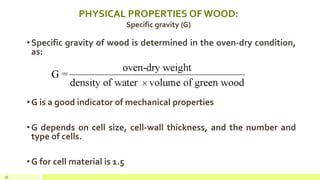
Specific gravity (G)
•Specific gravity of wood is determined in the oven-dry condition,
as:
•G is a good indicator of mechanical properties
•G depends on cell size, cell-wall thickness, and the number and
type of cells.
•G for cell material is 1.5
36
PHYSICAL PROPERTIES OF WOOD:
Density or unit weight (y)
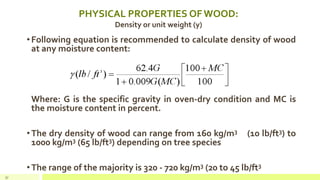
•Following equation is recommended to calculate density of wood
at any moisture content:
Where: G is the specific gravity in oven-dry condition and MC is
the moisture content in percent.
•The dry density of wood can range from 160 kg/m3 (10 lb/ft3) to
1000 kg/m3 (65 lb/ft3) depending on tree species
•The range of the majority is 320 - 720 kg/m3 (20 to 45 lb/ft3
37
PHYSICAL PROPERTIES OF WOOD:
Thermal conductivity,Thermal diffusivity and Electrical resistivity
Thermal Conductivity:
•It is the rate of heat flow
•Thermal conductivity for wood is a fraction of most metals and 3
to 4 times greater than most common insulating material
•It depends on grain orientation, moisture content, specific
gravity, extractive content, and irregularities
•Heat flow parallel to grain is 2.0 to 2.8 times greater than in the
radial direction
•As the moisture content increases from 0 to 40%, the thermal
conductivity increases by about 30%
•It has linear correlation with specific gravity meaning heavier
wood conduct heat faster
38
PHYSICAL PROPERTIES OF WOOD:
Thermal conductivity,Thermal diffusivity and Electrical resistivity
Thermal Diffusivity:
•It is a measure of the rate at which a material absorbs heat from
its surroundings
•For wood, it is much smaller than that of other common building
materials
•Thermal diffusivity value of wood averages 0.006 mm/s (0.00025
inch/s)
Electrical Resistivity:
•Air-dry wood is a good electrical insulator
•Resistivity decreases by a factor of three for each percentage
increase in moisture content
•Wood has the resistivity of water when it reaches the fiber
saturation point (FSP)
39
PHYSICAL PROPERTIES OF WOOD:
Specific heat and Coefficient of thermal expansion
Specific Heat:
•It is the ratio of the quantity of heat required to raise the
temperature of a material 1 degree to that required for
raising the temperature of an equal mass of water by 1
degree
•For wood, it is dependent on moisture and temperature
•Species and density have little or no effect on specific
heat
40
PHYSICAL PROPERTIES OF WOOD:
Specific heat and Coefficient of thermal expansion
Coefficient ofThermal Expansion:
•It is a measure of dimensional changes caused by a
temperature variance
•Longitudinal (parallel to grain) coefficient values range
from 0.009 to 0.0014 mm/m/°C (0.0000017 to 0.0000025
inch/inch/°F)
•Coefficients are 5 to 10 times greater across the grain
•Moist wood that is heated, expands due to thermal
expansion and shrinks due to moisture loss (below FSP)
which usually results in a net shrinkage
41

II. Wood as a construction materials.pdf

  • 1.
  • 2.
    INTRODUCTION • The "wood"used for building, carpentry or various other engineering purposes is termed as "timber". • Wood is used extensively for buildings, bridges, utility poles, piles, floor, trusses, roofs • Wood is used in the following forms: • Natural form, and • Engineered wood products (laminates, plywood, strand board, etc) • Low cost, availability, ease of use, and renewable • Wood is natural, renewable product from trees.There are more than 600 species of trees in the U.S alone 2 1/16/2025 Add a footer
  • 3.
    INTRODUCTION • 3 classificationsto wood: ➢Hardwoods (slow growing 100 years from warmer climates) ➢Softwoods(quick growing 30 years) ➢Manufactured boards (man made composites) • Each species of tree provides different timber that varies in color, rain pattern, texture, strength, weight, stability, durability, cost and ease of working. 3
  • 4.
    INTRODUCTION • Trees areclassified into two types based on growth -Exogenous: Growth from center out by adding concentric layer of wood -Endogenous: Growth with intertwined fibers, such as bamboo • Predominant physical features of tree stem ❖Bark ❖Cambium ❖Wood (sap wood and heartwood) ❖Pith 4 Sapwood functions as storehouse for starches and as a pipeline to transport sap Heartwood are cells that are chemically and physically altered by mineral deposit. It provides structural strength for the tree Annual rings or tree rings are the concentric layers in the stem of exogenous trees Each annual ring is composed of earlywood and latewood. Earlywood grows during spring time and has large cell openings (cavities). Latewood grows during summer and consists of dense, dark, and thick cells wall, which produce a stronger wood than earlywood
  • 5.
    Philippine Wood It isestimated that there are about 3000 species of Philippine wood that can attain a diameter of about 21 inches that can be converted into logs and finally into lumber. 75% of the standing trees in the forests belongs to LAUAN FAMILY 5
  • 6.
    Species of Wood 1.Acacia: Light to dark brown in color, fine grained, seldom found in long length. It is used a floor framing, roof framing, concrete forms. It is the common lumber. 6
  • 7.
    Species of Wood 2.Apitong: It is used in wide paneling and furniture manufacture. 7
  • 8.
    Species of Wood 3.Agoho:The color of the heartwood ranges from reddish brown, straight gained or lightly crossed. Moderately fine grained. Durable when exposed to weather. It is used in floor joist, girders and as piles for buildings. 8
  • 9.
    Species of Wood 4.Akle: Dark brown in color, cross grained, have coarse texture. Seasons well, durable even when in contact with ground. It has the resistance to termites. It is used in first class construction as floorings, panelings, post, etc. 9
  • 10.
    Species of Wood 5.Dao: Color ranges from white to yellow, light and dark brown to black.Very fine textured, moderately heavy and hard to work. It is used as floorings, panellings, plywood and for any purpose where high decorative finish decorative finish is desired. 10
  • 11.
    Species of Wood 6.Guijo: Brownish red in color,cross grained, hard and heavy. It is used as floor joists, girders, trusses, floorings, and for any purpose where structural strength is required 11
  • 12.
    Species of Wood 7.Ipil: Color is yellowish when fresh, turning to light brown and reddish when aged. Coarse grained. It has a characteristics smell. It bleeds or produces a brownish stain which is soluble in water. It is not recommended for floorings and windowsills. May be used in other parts of a building not directly exposed to weather. 12
  • 13.
    Species of Wood 8.Molave: It also known as Mulawin.The toughest and hardest wood in construction. Hard to work with because of its hardness. Durable even when in contact with the ground. Durable for interior works. It is used as railroad ties and used where strength and durability are needed. 13
  • 14.
    Species of Wood 9.Manggachapuy: Color is light yellow to yellow gray, it turns into a golden brown when aged, straight or slightly cross grained, glossy, durable when in contact with ground. Durable for interior works. It is used for window and door frames. 14
  • 15.
    Species of Wood 10.Narra: Reddish in color, fine grained, cross or wavy, seasons well, stains water to bluish green color, workable, finishes beautifully. It is extensive used as floorings, panellings, plywood, built in cabinets, and other purposes where beauty and strength are required. Used also in manufacture of fine furniture. 15
  • 16.
    Species of Wood 11.Palosapis: Color is light yellow with pink streaks, straight grained, coarse textured, seasons well, needs careful seasoning because it wraps easily. Not very workable but durable for interior works. Used for interior finishing and plywood manufacture. 12. Yakal: It belongs to Lauan family although heavier and harder. Color ranges from yellow to yellowish brown, cross grained, fine textured, very durable even when exposed to the weather or in contact with concrete. It is used in first class construction where durability and strength are required. Commonly used as post and beams. 16
  • 17.
    ANISOTROPIC NATURE OFWOOD • Wood is an anisotropic material because it has different properties in various directions • Three-axis orientation in wood are -Longitudinal or parallel to the grain -Radical or across the growth rings (perpendicular to the grain) -Tangential or tangent to the growth rings • An isotropic nature affects physical and mechanical properties of wood such as shrinkage, stiffness, and strength • The wood cells have a rectangular cross section.The center of the tubes is hollow. The tube structure resists stresses parallel to its length, but it will deform when loaded on its side • Tubes are 100/1 (length to diameter) 17
  • 18.
    CHEMICAL COMPOSITION OFWOOD • Cellulose: 50% by weight • Lignin: -23-33% in softwoods, 16-26% in hardwoods -It is the glue for the cells. It controls the shear strength. • Hemicellulose: -15-20% of softwood and 20-30% of hardwood. -Polymeric units made from sugar molecules. Xylone in hardwoods, mannose in softwood. • Extractives: -5-30% of the wood substance -Include poly-phenolics, coloring material, oils and fats, resins, waxes, gums, starches. -Soluble in water, alcohol, acetone, and benzene • Ash-forming materials: -0.1to 3.0% of the wood material -Include calcium, potassium, phosphate, and silica 18
  • 19.
    WATER IN WOOD Typesof water in wood: • Bound water: held within the cell wall by absorption forces • Free water exists as either condensed water or water vapor Fiber Saturation Point (FSP): • The level at which the cell walls are completely saturated, but no free water exists in the cell cavities • FSP varies among tree species, typically range in 21-32% • Physical and mechanical properties are dependent on the FSP Shrinkage: • If the moisture content is higher than the FSP, the wood is dimensionally stable • Shrinkage may result with the moisture content less than the FSP • Occurs when moisture is lost from cell walls • Swelling occurs when moisture is gained in the cell walls • Shrinkage in the radial direction is generally one-half the change in the tangential direction • Shrinkage in the longitudinal direction is usually minimal, ranging from 0.1 to 0.2% for a change in the moisture content from FSP to oven dry 19
  • 20.
    WOOD PRODUCTION PROCESSES Woodis produced through following processes: ✓Harvesting ✓Sawing into desired shapes and sizes ✓Seasoning ✓Surfacing ✓Preservation 20
  • 21.
    WOOD PRODUCTION PROCESSES: Logsof wood are harvested during the fall or winter due to fire hazards and also cutting the trees at the end of their non-tree plant lives in the forest 21
  • 22.
    WOOD PRODUCTION PROCESSES: Sawingof wood into desired shapes and sizes •Harvested logs are transported to sawmill where they are cut into following useful dimensional shapes: Lumber •50 - 125 mm (2 - 5 inch) thick, sawing and surfacing on all four sides remove 5-10 mm from the dimensions •Sizes include 24, 26, 28, 210, 212, 44 referring to rough cut dimensions in inches, actual sizes are less •Lengths range from 8 to 24 ft •Uses include studs, sill, and top plates, joists, beams, rafters, trusses, and decking 22
  • 23.
    WOOD PRODUCTION PROCESSES: Sawingof wood into desired shapes and sizes Heavy timber •Rough sawn dimensions of 46, 66, 88 reduced by 10 mm per side due to surfacing. •Uses include heavy-frame construction, landscaping, railroad ties, and marine construction Round stock •Poles and posts used for building, marine pilings, and utility poles 23
  • 24.
    WOOD PRODUCTION PROCESSES: Seasoningof wood •Seasoning is the process of removing moisture from a harvested wood •Green wood contains 30 to 200% moisture by oven-dried weight, this is lowered to 7% for dry areas or up to 14% in damp areas, leaving a saw mill, wood is at 15% moisture Air drying (inexpensive and slow) •Stack boards with air space between them to allow drying •After 3 to 4 months, it reaches the local humidity level •Often requires further dying to reach acceptable levels 24
  • 25.
    WOOD PRODUCTION PROCESSES: Seasoningof wood Kiln drying (scientific and expensive) •Boards dried at 70-120 F for 4-10 days •Rapid drying may result in cracks and deformed lumber, and post- process wood is thirsty, so it must be covered and cared for properly 25
  • 26.
    WOOD PRODUCTION PROCESSES: Woodpreservation •The wood needs to be preserved against the degradation caused by various organisms such as: fungi, bacteria, insects, and marine organisms. •The quality of preservation depends on the following: ➢The type of preservative ➢The degree of penetration by preservative ➢The amount of the chemical retained in the wood Types of preservatives •Paints •Petroleum-based solutions • These are very effective but environmentally sensitive. • Used where a high degree of environmental exposure exists and human contact is not a concern such as utility poles, railroad ties, retaining walls 26
  • 27.
    WOOD PRODUCTION PROCESSES: Woodpreservation •Waterborne preservatives (salts) • Ammoniacal copper arsenate • Chromated copper arsenate • Ammoniocal copper zinc arsenate • Advantages: Cleanliness and ability to be painted • Disadvantages: Their removal by leaching when exposed to moist conditions over long periods of time. Environmentally sensitive. • Used for wood structure such as residual decks and fences 27
  • 28.
    WOOD PRODUCTION PROCESSES: Woodpreservation •Waterborne preservatives (salts) • Ammoniacal copper arsenate • Chromated copper arsenate • Ammoniocal copper zinc arsenate • Advantages: Cleanliness and ability to be painted • Disadvantages: Their removal by leaching when exposed to moist conditions over long periods of time. Environmentally sensitive. • Used for wood structure such as residual decks and fences 28
  • 29.
    WOOD PRODUCTION PROCESSES: Woodpreservation Preservative application techniques • Superficial treatment • Techniques include coatings applied by painting, spraying, or immersion • Fluid penetration process • Occurs by capillary action and is a function of surface tension, angle of contact, • time, temperature, and pressure • Pressure-treated wood has greater resistance to degradation than surface- treated wood because the preservative is forced into the entire structure of the wood 29
  • 30.
    ENGINEEREDWOOD PRODUCTS Following engineeredwood products are manufactured by bonding wood strands, veneers, lumber, or fibers. • Glued - laminated timber (glulam) • Structural composite lumber (same dimensions as sawn wood dimensional lumber) • Structural strand panels (plywood, orientated strand board, and composite panels) • Wood I-Joists Quality and serviceability depend on: • Gluing properties and wood preparation • Type of adhesive • Quality control in the gluing process Adhesives used for gluing: • Natural (casein, vegetable protein, and blood protein glues) • Synthetic (phenol, urea, resorcinol, polyvinyl, and epoxy resins) 30
  • 31.
    ENGINEERED WOOD PRODUCTS Glued-laminatedtimbers Douglas-fir and southern pine are the most common Advantages: • Ease of manufacturing large members • Can design large members whose cross-sections vary along their length • Can use low grade wood for less stressed areas • Minimal seasoning defects Factors that affect strength: • Cross-grain • Knots • Effect of end joining 31
  • 32.
    ENGINEERED WOOD PRODUCTS Plywood Thinsheets of wood (plies) that are glued in layers Production of Plywood: • Logs are saturated. Six hours before processing are moved into boiling water. • Bark is removed and logs are cut into eight-foot sections • A continuous sheet of veneer is peeled from the log • Veneer is seasoned and dried • Assemble, glue, and press veneer Classification based on: • Type of wood used • Number of plies • Grade of plies • Type of adhesive 32
  • 33.
    ENGINEERED WOOD PRODUCTS Plywood Propertiesof Plies: • Adjacent sheets have grain that runs perpendicular to each other • The middle plies in even - plied panels have the same grain orientation • Plies are 1.6 mm to 7.9 mm thick • Plywood panels are 3.2 to 29 mm thick 33
  • 34.
    ENGINEERED WOOD PRODUCTS ParticleBoard and Strand Board •Manufactured by gluing together "scraps" produces •Particle board is made from sawdust-sized particles •Strand board is made from flat chips •These products are replacing plywood in many applications because it is cheaper 34
  • 35.
    PHYSICAL PROPERTIES OFWOOD: Moisture content (MC) •MC is the weight of water as a percentage of the oven-dry weight of the wood •Oven-dried is attained in an oven at 100ºC to 150ºC until the wood attains a constant weight •Physical properties, such as weight, shrinkage and strength depend on the moisture content of wood 35
  • 36.
    PHYSICAL PROPERTIES OFWOOD: Specific gravity (G) •Specific gravity of wood is determined in the oven-dry condition, as: •G is a good indicator of mechanical properties •G depends on cell size, cell-wall thickness, and the number and type of cells. •G for cell material is 1.5 36
  • 37.
    PHYSICAL PROPERTIES OFWOOD: Density or unit weight (y) •Following equation is recommended to calculate density of wood at any moisture content: Where: G is the specific gravity in oven-dry condition and MC is the moisture content in percent. •The dry density of wood can range from 160 kg/m3 (10 lb/ft3) to 1000 kg/m3 (65 lb/ft3) depending on tree species •The range of the majority is 320 - 720 kg/m3 (20 to 45 lb/ft3 37
  • 38.
    PHYSICAL PROPERTIES OFWOOD: Thermal conductivity,Thermal diffusivity and Electrical resistivity Thermal Conductivity: •It is the rate of heat flow •Thermal conductivity for wood is a fraction of most metals and 3 to 4 times greater than most common insulating material •It depends on grain orientation, moisture content, specific gravity, extractive content, and irregularities •Heat flow parallel to grain is 2.0 to 2.8 times greater than in the radial direction •As the moisture content increases from 0 to 40%, the thermal conductivity increases by about 30% •It has linear correlation with specific gravity meaning heavier wood conduct heat faster 38
  • 39.
    PHYSICAL PROPERTIES OFWOOD: Thermal conductivity,Thermal diffusivity and Electrical resistivity Thermal Diffusivity: •It is a measure of the rate at which a material absorbs heat from its surroundings •For wood, it is much smaller than that of other common building materials •Thermal diffusivity value of wood averages 0.006 mm/s (0.00025 inch/s) Electrical Resistivity: •Air-dry wood is a good electrical insulator •Resistivity decreases by a factor of three for each percentage increase in moisture content •Wood has the resistivity of water when it reaches the fiber saturation point (FSP) 39
  • 40.
    PHYSICAL PROPERTIES OFWOOD: Specific heat and Coefficient of thermal expansion Specific Heat: •It is the ratio of the quantity of heat required to raise the temperature of a material 1 degree to that required for raising the temperature of an equal mass of water by 1 degree •For wood, it is dependent on moisture and temperature •Species and density have little or no effect on specific heat 40
  • 41.
    PHYSICAL PROPERTIES OFWOOD: Specific heat and Coefficient of thermal expansion Coefficient ofThermal Expansion: •It is a measure of dimensional changes caused by a temperature variance •Longitudinal (parallel to grain) coefficient values range from 0.009 to 0.0014 mm/m/°C (0.0000017 to 0.0000025 inch/inch/°F) •Coefficients are 5 to 10 times greater across the grain •Moist wood that is heated, expands due to thermal expansion and shrinks due to moisture loss (below FSP) which usually results in a net shrinkage 41