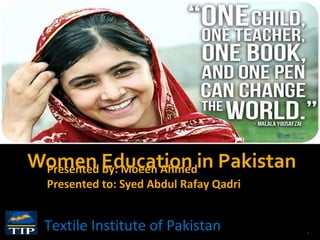
Women Education in PakistanPresented by: Moeen Ahmed
Presented to: Syed Abdul Rafay Qadri
1
Textile Institute of Pakistan
DESCRIPTION
Literacy is among one of the indicators of human development. Education in
Pakistan is a fundamental right of every citizen, according to article thirty-seven of
the Constitution of Pakistan but gender discrepancies still exist in the educational
sector. According to the 2011 Human Development Report of the United Nations
Development Program, approximately twice as many males as females receive a
secondary education in Pakistan but there is a very low literacy rate of women/girls
in Pakistan.
2
Textile Institute of Pakistan
Importance Given to Women Education in
Pakistan
3
Textile Institute of Pakistan
Our Survey
4
Textile Institute of Pakistan
City/town Responses
Karachi 80
Urban Sindh 28
Rural Sindh 31
Rural Balochistan 1
Urban Balochistan No Response
Urban Khberpakhtoonkhwah No Response
5
Textile Institute of Pakistan
Table According to Survey
City/town Responses
Rural Khberpakhtoonkhwah No Response
Islamabad 5
Gilgit Baltistan 2
Azad Kashmir No Response
Urban Punjab No Response
Rural Punjab 5
6
Textile Institute of Pakistan
Table According to Survey
7
Textile Institute of Pakistan
Conclusion
Statistics show that education in Pakistan can be described by
extensive gender inequalities. Girls/women have to face
socio-cultural hurdles to acquire education in a country like
Pakistan. Many people argue that it is not only human and
ethical thing to provide everyone easy access to education
without any gender bias, but it is also essential for
development and progress of a society that both men and
women are educated. Studies and different surveys have
confirmed that gender inequality in education has significant
impact on rural poverty in Pakistan, and female literacy is
important for poverty alleviation.

Women Education In Pakistan

  • 1.
    Women Education inPakistanPresented by: Moeen Ahmed Presented to: Syed Abdul Rafay Qadri 1 Textile Institute of Pakistan
  • 2.
    DESCRIPTION Literacy is amongone of the indicators of human development. Education in Pakistan is a fundamental right of every citizen, according to article thirty-seven of the Constitution of Pakistan but gender discrepancies still exist in the educational sector. According to the 2011 Human Development Report of the United Nations Development Program, approximately twice as many males as females receive a secondary education in Pakistan but there is a very low literacy rate of women/girls in Pakistan. 2 Textile Institute of Pakistan
  • 3.
    Importance Given toWomen Education in Pakistan 3 Textile Institute of Pakistan
  • 4.
  • 5.
    City/town Responses Karachi 80 UrbanSindh 28 Rural Sindh 31 Rural Balochistan 1 Urban Balochistan No Response Urban Khberpakhtoonkhwah No Response 5 Textile Institute of Pakistan Table According to Survey
  • 6.
    City/town Responses Rural KhberpakhtoonkhwahNo Response Islamabad 5 Gilgit Baltistan 2 Azad Kashmir No Response Urban Punjab No Response Rural Punjab 5 6 Textile Institute of Pakistan Table According to Survey
  • 7.
    7 Textile Institute ofPakistan Conclusion Statistics show that education in Pakistan can be described by extensive gender inequalities. Girls/women have to face socio-cultural hurdles to acquire education in a country like Pakistan. Many people argue that it is not only human and ethical thing to provide everyone easy access to education without any gender bias, but it is also essential for development and progress of a society that both men and women are educated. Studies and different surveys have confirmed that gender inequality in education has significant impact on rural poverty in Pakistan, and female literacy is important for poverty alleviation.