Contemporary Feminist Theories
 Feminism Introduction

 Basic Theoretical Questions
 Varieties of Contemporary Feminist Theories
 Gender Differences
 Gender Inequality
 Gender Oppression

 Structural Oppression
 Feminism is a collection of movements and ideologies

aimed at defining, establishing, and defending equal
political, economic, and social rights for women
 Main focus is to establish equal opportunities for

women in education and employment
“Feminist theory is a system of ideas about social life, and
human development from a woman centered perspective”
 Feminist Theory is the extension of feminism into theoretical

discourse.
 A ‘Feminist’ advocates and supports the rights and equality of

women
 It aims to understand the nature of Gender Inequality
 It examines women's Social roles, experience, interests, and

feminist politics in a variety of fields
 Feminist theory is women centered in Three ways:
i.

The major ‘object’ or starting point of all the
investigation is situation and experience of women in
society

ii.

It treats women as the “central Subjects” in the
investigation process, (see the world from the point of
women)

iii.

It is seeking to produce a better world for women .
Feminist theory is different from sociological theory in

two ways:
i.

It’s the work of interdisciplinary community

ii.

Feminist Sociologists work with double agenda (To
broaden and deepen their origin and to develop a
critical understanding of society in order to change

the world)
Contemporary feminist theories addresses such

questions like:
 And what about women?
 Where are the women in any situation which is being

investigated?
 If they are not present, Why?

 How do they experience the situation?
 What do they contribute to it?

 What does it mean to them? (Description of the Social

World)
Secondly,
 Why then is all this as it is? (it requires explanation of

that world)

Description and explanation are

the two faces of any sociological theory.
Third question for all feminists is:
 How can we change and improve the social world so as

to make it a just place for women and for all people?
 Typology is organized around feminism’s most basic

question: “And what about women?”
 Essentially we see the four answers:


Women experience in many situations is different
from men



The women location in most situation is less

privileged than men.


Women are

oppressed, restrained, subordinated, molded, used and
abused by men.


Women’s experience of difference, inequality and

oppression varies according to their locatedness in the
society.


Each of the various theory of feminist is classified into

the theory of : Gender Difference, Gender
Inequality, Gender oppression and structural
Oppression.
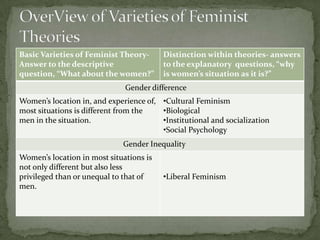
Basic Varieties of Feminist TheoryAnswer to the descriptive
question, “What about the women?”

Distinction within theories- answers
to the explanatory questions, “why
is women’s situation as it is?”

Gender difference
Women’s location in, and experience of, •Cultural Feminism
most situations is different from the
•Biological
men in the situation.
•Institutional and socialization
•Social Psychology
Gender Inequality
Women’s location in most situations is
not only different but also less
privileged than or unequal to that of
men.

•Liberal Feminism
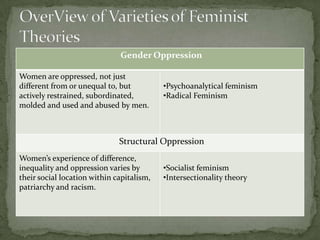
Gender Oppression
Women are oppressed, not just
different from or unequal to, but
actively restrained, subordinated,
molded and used and abused by men.

•Psychoanalytical feminism
•Radical Feminism

Structural Oppression
Women’s experience of difference,
inequality and oppression varies by
their social location within capitalism,
patriarchy and racism.

•Socialist feminism
•Intersectionality theory
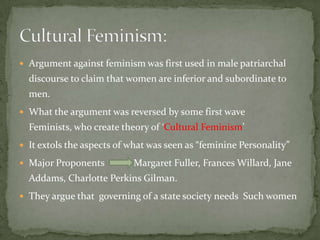
 Argument against feminism was first used in male patriarchal

discourse to claim that women are inferior and subordinate to
men.
 What the argument was reversed by some first wave

Feminists, who create theory of ‘Cultural Feminism’
 It extols the aspects of what was seen as “feminine Personality”
 Major Proponents

Margaret Fuller, Frances Willard, Jane

Addams, Charlotte Perkins Gilman.
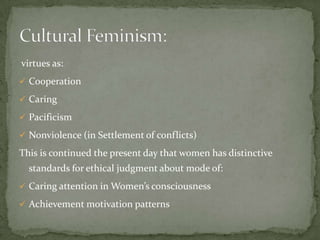
 They argue that governing of a state society needs Such women
virtues as:
 Cooperation
 Caring
 Pacificism
 Nonviolence (in Settlement of conflicts)

This is continued the present day that women has distinctive
standards for ethical judgment about mode of:
 Caring attention in Women’s consciousness
 Achievement motivation patterns
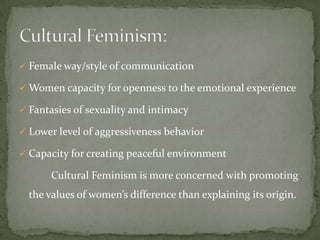
 Female way/style of communication

 Women capacity for openness to the emotional experience
 Fantasies of sexuality and intimacy
 Lower level of aggressiveness behavior
 Capacity for creating peaceful environment

Cultural Feminism is more concerned with promoting

the values of women’s difference than explaining its origin.
 It variously locate the causes of Gender Difference in Biology, in

Institutional roles, in Socialization, and in Social Interactions.
 The major proponent of explanatory theories is “Alice Rossi”
 She has linked different Biological functions of males and

females to different patterns of hormonally determined
development over the life cycle.
 Sex specific variations in such traits as sensitivity to light and

sound.
 Difference in left and right brain connectedness
 Different play pattern in childhood.
 The apparent fact that female are more disposed to care for

infants in nurturing way than men.
Institutional Explanations:
 Gender difference result from the different roles, that men and

women play in various institutional settings.
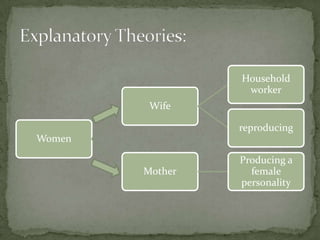
 Major determinant is seen in ‘Sexual Division of Labor’ that links

women with different roles like:
Household
worker
Wife
reproducing
Women
Mother

Producing a
female
personality
Socialization Theories:
 Studies argue that women’s experience of socialization and

institutional roles leads them to distinctive forms of
political activism.(e.g. Environmental justice movement)
 Some emphasize (Static and deterministic model) people’s

active work in reproducing gender in
contextualized, ongoing interactional practices, where
cultural typifications of gender are enacted, performed
experimented with and even transformed.
 These theorists describes people as “doing gender” in all

various interactions of daily life.
 They carry a ‘gendered personality’

Existential and Phenomenological Analyses:
 Developed one of the most enduring(remain in

existence, tolerate) theme of feminist theory:
“The marginalization of women as other in male
created culture”
 The world has been developed by the culture created by the men

and assuming the male as a ‘subject’ and consciousness by which
the world is viewed.
 That pushes women experiences to the very margins of

conceptual framing and its more frightening, creates the
construct of the women as “the other”
 “objectified being” who is assigned traits that represent the

opposite of Subject (male)
 ‘“otherness” is fundamental category of human thought’ that
binary opposition is one of the chief ways and

individual experience other people as a potential
threat to the subject’s consciousness.
 Women difference from men results in part from this

fact of cultural construction which excludes them and
in part from their internalization of otherness.
 Four themes characterizing ‘Gender Inequality’, these are :
 Both genders are situated in society not only differently but also

unequally (e.g. women get less opportunities, material
resources, social status, power and self actualization)
 Inequality results from the organization of society, not from any

significant biological or personality differences between women
and men.
 Although individual human beings may vary somewhat from

each other in profile of potential and traits. But no pattern
of natural variation distinguishes the sexes; all human are

characterized by a deep need of freedom to seek selfactualization.
 All inequality theories assume that both genders respond

fairly, easily and naturally to more egalitarian social structures
and situations. (it is possible to change the situation)
But the theorists of Gender difference present a picture
that what ever the cause of difference but they are more
durable, more penetrative and less easily to change.
Liberal Feminism:
 Major expression of ‘Gender Inequality’ theory is liberal

Feminism.
 All people are created equal and should not be denied equality of

opportunity because of gender.
 Liberal Feminists focus their efforts on social change through the
construction of legislation and regulation of employment
practices.
 Liberal feminism thus, rest on the beliefs that :
 All human beings have certain essential features- capacity for

reason, moral agency and self-actualization.
 The exercise of these capacities can be secured through legal

recognition of universal rights
 The inequalities between men and women are assigned by

‘sex’, are actually social constructions, having no basis in “nature”
 Social change for equality can be produced by an organized

appeal to reasonable public and state.
Contemporary Feminists’, an introduction to the concept of gender
as :“a way of understanding all the socially constructed features

built around an idea of sex identity and used to produce
inequality between persons considered ‘male’ and persons
considered ‘female …”
Contemporary Liberal Feminism’s explanation of Gender
inequality turns on interplay of Four factors and these are:
 The social construction of Gender
 The gendered division of labor
 The doctrine and practice of private and public spheres.
 Patriarchal Ideology

Finally for Liberal Feminists, the ideal gender arrangement is one
in which each individual acting as a free and responsible moral
agent chooses the life style most suitable to her or him, and has
that choice accepted and respected, be it for housewives or

househusbands, unmarried or married, childless or with
children and heterosexual or homosexual.
Gender oppression:
 Describes women’s situations as a result of direct power

relationship between men and women in which men have
fundamental and concrete interest in controlling, using and
oppressing women.
 Domination means in which one party/individual, the

dominant, succeeds in making the other party, the subordinate.
 This pattern o f gender oppression is incorporated in deepest
ways into society’s organization.
 Basic structure of Domination is called “Patriarchy”
 there are two major variants of oppression theory:
i.

Psychoanalytical Feminism

ii.

Radical Feminism

Psychoanalytical Feminism:
 It attempts to explain patriarchy by reformulating the theories of

Freud.
 Emotions often deeply buried in sub conscious and
unconscious areas of the psyche.
 Also highlight the importance of infancy and early

childhood.
 There are two basic themes of psycho-analytic Feminism:



Women, because of intimate involvement with bearing
and rearing new life, are less oppressed than
men, because of their own morality and men adopt a

series of defenses , all of which leads towards their
domination of
women.


Second theme, it centre on two facets of early childhood
development:

i.

Individuation and recognition

ii.

In all societies, infants and children experience their earliest
development in a close intimate relationship with a women- a
mother.



This theory gives us the deepen insight into the understanding

of Gender oppression.
Radical Feminism:
 Male power and privilege is the basis of social relations
 Sexism is the ultimate tool used by men to keep women

oppressed
 Women are the first oppressed group
 Women's oppression is the most widespread & deepest
 Women’s oppression provides a conceptual model for

understanding all other forms of oppression.
 Refusing to reproduce is the most effective way to escape.
 Speak out against all social structures because they are created

by men.
Structural Oppression:
 it states that oppression results from the fact that some group of

people derive direct benefits from controlling, using and
oppressing other groups of people
 It analyze how those interest in domination are enacted through

mechanism of social structure, the arrangements of interactions
are always the arrangements of power.
 We look at two types of structural oppression, and these are :
i.

Socialist Feminism

ii.

Intersectionality Theory

Socialist Feminism:
 They see capitalism rather than patriarchy as being principle

source of women oppression
 Women’s inferior position is the result of class-based capitalism
 Socialist believe that history can be made in the private

sphere (home) not just the public sphere (work)
 Arguments:
 An increased emphasis on the private sphere and the

role of women in the household
 Equal opportunities for women in the public sphere.
Marx & Engels:
 Engels focused that the economic factors are responsible for the

subservience of women.
 According to Engles the dominancy of man in marriage is simply

due to:
 His economic dominancy
 Man owned the means of production (outside the home)
 Man enjoy greater power
 Marx and Engels were actually against Capitalism but according
to them- Capitalism creates the new economic foundations like:
 Demand of female wages labor would increase status and power

of women within the family.
 No dependency on ‘man’ regarding economy
 Gender under Communism states that, there is complete

equality between men and women under capitalism because
‘means of production’ are communally owned
 Sexual inequality would be end

 Gender roles may be disappear

Second Wave Feminism (Gender)

  • 1.
  • 2.
     Feminism Introduction Basic Theoretical Questions  Varieties of Contemporary Feminist Theories  Gender Differences  Gender Inequality  Gender Oppression  Structural Oppression
  • 3.
     Feminism isa collection of movements and ideologies aimed at defining, establishing, and defending equal political, economic, and social rights for women  Main focus is to establish equal opportunities for women in education and employment
  • 4.
    “Feminist theory isa system of ideas about social life, and human development from a woman centered perspective”  Feminist Theory is the extension of feminism into theoretical discourse.  A ‘Feminist’ advocates and supports the rights and equality of women  It aims to understand the nature of Gender Inequality  It examines women's Social roles, experience, interests, and feminist politics in a variety of fields
  • 5.
     Feminist theoryis women centered in Three ways: i. The major ‘object’ or starting point of all the investigation is situation and experience of women in society ii. It treats women as the “central Subjects” in the investigation process, (see the world from the point of women) iii. It is seeking to produce a better world for women .
  • 6.
    Feminist theory isdifferent from sociological theory in two ways: i. It’s the work of interdisciplinary community ii. Feminist Sociologists work with double agenda (To broaden and deepen their origin and to develop a critical understanding of society in order to change the world)
  • 7.
    Contemporary feminist theoriesaddresses such questions like:  And what about women?  Where are the women in any situation which is being investigated?  If they are not present, Why?  How do they experience the situation?
  • 8.
     What dothey contribute to it?  What does it mean to them? (Description of the Social World) Secondly,  Why then is all this as it is? (it requires explanation of that world) Description and explanation are the two faces of any sociological theory.
  • 9.
    Third question forall feminists is:  How can we change and improve the social world so as to make it a just place for women and for all people?
  • 10.
     Typology isorganized around feminism’s most basic question: “And what about women?”  Essentially we see the four answers:  Women experience in many situations is different from men  The women location in most situation is less privileged than men.
  • 11.
     Women are oppressed, restrained,subordinated, molded, used and abused by men.  Women’s experience of difference, inequality and oppression varies according to their locatedness in the society.  Each of the various theory of feminist is classified into the theory of : Gender Difference, Gender Inequality, Gender oppression and structural Oppression.
  • 12.
    Basic Varieties ofFeminist TheoryAnswer to the descriptive question, “What about the women?” Distinction within theories- answers to the explanatory questions, “why is women’s situation as it is?” Gender difference Women’s location in, and experience of, •Cultural Feminism most situations is different from the •Biological men in the situation. •Institutional and socialization •Social Psychology Gender Inequality Women’s location in most situations is not only different but also less privileged than or unequal to that of men. •Liberal Feminism
  • 13.
    Gender Oppression Women areoppressed, not just different from or unequal to, but actively restrained, subordinated, molded and used and abused by men. •Psychoanalytical feminism •Radical Feminism Structural Oppression Women’s experience of difference, inequality and oppression varies by their social location within capitalism, patriarchy and racism. •Socialist feminism •Intersectionality theory
  • 14.
     Argument againstfeminism was first used in male patriarchal discourse to claim that women are inferior and subordinate to men.  What the argument was reversed by some first wave Feminists, who create theory of ‘Cultural Feminism’  It extols the aspects of what was seen as “feminine Personality”  Major Proponents Margaret Fuller, Frances Willard, Jane Addams, Charlotte Perkins Gilman.  They argue that governing of a state society needs Such women
  • 15.
    virtues as:  Cooperation Caring  Pacificism  Nonviolence (in Settlement of conflicts) This is continued the present day that women has distinctive standards for ethical judgment about mode of:  Caring attention in Women’s consciousness  Achievement motivation patterns
  • 16.
     Female way/styleof communication  Women capacity for openness to the emotional experience  Fantasies of sexuality and intimacy  Lower level of aggressiveness behavior  Capacity for creating peaceful environment Cultural Feminism is more concerned with promoting the values of women’s difference than explaining its origin.
  • 17.
     It variouslylocate the causes of Gender Difference in Biology, in Institutional roles, in Socialization, and in Social Interactions.  The major proponent of explanatory theories is “Alice Rossi”  She has linked different Biological functions of males and females to different patterns of hormonally determined development over the life cycle.  Sex specific variations in such traits as sensitivity to light and sound.
  • 18.
     Difference inleft and right brain connectedness  Different play pattern in childhood.  The apparent fact that female are more disposed to care for infants in nurturing way than men. Institutional Explanations:  Gender difference result from the different roles, that men and women play in various institutional settings.  Major determinant is seen in ‘Sexual Division of Labor’ that links women with different roles like:
  • 19.
  • 20.
    Socialization Theories:  Studiesargue that women’s experience of socialization and institutional roles leads them to distinctive forms of political activism.(e.g. Environmental justice movement)  Some emphasize (Static and deterministic model) people’s active work in reproducing gender in contextualized, ongoing interactional practices, where cultural typifications of gender are enacted, performed experimented with and even transformed.
  • 21.
     These theoristsdescribes people as “doing gender” in all various interactions of daily life.  They carry a ‘gendered personality’ Existential and Phenomenological Analyses:  Developed one of the most enduring(remain in existence, tolerate) theme of feminist theory: “The marginalization of women as other in male created culture”
  • 22.
     The worldhas been developed by the culture created by the men and assuming the male as a ‘subject’ and consciousness by which the world is viewed.  That pushes women experiences to the very margins of conceptual framing and its more frightening, creates the construct of the women as “the other”  “objectified being” who is assigned traits that represent the opposite of Subject (male)  ‘“otherness” is fundamental category of human thought’ that
  • 23.
    binary opposition isone of the chief ways and individual experience other people as a potential threat to the subject’s consciousness.  Women difference from men results in part from this fact of cultural construction which excludes them and in part from their internalization of otherness.
  • 24.
     Four themescharacterizing ‘Gender Inequality’, these are :  Both genders are situated in society not only differently but also unequally (e.g. women get less opportunities, material resources, social status, power and self actualization)  Inequality results from the organization of society, not from any significant biological or personality differences between women and men.  Although individual human beings may vary somewhat from each other in profile of potential and traits. But no pattern
  • 25.
    of natural variationdistinguishes the sexes; all human are characterized by a deep need of freedom to seek selfactualization.  All inequality theories assume that both genders respond fairly, easily and naturally to more egalitarian social structures and situations. (it is possible to change the situation) But the theorists of Gender difference present a picture
  • 26.
    that what everthe cause of difference but they are more durable, more penetrative and less easily to change. Liberal Feminism:  Major expression of ‘Gender Inequality’ theory is liberal Feminism.  All people are created equal and should not be denied equality of opportunity because of gender.  Liberal Feminists focus their efforts on social change through the
  • 27.
    construction of legislationand regulation of employment practices.  Liberal feminism thus, rest on the beliefs that :  All human beings have certain essential features- capacity for reason, moral agency and self-actualization.  The exercise of these capacities can be secured through legal recognition of universal rights  The inequalities between men and women are assigned by ‘sex’, are actually social constructions, having no basis in “nature”
  • 28.
     Social changefor equality can be produced by an organized appeal to reasonable public and state. Contemporary Feminists’, an introduction to the concept of gender as :“a way of understanding all the socially constructed features built around an idea of sex identity and used to produce inequality between persons considered ‘male’ and persons considered ‘female …” Contemporary Liberal Feminism’s explanation of Gender inequality turns on interplay of Four factors and these are:
  • 29.
     The socialconstruction of Gender  The gendered division of labor  The doctrine and practice of private and public spheres.  Patriarchal Ideology Finally for Liberal Feminists, the ideal gender arrangement is one in which each individual acting as a free and responsible moral agent chooses the life style most suitable to her or him, and has that choice accepted and respected, be it for housewives or househusbands, unmarried or married, childless or with
  • 30.
    children and heterosexualor homosexual. Gender oppression:  Describes women’s situations as a result of direct power relationship between men and women in which men have fundamental and concrete interest in controlling, using and oppressing women.  Domination means in which one party/individual, the dominant, succeeds in making the other party, the subordinate.  This pattern o f gender oppression is incorporated in deepest
  • 31.
    ways into society’sorganization.  Basic structure of Domination is called “Patriarchy”  there are two major variants of oppression theory: i. Psychoanalytical Feminism ii. Radical Feminism Psychoanalytical Feminism:  It attempts to explain patriarchy by reformulating the theories of Freud.  Emotions often deeply buried in sub conscious and
  • 32.
    unconscious areas ofthe psyche.  Also highlight the importance of infancy and early childhood.  There are two basic themes of psycho-analytic Feminism:  Women, because of intimate involvement with bearing and rearing new life, are less oppressed than men, because of their own morality and men adopt a series of defenses , all of which leads towards their domination of
  • 33.
    women.  Second theme, itcentre on two facets of early childhood development: i. Individuation and recognition ii. In all societies, infants and children experience their earliest development in a close intimate relationship with a women- a mother.  This theory gives us the deepen insight into the understanding of Gender oppression.
  • 34.
    Radical Feminism:  Malepower and privilege is the basis of social relations  Sexism is the ultimate tool used by men to keep women oppressed  Women are the first oppressed group  Women's oppression is the most widespread & deepest  Women’s oppression provides a conceptual model for understanding all other forms of oppression.
  • 35.
     Refusing toreproduce is the most effective way to escape.  Speak out against all social structures because they are created by men. Structural Oppression:  it states that oppression results from the fact that some group of people derive direct benefits from controlling, using and oppressing other groups of people  It analyze how those interest in domination are enacted through mechanism of social structure, the arrangements of interactions
  • 36.
    are always thearrangements of power.  We look at two types of structural oppression, and these are : i. Socialist Feminism ii. Intersectionality Theory Socialist Feminism:  They see capitalism rather than patriarchy as being principle source of women oppression  Women’s inferior position is the result of class-based capitalism
  • 37.
     Socialist believethat history can be made in the private sphere (home) not just the public sphere (work)  Arguments:  An increased emphasis on the private sphere and the role of women in the household  Equal opportunities for women in the public sphere.
  • 38.
    Marx & Engels: Engels focused that the economic factors are responsible for the subservience of women.  According to Engles the dominancy of man in marriage is simply due to:  His economic dominancy  Man owned the means of production (outside the home)  Man enjoy greater power  Marx and Engels were actually against Capitalism but according
  • 39.
    to them- Capitalismcreates the new economic foundations like:  Demand of female wages labor would increase status and power of women within the family.  No dependency on ‘man’ regarding economy  Gender under Communism states that, there is complete equality between men and women under capitalism because ‘means of production’ are communally owned  Sexual inequality would be end  Gender roles may be disappear