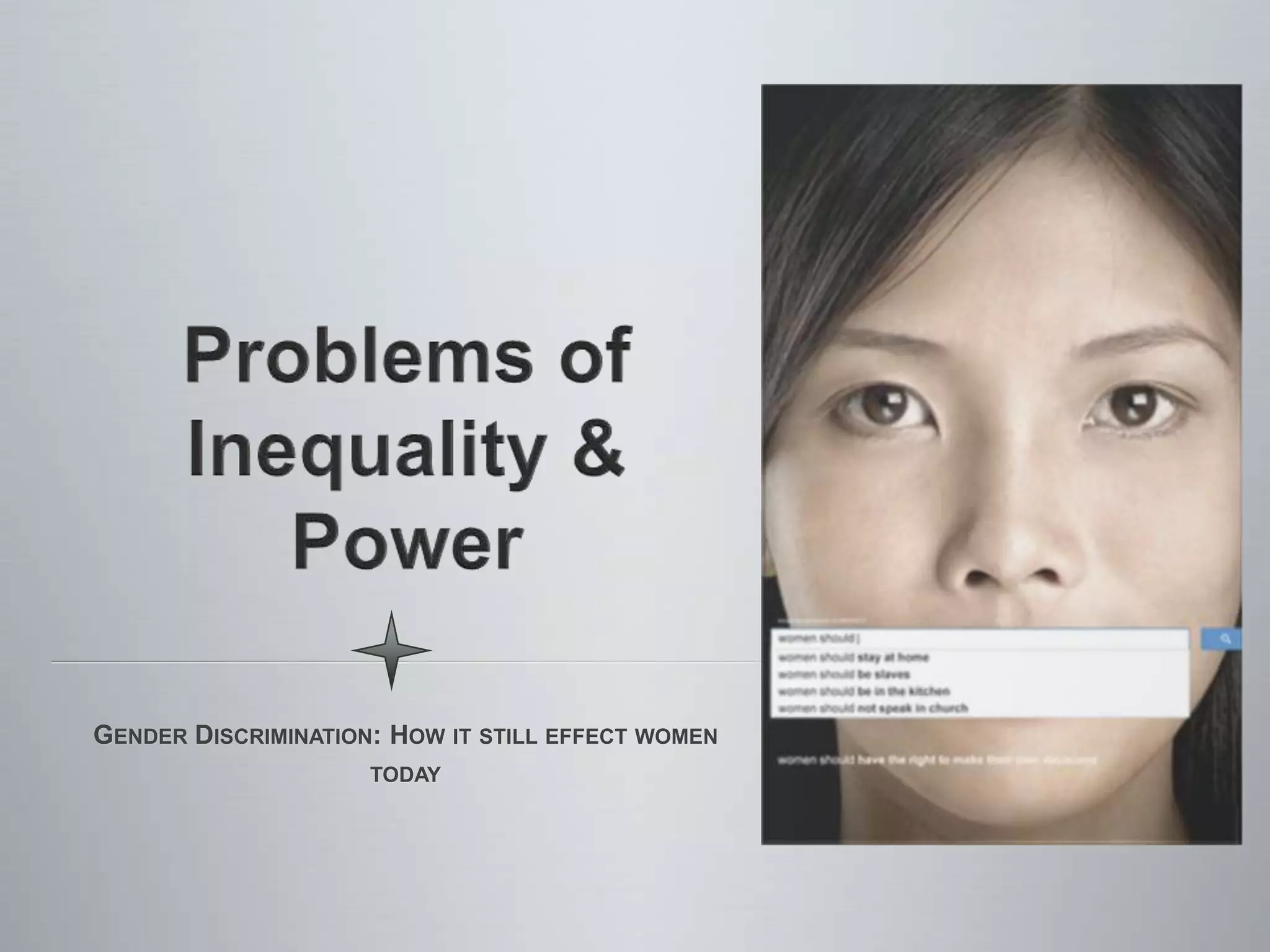
GENDER DISCRIMINATION: HOW IT STILL EFFECT WOMEN
TODAY
Prejudice or discrimination based on a person’s sex
or gender. It does effect both men and women, but
especially women. Some may believe that one sex or
gender is superior to another.
GENDER DISCRIMINATION COMMONLY FOUND:
I. Education
II. Work
III. Income
IV. Cultural
 IN 2012, 73.2% OF POST-SECONDARY GRADUATES WERE
WOMEN, WITH 65.1% OF MEN GRADUATING.
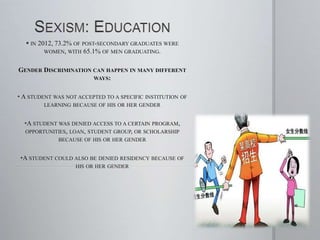
GENDER DISCRIMINATION CAN HAPPEN IN MANY DIFFERENT
WAYS:
• A STUDENT WAS NOT ACCEPTED TO A SPECIFIC INSTITUTION OF
LEARNING BECAUSE OF HIS OR HER GENDER
•A STUDENT WAS DENIED ACCESS TO A CERTAIN PROGRAM,
OPPORTUNITIES, LOAN, STUDENT GROUP, OR SCHOLARSHIP
BECAUSE OF HIS OR HER GENDER
•A STUDENT COULD ALSO BE DENIED RESIDENCY BECAUSE OF
HIS OR HER GENDER
There are three types of gender discrimination in
education
I. Direct gender discrimination
II. Indirect gender discrimination
III. Harassment
I. Direct gender discrimination:
Both male and female school attempts to maintain a gender balance in
the school by accepting one gender and not another gender when spots
are limited.
II. When a condition or requirement of accepting either gender into the
course or institution applies equally to both genders applicants but a lot
fewer members of one gender would be able to comply with it.
III. Harassment
Unwanted conduct of a sexual nature which violets your dignity or
creates an intimidating, hostile, degrading, humiliating or offensive
environment for you or;
Unwanted conduct on the grounds of your sex which has the same
effect. This does not have to be sexual in nature and could include, for
example, being bullied, if you feel that harasser would not treat
somebody of the opposite sex in this way.
• It is against the law for a governing body of an institution of further or
higher education to subject you to harassment if you are a student at
that institution or have applied to that institution.
• This would also apply to you if you were being harassed by an
employee of your college, as the college would be liable for the
harasser’s act.
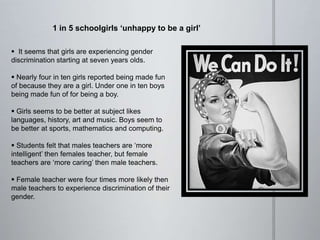
1 in 5 schoolgirls ‘unhappy to be a girl’
 It seems that girls are experiencing gender
discrimination starting at seven years olds.
 Nearly four in ten girls reported being made fun
of because they are a girl. Under one in ten boys
being made fun of for being a boy.
 Girls seems to be better at subject likes
languages, history, art and music. Boys seem to
be better at sports, mathematics and computing.
 Students felt that males teachers are ‘more
intelligent’ then females teacher, but female
teachers are ‘more caring’ then male teachers.
 Female teacher were four times more likely then
male teachers to experience discrimination of their
gender.
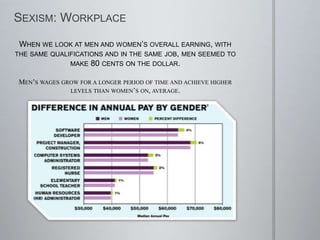
SEXISM: WORKPLACE
WHEN WE LOOK AT MEN AND WOMEN’S OVERALL EARNING, WITH
THE SAME QUALIFICATIONS AND IN THE SAME JOB, MEN SEEMED TO
MAKE 80 CENTS ON THE DOLLAR.
MEN’S WAGES GROW FOR A LONGER PERIOD OF TIME AND ACHIEVE HIGHER
LEVELS THAN WOMEN’S ON, AVERAGE.
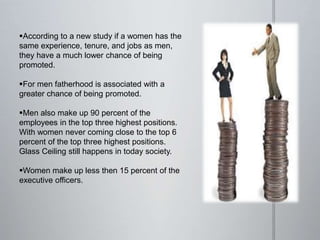
According to a new study if a women has the
same experience, tenure, and jobs as men,
they have a much lower chance of being
promoted.
For men fatherhood is associated with a
greater chance of being promoted.
Men also make up 90 percent of the
employees in the top three highest positions.
With women never coming close to the top 6
percent of the top three highest positions.
Glass Ceiling still happens in today society.
Women make up less then 15 percent of the
executive officers.
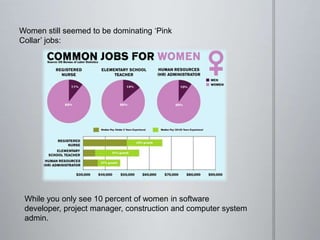
Women still seemed to be dominating ‘Pink
Collar’ jobs:
While you only see 10 percent of women in software
developer, project manager, construction and computer system
admin.
Other ways gender discrimination can
happen or be see in the work place:
 An employer did not hire a employee
because of their gender
An employee was wrongfully terminated
because of their gender
Discriminatory question are asked at a job
interview
Sexual harassment also falls under gender
and sex discrimination. Most victims are
women.
Sexual harassment:
10 percent of women between the ages of 25 to 45 years old
experienced sexual harassment at the same rate as women
aged 18 to 24 years old. 39 percent of reported cases were
involving a manager or supervisor.
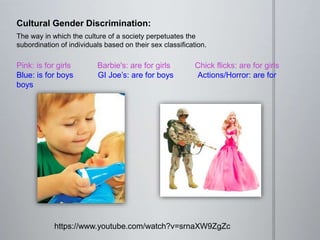
Cultural Gender Discrimination:
The way in which the culture of a society perpetuates the
subordination of individuals based on their sex classification.
Pink: is for girls Barbie's: are for girls Chick flicks: are for girls
Blue: is for boys GI Joe’s: are for boys Actions/Horror: are for
boys
https://www.youtube.com/watch?v=srnaXW9ZgZc
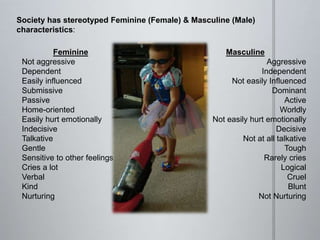
Society has stereotyped Feminine (Female) & Masculine (Male)
characteristics:
Feminine
Not aggressive
Dependent
Easily influenced
Submissive
Passive
Home-oriented
Easily hurt emotionally
Indecisive
Talkative
Gentle
Sensitive to other feelings
Cries a lot
Verbal
Kind
Nurturing
Masculine
Aggressive
Independent
Not easily Influenced
Dominant
Active
Worldly
Not easily hurt emotionally
Decisive
Not at all talkative
Tough
Rarely cries
Logical
Cruel
Blunt
Not Nurturing
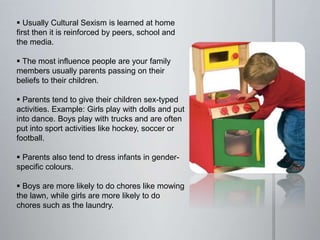
 Usually Cultural Sexism is learned at home
first then it is reinforced by peers, school and
the media.
 The most influence people are your family
members usually parents passing on their
beliefs to their children.
 Parents tend to give their children sex-typed
activities. Example: Girls play with dolls and put
into dance. Boys play with trucks and are often
put into sport activities like hockey, soccer or
football.
 Parents also tend to dress infants in gender-
specific colours.
 Boys are more likely to do chores like mowing
the lawn, while girls are more likely to do
chores such as the laundry.
Top ten countries with the least gender equality, least to
most:
• Yemen
• Chad
• Pakistan
• Saudi Arabia
• Turkey
• Iran
• Qatar
• Oman
• Morocco
• Ethiopia
Top ten countries with the most gender quality, from most to
least
• Finland
• Iceland
• Norway
• Sweden
• South Africa
• Denmark
• Ireland
• The Netherlands
• Germany
• Latvia
References:
Gender Discrimination Overview | Lawfirms.com. (n.d.). Retrieved April 2, 2015, from
http://www.lawfirms.com/resources/civil-rights/discrimination-law/gender-discrimination-
overview.htm
Learning - Educational Attainment. (n.d.). Retrieved April 3, 2015, from
http://www4.hrsdc.gc.ca/.3ndic.1t.4r@-eng.jsp?iid=29
Do Men Really Earn More Than Women? - Infographic - PayScale. (n.d.). Retrieved
April 3, 2015, from http://www.payscale.com/gender-lifetime-earnings-gap
Covert, B. (2014, December 22). Women With The Same Qualifications As Men Get
Passed Over For Promotion. Retrieved April 5, 2015, from
http://thinkprogress.org/economy/2014/12/22/3606282/women-promotions/
Sexual Harassment in the Workplace: Canadian Labour Relations. (n.d.). Retrieved
April 5, 2015, from http://www.canadianlabourrelations.com/sexual-harassment-in-the-
workplace.html
Sex discrimination in education. (2009, July 1). Retrieved April 6, 2015, from
http://www.equalityhumanrights.com/your-rights/equal-rights/gender/sex-discrimination-
in-education
Gender Discrimination. (n.d.). Retrieved April 6, 2015, from
http://www.campaignforeducation.org/en/campaigns/girls-education/gender-
discrimination

Gender Discrimination

  • 1.
    GENDER DISCRIMINATION: HOWIT STILL EFFECT WOMEN TODAY
  • 2.
    Prejudice or discriminationbased on a person’s sex or gender. It does effect both men and women, but especially women. Some may believe that one sex or gender is superior to another. GENDER DISCRIMINATION COMMONLY FOUND: I. Education II. Work III. Income IV. Cultural
  • 3.
     IN 2012,73.2% OF POST-SECONDARY GRADUATES WERE WOMEN, WITH 65.1% OF MEN GRADUATING. GENDER DISCRIMINATION CAN HAPPEN IN MANY DIFFERENT WAYS: • A STUDENT WAS NOT ACCEPTED TO A SPECIFIC INSTITUTION OF LEARNING BECAUSE OF HIS OR HER GENDER •A STUDENT WAS DENIED ACCESS TO A CERTAIN PROGRAM, OPPORTUNITIES, LOAN, STUDENT GROUP, OR SCHOLARSHIP BECAUSE OF HIS OR HER GENDER •A STUDENT COULD ALSO BE DENIED RESIDENCY BECAUSE OF HIS OR HER GENDER
  • 4.
    There are threetypes of gender discrimination in education I. Direct gender discrimination II. Indirect gender discrimination III. Harassment I. Direct gender discrimination: Both male and female school attempts to maintain a gender balance in the school by accepting one gender and not another gender when spots are limited. II. When a condition or requirement of accepting either gender into the course or institution applies equally to both genders applicants but a lot fewer members of one gender would be able to comply with it.
  • 5.
    III. Harassment Unwanted conductof a sexual nature which violets your dignity or creates an intimidating, hostile, degrading, humiliating or offensive environment for you or; Unwanted conduct on the grounds of your sex which has the same effect. This does not have to be sexual in nature and could include, for example, being bullied, if you feel that harasser would not treat somebody of the opposite sex in this way. • It is against the law for a governing body of an institution of further or higher education to subject you to harassment if you are a student at that institution or have applied to that institution. • This would also apply to you if you were being harassed by an employee of your college, as the college would be liable for the harasser’s act.
  • 6.
    1 in 5schoolgirls ‘unhappy to be a girl’  It seems that girls are experiencing gender discrimination starting at seven years olds.  Nearly four in ten girls reported being made fun of because they are a girl. Under one in ten boys being made fun of for being a boy.  Girls seems to be better at subject likes languages, history, art and music. Boys seem to be better at sports, mathematics and computing.  Students felt that males teachers are ‘more intelligent’ then females teacher, but female teachers are ‘more caring’ then male teachers.  Female teacher were four times more likely then male teachers to experience discrimination of their gender.
  • 7.
    SEXISM: WORKPLACE WHEN WELOOK AT MEN AND WOMEN’S OVERALL EARNING, WITH THE SAME QUALIFICATIONS AND IN THE SAME JOB, MEN SEEMED TO MAKE 80 CENTS ON THE DOLLAR. MEN’S WAGES GROW FOR A LONGER PERIOD OF TIME AND ACHIEVE HIGHER LEVELS THAN WOMEN’S ON, AVERAGE.
  • 8.
    According to anew study if a women has the same experience, tenure, and jobs as men, they have a much lower chance of being promoted. For men fatherhood is associated with a greater chance of being promoted. Men also make up 90 percent of the employees in the top three highest positions. With women never coming close to the top 6 percent of the top three highest positions. Glass Ceiling still happens in today society. Women make up less then 15 percent of the executive officers.
  • 9.
    Women still seemedto be dominating ‘Pink Collar’ jobs: While you only see 10 percent of women in software developer, project manager, construction and computer system admin.
  • 10.
    Other ways genderdiscrimination can happen or be see in the work place:  An employer did not hire a employee because of their gender An employee was wrongfully terminated because of their gender Discriminatory question are asked at a job interview Sexual harassment also falls under gender and sex discrimination. Most victims are women. Sexual harassment: 10 percent of women between the ages of 25 to 45 years old experienced sexual harassment at the same rate as women aged 18 to 24 years old. 39 percent of reported cases were involving a manager or supervisor.
  • 11.
    Cultural Gender Discrimination: Theway in which the culture of a society perpetuates the subordination of individuals based on their sex classification. Pink: is for girls Barbie's: are for girls Chick flicks: are for girls Blue: is for boys GI Joe’s: are for boys Actions/Horror: are for boys https://www.youtube.com/watch?v=srnaXW9ZgZc
  • 12.
    Society has stereotypedFeminine (Female) & Masculine (Male) characteristics: Feminine Not aggressive Dependent Easily influenced Submissive Passive Home-oriented Easily hurt emotionally Indecisive Talkative Gentle Sensitive to other feelings Cries a lot Verbal Kind Nurturing Masculine Aggressive Independent Not easily Influenced Dominant Active Worldly Not easily hurt emotionally Decisive Not at all talkative Tough Rarely cries Logical Cruel Blunt Not Nurturing
  • 13.
     Usually CulturalSexism is learned at home first then it is reinforced by peers, school and the media.  The most influence people are your family members usually parents passing on their beliefs to their children.  Parents tend to give their children sex-typed activities. Example: Girls play with dolls and put into dance. Boys play with trucks and are often put into sport activities like hockey, soccer or football.  Parents also tend to dress infants in gender- specific colours.  Boys are more likely to do chores like mowing the lawn, while girls are more likely to do chores such as the laundry.
  • 14.
    Top ten countrieswith the least gender equality, least to most: • Yemen • Chad • Pakistan • Saudi Arabia • Turkey • Iran • Qatar • Oman • Morocco • Ethiopia Top ten countries with the most gender quality, from most to least • Finland • Iceland • Norway • Sweden • South Africa • Denmark • Ireland • The Netherlands • Germany • Latvia
  • 15.
    References: Gender Discrimination Overview| Lawfirms.com. (n.d.). Retrieved April 2, 2015, from http://www.lawfirms.com/resources/civil-rights/discrimination-law/gender-discrimination- overview.htm Learning - Educational Attainment. (n.d.). Retrieved April 3, 2015, from http://www4.hrsdc.gc.ca/.3ndic.1t.4r@-eng.jsp?iid=29 Do Men Really Earn More Than Women? - Infographic - PayScale. (n.d.). Retrieved April 3, 2015, from http://www.payscale.com/gender-lifetime-earnings-gap Covert, B. (2014, December 22). Women With The Same Qualifications As Men Get Passed Over For Promotion. Retrieved April 5, 2015, from http://thinkprogress.org/economy/2014/12/22/3606282/women-promotions/ Sexual Harassment in the Workplace: Canadian Labour Relations. (n.d.). Retrieved April 5, 2015, from http://www.canadianlabourrelations.com/sexual-harassment-in-the- workplace.html Sex discrimination in education. (2009, July 1). Retrieved April 6, 2015, from http://www.equalityhumanrights.com/your-rights/equal-rights/gender/sex-discrimination- in-education Gender Discrimination. (n.d.). Retrieved April 6, 2015, from http://www.campaignforeducation.org/en/campaigns/girls-education/gender- discrimination