Gender Parity
Parity means the state or condition of
being equal.
MODULE 5 - LESSON 3
GENDER AND SOCIETY
Gender Parity
It means that the same proportion of girls and
boys enter and complete schooling. When
there is no gender parity, there is a gap, and a
greater proportion of either boys or girls are
receiving education.
MODULE 5 - LESSON 3
GENDER AND SOCIETY
Education is a fundamental human right
– one that all individuals are entitled to enjoy
whatever the circumstances in which they live
– that also brings important benefits to
human society as a whole
MODULE 5 - LESSON 3
GENDER AND SOCIETY
Education
Education can help to overcome constraints on capabilities
partly through developing the knowledge, understanding, and
skills that all girls and boys, women and men need in order to
achieve what they value for their lives. This means ensuring an
education system which allows all individuals, irrespective of
gender, to develop their capabilities and freedoms. Some
aspects of this equality are the freedom to attend school, to
learn and participate there in safety and security, to develop
identities that tolerate others, and to enjoy a range of
economic, political, and cultural opportunities and valued
outcomes.
For all countries, whatever their stage
of development, view education as a
cornerstone of economic
development. An educated citizenry is
also a key to social and political
stability within and between nations.
Education
MODULE 5 - LESSON 3
GENDER AND SOCIETY
“Education is the most powerful
weapon to change the world”
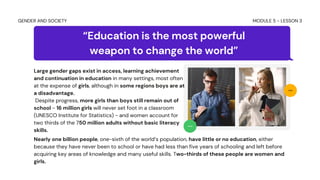
Large gender gaps exist in access, learning achievement
and continuation in education in many settings, most often
at the expense of girls, although in some regions boys are at
a disadvantage.
Despite progress, more girls than boys still remain out of
school - 16 million girls will never set foot in a classroom
(UNESCO Institute for Statistics) - and women account for
two thirds of the 750 million adults without basic literacy
skills.
Tomas
Chloe
Nearly one billion people, one-sixth of the world’s population, have little or no education, either
because they have never been to school or have had less than five years of schooling and left before
acquiring key areas of knowledge and many useful skills. Two-thirds of these people are women and
girls.
MODULE 5 - LESSON 3
GENDER AND SOCIETY
Poverty, geographical isolation, minority status, disability, early marriage and
pregnancy, gender-based violence, and traditional attitudes about the status and
role of women, are among the many obstacles that stand in the way of women
and girls fully exercising their right to participate in, complete and benefit from
education.
Concern with parity may also be linked with a focus on other tangible and
quantifiable factors such as the number of classrooms and toilets, numbers of
textbooks and supplies of materials, and measurement of learning in terms of
exam results. In places where there have been long periods of war, routinized
violence, discrimination, exploitation, exclusion, and a range of different forms
of poverty, achieving parity might be a substantive achievement of social justice,
but parity on its own is a rather limited aspiration.
Reasons Why?
MODULE 5 - LESSON 3
GENDER AND SOCIETY
In many countries girls are often expelled when they
become pregnant, gender-based violence is inadequately
tackled, and schools are ill-equipped to deal with the
education of children in families affected by AIDS
For Girls
MODULE 5 - LESSON 3
GENDER AND SOCIETY
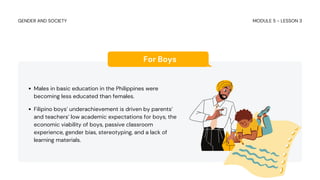
Males in basic education in the Philippines were
becoming less educated than females.
Filipino boys’ underachievement is driven by parents’
and teachers’ low academic expectations for boys, the
economic viability of boys, passive classroom
experience, gender bias, stereotyping, and a lack of
learning materials.
For Boys
MODULE 5 - LESSON 3
GENDER AND SOCIETY
In 2014, the Philippines’ fifth progress report on
the MDGs stated that “education indicators
continue to lean towards girls as basic
education data show that girls nearly surpass
boys in formal basic education”.
Similar findings were reported in the Philippines’
EFA 2015 review report which said that “for SY
2012-2013, girls outperformed boys in all
education efficiency indicators. Girls have also
been outperforming boys in terms of the
National Achievement Test (NAT) scores”
Comparative data consistently showing girls
doing better than boys on various education
indicators led the Philippine Commission on
Women (2014) to call on the education sector to
address the underperformance of boys in key
education indicators as a priority gender issue.
1
2
3
Get Owned BOYSZ!
MODULE 5 - LESSON 3
GENDER AND SOCIETY
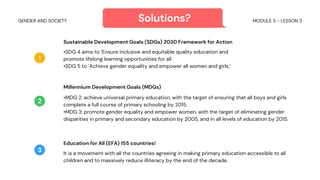
Sustainable Development Goals (SDGs) 2030 Framework for Action
•SDG 4 aims to ‘Ensure inclusive and equitable quality education and
promote lifelong learning opportunities for all
•SDG 5 to ‘Achieve gender equality and empower all women and girls.’
Millennium Development Goals (MDGs)
•MDG 2: achieve universal primary education, with the target of ensuring that all boys and girls
complete a full course of primary schooling by 2015.
•MDG 3: promote gender equality and empower women, with the target of eliminating gender
disparities in primary and secondary education by 2005, and in all levels of education by 2015.
1
2
Solutions?
Education for All (EFA) 155 countries!
It is a movement with all the countries agreeing in making primary education accessible to all
children and to massively reduce illiteracy by the end of the decade.
3
MODULE 5 - LESSON 3
GENDER AND SOCIETY
GENDER AND EDUCATION

GENDER AND EDUCATION

  • 1.
    Gender Parity Parity meansthe state or condition of being equal. MODULE 5 - LESSON 3 GENDER AND SOCIETY
  • 2.
    Gender Parity It meansthat the same proportion of girls and boys enter and complete schooling. When there is no gender parity, there is a gap, and a greater proportion of either boys or girls are receiving education. MODULE 5 - LESSON 3 GENDER AND SOCIETY
  • 3.
    Education is afundamental human right – one that all individuals are entitled to enjoy whatever the circumstances in which they live – that also brings important benefits to human society as a whole MODULE 5 - LESSON 3 GENDER AND SOCIETY
  • 4.
    Education Education can helpto overcome constraints on capabilities partly through developing the knowledge, understanding, and skills that all girls and boys, women and men need in order to achieve what they value for their lives. This means ensuring an education system which allows all individuals, irrespective of gender, to develop their capabilities and freedoms. Some aspects of this equality are the freedom to attend school, to learn and participate there in safety and security, to develop identities that tolerate others, and to enjoy a range of economic, political, and cultural opportunities and valued outcomes.
  • 5.
    For all countries,whatever their stage of development, view education as a cornerstone of economic development. An educated citizenry is also a key to social and political stability within and between nations. Education MODULE 5 - LESSON 3 GENDER AND SOCIETY
  • 6.
    “Education is themost powerful weapon to change the world” Large gender gaps exist in access, learning achievement and continuation in education in many settings, most often at the expense of girls, although in some regions boys are at a disadvantage. Despite progress, more girls than boys still remain out of school - 16 million girls will never set foot in a classroom (UNESCO Institute for Statistics) - and women account for two thirds of the 750 million adults without basic literacy skills. Tomas Chloe Nearly one billion people, one-sixth of the world’s population, have little or no education, either because they have never been to school or have had less than five years of schooling and left before acquiring key areas of knowledge and many useful skills. Two-thirds of these people are women and girls. MODULE 5 - LESSON 3 GENDER AND SOCIETY
  • 7.
    Poverty, geographical isolation,minority status, disability, early marriage and pregnancy, gender-based violence, and traditional attitudes about the status and role of women, are among the many obstacles that stand in the way of women and girls fully exercising their right to participate in, complete and benefit from education. Concern with parity may also be linked with a focus on other tangible and quantifiable factors such as the number of classrooms and toilets, numbers of textbooks and supplies of materials, and measurement of learning in terms of exam results. In places where there have been long periods of war, routinized violence, discrimination, exploitation, exclusion, and a range of different forms of poverty, achieving parity might be a substantive achievement of social justice, but parity on its own is a rather limited aspiration. Reasons Why? MODULE 5 - LESSON 3 GENDER AND SOCIETY
  • 8.
    In many countriesgirls are often expelled when they become pregnant, gender-based violence is inadequately tackled, and schools are ill-equipped to deal with the education of children in families affected by AIDS For Girls MODULE 5 - LESSON 3 GENDER AND SOCIETY
  • 9.
    Males in basiceducation in the Philippines were becoming less educated than females. Filipino boys’ underachievement is driven by parents’ and teachers’ low academic expectations for boys, the economic viability of boys, passive classroom experience, gender bias, stereotyping, and a lack of learning materials. For Boys MODULE 5 - LESSON 3 GENDER AND SOCIETY
  • 10.
    In 2014, thePhilippines’ fifth progress report on the MDGs stated that “education indicators continue to lean towards girls as basic education data show that girls nearly surpass boys in formal basic education”. Similar findings were reported in the Philippines’ EFA 2015 review report which said that “for SY 2012-2013, girls outperformed boys in all education efficiency indicators. Girls have also been outperforming boys in terms of the National Achievement Test (NAT) scores” Comparative data consistently showing girls doing better than boys on various education indicators led the Philippine Commission on Women (2014) to call on the education sector to address the underperformance of boys in key education indicators as a priority gender issue. 1 2 3 Get Owned BOYSZ! MODULE 5 - LESSON 3 GENDER AND SOCIETY
  • 11.
    Sustainable Development Goals(SDGs) 2030 Framework for Action •SDG 4 aims to ‘Ensure inclusive and equitable quality education and promote lifelong learning opportunities for all •SDG 5 to ‘Achieve gender equality and empower all women and girls.’ Millennium Development Goals (MDGs) •MDG 2: achieve universal primary education, with the target of ensuring that all boys and girls complete a full course of primary schooling by 2015. •MDG 3: promote gender equality and empower women, with the target of eliminating gender disparities in primary and secondary education by 2005, and in all levels of education by 2015. 1 2 Solutions? Education for All (EFA) 155 countries! It is a movement with all the countries agreeing in making primary education accessible to all children and to massively reduce illiteracy by the end of the decade. 3 MODULE 5 - LESSON 3 GENDER AND SOCIETY