PREPARATION AND CHARACTERIZATION OF
WITHANIA SOMNIFERA-PHOSPHOLIPID
COMPLEXES
GUIDE-
Ms. URMI CHAURASIA
PROJECT SUPERVISOR
Dr. A.K DWIVEDI
CHIEF SCIENTIST
DIV. OF PHARMACEUTICS
CSIR-CDRI
PRESENTED BY-
ISHA BHARDWAJ
CONTENT
INTRODUCTION
RATIONALE
DRUG PROFILE
LITERATURE REVIEW
PLAN OF WORK
REFERENCES
WITHANIA SOMNIFERA
One of the most powerful medicinal plants ,has been used for than
3000 years.
Also known as Indian ginseng , Ashwagandha , winter cherry .
Possess various medicinal properties.
MEDICINAL USES OF WITHANIA SOMNIFERA
STRENGTH VITALITY
POWER
ANTI-CANCER
ANTI-ULCER
SLEEP
RELAXATION
STRESS
DIGESTION
APHRODISIAC
LIPID BASED DRUG DELIVERY SYSTEM
 A novel approach for enhancing oral bio-availability.
Lipids, as carriers, used for drug delivery for poorly soluble drugs.
Methods – solubilization, encapsulation, complexation etc.
 examples of some LBDDS- Liposomes , Phytosomes , phospholipid complexes
, solid lipid nano particles etc.
PHOSPHOLIPID COMPLEXES
Technique was first developed in Italy in 1989.
Involves the complexation of drug with phospholipids.
 such complexes leads to improved dissolution and
bioavailability of a poorly water soluble drug.
What are phospholipids ?
a class of lipids that are the component of all cell
membranes as they can form lipid bilayer.
Amphipathic character.
Composition – 2 fatty acids + glycerol unit + phosphate
group + polar molecule.
IMPROVES SOLUBILITY
FACILITATE MEMBRANE PERMIABILITY
LIPID PROFILE IMPROVEMENT
REDUCED DOSE
HEPATOPROTECTIVE
MODIFIED RELEASE PROFILE
the aim of the current work is to develop a lipid based drug delivery system to
overcome the limitation of poor solubility and bio-availability of poorly
solublizing drug candidate Withania Somnifera root and leaf extract thus
formulated as w.somnifera complexes..
.
 PREFORMULATION STUDIES - solubility, partition coefficient , melting point etc and
selection of analytical methods.
 Formulation of Withania-somnifera Phospholipid Complex.
Improving the pharmaceutical properties of drug like solubility, membrane permeability
and partition coefficient.
 Enhancing bioavailability and activity of drug.
 Evaluation of the formulation.
DRUG
+
SOLVENT
LIPID
+
SOLVENT
REFLUX FOR 2
HOURS
EVAPORATION
USING
ROTAVAPOR
COMPLEX WILL
BE FORMED
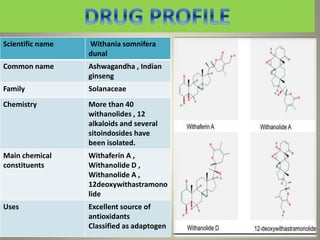
Scientific name Withania somnifera
dunal
Common name Ashwagandha , Indian
ginseng
Family Solanaceae
Chemistry More than 40
withanolides , 12
alkaloids and several
sitoindosides have
been isolated.
Main chemical
constituents
Withaferin A ,
Withanolide D ,
Withanolide A ,
12deoxywithastramono
lide
Uses Excellent source of
antioxidants
Classified as adaptogen
THIRD SEMESTER FOURTH SEMESTER
LITERATURE REVIEW
•Books
•journals
CHARACTERIZATION
•Drug content
•Zeta potential
PRE-FORMULATION STUDIES
•Solubility
•Partition coefficient
SURFACE MORPHOLOGICAL STUDIES
•TEM
OPTIMIZATION
•To check different possible ratios
IN VITRO DRUG RELEASE STUDY
HPLC METHOD DEVELOPMENT COMPATIBILITY STUDIES
•FTIR
•DSC
 Singh D et al (2012) developed an innovative technique in NDDS by developing
an amphiphillic phyto phospholipids complex in order to enhance the delivery of
poorly soluble rutin. The antioxidant test was carried out and indicated that the bio-
activity of rutin was maintained even after being complexed with phospholipids.
X long et al (2014) formulated a combination of phospholipid complex and self
emulsifying drug delivery system of baicalin (BCS class IV drug). The synergistic
effect resulted in increased solubility, partition coefficient and bioavailablity of
baicalin.
Kuntal maiti et al (2006) formulated curcumin phospholipid complexes to
overcome the limitation of absorption and to investigate its protective effect on
carbon tetra chloride induced acute liver damage in rats.
Arundhati . A Aphale et al (1998) planned a study to access the safety of
the combination of Withania Somnifera and Panax Ginseng by doing subacute
toxicity studies in rats with 90 days oral administration using 3 doses. It did not
revealed any toxicity.
Ahmad et al (2014) carried out stability indicating studies of W.Somnifera
including Forced degradation studies, Photo degradation studies, Drug
excipient studies. The present studies resulted in the successful development
and validation of rapid iso-cratic method for the detection and estimation of
withanolide.
Husch et al (2011) recently reported so called NSAID phospholipid
complexes in literature to reduce local gastrointestinal toxicity.the present
work was dedicated to the structural characterization of so called drug
phospholipid complex on the example of diclofenac sodium ibuprofen and
piroxicam complexes with dipalmitoylphosphatydylcholine at different stages
of preparation.
 Maiti, K., et al., Curcumin–phospholipid complex: Preparation, therapeutic
evaluation and pharmacokinetic study in rats. International Journal of
Pharmaceutics, 2007. 330(1–2): p. 155-163
 Singh .D et al., Rutin phospholipid complexes: An innovation technique in
Novel Drug Delivery System. Pubmed.gov, 2012 may;9 (3):305-14
Semalty . A et al., Development and characterization of aspirin phospholipid
complexes for improved drug delivery; International journal of pharmaceutical
sciences and nanotechnology, 2010.3(2):p940-947
 Arundhati A. Aphale et al., subacute toxicity study of the combination of Panax
ginseng and Withania Somnifera in rats; A safety assessment; Indian J physiology
pharmacol 1998;42(2):299-302
 Husch.J et al , structural properties of so called NSAID-phospholipids complexes,
European journal of pharmaceutical science,2011,volume44,issue-2,103-116
Devi P U et.al., study of anti-tumor and radio sensitizing properties of Lithuania
Somnifera,Indian journal of experimental biology,1996, 34(10):927-932.
Singh.G, Sharma.P, Dudhe.R Reviewed., Biological activity of Withania Somnifera,
Annals of biological research, 2010,1(3):56-63.
Withania somnifera(L.) USDA,NRCS.2007. The PLANTS database
(http;plants.usda.gov), 2010.
withania somnifera complexes

withania somnifera complexes

  • 1.
    PREPARATION AND CHARACTERIZATIONOF WITHANIA SOMNIFERA-PHOSPHOLIPID COMPLEXES GUIDE- Ms. URMI CHAURASIA PROJECT SUPERVISOR Dr. A.K DWIVEDI CHIEF SCIENTIST DIV. OF PHARMACEUTICS CSIR-CDRI PRESENTED BY- ISHA BHARDWAJ
  • 2.
  • 3.
    WITHANIA SOMNIFERA One ofthe most powerful medicinal plants ,has been used for than 3000 years. Also known as Indian ginseng , Ashwagandha , winter cherry . Possess various medicinal properties.
  • 4.
    MEDICINAL USES OFWITHANIA SOMNIFERA STRENGTH VITALITY POWER ANTI-CANCER ANTI-ULCER SLEEP RELAXATION STRESS DIGESTION APHRODISIAC
  • 5.
    LIPID BASED DRUGDELIVERY SYSTEM  A novel approach for enhancing oral bio-availability. Lipids, as carriers, used for drug delivery for poorly soluble drugs. Methods – solubilization, encapsulation, complexation etc.  examples of some LBDDS- Liposomes , Phytosomes , phospholipid complexes , solid lipid nano particles etc. PHOSPHOLIPID COMPLEXES Technique was first developed in Italy in 1989. Involves the complexation of drug with phospholipids.  such complexes leads to improved dissolution and bioavailability of a poorly water soluble drug. What are phospholipids ? a class of lipids that are the component of all cell membranes as they can form lipid bilayer. Amphipathic character. Composition – 2 fatty acids + glycerol unit + phosphate group + polar molecule.
  • 6.
    IMPROVES SOLUBILITY FACILITATE MEMBRANEPERMIABILITY LIPID PROFILE IMPROVEMENT REDUCED DOSE HEPATOPROTECTIVE MODIFIED RELEASE PROFILE
  • 7.
    the aim ofthe current work is to develop a lipid based drug delivery system to overcome the limitation of poor solubility and bio-availability of poorly solublizing drug candidate Withania Somnifera root and leaf extract thus formulated as w.somnifera complexes.. .  PREFORMULATION STUDIES - solubility, partition coefficient , melting point etc and selection of analytical methods.  Formulation of Withania-somnifera Phospholipid Complex. Improving the pharmaceutical properties of drug like solubility, membrane permeability and partition coefficient.  Enhancing bioavailability and activity of drug.  Evaluation of the formulation.
  • 8.
  • 9.
    Scientific name Withaniasomnifera dunal Common name Ashwagandha , Indian ginseng Family Solanaceae Chemistry More than 40 withanolides , 12 alkaloids and several sitoindosides have been isolated. Main chemical constituents Withaferin A , Withanolide D , Withanolide A , 12deoxywithastramono lide Uses Excellent source of antioxidants Classified as adaptogen
  • 10.
    THIRD SEMESTER FOURTHSEMESTER LITERATURE REVIEW •Books •journals CHARACTERIZATION •Drug content •Zeta potential PRE-FORMULATION STUDIES •Solubility •Partition coefficient SURFACE MORPHOLOGICAL STUDIES •TEM OPTIMIZATION •To check different possible ratios IN VITRO DRUG RELEASE STUDY HPLC METHOD DEVELOPMENT COMPATIBILITY STUDIES •FTIR •DSC
  • 11.
     Singh Det al (2012) developed an innovative technique in NDDS by developing an amphiphillic phyto phospholipids complex in order to enhance the delivery of poorly soluble rutin. The antioxidant test was carried out and indicated that the bio- activity of rutin was maintained even after being complexed with phospholipids. X long et al (2014) formulated a combination of phospholipid complex and self emulsifying drug delivery system of baicalin (BCS class IV drug). The synergistic effect resulted in increased solubility, partition coefficient and bioavailablity of baicalin. Kuntal maiti et al (2006) formulated curcumin phospholipid complexes to overcome the limitation of absorption and to investigate its protective effect on carbon tetra chloride induced acute liver damage in rats.
  • 12.
    Arundhati . AAphale et al (1998) planned a study to access the safety of the combination of Withania Somnifera and Panax Ginseng by doing subacute toxicity studies in rats with 90 days oral administration using 3 doses. It did not revealed any toxicity. Ahmad et al (2014) carried out stability indicating studies of W.Somnifera including Forced degradation studies, Photo degradation studies, Drug excipient studies. The present studies resulted in the successful development and validation of rapid iso-cratic method for the detection and estimation of withanolide. Husch et al (2011) recently reported so called NSAID phospholipid complexes in literature to reduce local gastrointestinal toxicity.the present work was dedicated to the structural characterization of so called drug phospholipid complex on the example of diclofenac sodium ibuprofen and piroxicam complexes with dipalmitoylphosphatydylcholine at different stages of preparation.
  • 13.
     Maiti, K.,et al., Curcumin–phospholipid complex: Preparation, therapeutic evaluation and pharmacokinetic study in rats. International Journal of Pharmaceutics, 2007. 330(1–2): p. 155-163  Singh .D et al., Rutin phospholipid complexes: An innovation technique in Novel Drug Delivery System. Pubmed.gov, 2012 may;9 (3):305-14 Semalty . A et al., Development and characterization of aspirin phospholipid complexes for improved drug delivery; International journal of pharmaceutical sciences and nanotechnology, 2010.3(2):p940-947  Arundhati A. Aphale et al., subacute toxicity study of the combination of Panax ginseng and Withania Somnifera in rats; A safety assessment; Indian J physiology pharmacol 1998;42(2):299-302
  • 14.
     Husch.J etal , structural properties of so called NSAID-phospholipids complexes, European journal of pharmaceutical science,2011,volume44,issue-2,103-116 Devi P U et.al., study of anti-tumor and radio sensitizing properties of Lithuania Somnifera,Indian journal of experimental biology,1996, 34(10):927-932. Singh.G, Sharma.P, Dudhe.R Reviewed., Biological activity of Withania Somnifera, Annals of biological research, 2010,1(3):56-63. Withania somnifera(L.) USDA,NRCS.2007. The PLANTS database (http;plants.usda.gov), 2010.