
TECHNICAL SEMINAR
ON
WIRELESS SENSOR NETWORK
Presented By
MANISH KUMAR SHARMA
(COMPUTER SCIENCE AND ENGINEERING )
CONTENTS
• INTRODUCTION
• WHAT IS WSN
• TYPES OF WSN
• CHARACTERISTICS OF WSN
• COMPONENTS OF WSN
• ARCHITECTURE OF A WSN
• ARCHITECTURAL ISSUES
• STANDARDS AND SPECIFICATIONS
• APPLICATION
• CHALLENGES
• ADVANTAGES
• DISADVANTAGES
• CONCLUSION
• REFERENCES
INTRODUCTION
➢A sensor network is a group of tiny, generally battery – powered devices and
wireless infrastructure that monitor and record conditions in any number of
environments.
➢A wireless sensor network(WSN) is a wireless network that is designed using
spatially distributed self –governing devices that uses sensors for monitoring
physical or environmental conditions.
➢Parameters monitored using WSN are temperature, pressure, humidity,
direction of wind and speed, intensity of sound, intensity of vibration, power-
line voltage, pollutant levels.
WHAT IS WSN
TYPES OF WSN
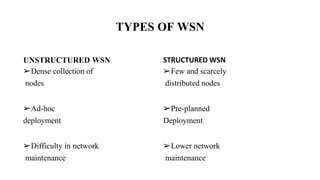
UNSTRUCTURED WSN
➢Dense collection of
nodes
➢Ad-hoc
deployment
➢Difficulty in network
maintenance
STRUCTURED WSN
➢Few and scarcely
distributed nodes
➢Pre-planned
Deployment
➢Lower network
maintenance
CHARACTERISTICS OF A WSN
• Self organization
• Concurrency processing
• Low cost
• Restricted energy resources
• Tiny
• Small radio range
COMPONENTS OF WSN
➢Gateway
➢Sensor/Actuator
➢Sensor node
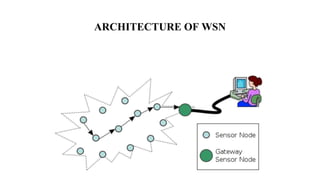
ARCHITECTURE OF WSN
ARCHITECTURE OF WSN
ARCHITECTURAL ISSUES
➢Energy efficiency
➢Network topology
➢Failure in long range communication
➢Increase in traffic decreases the lifetime
➢Single tier and multi tier architecture disadvantages
STANDARDS AND SPECIFICATIONS
➢Predominant standards commonly used in WSN communications include:
1. Zig Bee – Transmit data over long distances by passing data through
intermediate devices to reach more distant ones
2. Bluetooth – Wireless technology standard for exchanging data over short
distances from fixed and mobile devices by creating PAN’s
3. 6LoWPAN – Defined encapsulation and header compression mechanisms
that allow IPv6 packets to be sent to and received from over IEEE 802.15.4
APPLICATIONS OF WSN
➢Military applications
• Battlefield surveillance monitoring
• Guiding intelligent missiles
• Attack detection
➢Environment monitoring
• Forest fire detection
• Flood detection
• Air pollution
• Water quality
CHALLENGES
• HARDWARE
1. Low cost
2. Tiny sensors
3. Lifetime maximization
4. Robustness and fault tolerance
5. Self configuration
• SOFTWARE
1. Operating system
2. Security
3. Mobility
ADVANTAGES OF WSN
• Avoids a lot of wiring
• Can accommodate new devices at any time
• Flexible to go through physical partitions
• It can be accessed through a centralized monitor
• Infrastructure
DISADVANTAGES OF WSN
• Easy for hackers to hack a network
• Comparatively low speed of communication
• Gets distracted by various elements
• Costly at large
• Life of nodes
• Energy life
CONCLUSION
Wireless sensor networks the possess the potential for many
applications.
The advance of technology enabled the creation of prototype WSNs,
but the hardware and software both have a ways to go before WSNs
are practical, cost- effective, and usefully.
THANK YOU….!!

Wireless Sensor Network

  • 1.
    TECHNICAL SEMINAR ON WIRELESS SENSORNETWORK Presented By MANISH KUMAR SHARMA (COMPUTER SCIENCE AND ENGINEERING )
  • 2.
    CONTENTS • INTRODUCTION • WHATIS WSN • TYPES OF WSN • CHARACTERISTICS OF WSN • COMPONENTS OF WSN • ARCHITECTURE OF A WSN • ARCHITECTURAL ISSUES • STANDARDS AND SPECIFICATIONS • APPLICATION • CHALLENGES • ADVANTAGES • DISADVANTAGES • CONCLUSION • REFERENCES
  • 3.
    INTRODUCTION ➢A sensor networkis a group of tiny, generally battery – powered devices and wireless infrastructure that monitor and record conditions in any number of environments. ➢A wireless sensor network(WSN) is a wireless network that is designed using spatially distributed self –governing devices that uses sensors for monitoring physical or environmental conditions. ➢Parameters monitored using WSN are temperature, pressure, humidity, direction of wind and speed, intensity of sound, intensity of vibration, power- line voltage, pollutant levels.
  • 4.
  • 5.
    TYPES OF WSN UNSTRUCTUREDWSN ➢Dense collection of nodes ➢Ad-hoc deployment ➢Difficulty in network maintenance STRUCTURED WSN ➢Few and scarcely distributed nodes ➢Pre-planned Deployment ➢Lower network maintenance
  • 6.
    CHARACTERISTICS OF AWSN • Self organization • Concurrency processing • Low cost • Restricted energy resources • Tiny • Small radio range
  • 7.
  • 8.
  • 9.
  • 10.
    ARCHITECTURAL ISSUES ➢Energy efficiency ➢Networktopology ➢Failure in long range communication ➢Increase in traffic decreases the lifetime ➢Single tier and multi tier architecture disadvantages
  • 11.
    STANDARDS AND SPECIFICATIONS ➢Predominantstandards commonly used in WSN communications include: 1. Zig Bee – Transmit data over long distances by passing data through intermediate devices to reach more distant ones 2. Bluetooth – Wireless technology standard for exchanging data over short distances from fixed and mobile devices by creating PAN’s 3. 6LoWPAN – Defined encapsulation and header compression mechanisms that allow IPv6 packets to be sent to and received from over IEEE 802.15.4
  • 12.
    APPLICATIONS OF WSN ➢Militaryapplications • Battlefield surveillance monitoring • Guiding intelligent missiles • Attack detection ➢Environment monitoring • Forest fire detection • Flood detection • Air pollution • Water quality
  • 13.
    CHALLENGES • HARDWARE 1. Lowcost 2. Tiny sensors 3. Lifetime maximization 4. Robustness and fault tolerance 5. Self configuration • SOFTWARE 1. Operating system 2. Security 3. Mobility
  • 14.
    ADVANTAGES OF WSN •Avoids a lot of wiring • Can accommodate new devices at any time • Flexible to go through physical partitions • It can be accessed through a centralized monitor • Infrastructure
  • 15.
    DISADVANTAGES OF WSN •Easy for hackers to hack a network • Comparatively low speed of communication • Gets distracted by various elements • Costly at large • Life of nodes • Energy life
  • 16.
    CONCLUSION Wireless sensor networksthe possess the potential for many applications. The advance of technology enabled the creation of prototype WSNs, but the hardware and software both have a ways to go before WSNs are practical, cost- effective, and usefully.
  • 17.