













Wireless sensor networks
Contents
1. About company (LINTECH Intellectual Technology Labs LLC)
2. The company's activities (purposes, mission)
3. Definition of wireless sensor network (WSN)
4. Function of wireless sensor network (WSN)
5. Advantages of systems based on sensor networks
6. Composition of sensor networks
7. The structure node of WSN
8. The hardware part
9. Characteristics of the sensor
10. The software part
11. Zigbee IEEE 802.15.4 standard
12. Fields of application
13. Housing and communal services
14. Advantages of using sensor networks in the field of housing and communal services
15. Problems of industrial and environmental monitoring
16. Advantages of application sensor networks for systems of monitoring
17. Radiation monitoring
18. Industrial monitoring
19. Transport (Russian Railways)
20. Control of road traffic
21. Constructing
22. Medicine
23. Safety systems
24. Education
25. Geography of customers
26. Prospects
27. Contact information
About company
The development team of wireless network engineering was
formed in May 2010 at the ILIT RAS. Intellectual Technology
Labs "LINTECH" was established in March 2013.
The company is engaged in the development and
implementation of wireless sensor networks and monitoring
systems in various application areas.
"LINTECH" is a resident of Skolkovo Innovation Fund since
May 2013.
The company's activities
The main business is the development and
implementation of hardware and software of wireless sensor
networks (WSN), which allows economically to solve a wide
range of engineering, industrial and domestic problems of
modern life.

The company's mission
“Introduction of “smart dust” will make the world a safer,
more secure and more environmentally.”
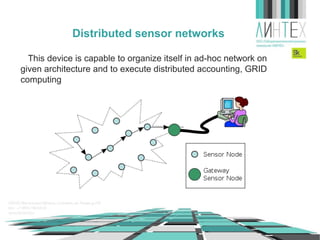
Wireless sensor networks
This device is capable to organize itself in ad-hoc network on
given architecture and to execute distributed accounting, GRID
computing
The main function of wireless sensor
network (WSN)
The main function of WSN is the solution of
problems of collecting, information processing and
transmission with high demands for autonomy,
reliability, scalability, and distributed network.
Advantages of systems based on sensor
networks
- promptness and economy of deployment;
- there is no need in service;
- extended autonomous operation;
- advanced fault tolerance and reliability under
severe operating conditions;
- wide field of application.
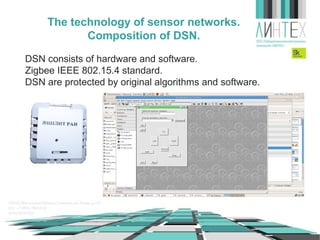
The technology of sensor networks.
Composition of WSN.
DSN consists of hardware and software.
Zigbee IEEE 802.15.4 standard.
WSN are protected by original algorithms and software.
The hardware of WSN
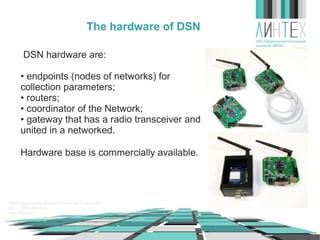
WSN hardware are:
• endpoints (nodes of networks) for
collection parameters;
• routers;
• coordinator of the Network;
• gateway that has a radio transceiver and
united in a networked.
Hardware base is commercially available.
The structure node of
WSN
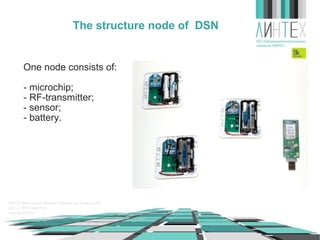
One node consists of:
- microchip;
- RF-transmitter;
- sensor;
- battery.
The software part of WSN
The software, based on the original
algorithms, which are protected by
copyright:
- to control, data collection and
transmission;
- to visualize the results.
OS: TinyOS, Linux, Win.
Programming language: C, Java.
Сompiler gcc
Zigbee IEEE 802.15.4 standard
Standard IEEE 802.15.4, also known as ZigBee, is a
low-speed connection standard intended for low-power,
short-range communication between wireless devices. In
addition, radioequipment ZigBee must have an extremely low
power consumption, and must work for years without
replacement of power sources.
Characteristics of the sensor
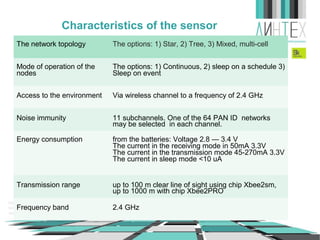
The network topology

The options: 1) Star, 2) Tree, 3) Mixed, multi-cell

Mode of operation of the
nodes

The options: 1) Continuous, 2) sleep on a schedule 3)
Sleep on event

Access to the environment

Via wireless channel to a frequency of 2.4 GHz

Noise immunity

11 subchannels. One of the 64 PAN ID networks
may be selected in each channel.

Energy consumption

from the batteries: Voltage 2.8 — 3.4 V
The current in the receiving mode in 50mA 3.3V
The current in the transmission mode 45-270mA 3.3V
The current in sleep mode <10 uA

Transmission range

up to 100 m clear line of sight using chip Xbee2sm,
up to 1000 m with chip Xbee2PRO

Frequency band

2.4 GHz
Fields of application:
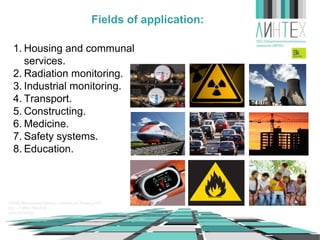
1. Housing and communal
services.
2. Radiation monitoring.
3. Industrial monitoring.
4. Transport.
5. Constructing.
6. Medicine.
7. Safety systems.
8. Education.
The field of application. Housing and
communal services.
-

elevator monitoring;

- data collection from metering
devices;
- control of ventilation of premises.

Sensors in the elevator
Advantages of using sensor networks in
the field of housing and communal services
- getting the current data from metering devices;
- easy of tracking and payment of public utilities;
- fault tolerance system;
- reduce the cost of rebuilding infrastructure in an
emergency.
Problems of the modern industrial and
environmental monitoring (if using wired
connection)
Installation of wires requires
the development of the project,
a lot of time and financial costs.
In the event of breakage of wires
can be difficult to diagnose break
points and to make repair works.
Sometimes, the cost of repair
exceeds the value of laying new
cables!
The advantages of using sensor networks
for systems of monitoring






The possibility of the placement in inaccessible locations;
Quick deployment and system maintenance;
The reliability of the whole network - in case of failure to 40% of nodes of the network,
the network performs its functions;
Can be added or removed any number of devices from the network;



High level of penetration through obstacles (walls, ceilings) and resistance to
electromagnetic interference (unlike wi-fi);



Long operating time without battery replacement due to budget conscious microchips
and algorithms developed in the framework of the project;




Reducing the cost of maintenance building of systems;
Reducing the cost of data collection of secondary information (development of service).
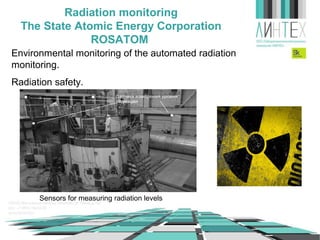
Radiation monitoring
The State Atomic Energy Corporation
ROSATOM
Environmental monitoring of the automated radiation
monitoring.
Radiation safety.

Sensors for measuring radiation levels
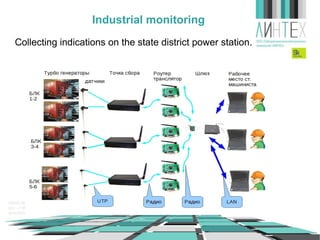
Industrial monitoring
Collecting indications on the state district power station.
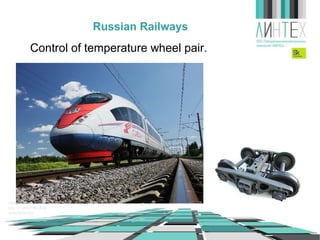
Russian Railways

Control of temperature wheel pair.
Automobile transportation
Control of traffic and road situation.
Rosstroy (Federal agency of construction,
housing and housing services of Russian
Federation)
Creating of distributed system for monitoring buildings vibrations
and deformations of structural health monitoring (SHM)

Sensors of deviation from the vertical
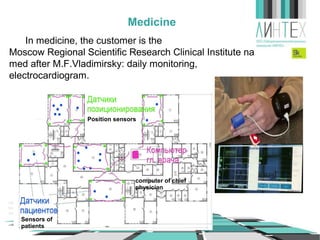
Medicine
In medicine, the customer is the
Moscow Regional Scientific Research Clinical Institute na
med after M.F.Vladimirsky: daily monitoring,
electrocardiogram.

Position sensors

computer of chief
physician

Sensors of
patients
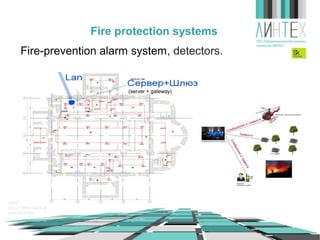
Fire protection systems
Fire-prevention alarm system, detectors.

(server + gateway)
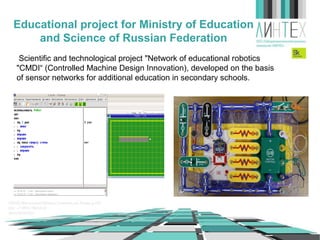
Educational project for Ministry of Education
and Science of Russian Federation
Scientific and technological project "Network of educational robotics
"CMDI“ (Controlled Machine Design Innovation), developed on the basis
of sensor networks for additional education in secondary schools.
Geography of customers
Prospects
The technology of distributed sensor networks has a
great potential for using in various fields.
Development of infrastructure, technology and software
base of WSN today - the success and high level
processability in all fields of applications.
Contact information
Address: Novaya ul. 100, Skolkovo village, Odintsovsky
District, Moscow Region, 143025, Russia
Phone: +7 (495) 748-68-20
Web: www.lin-tech.ru E-mail: info@lin-tech.ru

Wireless sensor networks

  • 1.
  • 2.
    Contents 1. About company(LINTECH Intellectual Technology Labs LLC) 2. The company's activities (purposes, mission) 3. Definition of wireless sensor network (WSN) 4. Function of wireless sensor network (WSN) 5. Advantages of systems based on sensor networks 6. Composition of sensor networks 7. The structure node of WSN 8. The hardware part 9. Characteristics of the sensor 10. The software part 11. Zigbee IEEE 802.15.4 standard 12. Fields of application 13. Housing and communal services 14. Advantages of using sensor networks in the field of housing and communal services 15. Problems of industrial and environmental monitoring 16. Advantages of application sensor networks for systems of monitoring 17. Radiation monitoring 18. Industrial monitoring 19. Transport (Russian Railways) 20. Control of road traffic 21. Constructing 22. Medicine 23. Safety systems 24. Education 25. Geography of customers 26. Prospects 27. Contact information
  • 3.
    About company The developmentteam of wireless network engineering was formed in May 2010 at the ILIT RAS. Intellectual Technology Labs "LINTECH" was established in March 2013. The company is engaged in the development and implementation of wireless sensor networks and monitoring systems in various application areas. "LINTECH" is a resident of Skolkovo Innovation Fund since May 2013.
  • 4.
    The company's activities Themain business is the development and implementation of hardware and software of wireless sensor networks (WSN), which allows economically to solve a wide range of engineering, industrial and domestic problems of modern life. The company's mission “Introduction of “smart dust” will make the world a safer, more secure and more environmentally.”
  • 5.
    Wireless sensor networks Thisdevice is capable to organize itself in ad-hoc network on given architecture and to execute distributed accounting, GRID computing
  • 6.
    The main functionof wireless sensor network (WSN) The main function of WSN is the solution of problems of collecting, information processing and transmission with high demands for autonomy, reliability, scalability, and distributed network.
  • 7.
    Advantages of systemsbased on sensor networks - promptness and economy of deployment; - there is no need in service; - extended autonomous operation; - advanced fault tolerance and reliability under severe operating conditions; - wide field of application.
  • 8.
    The technology ofsensor networks. Composition of WSN. DSN consists of hardware and software. Zigbee IEEE 802.15.4 standard. WSN are protected by original algorithms and software.
  • 9.
    The hardware ofWSN WSN hardware are: • endpoints (nodes of networks) for collection parameters; • routers; • coordinator of the Network; • gateway that has a radio transceiver and united in a networked. Hardware base is commercially available.
  • 10.
    The structure nodeof WSN One node consists of: - microchip; - RF-transmitter; - sensor; - battery.
  • 11.
    The software partof WSN The software, based on the original algorithms, which are protected by copyright: - to control, data collection and transmission; - to visualize the results. OS: TinyOS, Linux, Win. Programming language: C, Java. Сompiler gcc
  • 12.
    Zigbee IEEE 802.15.4standard Standard IEEE 802.15.4, also known as ZigBee, is a low-speed connection standard intended for low-power, short-range communication between wireless devices. In addition, radioequipment ZigBee must have an extremely low power consumption, and must work for years without replacement of power sources.
  • 13.
    Characteristics of thesensor The network topology The options: 1) Star, 2) Tree, 3) Mixed, multi-cell Mode of operation of the nodes The options: 1) Continuous, 2) sleep on a schedule 3) Sleep on event Access to the environment Via wireless channel to a frequency of 2.4 GHz Noise immunity 11 subchannels. One of the 64 PAN ID networks may be selected in each channel. Energy consumption from the batteries: Voltage 2.8 — 3.4 V The current in the receiving mode in 50mA 3.3V The current in the transmission mode 45-270mA 3.3V The current in sleep mode <10 uA Transmission range up to 100 m clear line of sight using chip Xbee2sm, up to 1000 m with chip Xbee2PRO Frequency band 2.4 GHz
  • 14.
    Fields of application: 1.Housing and communal services. 2. Radiation monitoring. 3. Industrial monitoring. 4. Transport. 5. Constructing. 6. Medicine. 7. Safety systems. 8. Education.
  • 15.
    The field ofapplication. Housing and communal services. - elevator monitoring; - data collection from metering devices; - control of ventilation of premises. Sensors in the elevator
  • 16.
    Advantages of usingsensor networks in the field of housing and communal services - getting the current data from metering devices; - easy of tracking and payment of public utilities; - fault tolerance system; - reduce the cost of rebuilding infrastructure in an emergency.
  • 17.
    Problems of themodern industrial and environmental monitoring (if using wired connection) Installation of wires requires the development of the project, a lot of time and financial costs.
  • 18.
    In the eventof breakage of wires can be difficult to diagnose break points and to make repair works. Sometimes, the cost of repair exceeds the value of laying new cables!
  • 19.
    The advantages ofusing sensor networks for systems of monitoring     The possibility of the placement in inaccessible locations; Quick deployment and system maintenance; The reliability of the whole network - in case of failure to 40% of nodes of the network, the network performs its functions; Can be added or removed any number of devices from the network;  High level of penetration through obstacles (walls, ceilings) and resistance to electromagnetic interference (unlike wi-fi);  Long operating time without battery replacement due to budget conscious microchips and algorithms developed in the framework of the project;   Reducing the cost of maintenance building of systems; Reducing the cost of data collection of secondary information (development of service).
  • 20.
    Radiation monitoring The StateAtomic Energy Corporation ROSATOM Environmental monitoring of the automated radiation monitoring. Radiation safety. Sensors for measuring radiation levels
  • 21.
    Industrial monitoring Collecting indicationson the state district power station.
  • 22.
    Russian Railways Control oftemperature wheel pair.
  • 23.
    Automobile transportation Control oftraffic and road situation.
  • 24.
    Rosstroy (Federal agencyof construction, housing and housing services of Russian Federation) Creating of distributed system for monitoring buildings vibrations and deformations of structural health monitoring (SHM) Sensors of deviation from the vertical
  • 25.
    Medicine In medicine, thecustomer is the Moscow Regional Scientific Research Clinical Institute na med after M.F.Vladimirsky: daily monitoring, electrocardiogram. Position sensors computer of chief physician Sensors of patients
  • 26.
    Fire protection systems Fire-preventionalarm system, detectors. (server + gateway)
  • 27.
    Educational project forMinistry of Education and Science of Russian Federation Scientific and technological project "Network of educational robotics "CMDI“ (Controlled Machine Design Innovation), developed on the basis of sensor networks for additional education in secondary schools.
  • 28.
  • 29.
    Prospects The technology ofdistributed sensor networks has a great potential for using in various fields. Development of infrastructure, technology and software base of WSN today - the success and high level processability in all fields of applications.
  • 30.
    Contact information Address: Novayaul. 100, Skolkovo village, Odintsovsky District, Moscow Region, 143025, Russia Phone: +7 (495) 748-68-20 Web: www.lin-tech.ru E-mail: info@lin-tech.ru