1
3GPP TSG CT Chairman3GPP TSG CT Chairman
Hannu HietalahtiHannu Hietalahti
3GPP presentation
Architecture evolution
Moscow, October 2008
2
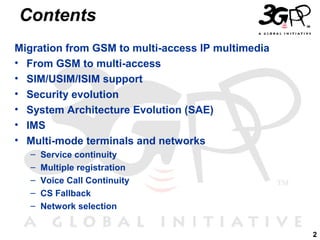
Migration from GSM to multi-access IP multimedia
• From GSM to multi-access
• SIM/USIM/ISIM support
• Security evolution
• System Architecture Evolution (SAE)
• IMS
• Multi-mode terminals and networks
– Service continuity
– Multiple registration
– Voice Call Continuity
– CS Fallback
– Network selection
Contents
3
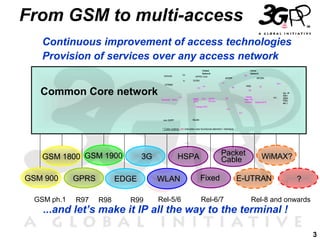
Continuous improvement of access technologies
Provision of services over any access network
...and let’s make it IP all the way to the terminal !
Common Core network
GSM 900
3G HSPA
WLAN E-UTRANEDGE
GSM 1800
GPRS
GSM 1900
GSM ph.1 R97 R98 R99 Rel-5/6 Rel-6/7 Rel-8 and onwards
WiMAX?
?
Evolved RAN
S1
GERAN
UTRAN
GPRS Core
Gb
Iu
S 3
S8
S 2
S7 Rx+
Home EPC
MME
UPE
S6
Op. IP
Serv
(IMS,
PSS,
etc.)
Home
Inter AS
Anchor
HSS
S6
non 3GPP WLAN
S4
S 2
vPCRF
S7
hPCRF
Visited
Network
Home
Network
S9
Visited EPC
Evolved RAN
S1 SGi
UTRAN
Iu
S 3
S8
S 2
Rx+
Home EPC
MME
UPE
S6
Op. IP
Serv
(IMS,
PSS,
etc.)
Home
Inter AS
Anchor
HSS
S6
non 3GPP WLAN
S 2
vPCRF
S7
hPCRF
Visited
Network
Home
Network
S9
* Color coding: red indicates new functional element / interface
3GPP
Anchor
SGSN
S5a
From GSM to multi-access
Fixed
Packet
Cable
4
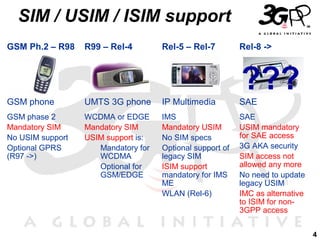
SIM / USIM / ISIM support
GSM Ph.2 – R98 R99 – Rel-4 Rel-5 – Rel-7 Rel-8 ->
GSM phone UMTS 3G phone IP Multimedia SAE
GSM phase 2
Mandatory SIM
No USIM support
Optional GPRS
(R97 ->)
WCDMA or EDGE
Mandatory SIM
USIM support is:
Mandatory for
WCDMA
Optional for
GSM/EDGE
IMS
Mandatory USIM
No SIM specs
Optional support of
legacy SIM
ISIM support
mandatory for IMS
ME
WLAN (Rel-6)
SAE
USIM mandatory
for SAE access
3G AKA security
SIM access not
allowed any more
No need to update
legacy USIM
IMC as alternative
to ISIM for non-
3GPP access
???
5
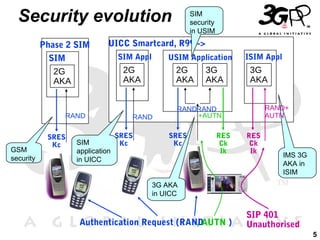
Security evolution
Phase 2 SIM
2G
AKA
SIM
SRES
Kc
RAND
RES
Ck
Ik
RES
Ck
Ik
USIM Application
3G
AKA
ISIM Appl
UICC Smartcard, R99 ->
2G
AKA
RANDRAND
SRES
Kc
2G
AKA
SIM Appl
SRES
Kc
RAND
3G
AKA
Authentication Request (RAND )
SIP 401
Unauthorised, AUTN
GSM
security
SIM
application
in UICC
3G AKA
in UICC
IMS 3G
AKA in
ISIM
+AUTN
SIM
security
in USIM
RAND+
AUTN
6
• LTE = E-UTRAN = evolved radio network
– Megabit class data rates
– Short delays
– Short transition from idle to active
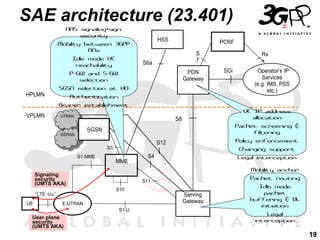
• SAE = System Architecture evolution
– Evolved IP oriented multi access architecture
• E-UTRAN integrates only to SAE, A/Gb or Iu not possible
• Strongly IP based PS only network
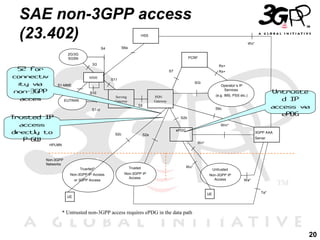
• SAE covers both 3GPP and non-3GPP access technologies
• Seamless roaming between E-UTRAN, 2G and 3G (tight interworking)
• Loose interworking with non-3GPP accesses
• Currently work is progressing on GTP for intra-3GPP mobility and
IETF based mobility for non-3GPP mobility
– The main Architecture specifications 23.401 and 23.402 frozen in June 2008
– Protocol work is ongoing with the goal to freeze it in December 2008
System Architecture Evolution
(SAE)
7
• Deployments are expected to start with overlapping
cellular coverage
– E-UTRAN overlapping with legacy 3GPP GERAN / UTRAN coverage
– E-UTRAN overlapping with legacy 3GPP2 coverage
– Multi-mode networks and terminals
• E-UTRAN is a packet-only radio with no CS capacity
• Initially E-UTRAN is foreseen as “islands” in the sea of
legacy cellular access
– Mobility between E-UTRAN and legacy access is required
– Mobility between PS and CS domains is required
– Multi-mode terminals expect to use PS coverage where available
– Desire to keep the connectivity and services
SAE/LTE Deployment
8
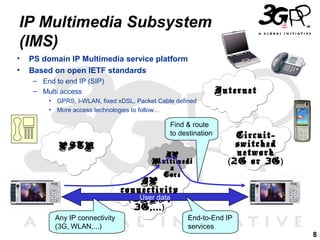
Internet
IP Multimedia Subsystem
(IMS)
• PS domain IP Multimedia service platform
• Based on open IETF standards
– End to end IP (SIP)
– Multi access
• GPRS, I-WLAN, fixed xDSL, Packet Cable defined
• More access technologies to follow...
Circuit-
switched
network
2G or 3G( )
IP
Multimedi
a
Core
PSTN
IP
connectivity
GPRS,(
3G,...)
Find & route
to destination
User data
Any IP connectivity
(3G, WLAN,...)
End-to-End IP
services
9
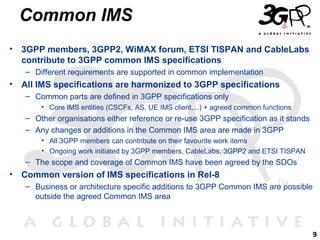
• 3GPP members, 3GPP2, WiMAX forum, ETSI TISPAN and CableLabs
contribute to 3GPP common IMS specifications
– Different requirements are supported in common implementation
• All IMS specifications are harmonized to 3GPP specifications
– Common parts are defined in 3GPP specifications only
• Core IMS entities (CSCFs, AS, UE IMS client,...) + agreed common functions
– Other organisations either reference or re-use 3GPP specification as it stands
– Any changes or additions in the Common IMS area are made in 3GPP
• All 3GPP members can contribute on their favourite work items
• Ongoing work initiated by 3GPP members, CableLabs, 3GPP2 and ETSI TISPAN
– The scope and coverage of Common IMS have been agreed by the SDOs
• Common version of IMS specifications in Rel-8
– Business or architecture specific additions to 3GPP Common IMS are possible
outside the agreed Common IMS area
Common IMS
10
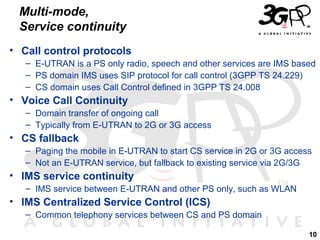
• Call control protocols
– E-UTRAN is a PS only radio, speech and other services are IMS based
– PS domain IMS uses SIP protocol for call control (3GPP TS 24.229)
– CS domain uses Call Control defined in 3GPP TS 24.008
• Voice Call Continuity
– Domain transfer of ongoing call
– Typically from E-UTRAN to 2G or 3G access
• CS fallback
– Paging the mobile in E-UTRAN to start CS service in 2G or 3G access
– Not an E-UTRAN service, but fallback to existing service via 2G/3G
• IMS service continuity
– IMS service between E-UTRAN and other PS only, such as WLAN
• IMS Centralized Service Control (ICS)
– Common telephony services between CS and PS domain
Multi-mode,
Service continuity
11
Multi-mode,
IMS registration in Rel-7
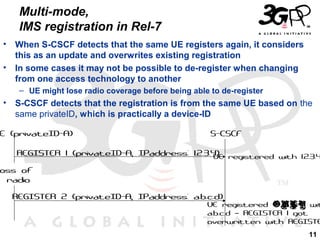
• When S-CSCF detects that the same UE registers again, it considers
this as an update and overwrites existing registration
• In some cases it may not be possible to de-register when changing
from one access technology to another
– UE might lose radio coverage before being able to de-register
• S-CSCF detects that the registration is from the same UE based on the
same privateID, which is practically a device-ID
E (privateID-A) S-CSCF
REGISTER 1 (privateID-A, IPaddress: 1.2.3.4)
oss of
radio
UE registered with 1.2.3.4
REGISTER 2 (privateID-A, IPaddress: a.b.c.d)
UE registered ONLY wit
a.b.c.d REGISTER 1 got–
overwritten with REGISTE
12
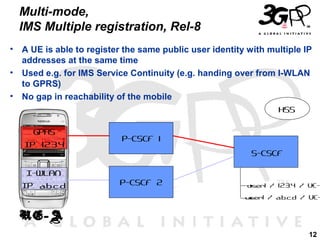
Multi-mode,
IMS Multiple registration, Rel-8
• A UE is able to register the same public user identity with multiple IP
addresses at the same time
• Used e.g. for IMS Service Continuity (e.g. handing over from I-WLAN
to GPRS)
• No gap in reachability of the mobile
S-CSCF
P-CSCF 1
P-CSCF 2
GPRS
IP: 1.2.3.4
UE-A
HSS
I-WLAN
IP: a.b.c.d user1 / 1.2.3.4 / UE-A
user1 / a.b.c.d / UE-
13
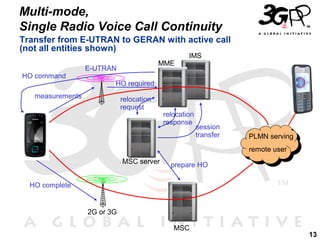
Multi-mode,
Single Radio Voice Call Continuity
Transfer from E-UTRAN to GERAN with active call
(not all entities shown)
PLMN serving
remote user
MSC server
IMS
MSC
E-UTRAN
2G or 3G
measurements
HO required
MME
relocation
request
prepare HO
relocation
response
session
transfer
HO command
HO complete
14
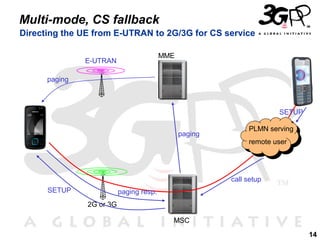
Multi-mode, CS fallback
Directing the UE from E-UTRAN to 2G/3G for CS service
PLMN serving
remote user
MSC
E-UTRAN
2G or 3G
MME
SETUP
call setup
paging
paging
paging resp.SETUP
15
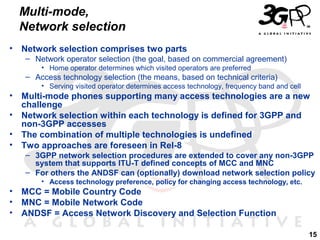
Multi-mode,
Network selection
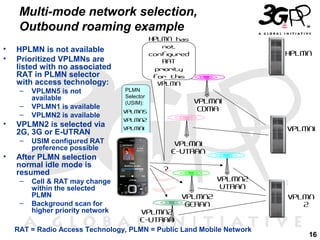
• Network selection comprises two parts
– Network operator selection (the goal, based on commercial agreement)
• Home operator determines which visited operators are preferred
– Access technology selection (the means, based on technical criteria)
• Serving visited operator determines access technology, frequency band and cell
• Multi-mode phones supporting many access technologies are a new
challenge
• Network selection within each technology is defined for 3GPP and
non-3GPP accesses
• The combination of multiple technologies is undefined
• Two approaches are foreseen in Rel-8
– 3GPP network selection procedures are extended to cover any non-3GPP
system that supports ITU-T defined concepts of MCC and MNC
– For others the ANDSF can (optionally) download network selection policy
• Access technology preference, policy for changing access technology, etc.
• MCC = Mobile Country Code
• MNC = Mobile Network Code
• ANDSF = Access Network Discovery and Selection Function
16
PLMN
Selector
(USIM):
VPLMN5
VPLMN2
VPLMN1
Multi-mode network selection,
Outbound roaming example
HPLMN
VPLMN1
VPLMN
2
VPLMN1
CDMA
VPLMN2
GERAN
VPLMN1
E-UTRAN
?
HPLMN has
not
configured
RAT
priority
for this
VPLMN
• HPLMN is not available
• Prioritized VPLMNs are
listed with no associated
RAT in PLMN selector
with access technology:
– VPLMN5 is not
available
– VPLMN1 is available
– VPLMN2 is available
• VPLMN2 is selected via
2G, 3G or E-UTRAN
– USIM configured RAT
preference possible
• After PLMN selection
normal idle mode is
resumed
– Cell & RAT may change
within the selected
PLMN
– Background scan for
higher priority network
RAT = Radio Access Technology, PLMN = Public Land Mobile Network
VPLMN2
UTRAN
VPLMN2
E-UTRAN
17
Thanks f or your
at t ent i on !
Mor e i nf or mat i on at
www. 3gpp. or g
18
Ar chi t ect ur e Annex:
3GPP and non- 3GPP
access ar chi t ect ur e
19
S6a
HSS
S8
S3
S1-MME
S10
UTRAN
GERAN
SGSN
MME
S11
Serving
GatewayUE
“LTE -Uu”
E-UTRAN
S12
HPLMN
VPLMN
PCRF
S
7
Rx
+
SGi •Operator’s IP
Services
(e.g. IMS, PSS
etc.)
PDN
Gateway
S1-U
S4
Mobility anchor
Packet routing
Idle mode
packet
buffering & DL
initiation
Legal
interception
UE IP address
allocation
Packet screening &
filtering
Policy enforcement
Charging support
Legal interception
NAS signaling+sign.
security
Mobility between 3GPP
ANs
Idle mode UE
reachability
P-GW and S-GW
selection
SGSN selection at HO
Authentication
Bearer establishment
SAE architecture (23.401)
User plane
security
(UMTS AKA)
Signaling
security
(UMTS AKA)
20
Trusrted*
Non-3GPP IP Access
or 3GPP Access
SGi
PCRF
S7
S6a
HSS
ePDG
S2b
Serving
Gateway
Wn*
3GPP AAA
Server
Operator’s IP
Services
(e.g. IMS, PSS etc.)
Wm*
Wx*
Untrusted
Non-3GPP IP
Access
Trusted
Non-3GPP IP
Access
Wa*
Ta*
HPLMN
Non-3GPP
Networks
S1-U
S1-MME
EUTRAN
2G/3G
SGSN
S4
S3
S5
S6c
Rx+
Rx+
S2a
PDN
Gateway
MME
S11
S10
UE
S2c
* Untrusted non-3GPP access requires ePDG in the data path
UE
Wu*
S2 for
connectiv
ity via
non-3GPP
acces
Trusted IP
access
directly to
P-GW
Untruste
d IP
access via
ePDG
SAE non-3GPP access
(23.402)

Wireless communication netwrks.unit 5...3gpp architecture evolution

  • 1.
    1 3GPP TSG CTChairman3GPP TSG CT Chairman Hannu HietalahtiHannu Hietalahti 3GPP presentation Architecture evolution Moscow, October 2008
  • 2.
    2 Migration from GSMto multi-access IP multimedia • From GSM to multi-access • SIM/USIM/ISIM support • Security evolution • System Architecture Evolution (SAE) • IMS • Multi-mode terminals and networks – Service continuity – Multiple registration – Voice Call Continuity – CS Fallback – Network selection Contents
  • 3.
    3 Continuous improvement ofaccess technologies Provision of services over any access network ...and let’s make it IP all the way to the terminal ! Common Core network GSM 900 3G HSPA WLAN E-UTRANEDGE GSM 1800 GPRS GSM 1900 GSM ph.1 R97 R98 R99 Rel-5/6 Rel-6/7 Rel-8 and onwards WiMAX? ? Evolved RAN S1 GERAN UTRAN GPRS Core Gb Iu S 3 S8 S 2 S7 Rx+ Home EPC MME UPE S6 Op. IP Serv (IMS, PSS, etc.) Home Inter AS Anchor HSS S6 non 3GPP WLAN S4 S 2 vPCRF S7 hPCRF Visited Network Home Network S9 Visited EPC Evolved RAN S1 SGi UTRAN Iu S 3 S8 S 2 Rx+ Home EPC MME UPE S6 Op. IP Serv (IMS, PSS, etc.) Home Inter AS Anchor HSS S6 non 3GPP WLAN S 2 vPCRF S7 hPCRF Visited Network Home Network S9 * Color coding: red indicates new functional element / interface 3GPP Anchor SGSN S5a From GSM to multi-access Fixed Packet Cable
  • 4.
    4 SIM / USIM/ ISIM support GSM Ph.2 – R98 R99 – Rel-4 Rel-5 – Rel-7 Rel-8 -> GSM phone UMTS 3G phone IP Multimedia SAE GSM phase 2 Mandatory SIM No USIM support Optional GPRS (R97 ->) WCDMA or EDGE Mandatory SIM USIM support is: Mandatory for WCDMA Optional for GSM/EDGE IMS Mandatory USIM No SIM specs Optional support of legacy SIM ISIM support mandatory for IMS ME WLAN (Rel-6) SAE USIM mandatory for SAE access 3G AKA security SIM access not allowed any more No need to update legacy USIM IMC as alternative to ISIM for non- 3GPP access ???
  • 5.
    5 Security evolution Phase 2SIM 2G AKA SIM SRES Kc RAND RES Ck Ik RES Ck Ik USIM Application 3G AKA ISIM Appl UICC Smartcard, R99 -> 2G AKA RANDRAND SRES Kc 2G AKA SIM Appl SRES Kc RAND 3G AKA Authentication Request (RAND ) SIP 401 Unauthorised, AUTN GSM security SIM application in UICC 3G AKA in UICC IMS 3G AKA in ISIM +AUTN SIM security in USIM RAND+ AUTN
  • 6.
    6 • LTE =E-UTRAN = evolved radio network – Megabit class data rates – Short delays – Short transition from idle to active • SAE = System Architecture evolution – Evolved IP oriented multi access architecture • E-UTRAN integrates only to SAE, A/Gb or Iu not possible • Strongly IP based PS only network • SAE covers both 3GPP and non-3GPP access technologies • Seamless roaming between E-UTRAN, 2G and 3G (tight interworking) • Loose interworking with non-3GPP accesses • Currently work is progressing on GTP for intra-3GPP mobility and IETF based mobility for non-3GPP mobility – The main Architecture specifications 23.401 and 23.402 frozen in June 2008 – Protocol work is ongoing with the goal to freeze it in December 2008 System Architecture Evolution (SAE)
  • 7.
    7 • Deployments areexpected to start with overlapping cellular coverage – E-UTRAN overlapping with legacy 3GPP GERAN / UTRAN coverage – E-UTRAN overlapping with legacy 3GPP2 coverage – Multi-mode networks and terminals • E-UTRAN is a packet-only radio with no CS capacity • Initially E-UTRAN is foreseen as “islands” in the sea of legacy cellular access – Mobility between E-UTRAN and legacy access is required – Mobility between PS and CS domains is required – Multi-mode terminals expect to use PS coverage where available – Desire to keep the connectivity and services SAE/LTE Deployment
  • 8.
    8 Internet IP Multimedia Subsystem (IMS) •PS domain IP Multimedia service platform • Based on open IETF standards – End to end IP (SIP) – Multi access • GPRS, I-WLAN, fixed xDSL, Packet Cable defined • More access technologies to follow... Circuit- switched network 2G or 3G( ) IP Multimedi a Core PSTN IP connectivity GPRS,( 3G,...) Find & route to destination User data Any IP connectivity (3G, WLAN,...) End-to-End IP services
  • 9.
    9 • 3GPP members,3GPP2, WiMAX forum, ETSI TISPAN and CableLabs contribute to 3GPP common IMS specifications – Different requirements are supported in common implementation • All IMS specifications are harmonized to 3GPP specifications – Common parts are defined in 3GPP specifications only • Core IMS entities (CSCFs, AS, UE IMS client,...) + agreed common functions – Other organisations either reference or re-use 3GPP specification as it stands – Any changes or additions in the Common IMS area are made in 3GPP • All 3GPP members can contribute on their favourite work items • Ongoing work initiated by 3GPP members, CableLabs, 3GPP2 and ETSI TISPAN – The scope and coverage of Common IMS have been agreed by the SDOs • Common version of IMS specifications in Rel-8 – Business or architecture specific additions to 3GPP Common IMS are possible outside the agreed Common IMS area Common IMS
  • 10.
    10 • Call controlprotocols – E-UTRAN is a PS only radio, speech and other services are IMS based – PS domain IMS uses SIP protocol for call control (3GPP TS 24.229) – CS domain uses Call Control defined in 3GPP TS 24.008 • Voice Call Continuity – Domain transfer of ongoing call – Typically from E-UTRAN to 2G or 3G access • CS fallback – Paging the mobile in E-UTRAN to start CS service in 2G or 3G access – Not an E-UTRAN service, but fallback to existing service via 2G/3G • IMS service continuity – IMS service between E-UTRAN and other PS only, such as WLAN • IMS Centralized Service Control (ICS) – Common telephony services between CS and PS domain Multi-mode, Service continuity
  • 11.
    11 Multi-mode, IMS registration inRel-7 • When S-CSCF detects that the same UE registers again, it considers this as an update and overwrites existing registration • In some cases it may not be possible to de-register when changing from one access technology to another – UE might lose radio coverage before being able to de-register • S-CSCF detects that the registration is from the same UE based on the same privateID, which is practically a device-ID E (privateID-A) S-CSCF REGISTER 1 (privateID-A, IPaddress: 1.2.3.4) oss of radio UE registered with 1.2.3.4 REGISTER 2 (privateID-A, IPaddress: a.b.c.d) UE registered ONLY wit a.b.c.d REGISTER 1 got– overwritten with REGISTE
  • 12.
    12 Multi-mode, IMS Multiple registration,Rel-8 • A UE is able to register the same public user identity with multiple IP addresses at the same time • Used e.g. for IMS Service Continuity (e.g. handing over from I-WLAN to GPRS) • No gap in reachability of the mobile S-CSCF P-CSCF 1 P-CSCF 2 GPRS IP: 1.2.3.4 UE-A HSS I-WLAN IP: a.b.c.d user1 / 1.2.3.4 / UE-A user1 / a.b.c.d / UE-
  • 13.
    13 Multi-mode, Single Radio VoiceCall Continuity Transfer from E-UTRAN to GERAN with active call (not all entities shown) PLMN serving remote user MSC server IMS MSC E-UTRAN 2G or 3G measurements HO required MME relocation request prepare HO relocation response session transfer HO command HO complete
  • 14.
    14 Multi-mode, CS fallback Directingthe UE from E-UTRAN to 2G/3G for CS service PLMN serving remote user MSC E-UTRAN 2G or 3G MME SETUP call setup paging paging paging resp.SETUP
  • 15.
    15 Multi-mode, Network selection • Networkselection comprises two parts – Network operator selection (the goal, based on commercial agreement) • Home operator determines which visited operators are preferred – Access technology selection (the means, based on technical criteria) • Serving visited operator determines access technology, frequency band and cell • Multi-mode phones supporting many access technologies are a new challenge • Network selection within each technology is defined for 3GPP and non-3GPP accesses • The combination of multiple technologies is undefined • Two approaches are foreseen in Rel-8 – 3GPP network selection procedures are extended to cover any non-3GPP system that supports ITU-T defined concepts of MCC and MNC – For others the ANDSF can (optionally) download network selection policy • Access technology preference, policy for changing access technology, etc. • MCC = Mobile Country Code • MNC = Mobile Network Code • ANDSF = Access Network Discovery and Selection Function
  • 16.
    16 PLMN Selector (USIM): VPLMN5 VPLMN2 VPLMN1 Multi-mode network selection, Outboundroaming example HPLMN VPLMN1 VPLMN 2 VPLMN1 CDMA VPLMN2 GERAN VPLMN1 E-UTRAN ? HPLMN has not configured RAT priority for this VPLMN • HPLMN is not available • Prioritized VPLMNs are listed with no associated RAT in PLMN selector with access technology: – VPLMN5 is not available – VPLMN1 is available – VPLMN2 is available • VPLMN2 is selected via 2G, 3G or E-UTRAN – USIM configured RAT preference possible • After PLMN selection normal idle mode is resumed – Cell & RAT may change within the selected PLMN – Background scan for higher priority network RAT = Radio Access Technology, PLMN = Public Land Mobile Network VPLMN2 UTRAN VPLMN2 E-UTRAN
  • 17.
    17 Thanks f oryour at t ent i on ! Mor e i nf or mat i on at www. 3gpp. or g
  • 18.
    18 Ar chi tect ur e Annex: 3GPP and non- 3GPP access ar chi t ect ur e
  • 19.
    19 S6a HSS S8 S3 S1-MME S10 UTRAN GERAN SGSN MME S11 Serving GatewayUE “LTE -Uu” E-UTRAN S12 HPLMN VPLMN PCRF S 7 Rx + SGi •Operator’sIP Services (e.g. IMS, PSS etc.) PDN Gateway S1-U S4 Mobility anchor Packet routing Idle mode packet buffering & DL initiation Legal interception UE IP address allocation Packet screening & filtering Policy enforcement Charging support Legal interception NAS signaling+sign. security Mobility between 3GPP ANs Idle mode UE reachability P-GW and S-GW selection SGSN selection at HO Authentication Bearer establishment SAE architecture (23.401) User plane security (UMTS AKA) Signaling security (UMTS AKA)
  • 20.
    20 Trusrted* Non-3GPP IP Access or3GPP Access SGi PCRF S7 S6a HSS ePDG S2b Serving Gateway Wn* 3GPP AAA Server Operator’s IP Services (e.g. IMS, PSS etc.) Wm* Wx* Untrusted Non-3GPP IP Access Trusted Non-3GPP IP Access Wa* Ta* HPLMN Non-3GPP Networks S1-U S1-MME EUTRAN 2G/3G SGSN S4 S3 S5 S6c Rx+ Rx+ S2a PDN Gateway MME S11 S10 UE S2c * Untrusted non-3GPP access requires ePDG in the data path UE Wu* S2 for connectiv ity via non-3GPP acces Trusted IP access directly to P-GW Untruste d IP access via ePDG SAE non-3GPP access (23.402)