Copyright © TELCOMA. All Rights Reserved
IOT in 5G
TELCOMAwww.telcomaglobal.com
Copyright © TELCOMA. All Rights Reserved
Internet of things in 5G
Copyright © TELCOMA. All Rights Reserved
IOT in 5G :
There are three different types of clouds:
● Data centres
● Backbone IP networks
● Cellular core networks
Responsible for computation , storage , communication & network
management.
Copyright © TELCOMA. All Rights Reserved
FOG
Copyright © TELCOMA. All Rights Reserved
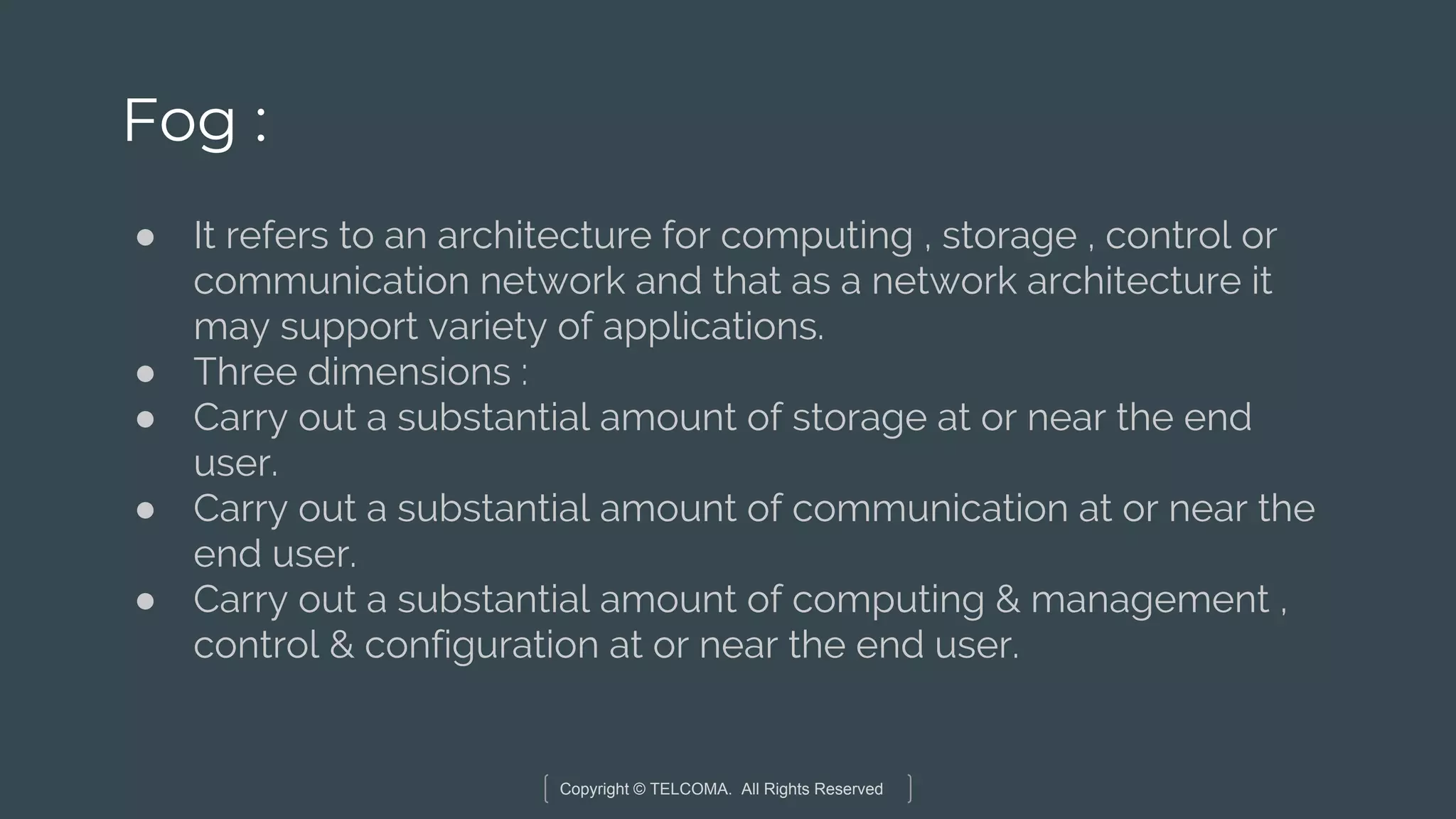
Fog :
● It refers to an architecture for computing , storage , control or
communication network and that as a network architecture it
may support variety of applications.
● Three dimensions :
● Carry out a substantial amount of storage at or near the end
user.
● Carry out a substantial amount of communication at or near the
end user.
● Carry out a substantial amount of computing & management ,
control & configuration at or near the end user.
Copyright © TELCOMA. All Rights Reserved
Fog :
● Fog Networking architecture
● Fog computing architecture
● Fog storage architecture
● Fog control architecture
Copyright © TELCOMA. All Rights Reserved
Computation & management
of Fog
Copyright © TELCOMA. All Rights Reserved
Paradrop :
An edge computing platform
in home gateways
Copyright © TELCOMA. All Rights Reserved
Introduction :
● Cloud computing platforms such as Amazon EC2 & Google app
engine have become a popular approach to provide ubiquitous
access to services across different user devices.
● Netflix & dropbox are popular cloud based services.
● For better user experience , computation is performed close to
end user referred to as “ edge computing “ & comes in various
flavours including :
Cyber foraging , cloudlets and fog computing
Copyright © TELCOMA. All Rights Reserved
Paradrop :
● Unique edge computing framework
● It allows developers to leverage one of the last bastions of
persistent computing resources in the end customer premises:
the gateway ( wireless Access point or home setup box).
● Paradrop framework allows multi tenancy through virtualisation,
dynamic installation through the developer API and resource
control through managed policy design.
Copyright © TELCOMA. All Rights Reserved
Paradrop :
Enabling multi-tenant
wireless gateways &
applications
Copyright © TELCOMA. All Rights Reserved
Enabling multi-tenant gateways & apps
● We want to push computation onto home gateways (e.g APs or
setup boxes ) for reasons :
● Home gateways can handle it.
● Internet gateway is there in the home.
● Pervasive hardware
Copyright © TELCOMA. All Rights Reserved
Paradrop capabilities :
● Privacy
● Low latency
● Local networking context
● Proprietary friendly
● Internet disconnectivity
Copyright © TELCOMA. All Rights Reserved
BANDWIDTH
Copyright © TELCOMA. All Rights Reserved
Leveraging the Fog :
● User based system - example of fog networking paradigm.
● Fog like architecture allows users to better control services they
receive.
● Fog networking can be applied to a broad range of systems ,
ranging from distributed storage and computing to network
bandwidth allocation.
Copyright © TELCOMA. All Rights Reserved
Socially aware cooperative
D2D & D4D communications
towards Fog Networking
Copyright © TELCOMA. All Rights Reserved
Cooperative communication :
● It is an efficient D2D & D4D communication paradigm where
devices can serve as relays for each other.
● Cooperative D2D & D4D communication can achieve BW by
exploiting different types of spectrum bands to support D2D
communications :
● Inband D2D & D4D communication.
● Outband D2D & D4D communication.
Copyright © TELCOMA. All Rights Reserved
Storage & Computation in Fog
Copyright © TELCOMA. All Rights Reserved
Distributed caching for enhanced
communication efficiency :
Wireless data traffic expected to increase by almost 10000 % over
next 5 years.
Type of data traffic increasing properties :
● User activity is highly asynchronous.
● High content reuse.
Copyright © TELCOMA. All Rights Reserved
Two caching methods :
● Femto - Caching : small dedicated “ helper nodes” can cache
popular files & serve requests from wireless users by enabling
localized wireless communication.
● The devices “pool” their caching resources so that different
devices caches different files and then exchange them, when
occasion arises , through short range , highly spectrally efficient
, D2D communication known as user caching.
Copyright © TELCOMA. All Rights Reserved
Two caching methods :
● User - caching enables the users to “ pool “ their caching
resources so that different files & then exchange them through
short range , highly spectrally efficient , local D2D
communication which results in further gains in spectral
efficiency.
Copyright © TELCOMA. All Rights Reserved
Get IoT in 5G Training with Certification
Visit our website
https://telcomaglobal.com/p/iot-in-5g
Copyright © TELCOMA. All Rights Reserved
User caching
Copyright © TELCOMA. All Rights Reserved
Cluster based caching & D2D comm. :
● In D2D network architecture , where devices act as caches.
● Let no. of files cached at each user & “K” be finite & do not
assume any helper stations.
● If device cannot obtain a file through D2D communication, it can
obtain it from macro cellular BS through conventional cellular
transmission.
Copyright © TELCOMA. All Rights Reserved
Wireless Video Fog
Copyright © TELCOMA. All Rights Reserved
Wireless video Fog :
● To serve geographically distributed clients , the stream is
distributed using a cloud , with the wireless clients
independently pulling the stream via Access point or Base
station.
● In wireless Fog for live video , the devices hence donate their
resources ( computing power, storage and communication BW)
to scale up the system in a cost effective manner.
Copyright © TELCOMA. All Rights Reserved
Wireless video Fog :
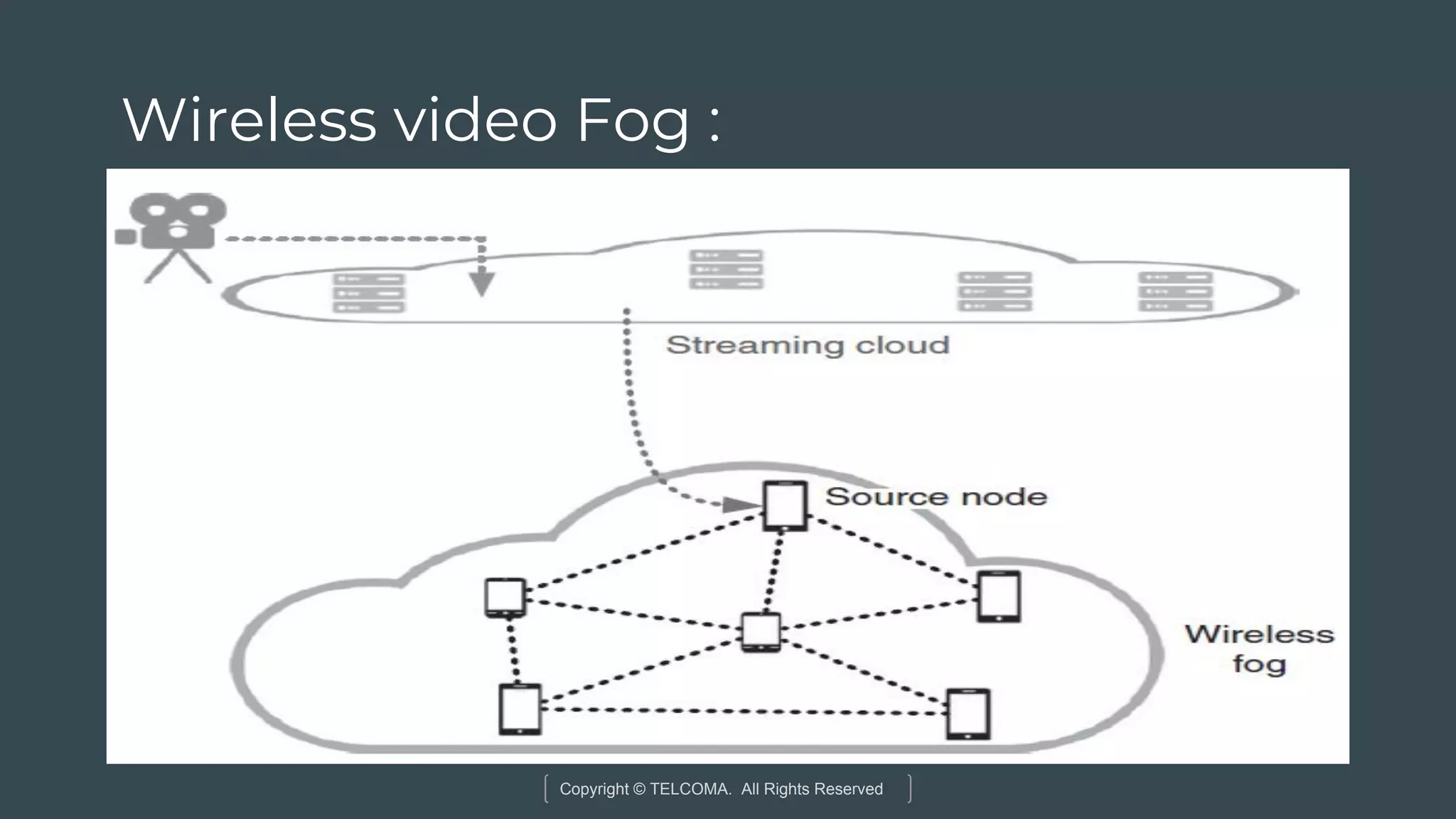
● The cloud is integrated with a wireless fog.
● In the fog, a source node first pulls the stream from a nearby
cloud server through an AP or BS.
● It then distributes its stream to nearby clients.
● By cooperatively relaying their received packets , nodes can
efficiently distribute the live stream within the fog.
Copyright © TELCOMA. All Rights Reserved
Wireless video Fog :
Copyright © TELCOMA. All Rights Reserved
Wireless video Fog :
● In a wireless fog, conventionally the live stream is distributed
using the “ store - and - forward “ approach , where selected
broadcasters simply forward their received packets to their
neighbors.
Copyright © TELCOMA. All Rights Reserved
Elastic Mobile device clouds :
Copyright © TELCOMA. All Rights Reserved
Elastic mobile device clouds :
● The cloudlet system move computation closer to mobile
devices, creating a two tier architecture .
● A mobile device can offload to a nearby, less capable server, at
low latency and high bandwidth rather than offloading to the
cloud.
● In the cloudlet vision , these nearby servers would be located in
public & commercial spaces where people congregate.
Copyright © TELCOMA. All Rights Reserved
Vision of Edge based clouds :
Two observations :
● While gap remains between truly mobile devices(handheld ,
wearable) & high capacity servers, mobile devices have grown
increasingly powerful especially when laptops are included.
● From an architectural perspective , it is possible use the
cloudlet , responsible for receiving tasks, scheduling their
computation and returning results & a complete cluster
responsible for performing the computation.
Copyright © TELCOMA. All Rights Reserved
Mont Blanc :
● This project aims to develop an energy and cost efficient
exascale HPC architecture.
● It utilizes energy efficient mobile device processors and
assembles a set of these processors.
Copyright © TELCOMA. All Rights Reserved
Goal of Mont Blanc project :
● Maximizing the performance of every single processor.
● Efficiently clustering multiple processors.
To maximize the performance gains from each processor, the
authors address a set of hardware challenges such as lack of
cooling infrastructure as well as software challenges
Copyright © TELCOMA. All Rights Reserved
Computing while charging :
It is a distributed computing infrastructure that uses smartphones as
the main computing nodes.
It consists of :
● Data center that has tasks to execute.
● Mobile devices with idle capacities that are charging their
batteries & connected to the data center via internet.
Copyright © TELCOMA. All Rights Reserved
Computing while charging :
● The CWC architecture is designed to enable a data center to
utilize idle capacity in mobile devices to enhance its
performance and/or reduce data center energy consumption.
● The CWC cluster environment is stable.
● The mobile devices are connected to power sources, which
means they do not move & they have good energy availability.
Copyright © TELCOMA. All Rights Reserved
Femto Cloud :
Copyright © TELCOMA. All Rights Reserved
Femto cloud :
● It is a system designed & implemented tp leverage mobile
devices to provide mobile computing services at the edge.
● It is designed to cluster co-located mobile devices in
environments where mobile devices presence times can be
estimated.
● Femto cloud architecture consists of a control device & a set of
executing mobile devices.
Copyright © TELCOMA. All Rights Reserved
Femto cloud :
The Femto cloud architecture predicts task characteristics ,
estimates device capacities , presence times & uses the acquired
information to distribute tasks across different executing devices as
follows :
● Task/cloud interface : it relies on the control device, which is
relatively stable compared to rest of devices in a Femto cloud
to provide a stable & discoverable interface between femto
cloud & its potential users.
Copyright © TELCOMA. All Rights Reserved
Femto cloud :
● Execution prediction : it relies on a generic task model where a
task is coordinated by its input size , output size and
computational load.
● Femto cloud only needs to estimate its output size & its
computational load.
● It relies on task originator to send the task with an estimate for
its computational load.
Copyright © TELCOMA. All Rights Reserved
Femto cloud :
● Device management : it is divided into three sub-tasks
implemented by control device and the computing mobile
devices :
● Discovery & registration
● Estimating device capacity
● Estimating the device presence time
Copyright © TELCOMA. All Rights Reserved
Femto cloud :
● Network management : it utilizes the shared wireless spectrum
to send tasks to their executing devices & gather their results .
● Task assignment & scheduling module
Copyright © TELCOMA. All Rights Reserved
Applications of Fog :
Copyright © TELCOMA. All Rights Reserved
Role of Fog computing in the
future of the Automobile :
Copyright © TELCOMA. All Rights Reserved
Role in Automobiles :
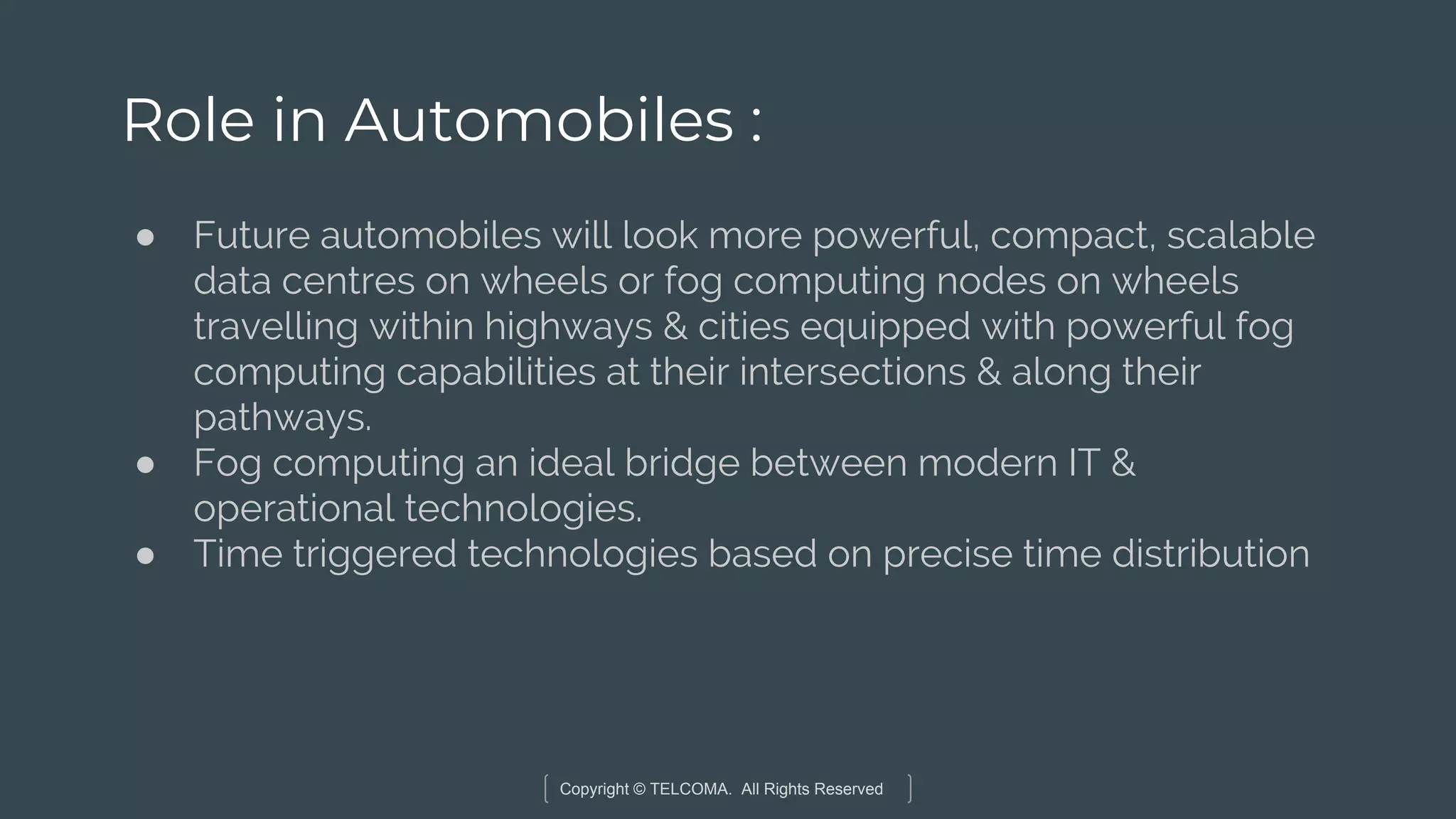
● Future automobiles will look more powerful, compact, scalable
data centres on wheels or fog computing nodes on wheels
travelling within highways & cities equipped with powerful fog
computing capabilities at their intersections & along their
pathways.
● Fog computing an ideal bridge between modern IT &
operational technologies.
● Time triggered technologies based on precise time distribution
Copyright © TELCOMA. All Rights Reserved
Role in Automobiles :
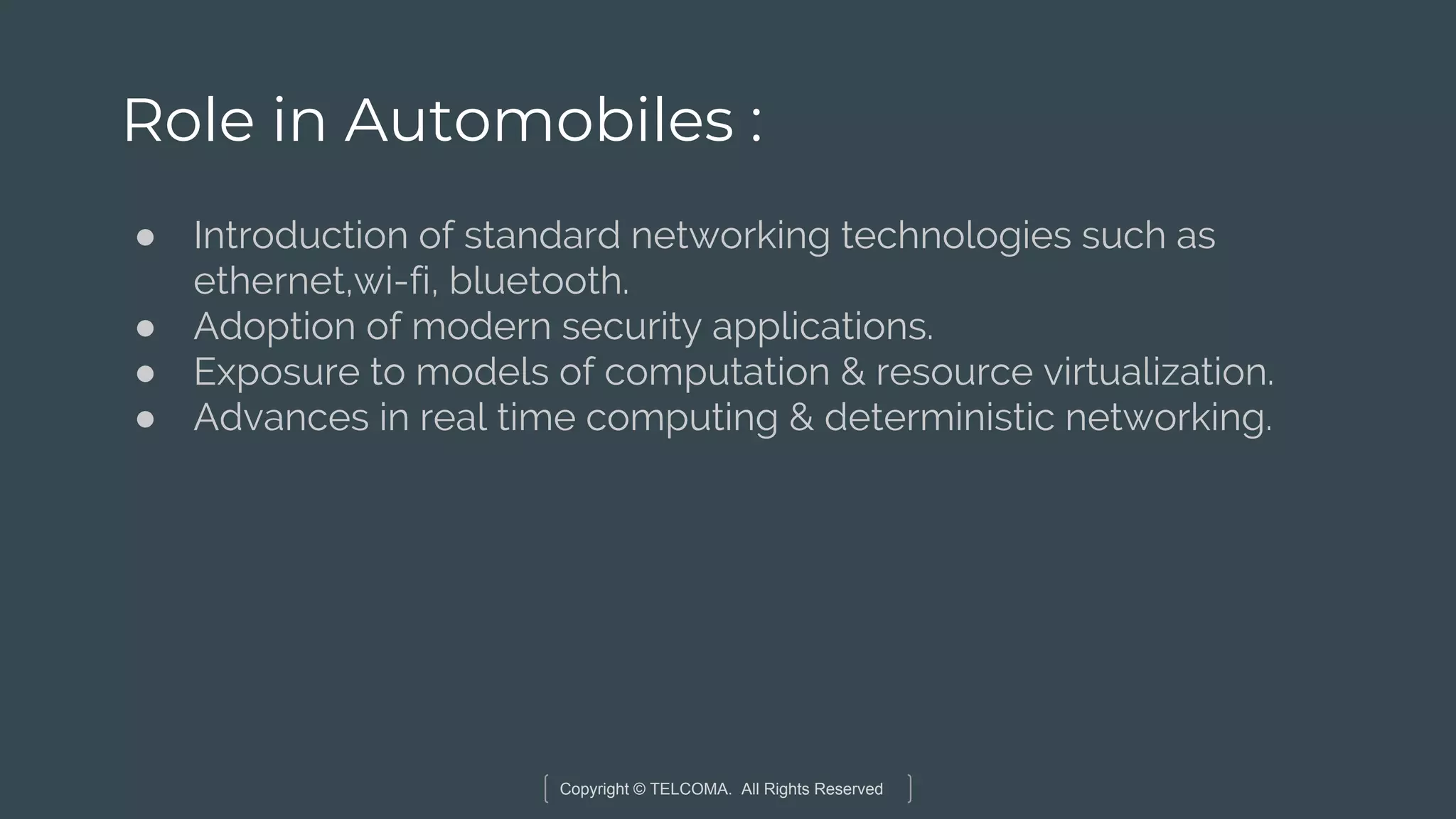
● Introduction of standard networking technologies such as
ethernet,wi-fi, bluetooth.
● Adoption of modern security applications.
● Exposure to models of computation & resource virtualization.
● Advances in real time computing & deterministic networking.
Copyright © TELCOMA. All Rights Reserved
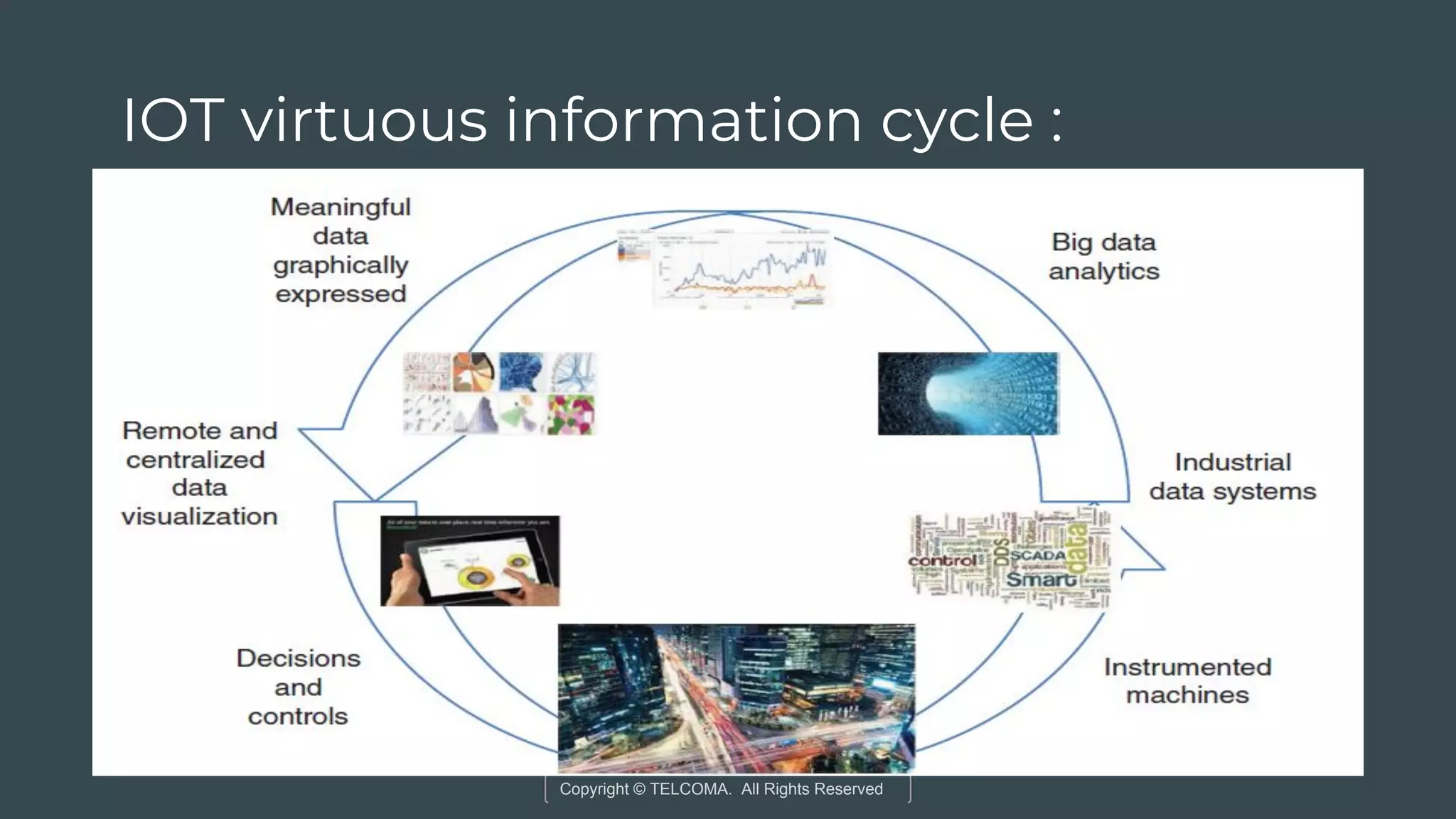
IOT virtuous information cycle :
Copyright © TELCOMA. All Rights Reserved
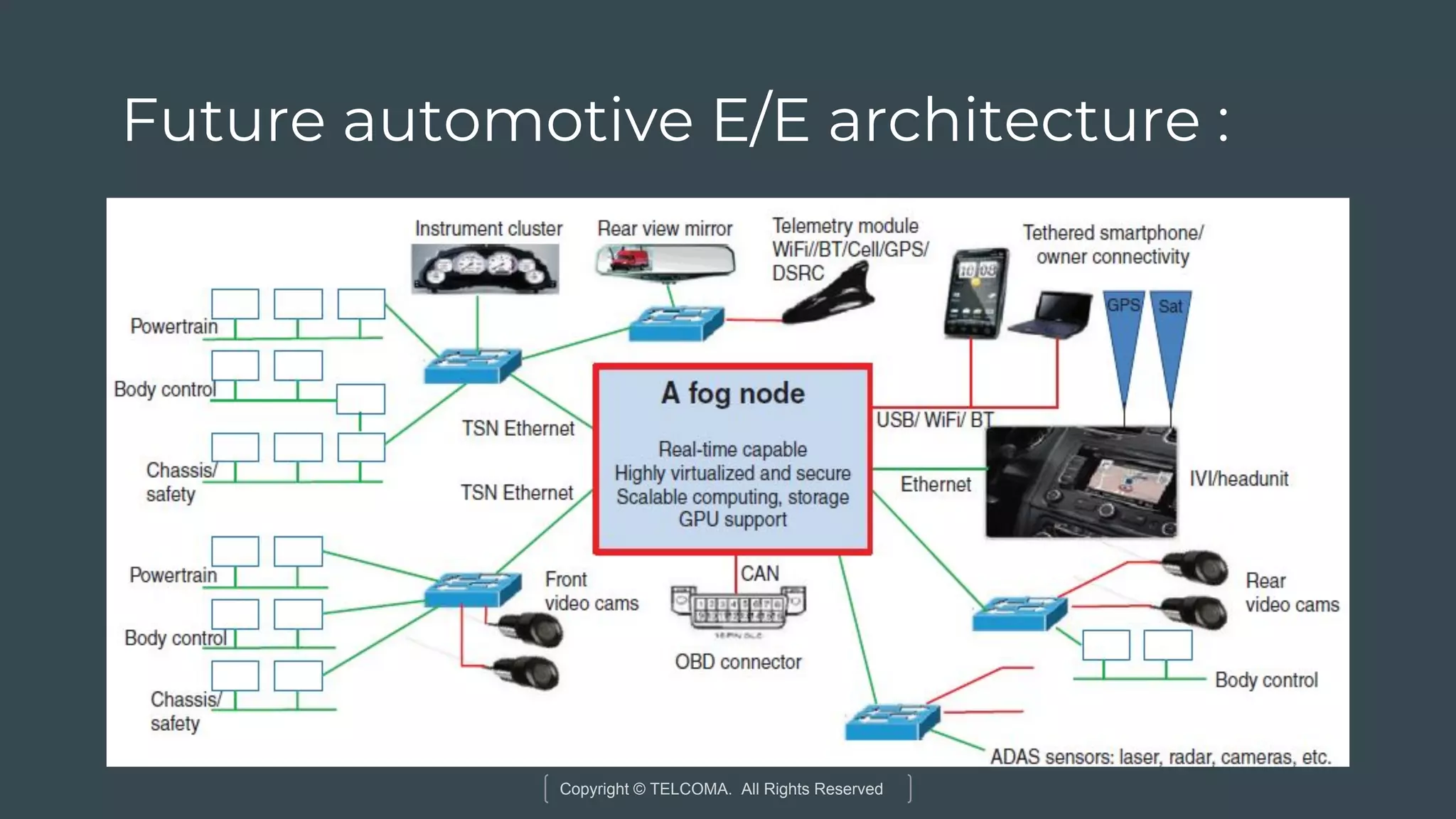
Future automotive E/E architecture :
Copyright © TELCOMA. All Rights Reserved
Geographic addressing for
field networks :
Copyright © TELCOMA. All Rights Reserved
Field networking :
Copyright © TELCOMA. All Rights Reserved
Field networking :
● Data communication networks enables devices in large scale
physical environment to communicate in order to support real
world tasks.
● In addition to emergency response & games , other applications
of field networking include Geosensing & data collection ,
process control , drone airspace awareness & control , military
operations & force protection , military training , connected &
autonomous vehicles.
Copyright © TELCOMA. All Rights Reserved
Field networking :
● Field networking scenarios involve fog networking scenarios.
● Firefighters need maps that come from servers in the cloud &
may upload logged sensor data to the cloud to support action
reviews.
Copyright © TELCOMA. All Rights Reserved
Geographic Addressing :
● It refers to communication protocols that allow a sender to
specify the intended recipients with traditional schemes, such
as IP addressing.
● The address refers exactly to the set of devices that are in the
area at the time the message is transferred , a set whose
extension changes rapidly with time.
Copyright © TELCOMA. All Rights Reserved
IOT capabilities towards 5G :
Copyright © TELCOMA. All Rights Reserved
IOT capabilities towards 5G :
● LTE IOT, which includes enhanced eMTC
● Long term evolution for machines
● Narrowband IOT
Copyright © TELCOMA. All Rights Reserved
Executing use cases :
● Ubiquitous coverage : coverage of challenging locations by
optimizing the device link budgeted for low - data rates.
● Ultra - low current : it enables efficient use of device battery life
to maximize years of useful operation in the field.
● Increased capacity : to efficiently support dense connections
per km2.
● Low complexity : scaling the IOT for low end , single mode use
cases.
Copyright © TELCOMA. All Rights Reserved
On the way to 5G & IOT :
● Connecting & managing growing no. of cars , meters ,
machinery sensors and consumer electronics profitably will
require innovative business models.
● The vast majority of operator IOT revenues come from
connectivity.
● Operators capable of creating & managing
Copyright © TELCOMA. All Rights Reserved
From IOT to IOE :
Copyright © TELCOMA. All Rights Reserved
From IOT to IOE :
● IOT is a novel computing platform that is rapidly gaining space
in terms of modern communication technologies.
● IOT idea implied other concepts, such as
IOS - internet of service
IOE - internet of everything
WOT - web of things
Copyright © TELCOMA. All Rights Reserved
Internet of everything :
● IOE connects people, data , things and processes in networks of
billions or trillions of connections.
● There are three keys in which IOE will significantly impact our
lives as described :
IOT will automate connections
IOE will enable fast personal communication & decision making
IOE will uncover new information
Copyright © TELCOMA. All Rights Reserved
IOE’s individual concepts :
● People
● Data
● Things
● Process
Copyright © TELCOMA. All Rights Reserved
Architecture :
Copyright © TELCOMA. All Rights Reserved
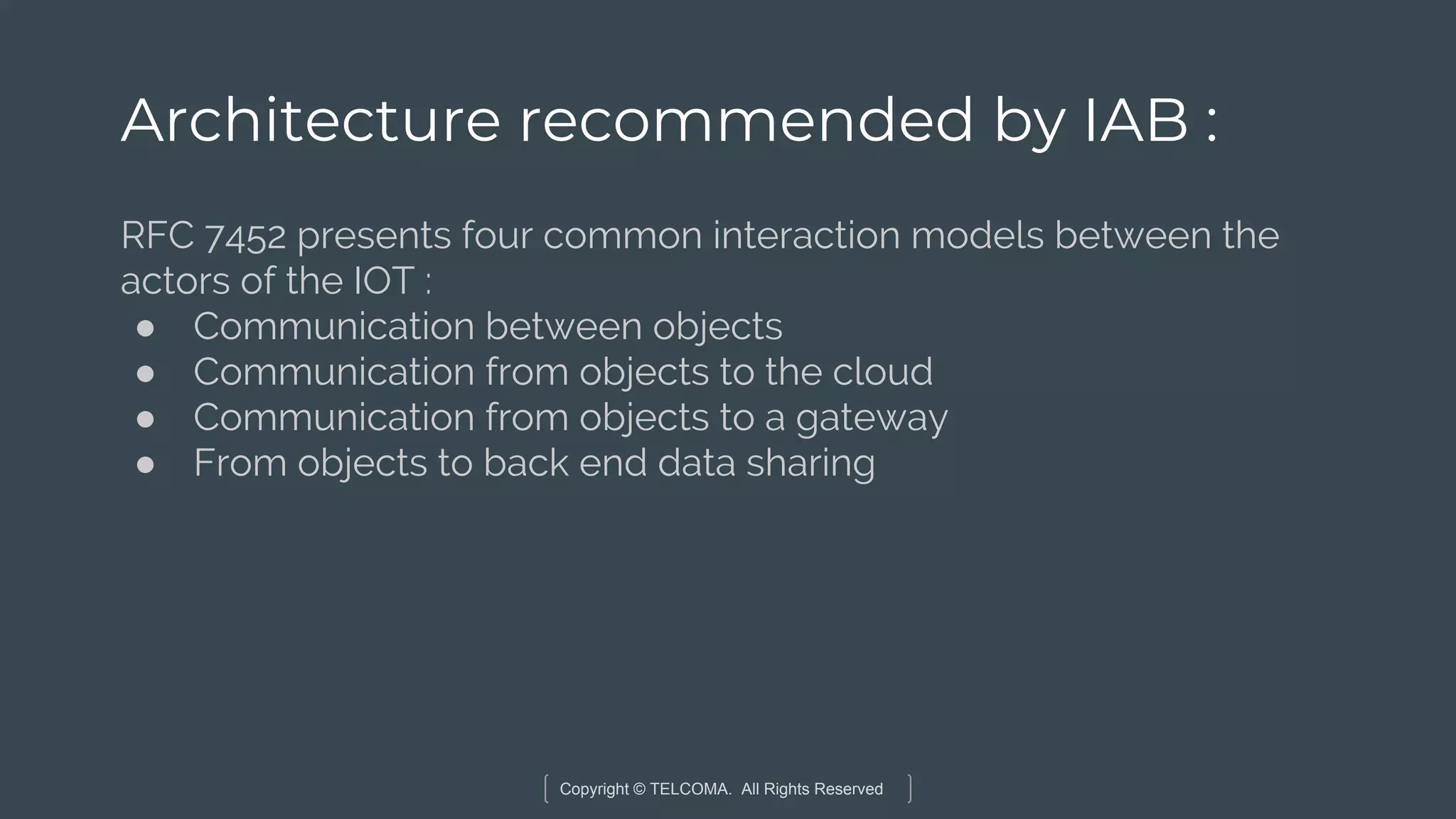
Architecture recommended by IAB :
RFC 7452 presents four common interaction models between the
actors of the IOT :
● Communication between objects
● Communication from objects to the cloud
● Communication from objects to a gateway
● From objects to back end data sharing
Copyright © TELCOMA. All Rights Reserved
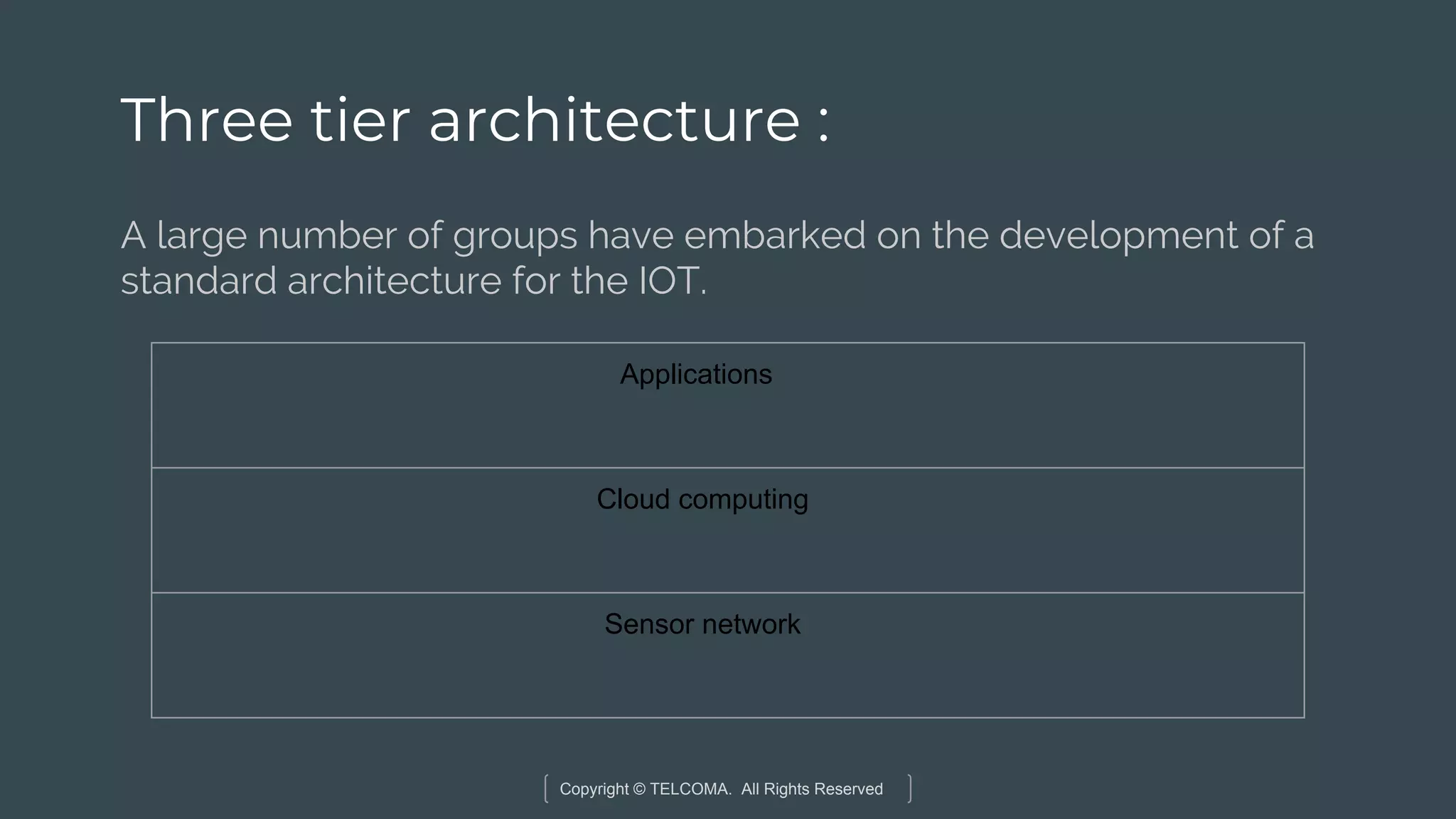
Three tier architecture :
A large number of groups have embarked on the development of a
standard architecture for the IOT.
Applications
Cloud computing
Sensor network
Copyright © TELCOMA. All Rights Reserved
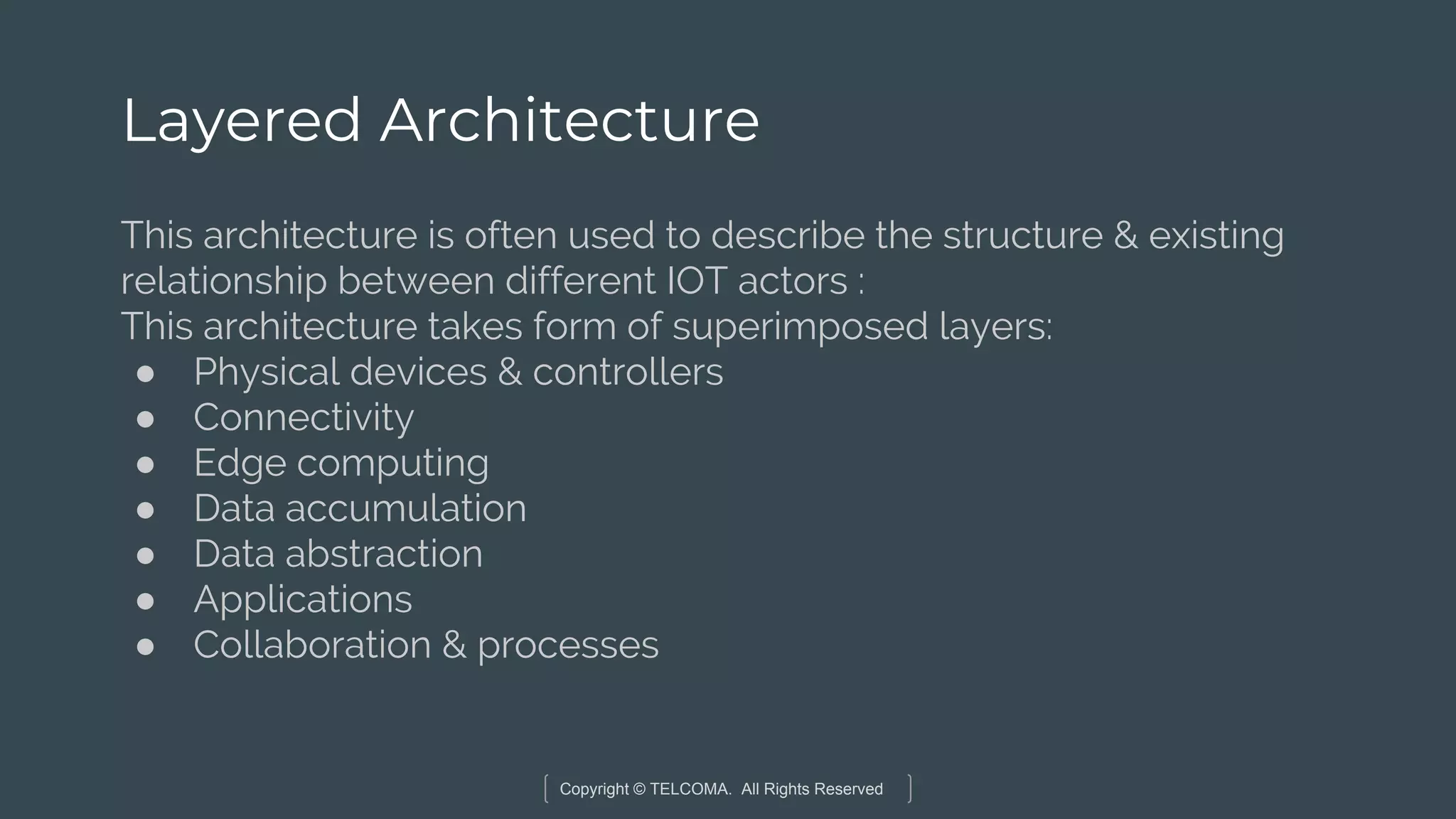
Layered Architecture
This architecture is often used to describe the structure & existing
relationship between different IOT actors :
This architecture takes form of superimposed layers:
● Physical devices & controllers
● Connectivity
● Edge computing
● Data accumulation
● Data abstraction
● Applications
● Collaboration & processes
Copyright © TELCOMA. All Rights Reserved
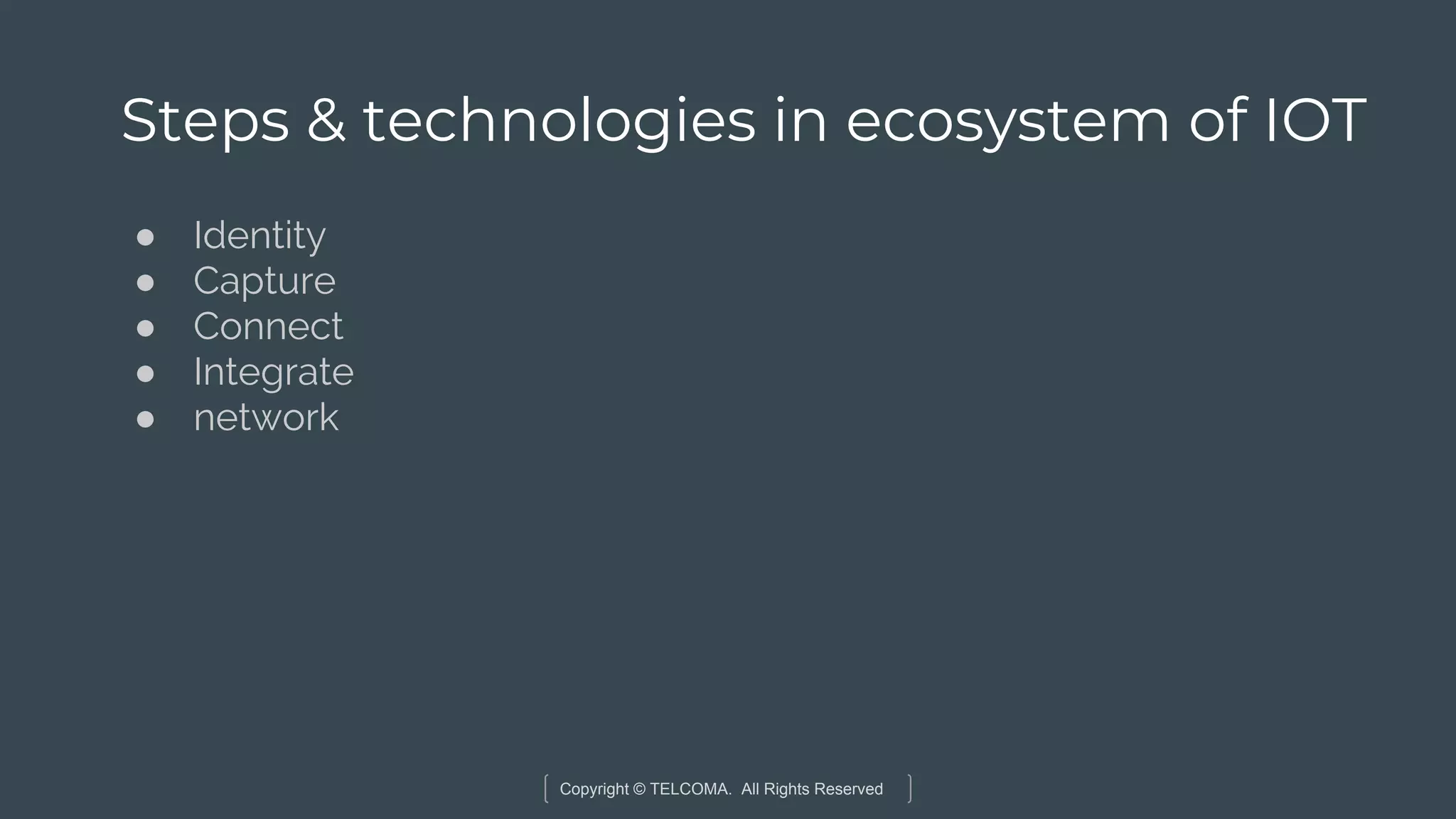
Steps & technologies in ecosystem of IOT
● Identity
● Capture
● Connect
● Integrate
● network
Copyright © TELCOMA. All Rights Reserved
Steps :
● Identifying : Knowing how to precisely determine which object is
connected to what in what way and in which location.
● Capture : in order for CO’s to fulfill their role of bridge between
the physical and virtual worlds, sensors are indispensable.
● Connection : linking objects with each other so that they can
exchange data in a more autonomous manner.
● Integrate : connecting CO’s to the virtual world with the help of
wireless communication method.
● Networking : users want to able to interact remotely with their
objects while the providers want to collect the data generated ,
that is often the service basis.
Copyright © TELCOMA. All Rights Reserved
Fog Computing :
Copyright © TELCOMA. All Rights Reserved
Basics :
● Introduction of IOT brings billions of devices to the internet.
● To overcome the challenges of these devices and meet the
requirements of the application domain .
● The concept of fog computing is the latest descendant in the
line of physical separation of functional units.
Copyright © TELCOMA. All Rights Reserved
Characteristics of Fog layer :
● Fog layer is closer to the perception layer & this proximity
provides a range of advantages that characterize the layer.
● Location awareness comes due to the large scale geographical
distribution of devices that make up the Fog layer.
● This subset of of resource constrained devices are located
close to each other and the managing gateway can easily
locate each device.
Copyright © TELCOMA. All Rights Reserved
Characteristics of Fog layer :
● The geographical distribution of the Fog layer & subsequently
the offered low communication latency are among the critical
features of fog layer.
● The IOT in general is dominated by wireless networks.
● There are many wireless protocols mostly tailored for low
power operation , coverage or bandwidth.
Copyright © TELCOMA. All Rights Reserved
Characteristics of Fog layer :
● The majority of these protocols connect sensor nodes to the fog
layer to get access to the internet.
● Fog layer provides an additional benefit of acting as
interpretability layer among these heterogenous protocols.
● The gateways in the Fog layer can also perform lightweight
analytics at the edge to give feedback , command and
notification to the end users as well as sensor nodes in real time.
Copyright © TELCOMA. All Rights Reserved
Design & organization of Fog layer :
● In a larger environment, multiple access points can be arranged
to provide users with seamless connectivity throughout the
intended area.
● In addition to simply passing network packets , these networked
smart gateways can process the data or store it when
necessary.
● Distributed smart gateways communicate with the cloud , the
sensor layer and among themselves.
Copyright © TELCOMA. All Rights Reserved
Fog computing services :
These services are organized into three layers :
● Compute
● Storage
● Network
Copyright © TELCOMA. All Rights Reserved
Computing services :
● There are multiple configurations of sharing the computing load
among the different layers in the IOT based systems.
● Beside data management, events can be handled at the Fog
layer.
● There are many middleware that leverage the fog layer to
manage devices through abstraction , agent based
management & virtual machines.
Copyright © TELCOMA. All Rights Reserved
Storage services :
● The storage services helps to enhance the reliability of the
system by maintaining proper behavior of client nodes.
● Combined with computing service, stored data can be filtered,
analyzed and compressed for efficient transmission.
Copyright © TELCOMA. All Rights Reserved
communication services :
● The communication in the IOT is dominated by wireless nodes.
● The Fog layer is located in a strategic place to organize
multitude of wireless protocols and unify their communication
to the cloud layer.
● This helps in managing sub-networks of sensors and actuators
providing security, channeling messaging among devices &
enhancing reliability of the system.
Copyright © TELCOMA. All Rights Reserved
Management of Fog layer :
Copyright © TELCOMA. All Rights Reserved
IOT Resource estimation challenges :
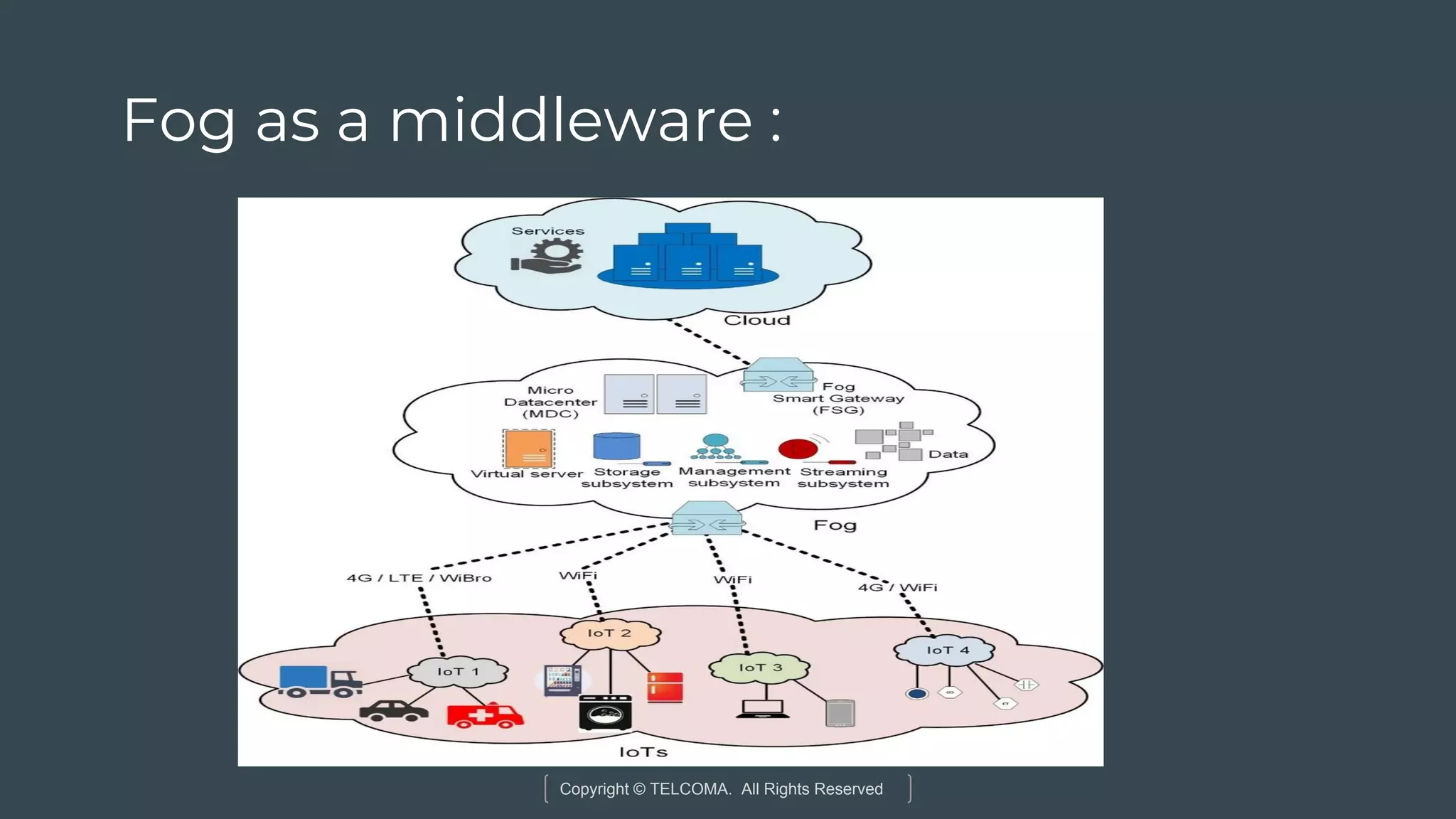
● Fog will act like a mediator & will be able to perform tasks that
may not be efficiently done by distant cloud.
● Fog would be present close to the underlying nodes for the
purpose of offloading the tasks & preprocessing the raw data.
● Fog will also be responsible to minimize delay & enhance
service quality.
Copyright © TELCOMA. All Rights Reserved
Resource management :
● Resource scheduling is tricky in case of mobile nodes.
● Resource underutilization become problem when underlying
nodes are mobile.
● Fog plays an important role in resource management , being in
proximity to the users and to make decisions in a more realistic
way.
● Mission critical & latency sensitive IOT services require very
quick response & processing.
Copyright © TELCOMA. All Rights Reserved
Resource management :
● The concept of fog networking is to bring networking resources
near the nodes that are generating data .
● Fog resources lies between the perception layer & cloud layer.
● For mobile nodes , fog provides low latency and high quality
streaming through proxies & access points located across
highways & tracks.
● Resource & power constrained individual nodes , WSNs &
virtual sensor networks would be able to take advantage from
the presence of fogs.
Copyright © TELCOMA. All Rights Reserved
Resource management :
● The concept of fog networking is to bring networking resources
near the nodes that are generating data .
● Fog resources lies between the perception layer & cloud layer.
● For mobile nodes , fog provides low latency and high quality
streaming through proxies & access points located across
highways & tracks.
● Resource & power constrained individual nodes , WSNs &
virtual sensor networks would be able to take advantage from
the presence of fogs.
Copyright © TELCOMA. All Rights Reserved
Fog Resource estimation & its
challenges :
Copyright © TELCOMA. All Rights Reserved
Fog Resource estimation & its challenges :
● Depending upon the type of IOT service , the underlying nodes
can be devices as well as dumb objects.
● A multitude of mobile nodes , including fast moving vehicles
would also be among the pool of nodes requiring resources
from a fog.
Copyright © TELCOMA. All Rights Reserved
Fog as a middleware between
IOT & Cloud :
Copyright © TELCOMA. All Rights Reserved
Fog as a middleware :
Copyright © TELCOMA. All Rights Reserved
Device type :
● A resource rich computer or laptop with ample resources a lot
of resource with high quality expectations.
● A sensor would be resource constrained.
● Fog has to allocate resources keeping in view the power or
battery status of the sensor.
● Processing resource would be the key as the data generated
from them may have to be accumulated, trimmed & processed
before sending it to the cloud or creating services locally.
Copyright © TELCOMA. All Rights Reserved
Mobility on the ground :
● With mobility , the resource procurement becomes more of
challenge.
● Several crowdsensing applications will take benefit from fog
based IOT services.
● Several sensors within a vehicle will be working under a fog.
● Fog has to take into account the type sensor, the way they are
being powered, data communication frequency, mobility speed
& mobility pattern while deciding about reasonable resources.
Copyright © TELCOMA. All Rights Reserved
Mobility in the Air : internet of Drones
● For flying objects , resource estimation would be way beyond
the conventions.
● IOD would require much faster processing & high bandwidth.
● Some drones would generate HD video data , some will be
responsible for imagery , and some would be equipped with
sensors or an array of sensors.
Copyright © TELCOMA. All Rights Reserved
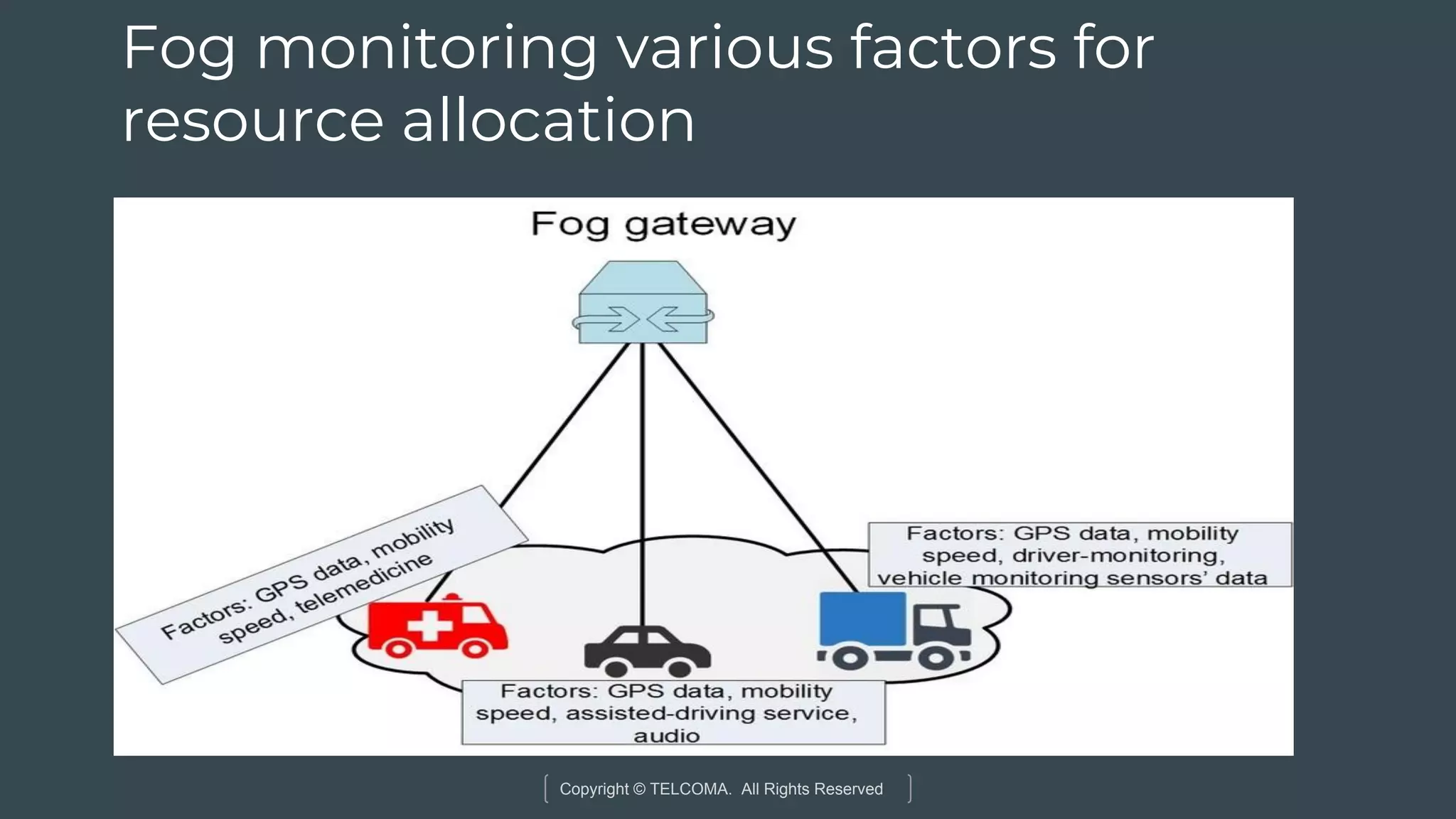
Fog monitoring various factors for
resource allocation
Copyright © TELCOMA. All Rights Reserved
Power utilization & status
● Fog is responsible for monitoring power and deciding when to
offload tasks from devices.
● The resource estimation would be performed dynamically in
real time.
Copyright © TELCOMA. All Rights Reserved
Data types
● Types of data plays an important role in accessing the time and
amount of resources.
● Multimedia data would require processing , memory, storage &
GPU.
● Storage & memory depends on type of data and nature of
application.
Copyright © TELCOMA. All Rights Reserved
Security
● It is of two types : data security & communication security
● Data security refers to making the data unreadable for
unintended party.
● Communication security means the data is transferred through
a secure channel.
Copyright © TELCOMA. All Rights Reserved
Customer’s reliability & loyality of service
utilization
● It would be very difficult to forecast if a requiring customer is
going to fully utilize the resources requested for.
● With mobile nodes, reliability can not be guaranteed.
● If a certain check is set on customer’s behavior and service
utilization pattern , better resource estimation can be
performed.
Copyright © TELCOMA. All Rights Reserved
Fog’s role within ULSS
Copyright © TELCOMA. All Rights Reserved
Architecture
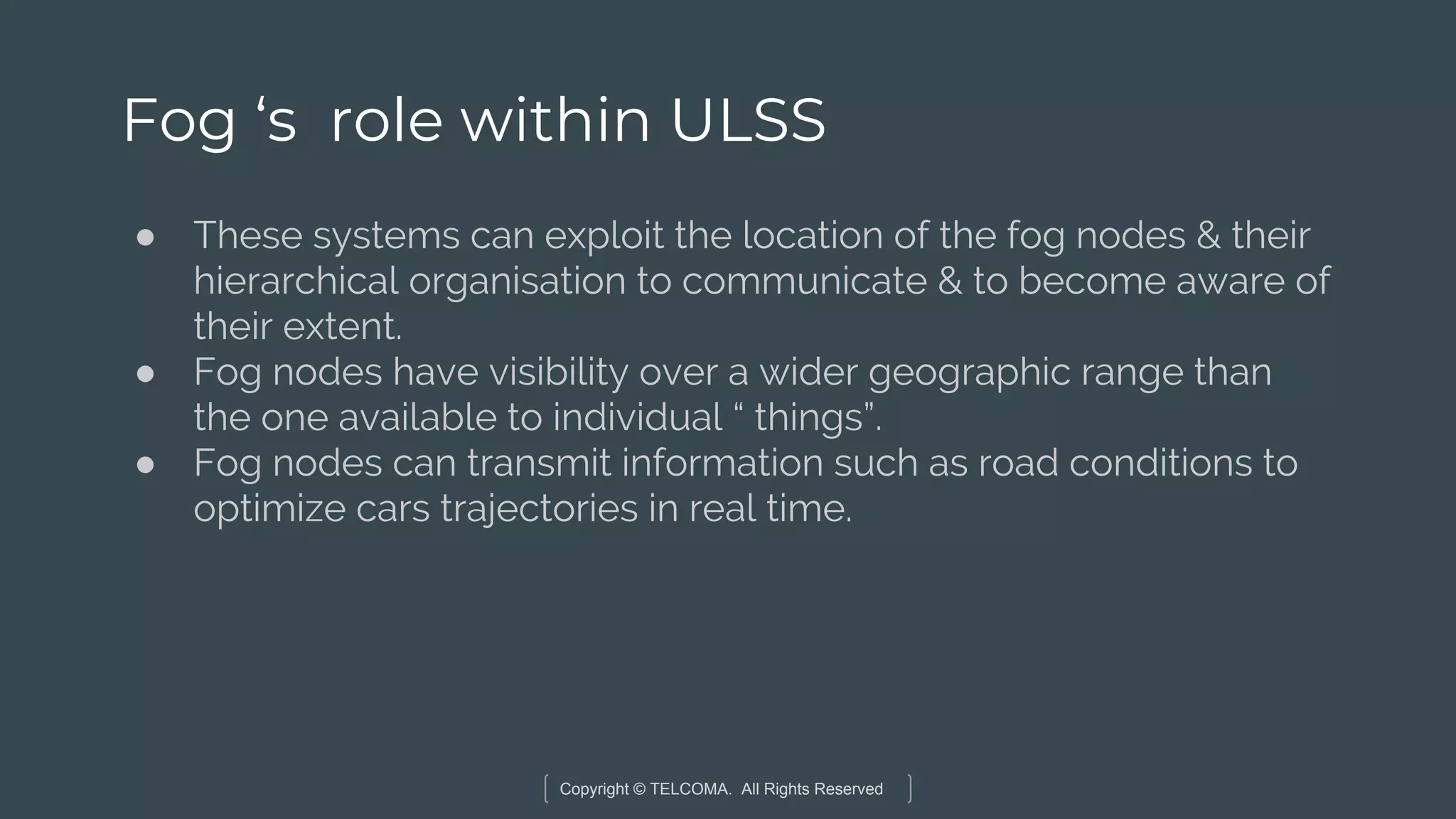
● Sensors & actuators are responsible for gathering information &
acting on the environment.
● Heterogenous fog nodes , which constitute the aggregation
points.
● The “things” & “nodes” communicate mostly through wireless
technologies , since both things & nodes can move.
Copyright © TELCOMA. All Rights Reserved
Architecture
● The cloud constitutes the highest layer, offering a large pool of
resources low-cost without any latency requirements.
Copyright © TELCOMA. All Rights Reserved
Fog ‘s role within ULSS
● These systems can exploit the location of the fog nodes & their
hierarchical organisation to communicate & to become aware of
their extent.
● Fog nodes have visibility over a wider geographic range than
the one available to individual “ things”.
● Fog nodes can transmit information such as road conditions to
optimize cars trajectories in real time.
Copyright © TELCOMA. All Rights Reserved
Fog ‘s role within ULSS
● These systems can exploit the location of the fog nodes & their
hierarchical organisation to communicate & to become aware of
their extent.
● Fog nodes have visibility over a wider geographic range than
the one available to individual “ things”.
● Fog nodes can transmit information such as road conditions to
optimize cars trajectories in real time.
Copyright © TELCOMA. All Rights Reserved
Fog ‘s role within ULSS
● When “things” move out of the range they get disconnected
from that node.
● If another node is available in the next location , the process can
continue.
● This technique eliminates the need of migrating data from one
node to the next node because the “thing” itself carries the
necessary information.
Copyright © TELCOMA. All Rights Reserved
Services of Fog layer :
Copyright © TELCOMA. All Rights Reserved
Blockchain
● It is a decentralized ledger of all Bitcoin transactions across a
peer to peer network.
● The nodes with in the network validate the transaction and the
user’s status by using known algorithms to ensure that the same
bitcoins were not spent previously.
Copyright © TELCOMA. All Rights Reserved
Blockchain
● A verified transaction can involve cryptocurrency , contracts,
records & other information.
● Using this technology , users can confirm transactions without
the need for a central certifying authority , normally enforced by
central banks.
Copyright © TELCOMA. All Rights Reserved
IOT , Fog computing & Block chain
● IOT devices normally have limited resources that are not
enough to properly support cryptocurrency mining due to its
computational cost.
● Mining of blocks is time consuming & creates signalling
overhead traffic , which is undesirable. Moreover , blockchain
does not properly scale with the ever increasing introduction of
nodes in the network.
Copyright © TELCOMA. All Rights Reserved
IOTA
● It is a novel transactional settlement and data transfer layer for
IOT.
● It is based on a new distributed ledger , the tangle which
overcomes the deficiencies of blockchain designs & introduces
a new way of reaching consensus in a decentralized peer - to
-peer system.
● IOTA enables companies to explore new B2B models by making
every technological resource a potential service to be traded in
an open market.
Copyright © TELCOMA. All Rights Reserved
IOTA
● New approaches for IOT have been proposed with the
introduction of Fog & Mist.
● IOTA combines both Fog & Mist into a new distributed
computing solution.
● This can be seen as a combination of smart sensors with built-in
computational capabilities (mist computing) with nearby
processing stations ( Fog computing).
Copyright © TELCOMA. All Rights Reserved
Get IoT in 5G Training with Certification
Visit our website
https://telcomaglobal.com/p/iot-in-5g
Copyright © TELCOMA. All Rights Reserved
Services of Fog layer :
Copyright © TELCOMA. All Rights Reserved
ADEPT :
Copyright © TELCOMA. All Rights Reserved
Autonomous decentralized P2P Telemetry
● By using the devices themselves as computational, storage &
communication nodes , we can build “hybrid” IOT systems
where the edge complements centralized systems.
● IBM & Samsung have developed ADEPT proof of concept.
● This work is supported by three distinct protocols:
● Bit torrent
● Ethereum
● Telehash
Copyright © TELCOMA. All Rights Reserved
Autonomous decentralized P2P Telemetry
● Use case : decentralized advertising marketplace using large
format displays to share & publish content without a centralized
controller. The concept in LFD as compared with conventional is
that we can share the content with anyone.
Copyright © TELCOMA. All Rights Reserved
Multi party computation :
Copyright © TELCOMA. All Rights Reserved
Multi party computation
● Secure multi-party computing is a technique that can be used
here , since its purpose is to have multi parties exchanging
secret information privately without the need of trusted third
party.
● MPC consists of two or more parties where each part has their
own secret input.
Copyright © TELCOMA. All Rights Reserved
Self Aware fog computing in
private & secure spheres :
Copyright © TELCOMA. All Rights Reserved
Self aware fog computing
● Wearable sensors for measuring our leisure & sports activities
as well as our health conditions have proliferated & gained
acceptance.
● The advances of sensing, computation & communication
technology are also being utilized in military applications.
Copyright © TELCOMA. All Rights Reserved
Cloud , Fog & Mist computing networks
● The functional & non-functional system parameters are affected
by the selection of computing architecture when choosing
between Fog, Mist & cloud computing architectures.
● Some of these parameters include latency of control loops,
bandwidth usage , storage requirements , security & privacy
aspects , system robustness & reliability.
● In applications where low latency from the sensor to the data
consumer is critical - mist computing architecture is beneficial.
Copyright © TELCOMA. All Rights Reserved
Cloud , Fog & Mist computing networks
● Cloud computing is applicable where we are either processing
big amounts of data, for which processing methods may be
complex.
● Fog computing brings computation closer to the edge of the
network. In Fog computing , a more capable device bears the
responsibility for data processing or IOT application execution.
Copyright © TELCOMA. All Rights Reserved
Self aware data processing
The umbrella term self awareness encloses a no. of concepts such
as :
● Self - adaptation
● Self - organization
● Self - healing
● Self - expression and other self - properties
Copyright © TELCOMA. All Rights Reserved
Self aware data processing
A self aware system should fully understand its own situation &
detect its own misbehavior or underperformance due to :
● Faults, that may be caused by aging , accidents or physical
attacks
● A malicious attack on its functions
● Functional design errors in its hardware or software
Copyright © TELCOMA. All Rights Reserved
Control as a service in cyber
physical energy systems over
Fog computing
Copyright © TELCOMA. All Rights Reserved
Power grid & energy management
● Localized distributed energy system is called microgrid.
● The primary purpose of microgrid is to ensure local , reliable
and affordable energy security for communities.
● The growing number of devices & customers in the power grid
increases the demand for electrical energy consumption.
Copyright © TELCOMA. All Rights Reserved
Energy management methodologies
● Smart & energy efficient appliance control
● Utilizing renewable energy
● Electricity demand management
Copyright © TELCOMA. All Rights Reserved
Cyber physical energy systems
● The cyber system brings the capability of computation ,
communications & control.
● The smart grid which leverages the cyber and physical
interaction is called CPES.
● It brings multi level monitoring & control capability to the power
grid in order to improve its reliability, flexibility, efficiency & cost
effectiveness.
Copyright © TELCOMA. All Rights Reserved
Cyber physical energy systems
● Multitude of sensors at different levels of the system
responsible for monitoring multiple variables indicating state of
the system.
● Major requirements of the architecture :
Interoperability
Scalability
Ease of deployment
Open architecture
Play & plug capability
Local & remote monitoring
Copyright © TELCOMA. All Rights Reserved
Control as a service
● The energy management platform can be used for any type of
buildings & various domains of operation e.g microgrid or home.
● The energy management may have various purposes:
Monitoring & metering the power consumption of each device
e.g home power consumption
Managing the energy consumption by controlling the devices
efficiently.
Copyright © TELCOMA. All Rights Reserved
Residential cyber-physical energy system
● The implementation of caas on top of fog computing platform is
applied to two prototypes of HEM & microgrid- level energy
management to demonstrate its advantages for different
domains.
Copyright © TELCOMA. All Rights Reserved
Home energy management
● In the home , multiple smart devices such as : HVAC, water
heater & EV charger.
● Each device is monitored & controlled by the HEM control
panel.
● The devices have their own control panel to monitor their status
& set their configurations,
● The home is being monitored by a network of four sensor
devices .
● The sensor network is defined as a subsystem inside the
platform.
Copyright © TELCOMA. All Rights Reserved
Micro grid level energy management
● The micro level energy management platform comprises three
homes connected to a transformer.
● A control panel is implemented in the transformer to monitor
and manage the power consumption of each home.
● The transformer level control panel monitors the load of each
home and may decide to send demands to their HEM in order to
reduce power consumption.
Copyright © TELCOMA. All Rights Reserved
Micro grid level energy management
● In this platform a transformer management has been
implemented as a service.
● The controller monitors the home connected to the transformer
in order to prevent overloading of the transformer.
● It receives information about the array of homes connected and
the total load on the transformer.
● The controllers are implemented in the micro-grid level fog
computing platform.
Copyright © TELCOMA. All Rights Reserved
Leveraging Fog computing for
Healthcare IOT
Copyright © TELCOMA. All Rights Reserved
Healthcare services in Fog layer
● This layer provides computing , networking, storage and other
domain specific services for IOT systems.
● The healthcare domain has a set of requirements that uniquely
identify it from other IOT apps.
● The physical proximity of Fog layer to Body area networks of
sensors & actuators allows us to address the requirements of
healthcare IOT.
Copyright © TELCOMA. All Rights Reserved
Data management
● It has an important role in Fog computing by which sensory data
is locally processed to extract meaningful information.
● Fog layer continuously receives a large amount of sensory data
in a short period of time from the sensor network.
● Different gateways in smart e-health gateway:
Local storage
Data filtering
Data compression
Data fusion
Data analysis
Copyright © TELCOMA. All Rights Reserved
Local storage
● The gateway needs to store received data from several sources
in a local storage to be able to utilize it in the near future
analysis.
● The local storage in the gateway can be used to store files in
encrypted or compressed format based on type, size and
importance of data.
● Using local storage , the gateway is able to export data to
medical standard formats such as Health level seven (HL7) if
required.
Copyright © TELCOMA. All Rights Reserved
Data filtering
● It is the first data processing unit to implement filtering methods
at the edge after receiving data from sensor network.
● Available light weight filtering in some of the sensor nodes
reduces these accumulated noises although it might be
insufficient in practical cases.
● Data filtering unit in Fog layer enables to remove noise and
increase aspects of the signals using various filters before any
other local data analytics.
Copyright © TELCOMA. All Rights Reserved
Data compression
● In health care IOT applications, loss-less compression is more
preferable in most of the cases because lost data can cause
inappropriate disease diagnosis.
● In some cases loss-less algorithms can be successfully
operated at sensor nodes but they cause a large power
consumption and latency.
● With fog computing all limitations can be avoided.
Copyright © TELCOMA. All Rights Reserved
Data fusion
● It is the data processing unit to integrate sensory data from
multiple sources to obtain more robust data and meaningful
information.
● Data fusion can be divided into 3 classes :
Complementary
Competitive
cooperative
Copyright © TELCOMA. All Rights Reserved
Data analysis
● Data analysis unit at the edge enables the health care to
process the sensory data locally.
● This unit improves the system performance by decreasing
response latency and data transmission to the cloud servers.
● Data analysis at the edge could manage the system’s
functionality locally , store the sensory data as well as the
calculations in the local storage and subsequently synchronize
the Fog layer with the remote control after reconnecting to the
network.
Copyright © TELCOMA. All Rights Reserved
Event management
● Fog computing provides low latency communication which
helps to notify health experts , caregivers and even patients
very fast in case of serious events.
● The real time and fast response of actuators are important in
some medical events
Copyright © TELCOMA. All Rights Reserved
System architecture of
Healthcare IOT
Copyright © TELCOMA. All Rights Reserved
System architecture
● The architecture of a system provides information about the
components , interaction and organization of the parts.
● It is one of the key elements for achieving graceful scaling and
performance.
● It is designed to meet functional requirements of the application
domain.
Copyright © TELCOMA. All Rights Reserved
System architecture
Copyright © TELCOMA. All Rights Reserved
System architecture
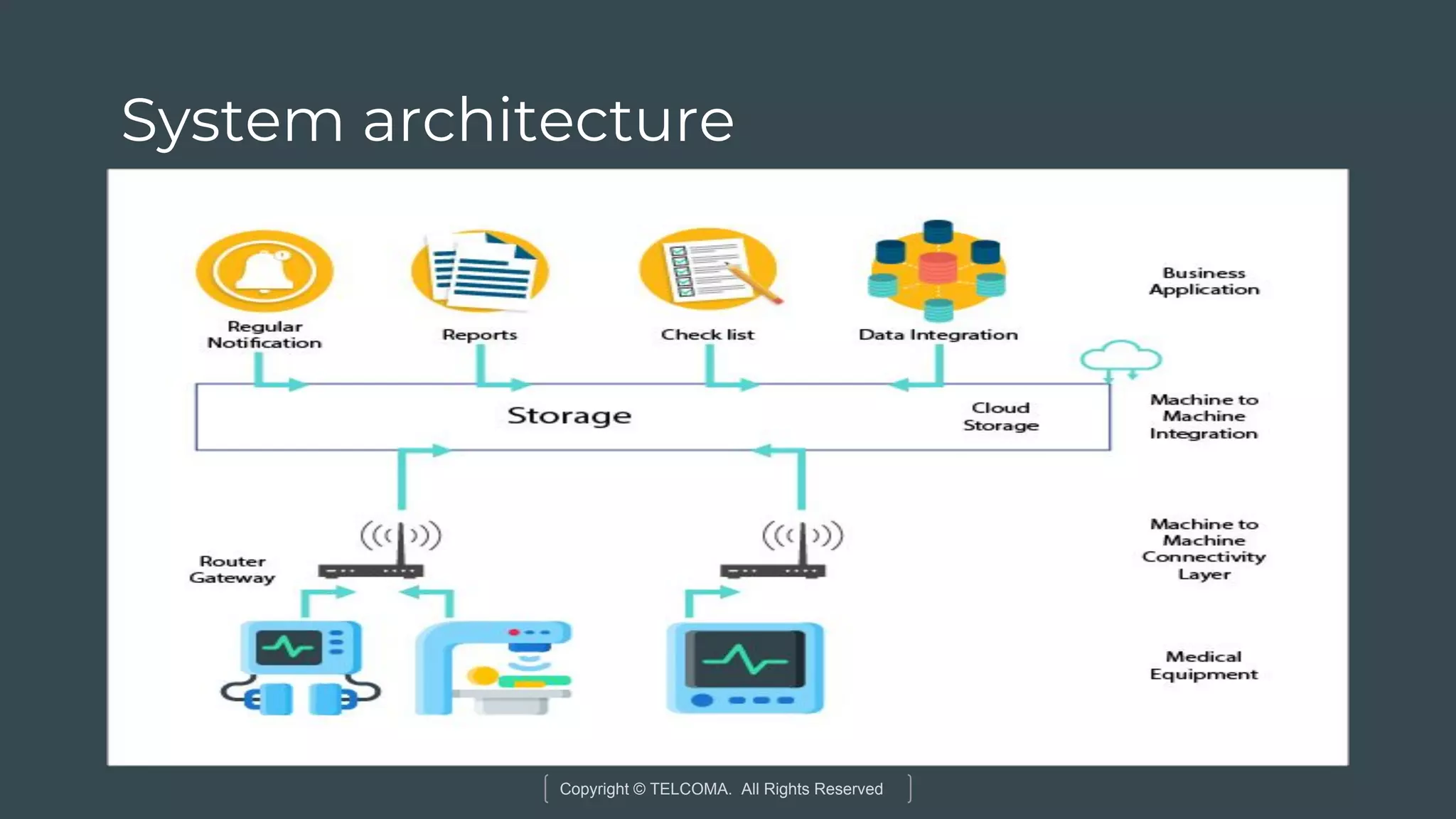
In healthcare scenario , this architecture is composed of three main
parts in each layer :
● Medical sensors and actuators
● Smart e-health gateways
● Cloud platform
Copyright © TELCOMA. All Rights Reserved
Internet of things in 5G
Copyright © TELCOMA. All Rights Reserved
IOT in 5G
5G technology is expected to provide :
● Faster speeds
● Lower latency
● Network support for massive increase in data traffic
● Expansion of cell sites
Copyright © TELCOMA. All Rights Reserved
IOT in 5G
● 5G technology is expected to handle 1000 times more data than
current cellular technologies.
● 5G technology will become backbone of IOT technologies
connecting multiple devices together.
● IOT will be ideal application of 5G.
● The use of millimeter wave communications for many
applications of IOT.
Copyright © TELCOMA. All Rights Reserved
IOT in 5G
● 5G technology will be fully functional along with IOT enabled
systems like smart homes , smart mobile , smart city ,vehicular,
sports and leisure.
● 5G technology will transmit data 10 times faster than 4G
systems.
● Smart city is a bigger concept implemented by 5G faster
network where things communicate and decide best decision
and devices.
Copyright © TELCOMA. All Rights Reserved
Why 5G is compatible with IOT
● IOT applications require low latency.
● IOT applications require high data rates.
Copyright © TELCOMA. All Rights Reserved
IOT & 5G research
● Connected homes
● E-health
● Entertainment
● Home automation
● Security
● Smart architecture
● Smart cars
● Smart grid
● Smart mobility
● Smart parking
● Smart wearables
Copyright © TELCOMA. All Rights Reserved
Thanks
Copyright © TELCOMA. All Rights Reserved
Get IoT in 5G Training with Certification
Visit our website
https://telcomaglobal.com/p/iot-in-5g

IOT in 5G Training and Certification by TELCOMA Global

  • 1.
    Copyright © TELCOMA.All Rights Reserved IOT in 5G TELCOMAwww.telcomaglobal.com
  • 2.
    Copyright © TELCOMA.All Rights Reserved Internet of things in 5G
  • 3.
    Copyright © TELCOMA.All Rights Reserved IOT in 5G : There are three different types of clouds: ● Data centres ● Backbone IP networks ● Cellular core networks Responsible for computation , storage , communication & network management.
  • 4.
    Copyright © TELCOMA.All Rights Reserved FOG
  • 5.
    Copyright © TELCOMA.All Rights Reserved Fog : ● It refers to an architecture for computing , storage , control or communication network and that as a network architecture it may support variety of applications. ● Three dimensions : ● Carry out a substantial amount of storage at or near the end user. ● Carry out a substantial amount of communication at or near the end user. ● Carry out a substantial amount of computing & management , control & configuration at or near the end user.
  • 6.
    Copyright © TELCOMA.All Rights Reserved Fog : ● Fog Networking architecture ● Fog computing architecture ● Fog storage architecture ● Fog control architecture
  • 7.
    Copyright © TELCOMA.All Rights Reserved Computation & management of Fog
  • 8.
    Copyright © TELCOMA.All Rights Reserved Paradrop : An edge computing platform in home gateways
  • 9.
    Copyright © TELCOMA.All Rights Reserved Introduction : ● Cloud computing platforms such as Amazon EC2 & Google app engine have become a popular approach to provide ubiquitous access to services across different user devices. ● Netflix & dropbox are popular cloud based services. ● For better user experience , computation is performed close to end user referred to as “ edge computing “ & comes in various flavours including : Cyber foraging , cloudlets and fog computing
  • 10.
    Copyright © TELCOMA.All Rights Reserved Paradrop : ● Unique edge computing framework ● It allows developers to leverage one of the last bastions of persistent computing resources in the end customer premises: the gateway ( wireless Access point or home setup box). ● Paradrop framework allows multi tenancy through virtualisation, dynamic installation through the developer API and resource control through managed policy design.
  • 11.
    Copyright © TELCOMA.All Rights Reserved Paradrop : Enabling multi-tenant wireless gateways & applications
  • 12.
    Copyright © TELCOMA.All Rights Reserved Enabling multi-tenant gateways & apps ● We want to push computation onto home gateways (e.g APs or setup boxes ) for reasons : ● Home gateways can handle it. ● Internet gateway is there in the home. ● Pervasive hardware
  • 13.
    Copyright © TELCOMA.All Rights Reserved Paradrop capabilities : ● Privacy ● Low latency ● Local networking context ● Proprietary friendly ● Internet disconnectivity
  • 14.
    Copyright © TELCOMA.All Rights Reserved BANDWIDTH
  • 15.
    Copyright © TELCOMA.All Rights Reserved Leveraging the Fog : ● User based system - example of fog networking paradigm. ● Fog like architecture allows users to better control services they receive. ● Fog networking can be applied to a broad range of systems , ranging from distributed storage and computing to network bandwidth allocation.
  • 16.
    Copyright © TELCOMA.All Rights Reserved Socially aware cooperative D2D & D4D communications towards Fog Networking
  • 17.
    Copyright © TELCOMA.All Rights Reserved Cooperative communication : ● It is an efficient D2D & D4D communication paradigm where devices can serve as relays for each other. ● Cooperative D2D & D4D communication can achieve BW by exploiting different types of spectrum bands to support D2D communications : ● Inband D2D & D4D communication. ● Outband D2D & D4D communication.
  • 18.
    Copyright © TELCOMA.All Rights Reserved Storage & Computation in Fog
  • 19.
    Copyright © TELCOMA.All Rights Reserved Distributed caching for enhanced communication efficiency : Wireless data traffic expected to increase by almost 10000 % over next 5 years. Type of data traffic increasing properties : ● User activity is highly asynchronous. ● High content reuse.
  • 20.
    Copyright © TELCOMA.All Rights Reserved Two caching methods : ● Femto - Caching : small dedicated “ helper nodes” can cache popular files & serve requests from wireless users by enabling localized wireless communication. ● The devices “pool” their caching resources so that different devices caches different files and then exchange them, when occasion arises , through short range , highly spectrally efficient , D2D communication known as user caching.
  • 21.
    Copyright © TELCOMA.All Rights Reserved Two caching methods : ● User - caching enables the users to “ pool “ their caching resources so that different files & then exchange them through short range , highly spectrally efficient , local D2D communication which results in further gains in spectral efficiency.
  • 22.
    Copyright © TELCOMA.All Rights Reserved Get IoT in 5G Training with Certification Visit our website https://telcomaglobal.com/p/iot-in-5g
  • 23.
    Copyright © TELCOMA.All Rights Reserved User caching
  • 24.
    Copyright © TELCOMA.All Rights Reserved Cluster based caching & D2D comm. : ● In D2D network architecture , where devices act as caches. ● Let no. of files cached at each user & “K” be finite & do not assume any helper stations. ● If device cannot obtain a file through D2D communication, it can obtain it from macro cellular BS through conventional cellular transmission.
  • 25.
    Copyright © TELCOMA.All Rights Reserved Wireless Video Fog
  • 26.
    Copyright © TELCOMA.All Rights Reserved Wireless video Fog : ● To serve geographically distributed clients , the stream is distributed using a cloud , with the wireless clients independently pulling the stream via Access point or Base station. ● In wireless Fog for live video , the devices hence donate their resources ( computing power, storage and communication BW) to scale up the system in a cost effective manner.
  • 27.
    Copyright © TELCOMA.All Rights Reserved Wireless video Fog : ● The cloud is integrated with a wireless fog. ● In the fog, a source node first pulls the stream from a nearby cloud server through an AP or BS. ● It then distributes its stream to nearby clients. ● By cooperatively relaying their received packets , nodes can efficiently distribute the live stream within the fog.
  • 28.
    Copyright © TELCOMA.All Rights Reserved Wireless video Fog :
  • 29.
    Copyright © TELCOMA.All Rights Reserved Wireless video Fog : ● In a wireless fog, conventionally the live stream is distributed using the “ store - and - forward “ approach , where selected broadcasters simply forward their received packets to their neighbors.
  • 30.
    Copyright © TELCOMA.All Rights Reserved Elastic Mobile device clouds :
  • 31.
    Copyright © TELCOMA.All Rights Reserved Elastic mobile device clouds : ● The cloudlet system move computation closer to mobile devices, creating a two tier architecture . ● A mobile device can offload to a nearby, less capable server, at low latency and high bandwidth rather than offloading to the cloud. ● In the cloudlet vision , these nearby servers would be located in public & commercial spaces where people congregate.
  • 32.
    Copyright © TELCOMA.All Rights Reserved Vision of Edge based clouds : Two observations : ● While gap remains between truly mobile devices(handheld , wearable) & high capacity servers, mobile devices have grown increasingly powerful especially when laptops are included. ● From an architectural perspective , it is possible use the cloudlet , responsible for receiving tasks, scheduling their computation and returning results & a complete cluster responsible for performing the computation.
  • 33.
    Copyright © TELCOMA.All Rights Reserved Mont Blanc : ● This project aims to develop an energy and cost efficient exascale HPC architecture. ● It utilizes energy efficient mobile device processors and assembles a set of these processors.
  • 34.
    Copyright © TELCOMA.All Rights Reserved Goal of Mont Blanc project : ● Maximizing the performance of every single processor. ● Efficiently clustering multiple processors. To maximize the performance gains from each processor, the authors address a set of hardware challenges such as lack of cooling infrastructure as well as software challenges
  • 35.
    Copyright © TELCOMA.All Rights Reserved Computing while charging : It is a distributed computing infrastructure that uses smartphones as the main computing nodes. It consists of : ● Data center that has tasks to execute. ● Mobile devices with idle capacities that are charging their batteries & connected to the data center via internet.
  • 36.
    Copyright © TELCOMA.All Rights Reserved Computing while charging : ● The CWC architecture is designed to enable a data center to utilize idle capacity in mobile devices to enhance its performance and/or reduce data center energy consumption. ● The CWC cluster environment is stable. ● The mobile devices are connected to power sources, which means they do not move & they have good energy availability.
  • 37.
    Copyright © TELCOMA.All Rights Reserved Femto Cloud :
  • 38.
    Copyright © TELCOMA.All Rights Reserved Femto cloud : ● It is a system designed & implemented tp leverage mobile devices to provide mobile computing services at the edge. ● It is designed to cluster co-located mobile devices in environments where mobile devices presence times can be estimated. ● Femto cloud architecture consists of a control device & a set of executing mobile devices.
  • 39.
    Copyright © TELCOMA.All Rights Reserved Femto cloud : The Femto cloud architecture predicts task characteristics , estimates device capacities , presence times & uses the acquired information to distribute tasks across different executing devices as follows : ● Task/cloud interface : it relies on the control device, which is relatively stable compared to rest of devices in a Femto cloud to provide a stable & discoverable interface between femto cloud & its potential users.
  • 40.
    Copyright © TELCOMA.All Rights Reserved Femto cloud : ● Execution prediction : it relies on a generic task model where a task is coordinated by its input size , output size and computational load. ● Femto cloud only needs to estimate its output size & its computational load. ● It relies on task originator to send the task with an estimate for its computational load.
  • 41.
    Copyright © TELCOMA.All Rights Reserved Femto cloud : ● Device management : it is divided into three sub-tasks implemented by control device and the computing mobile devices : ● Discovery & registration ● Estimating device capacity ● Estimating the device presence time
  • 42.
    Copyright © TELCOMA.All Rights Reserved Femto cloud : ● Network management : it utilizes the shared wireless spectrum to send tasks to their executing devices & gather their results . ● Task assignment & scheduling module
  • 43.
    Copyright © TELCOMA.All Rights Reserved Applications of Fog :
  • 44.
    Copyright © TELCOMA.All Rights Reserved Role of Fog computing in the future of the Automobile :
  • 45.
    Copyright © TELCOMA.All Rights Reserved Role in Automobiles : ● Future automobiles will look more powerful, compact, scalable data centres on wheels or fog computing nodes on wheels travelling within highways & cities equipped with powerful fog computing capabilities at their intersections & along their pathways. ● Fog computing an ideal bridge between modern IT & operational technologies. ● Time triggered technologies based on precise time distribution
  • 46.
    Copyright © TELCOMA.All Rights Reserved Role in Automobiles : ● Introduction of standard networking technologies such as ethernet,wi-fi, bluetooth. ● Adoption of modern security applications. ● Exposure to models of computation & resource virtualization. ● Advances in real time computing & deterministic networking.
  • 47.
    Copyright © TELCOMA.All Rights Reserved IOT virtuous information cycle :
  • 48.
    Copyright © TELCOMA.All Rights Reserved Future automotive E/E architecture :
  • 49.
    Copyright © TELCOMA.All Rights Reserved Geographic addressing for field networks :
  • 50.
    Copyright © TELCOMA.All Rights Reserved Field networking :
  • 51.
    Copyright © TELCOMA.All Rights Reserved Field networking : ● Data communication networks enables devices in large scale physical environment to communicate in order to support real world tasks. ● In addition to emergency response & games , other applications of field networking include Geosensing & data collection , process control , drone airspace awareness & control , military operations & force protection , military training , connected & autonomous vehicles.
  • 52.
    Copyright © TELCOMA.All Rights Reserved Field networking : ● Field networking scenarios involve fog networking scenarios. ● Firefighters need maps that come from servers in the cloud & may upload logged sensor data to the cloud to support action reviews.
  • 53.
    Copyright © TELCOMA.All Rights Reserved Geographic Addressing : ● It refers to communication protocols that allow a sender to specify the intended recipients with traditional schemes, such as IP addressing. ● The address refers exactly to the set of devices that are in the area at the time the message is transferred , a set whose extension changes rapidly with time.
  • 54.
    Copyright © TELCOMA.All Rights Reserved IOT capabilities towards 5G :
  • 55.
    Copyright © TELCOMA.All Rights Reserved IOT capabilities towards 5G : ● LTE IOT, which includes enhanced eMTC ● Long term evolution for machines ● Narrowband IOT
  • 56.
    Copyright © TELCOMA.All Rights Reserved Executing use cases : ● Ubiquitous coverage : coverage of challenging locations by optimizing the device link budgeted for low - data rates. ● Ultra - low current : it enables efficient use of device battery life to maximize years of useful operation in the field. ● Increased capacity : to efficiently support dense connections per km2. ● Low complexity : scaling the IOT for low end , single mode use cases.
  • 57.
    Copyright © TELCOMA.All Rights Reserved On the way to 5G & IOT : ● Connecting & managing growing no. of cars , meters , machinery sensors and consumer electronics profitably will require innovative business models. ● The vast majority of operator IOT revenues come from connectivity. ● Operators capable of creating & managing
  • 58.
    Copyright © TELCOMA.All Rights Reserved From IOT to IOE :
  • 59.
    Copyright © TELCOMA.All Rights Reserved From IOT to IOE : ● IOT is a novel computing platform that is rapidly gaining space in terms of modern communication technologies. ● IOT idea implied other concepts, such as IOS - internet of service IOE - internet of everything WOT - web of things
  • 60.
    Copyright © TELCOMA.All Rights Reserved Internet of everything : ● IOE connects people, data , things and processes in networks of billions or trillions of connections. ● There are three keys in which IOE will significantly impact our lives as described : IOT will automate connections IOE will enable fast personal communication & decision making IOE will uncover new information
  • 61.
    Copyright © TELCOMA.All Rights Reserved IOE’s individual concepts : ● People ● Data ● Things ● Process
  • 62.
    Copyright © TELCOMA.All Rights Reserved Architecture :
  • 63.
    Copyright © TELCOMA.All Rights Reserved Architecture recommended by IAB : RFC 7452 presents four common interaction models between the actors of the IOT : ● Communication between objects ● Communication from objects to the cloud ● Communication from objects to a gateway ● From objects to back end data sharing
  • 64.
    Copyright © TELCOMA.All Rights Reserved Three tier architecture : A large number of groups have embarked on the development of a standard architecture for the IOT. Applications Cloud computing Sensor network
  • 65.
    Copyright © TELCOMA.All Rights Reserved Layered Architecture This architecture is often used to describe the structure & existing relationship between different IOT actors : This architecture takes form of superimposed layers: ● Physical devices & controllers ● Connectivity ● Edge computing ● Data accumulation ● Data abstraction ● Applications ● Collaboration & processes
  • 66.
    Copyright © TELCOMA.All Rights Reserved Steps & technologies in ecosystem of IOT ● Identity ● Capture ● Connect ● Integrate ● network
  • 67.
    Copyright © TELCOMA.All Rights Reserved Steps : ● Identifying : Knowing how to precisely determine which object is connected to what in what way and in which location. ● Capture : in order for CO’s to fulfill their role of bridge between the physical and virtual worlds, sensors are indispensable. ● Connection : linking objects with each other so that they can exchange data in a more autonomous manner. ● Integrate : connecting CO’s to the virtual world with the help of wireless communication method. ● Networking : users want to able to interact remotely with their objects while the providers want to collect the data generated , that is often the service basis.
  • 68.
    Copyright © TELCOMA.All Rights Reserved Fog Computing :
  • 69.
    Copyright © TELCOMA.All Rights Reserved Basics : ● Introduction of IOT brings billions of devices to the internet. ● To overcome the challenges of these devices and meet the requirements of the application domain . ● The concept of fog computing is the latest descendant in the line of physical separation of functional units.
  • 70.
    Copyright © TELCOMA.All Rights Reserved Characteristics of Fog layer : ● Fog layer is closer to the perception layer & this proximity provides a range of advantages that characterize the layer. ● Location awareness comes due to the large scale geographical distribution of devices that make up the Fog layer. ● This subset of of resource constrained devices are located close to each other and the managing gateway can easily locate each device.
  • 71.
    Copyright © TELCOMA.All Rights Reserved Characteristics of Fog layer : ● The geographical distribution of the Fog layer & subsequently the offered low communication latency are among the critical features of fog layer. ● The IOT in general is dominated by wireless networks. ● There are many wireless protocols mostly tailored for low power operation , coverage or bandwidth.
  • 72.
    Copyright © TELCOMA.All Rights Reserved Characteristics of Fog layer : ● The majority of these protocols connect sensor nodes to the fog layer to get access to the internet. ● Fog layer provides an additional benefit of acting as interpretability layer among these heterogenous protocols. ● The gateways in the Fog layer can also perform lightweight analytics at the edge to give feedback , command and notification to the end users as well as sensor nodes in real time.
  • 73.
    Copyright © TELCOMA.All Rights Reserved Design & organization of Fog layer : ● In a larger environment, multiple access points can be arranged to provide users with seamless connectivity throughout the intended area. ● In addition to simply passing network packets , these networked smart gateways can process the data or store it when necessary. ● Distributed smart gateways communicate with the cloud , the sensor layer and among themselves.
  • 74.
    Copyright © TELCOMA.All Rights Reserved Fog computing services : These services are organized into three layers : ● Compute ● Storage ● Network
  • 75.
    Copyright © TELCOMA.All Rights Reserved Computing services : ● There are multiple configurations of sharing the computing load among the different layers in the IOT based systems. ● Beside data management, events can be handled at the Fog layer. ● There are many middleware that leverage the fog layer to manage devices through abstraction , agent based management & virtual machines.
  • 76.
    Copyright © TELCOMA.All Rights Reserved Storage services : ● The storage services helps to enhance the reliability of the system by maintaining proper behavior of client nodes. ● Combined with computing service, stored data can be filtered, analyzed and compressed for efficient transmission.
  • 77.
    Copyright © TELCOMA.All Rights Reserved communication services : ● The communication in the IOT is dominated by wireless nodes. ● The Fog layer is located in a strategic place to organize multitude of wireless protocols and unify their communication to the cloud layer. ● This helps in managing sub-networks of sensors and actuators providing security, channeling messaging among devices & enhancing reliability of the system.
  • 78.
    Copyright © TELCOMA.All Rights Reserved Management of Fog layer :
  • 79.
    Copyright © TELCOMA.All Rights Reserved IOT Resource estimation challenges : ● Fog will act like a mediator & will be able to perform tasks that may not be efficiently done by distant cloud. ● Fog would be present close to the underlying nodes for the purpose of offloading the tasks & preprocessing the raw data. ● Fog will also be responsible to minimize delay & enhance service quality.
  • 80.
    Copyright © TELCOMA.All Rights Reserved Resource management : ● Resource scheduling is tricky in case of mobile nodes. ● Resource underutilization become problem when underlying nodes are mobile. ● Fog plays an important role in resource management , being in proximity to the users and to make decisions in a more realistic way. ● Mission critical & latency sensitive IOT services require very quick response & processing.
  • 81.
    Copyright © TELCOMA.All Rights Reserved Resource management : ● The concept of fog networking is to bring networking resources near the nodes that are generating data . ● Fog resources lies between the perception layer & cloud layer. ● For mobile nodes , fog provides low latency and high quality streaming through proxies & access points located across highways & tracks. ● Resource & power constrained individual nodes , WSNs & virtual sensor networks would be able to take advantage from the presence of fogs.
  • 82.
    Copyright © TELCOMA.All Rights Reserved Resource management : ● The concept of fog networking is to bring networking resources near the nodes that are generating data . ● Fog resources lies between the perception layer & cloud layer. ● For mobile nodes , fog provides low latency and high quality streaming through proxies & access points located across highways & tracks. ● Resource & power constrained individual nodes , WSNs & virtual sensor networks would be able to take advantage from the presence of fogs.
  • 83.
    Copyright © TELCOMA.All Rights Reserved Fog Resource estimation & its challenges :
  • 84.
    Copyright © TELCOMA.All Rights Reserved Fog Resource estimation & its challenges : ● Depending upon the type of IOT service , the underlying nodes can be devices as well as dumb objects. ● A multitude of mobile nodes , including fast moving vehicles would also be among the pool of nodes requiring resources from a fog.
  • 85.
    Copyright © TELCOMA.All Rights Reserved Fog as a middleware between IOT & Cloud :
  • 86.
    Copyright © TELCOMA.All Rights Reserved Fog as a middleware :
  • 87.
    Copyright © TELCOMA.All Rights Reserved Device type : ● A resource rich computer or laptop with ample resources a lot of resource with high quality expectations. ● A sensor would be resource constrained. ● Fog has to allocate resources keeping in view the power or battery status of the sensor. ● Processing resource would be the key as the data generated from them may have to be accumulated, trimmed & processed before sending it to the cloud or creating services locally.
  • 88.
    Copyright © TELCOMA.All Rights Reserved Mobility on the ground : ● With mobility , the resource procurement becomes more of challenge. ● Several crowdsensing applications will take benefit from fog based IOT services. ● Several sensors within a vehicle will be working under a fog. ● Fog has to take into account the type sensor, the way they are being powered, data communication frequency, mobility speed & mobility pattern while deciding about reasonable resources.
  • 89.
    Copyright © TELCOMA.All Rights Reserved Mobility in the Air : internet of Drones ● For flying objects , resource estimation would be way beyond the conventions. ● IOD would require much faster processing & high bandwidth. ● Some drones would generate HD video data , some will be responsible for imagery , and some would be equipped with sensors or an array of sensors.
  • 90.
    Copyright © TELCOMA.All Rights Reserved Fog monitoring various factors for resource allocation
  • 91.
    Copyright © TELCOMA.All Rights Reserved Power utilization & status ● Fog is responsible for monitoring power and deciding when to offload tasks from devices. ● The resource estimation would be performed dynamically in real time.
  • 92.
    Copyright © TELCOMA.All Rights Reserved Data types ● Types of data plays an important role in accessing the time and amount of resources. ● Multimedia data would require processing , memory, storage & GPU. ● Storage & memory depends on type of data and nature of application.
  • 93.
    Copyright © TELCOMA.All Rights Reserved Security ● It is of two types : data security & communication security ● Data security refers to making the data unreadable for unintended party. ● Communication security means the data is transferred through a secure channel.
  • 94.
    Copyright © TELCOMA.All Rights Reserved Customer’s reliability & loyality of service utilization ● It would be very difficult to forecast if a requiring customer is going to fully utilize the resources requested for. ● With mobile nodes, reliability can not be guaranteed. ● If a certain check is set on customer’s behavior and service utilization pattern , better resource estimation can be performed.
  • 95.
    Copyright © TELCOMA.All Rights Reserved Fog’s role within ULSS
  • 96.
    Copyright © TELCOMA.All Rights Reserved Architecture ● Sensors & actuators are responsible for gathering information & acting on the environment. ● Heterogenous fog nodes , which constitute the aggregation points. ● The “things” & “nodes” communicate mostly through wireless technologies , since both things & nodes can move.
  • 97.
    Copyright © TELCOMA.All Rights Reserved Architecture ● The cloud constitutes the highest layer, offering a large pool of resources low-cost without any latency requirements.
  • 98.
    Copyright © TELCOMA.All Rights Reserved Fog ‘s role within ULSS ● These systems can exploit the location of the fog nodes & their hierarchical organisation to communicate & to become aware of their extent. ● Fog nodes have visibility over a wider geographic range than the one available to individual “ things”. ● Fog nodes can transmit information such as road conditions to optimize cars trajectories in real time.
  • 99.
    Copyright © TELCOMA.All Rights Reserved Fog ‘s role within ULSS ● These systems can exploit the location of the fog nodes & their hierarchical organisation to communicate & to become aware of their extent. ● Fog nodes have visibility over a wider geographic range than the one available to individual “ things”. ● Fog nodes can transmit information such as road conditions to optimize cars trajectories in real time.
  • 100.
    Copyright © TELCOMA.All Rights Reserved Fog ‘s role within ULSS ● When “things” move out of the range they get disconnected from that node. ● If another node is available in the next location , the process can continue. ● This technique eliminates the need of migrating data from one node to the next node because the “thing” itself carries the necessary information.
  • 101.
    Copyright © TELCOMA.All Rights Reserved Services of Fog layer :
  • 102.
    Copyright © TELCOMA.All Rights Reserved Blockchain ● It is a decentralized ledger of all Bitcoin transactions across a peer to peer network. ● The nodes with in the network validate the transaction and the user’s status by using known algorithms to ensure that the same bitcoins were not spent previously.
  • 103.
    Copyright © TELCOMA.All Rights Reserved Blockchain ● A verified transaction can involve cryptocurrency , contracts, records & other information. ● Using this technology , users can confirm transactions without the need for a central certifying authority , normally enforced by central banks.
  • 104.
    Copyright © TELCOMA.All Rights Reserved IOT , Fog computing & Block chain ● IOT devices normally have limited resources that are not enough to properly support cryptocurrency mining due to its computational cost. ● Mining of blocks is time consuming & creates signalling overhead traffic , which is undesirable. Moreover , blockchain does not properly scale with the ever increasing introduction of nodes in the network.
  • 105.
    Copyright © TELCOMA.All Rights Reserved IOTA ● It is a novel transactional settlement and data transfer layer for IOT. ● It is based on a new distributed ledger , the tangle which overcomes the deficiencies of blockchain designs & introduces a new way of reaching consensus in a decentralized peer - to -peer system. ● IOTA enables companies to explore new B2B models by making every technological resource a potential service to be traded in an open market.
  • 106.
    Copyright © TELCOMA.All Rights Reserved IOTA ● New approaches for IOT have been proposed with the introduction of Fog & Mist. ● IOTA combines both Fog & Mist into a new distributed computing solution. ● This can be seen as a combination of smart sensors with built-in computational capabilities (mist computing) with nearby processing stations ( Fog computing).
  • 107.
    Copyright © TELCOMA.All Rights Reserved Get IoT in 5G Training with Certification Visit our website https://telcomaglobal.com/p/iot-in-5g
  • 108.
    Copyright © TELCOMA.All Rights Reserved Services of Fog layer :
  • 109.
    Copyright © TELCOMA.All Rights Reserved ADEPT :
  • 110.
    Copyright © TELCOMA.All Rights Reserved Autonomous decentralized P2P Telemetry ● By using the devices themselves as computational, storage & communication nodes , we can build “hybrid” IOT systems where the edge complements centralized systems. ● IBM & Samsung have developed ADEPT proof of concept. ● This work is supported by three distinct protocols: ● Bit torrent ● Ethereum ● Telehash
  • 111.
    Copyright © TELCOMA.All Rights Reserved Autonomous decentralized P2P Telemetry ● Use case : decentralized advertising marketplace using large format displays to share & publish content without a centralized controller. The concept in LFD as compared with conventional is that we can share the content with anyone.
  • 112.
    Copyright © TELCOMA.All Rights Reserved Multi party computation :
  • 113.
    Copyright © TELCOMA.All Rights Reserved Multi party computation ● Secure multi-party computing is a technique that can be used here , since its purpose is to have multi parties exchanging secret information privately without the need of trusted third party. ● MPC consists of two or more parties where each part has their own secret input.
  • 114.
    Copyright © TELCOMA.All Rights Reserved Self Aware fog computing in private & secure spheres :
  • 115.
    Copyright © TELCOMA.All Rights Reserved Self aware fog computing ● Wearable sensors for measuring our leisure & sports activities as well as our health conditions have proliferated & gained acceptance. ● The advances of sensing, computation & communication technology are also being utilized in military applications.
  • 116.
    Copyright © TELCOMA.All Rights Reserved Cloud , Fog & Mist computing networks ● The functional & non-functional system parameters are affected by the selection of computing architecture when choosing between Fog, Mist & cloud computing architectures. ● Some of these parameters include latency of control loops, bandwidth usage , storage requirements , security & privacy aspects , system robustness & reliability. ● In applications where low latency from the sensor to the data consumer is critical - mist computing architecture is beneficial.
  • 117.
    Copyright © TELCOMA.All Rights Reserved Cloud , Fog & Mist computing networks ● Cloud computing is applicable where we are either processing big amounts of data, for which processing methods may be complex. ● Fog computing brings computation closer to the edge of the network. In Fog computing , a more capable device bears the responsibility for data processing or IOT application execution.
  • 118.
    Copyright © TELCOMA.All Rights Reserved Self aware data processing The umbrella term self awareness encloses a no. of concepts such as : ● Self - adaptation ● Self - organization ● Self - healing ● Self - expression and other self - properties
  • 119.
    Copyright © TELCOMA.All Rights Reserved Self aware data processing A self aware system should fully understand its own situation & detect its own misbehavior or underperformance due to : ● Faults, that may be caused by aging , accidents or physical attacks ● A malicious attack on its functions ● Functional design errors in its hardware or software
  • 120.
    Copyright © TELCOMA.All Rights Reserved Control as a service in cyber physical energy systems over Fog computing
  • 121.
    Copyright © TELCOMA.All Rights Reserved Power grid & energy management ● Localized distributed energy system is called microgrid. ● The primary purpose of microgrid is to ensure local , reliable and affordable energy security for communities. ● The growing number of devices & customers in the power grid increases the demand for electrical energy consumption.
  • 122.
    Copyright © TELCOMA.All Rights Reserved Energy management methodologies ● Smart & energy efficient appliance control ● Utilizing renewable energy ● Electricity demand management
  • 123.
    Copyright © TELCOMA.All Rights Reserved Cyber physical energy systems ● The cyber system brings the capability of computation , communications & control. ● The smart grid which leverages the cyber and physical interaction is called CPES. ● It brings multi level monitoring & control capability to the power grid in order to improve its reliability, flexibility, efficiency & cost effectiveness.
  • 124.
    Copyright © TELCOMA.All Rights Reserved Cyber physical energy systems ● Multitude of sensors at different levels of the system responsible for monitoring multiple variables indicating state of the system. ● Major requirements of the architecture : Interoperability Scalability Ease of deployment Open architecture Play & plug capability Local & remote monitoring
  • 125.
    Copyright © TELCOMA.All Rights Reserved Control as a service ● The energy management platform can be used for any type of buildings & various domains of operation e.g microgrid or home. ● The energy management may have various purposes: Monitoring & metering the power consumption of each device e.g home power consumption Managing the energy consumption by controlling the devices efficiently.
  • 126.
    Copyright © TELCOMA.All Rights Reserved Residential cyber-physical energy system ● The implementation of caas on top of fog computing platform is applied to two prototypes of HEM & microgrid- level energy management to demonstrate its advantages for different domains.
  • 127.
    Copyright © TELCOMA.All Rights Reserved Home energy management ● In the home , multiple smart devices such as : HVAC, water heater & EV charger. ● Each device is monitored & controlled by the HEM control panel. ● The devices have their own control panel to monitor their status & set their configurations, ● The home is being monitored by a network of four sensor devices . ● The sensor network is defined as a subsystem inside the platform.
  • 128.
    Copyright © TELCOMA.All Rights Reserved Micro grid level energy management ● The micro level energy management platform comprises three homes connected to a transformer. ● A control panel is implemented in the transformer to monitor and manage the power consumption of each home. ● The transformer level control panel monitors the load of each home and may decide to send demands to their HEM in order to reduce power consumption.
  • 129.
    Copyright © TELCOMA.All Rights Reserved Micro grid level energy management ● In this platform a transformer management has been implemented as a service. ● The controller monitors the home connected to the transformer in order to prevent overloading of the transformer. ● It receives information about the array of homes connected and the total load on the transformer. ● The controllers are implemented in the micro-grid level fog computing platform.
  • 130.
    Copyright © TELCOMA.All Rights Reserved Leveraging Fog computing for Healthcare IOT
  • 131.
    Copyright © TELCOMA.All Rights Reserved Healthcare services in Fog layer ● This layer provides computing , networking, storage and other domain specific services for IOT systems. ● The healthcare domain has a set of requirements that uniquely identify it from other IOT apps. ● The physical proximity of Fog layer to Body area networks of sensors & actuators allows us to address the requirements of healthcare IOT.
  • 132.
    Copyright © TELCOMA.All Rights Reserved Data management ● It has an important role in Fog computing by which sensory data is locally processed to extract meaningful information. ● Fog layer continuously receives a large amount of sensory data in a short period of time from the sensor network. ● Different gateways in smart e-health gateway: Local storage Data filtering Data compression Data fusion Data analysis
  • 133.
    Copyright © TELCOMA.All Rights Reserved Local storage ● The gateway needs to store received data from several sources in a local storage to be able to utilize it in the near future analysis. ● The local storage in the gateway can be used to store files in encrypted or compressed format based on type, size and importance of data. ● Using local storage , the gateway is able to export data to medical standard formats such as Health level seven (HL7) if required.
  • 134.
    Copyright © TELCOMA.All Rights Reserved Data filtering ● It is the first data processing unit to implement filtering methods at the edge after receiving data from sensor network. ● Available light weight filtering in some of the sensor nodes reduces these accumulated noises although it might be insufficient in practical cases. ● Data filtering unit in Fog layer enables to remove noise and increase aspects of the signals using various filters before any other local data analytics.
  • 135.
    Copyright © TELCOMA.All Rights Reserved Data compression ● In health care IOT applications, loss-less compression is more preferable in most of the cases because lost data can cause inappropriate disease diagnosis. ● In some cases loss-less algorithms can be successfully operated at sensor nodes but they cause a large power consumption and latency. ● With fog computing all limitations can be avoided.
  • 136.
    Copyright © TELCOMA.All Rights Reserved Data fusion ● It is the data processing unit to integrate sensory data from multiple sources to obtain more robust data and meaningful information. ● Data fusion can be divided into 3 classes : Complementary Competitive cooperative
  • 137.
    Copyright © TELCOMA.All Rights Reserved Data analysis ● Data analysis unit at the edge enables the health care to process the sensory data locally. ● This unit improves the system performance by decreasing response latency and data transmission to the cloud servers. ● Data analysis at the edge could manage the system’s functionality locally , store the sensory data as well as the calculations in the local storage and subsequently synchronize the Fog layer with the remote control after reconnecting to the network.
  • 138.
    Copyright © TELCOMA.All Rights Reserved Event management ● Fog computing provides low latency communication which helps to notify health experts , caregivers and even patients very fast in case of serious events. ● The real time and fast response of actuators are important in some medical events
  • 139.
    Copyright © TELCOMA.All Rights Reserved System architecture of Healthcare IOT
  • 140.
    Copyright © TELCOMA.All Rights Reserved System architecture ● The architecture of a system provides information about the components , interaction and organization of the parts. ● It is one of the key elements for achieving graceful scaling and performance. ● It is designed to meet functional requirements of the application domain.
  • 141.
    Copyright © TELCOMA.All Rights Reserved System architecture
  • 142.
    Copyright © TELCOMA.All Rights Reserved System architecture In healthcare scenario , this architecture is composed of three main parts in each layer : ● Medical sensors and actuators ● Smart e-health gateways ● Cloud platform
  • 143.
    Copyright © TELCOMA.All Rights Reserved Internet of things in 5G
  • 144.
    Copyright © TELCOMA.All Rights Reserved IOT in 5G 5G technology is expected to provide : ● Faster speeds ● Lower latency ● Network support for massive increase in data traffic ● Expansion of cell sites
  • 145.
    Copyright © TELCOMA.All Rights Reserved IOT in 5G ● 5G technology is expected to handle 1000 times more data than current cellular technologies. ● 5G technology will become backbone of IOT technologies connecting multiple devices together. ● IOT will be ideal application of 5G. ● The use of millimeter wave communications for many applications of IOT.
  • 146.
    Copyright © TELCOMA.All Rights Reserved IOT in 5G ● 5G technology will be fully functional along with IOT enabled systems like smart homes , smart mobile , smart city ,vehicular, sports and leisure. ● 5G technology will transmit data 10 times faster than 4G systems. ● Smart city is a bigger concept implemented by 5G faster network where things communicate and decide best decision and devices.
  • 147.
    Copyright © TELCOMA.All Rights Reserved Why 5G is compatible with IOT ● IOT applications require low latency. ● IOT applications require high data rates.
  • 148.
    Copyright © TELCOMA.All Rights Reserved IOT & 5G research ● Connected homes ● E-health ● Entertainment ● Home automation ● Security ● Smart architecture ● Smart cars ● Smart grid ● Smart mobility ● Smart parking ● Smart wearables
  • 149.
    Copyright © TELCOMA.All Rights Reserved Thanks
  • 150.
    Copyright © TELCOMA.All Rights Reserved Get IoT in 5G Training with Certification Visit our website https://telcomaglobal.com/p/iot-in-5g