
Summer Training
Presentation
on
“Wireless Communication”
Name- Mohit Kumar Singh
ECE ‘4th’ year
Roll No-120070102065
Contents:-
 BTS (Base Transreceiver System)
 Parameters for network optimization at MSC level
 Generation of wireless cellular system
 1st generation
 2nd generation
 GSM Architecture
 GPRS
 EDGE
 3rd Generation
 4th Generation
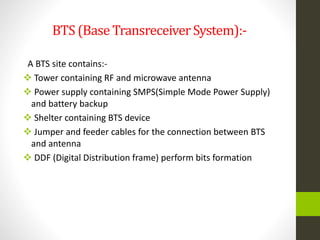
BTS (Base TransreceiverSystem):-
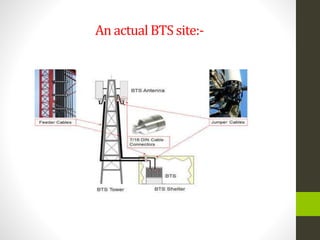
A BTS site contains:-
 Tower containing RF and microwave antenna
 Power supply containing SMPS(Simple Mode Power Supply)
and battery backup
 Shelter containing BTS device
 Jumper and feeder cables for the connection between BTS
and antenna
 DDF (Digital Distribution frame) perform bits formation
An actual BTS site:-
Parametersfor networkoptimizationat MSC
level:-
 ASR (Answer to Seize Ratio)
 PSR (Paging Success Rate)
 SCR (Success call Rate)
Generationsof wirelesscellular system:-
First Generation(1G)
Second Generation(2G)
GSM
GPRS
EDGE
Third Generation(3G)
Fourth Generation(4G)
LTE(Long Term Evolution)
Wi-Max(Worldwide Interoperability for
Microwave Access)
1’st Generation(1G):-
 Works on analog system
 Related technologies-
(i) NMI(Nordic Mobile Technology)
(ii) TACS(Total Access Communication System)
(iii) NTACS(European Total Access Communication
System)
 Based on FDMA(Frequency Division Multiplexing)
SecondGeneration(2G):-
 Digital Communication first used
 Initial technology of 2G was called Groupe Special
Module which later converted to Global System for
Mobile Communication
 Used only for voice calling
 Channel distribution based on TDMA(Time Division
Multiple Access)
 Modulate 2-bit at a time
 Channel bandwidth of 200KHz is proposed
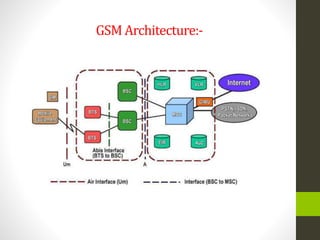
GSM Architecture:-
GSM Identifiers:-
 IMSI (International Mobile Subscriber Identity)
IMSI contains-
(i)MCC(Mobile Country Code) -3 Digit (404/405 for India)
(ii)MNC(Mobile Network code)-2 digits
(iii)MSIN(Mobile Subscriber Integrated Number)-10 digits
 MSISDN(Mobile Subscriber Integrated Service Digital
Number)
MSISDN Contains-
(i)CC(Country Code)-+91/0
(ii)NVM(National Valid Number)-MSC id + HLR id + Serial no
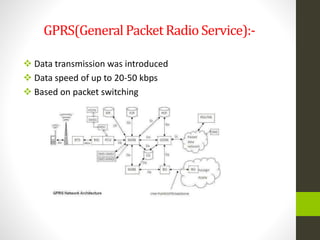
GPRS(GeneralPacketRadio Service):-
 Data transmission was introduced
 Data speed of up to 20-50 kbps
 Based on packet switching
EDGE(EnhanceData rate for GSM Evolution):-
 Used for enhanced data rate(up to 200 kbps)
 8PSK modulation scheme is used
 3-bit modulation at a time so data rate increase up to 2 to 4
times
 Both voice and data transmission is possible
Third Generation(3G):-
 Proposed by 3GPP(Third Generation Partnership
Project)
 UMTS (Universal Mobile Terrestrial System) standard
was used
 Minimum speed of 200 kbps was defined for 3G
WCDMA(wideband CDMA) interface was used
 HSDPA(3.5G) and HSUPA(3.75G) was further introduced
for higher data
 Channel bandwidth is 5MHz
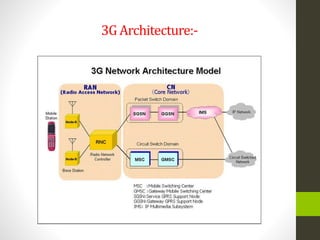
3G Architecture:-
4th Generation:-
Objective:-
 Download speed of 1 Gbps for stationary users and
100 Mbps for moving users
Fully packet switched network
Mobile ultra broadband concept(fixed speed to each
user)
Total IP based communication
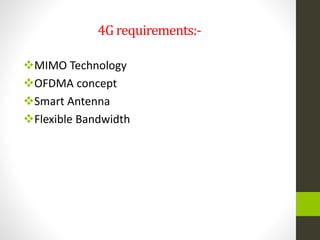
4G requirements:-
MIMO Technology
OFDMA concept
Smart Antenna
Flexible Bandwidth
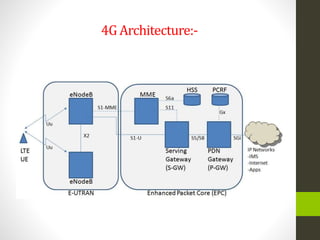
4G Architecture:-
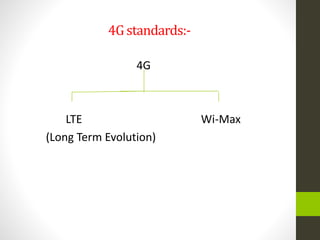
4G standards:-
4G
LTE Wi-Max
(Long Term Evolution)
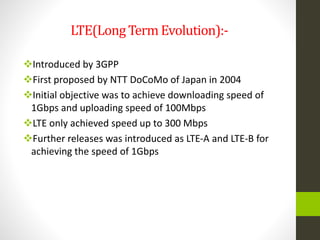
LTE(LongTerm Evolution):-
Introduced by 3GPP
First proposed by NTT DoCoMo of Japan in 2004
Initial objective was to achieve downloading speed of
1Gbps and uploading speed of 100Mbps
LTE only achieved speed up to 300 Mbps
Further releases was introduced as LTE-A and LTE-B for
achieving the speed of 1Gbps
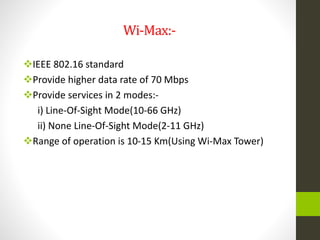
Wi-Max:-
IEEE 802.16 standard
Provide higher data rate of 70 Mbps
Provide services in 2 modes:-
i) Line-Of-Sight Mode(10-66 GHz)
ii) None Line-Of-Sight Mode(2-11 GHz)
Range of operation is 10-15 Km(Using Wi-Max Tower)
THANK YOU

Wireless Communication Generations

  • 1.
    Summer Training Presentation on “Wireless Communication” Name-Mohit Kumar Singh ECE ‘4th’ year Roll No-120070102065
  • 2.
    Contents:-  BTS (BaseTransreceiver System)  Parameters for network optimization at MSC level  Generation of wireless cellular system  1st generation  2nd generation  GSM Architecture  GPRS  EDGE  3rd Generation  4th Generation
  • 3.
    BTS (Base TransreceiverSystem):- ABTS site contains:-  Tower containing RF and microwave antenna  Power supply containing SMPS(Simple Mode Power Supply) and battery backup  Shelter containing BTS device  Jumper and feeder cables for the connection between BTS and antenna  DDF (Digital Distribution frame) perform bits formation
  • 4.
  • 5.
    Parametersfor networkoptimizationat MSC level:- ASR (Answer to Seize Ratio)  PSR (Paging Success Rate)  SCR (Success call Rate)
  • 6.
    Generationsof wirelesscellular system:- FirstGeneration(1G) Second Generation(2G) GSM GPRS EDGE Third Generation(3G) Fourth Generation(4G) LTE(Long Term Evolution) Wi-Max(Worldwide Interoperability for Microwave Access)
  • 7.
    1’st Generation(1G):-  Workson analog system  Related technologies- (i) NMI(Nordic Mobile Technology) (ii) TACS(Total Access Communication System) (iii) NTACS(European Total Access Communication System)  Based on FDMA(Frequency Division Multiplexing)
  • 8.
    SecondGeneration(2G):-  Digital Communicationfirst used  Initial technology of 2G was called Groupe Special Module which later converted to Global System for Mobile Communication  Used only for voice calling  Channel distribution based on TDMA(Time Division Multiple Access)  Modulate 2-bit at a time  Channel bandwidth of 200KHz is proposed
  • 9.
  • 10.
    GSM Identifiers:-  IMSI(International Mobile Subscriber Identity) IMSI contains- (i)MCC(Mobile Country Code) -3 Digit (404/405 for India) (ii)MNC(Mobile Network code)-2 digits (iii)MSIN(Mobile Subscriber Integrated Number)-10 digits  MSISDN(Mobile Subscriber Integrated Service Digital Number) MSISDN Contains- (i)CC(Country Code)-+91/0 (ii)NVM(National Valid Number)-MSC id + HLR id + Serial no
  • 11.
    GPRS(GeneralPacketRadio Service):-  Datatransmission was introduced  Data speed of up to 20-50 kbps  Based on packet switching
  • 12.
    EDGE(EnhanceData rate forGSM Evolution):-  Used for enhanced data rate(up to 200 kbps)  8PSK modulation scheme is used  3-bit modulation at a time so data rate increase up to 2 to 4 times  Both voice and data transmission is possible
  • 13.
    Third Generation(3G):-  Proposedby 3GPP(Third Generation Partnership Project)  UMTS (Universal Mobile Terrestrial System) standard was used  Minimum speed of 200 kbps was defined for 3G WCDMA(wideband CDMA) interface was used  HSDPA(3.5G) and HSUPA(3.75G) was further introduced for higher data  Channel bandwidth is 5MHz
  • 14.
  • 15.
    4th Generation:- Objective:-  Downloadspeed of 1 Gbps for stationary users and 100 Mbps for moving users Fully packet switched network Mobile ultra broadband concept(fixed speed to each user) Total IP based communication
  • 16.
    4G requirements:- MIMO Technology OFDMAconcept Smart Antenna Flexible Bandwidth
  • 17.
  • 18.
  • 19.
    LTE(LongTerm Evolution):- Introduced by3GPP First proposed by NTT DoCoMo of Japan in 2004 Initial objective was to achieve downloading speed of 1Gbps and uploading speed of 100Mbps LTE only achieved speed up to 300 Mbps Further releases was introduced as LTE-A and LTE-B for achieving the speed of 1Gbps
  • 20.
    Wi-Max:- IEEE 802.16 standard Providehigher data rate of 70 Mbps Provide services in 2 modes:- i) Line-Of-Sight Mode(10-66 GHz) ii) None Line-Of-Sight Mode(2-11 GHz) Range of operation is 10-15 Km(Using Wi-Max Tower)
  • 21.