WIRED TRANSMISSION MEDIA
PRESENTED BY
Md. Tutul Haque
Roll: 160129
Department of Computer Science & Engineering
Jashore University of Science & Technology
OBJECTIVES
 Transmission Media
 Wired Transmission Media
 Twisted-Pair Cable
 Coaxial Cable
 Fiber-optic Cable
 Advantage and Disadvantage
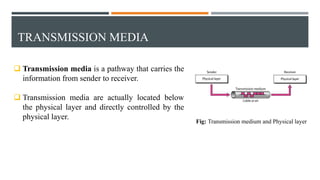
TRANSMISSION MEDIA
 Transmission media is a pathway that carries the
information from sender to receiver.
 Transmission media are actually located below
the physical layer and directly controlled by the
physical layer.
Fig: Transmission medium and Physical layer
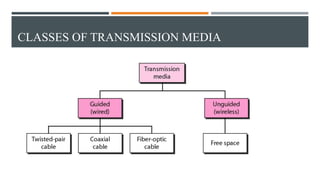
CLASSES OF TRANSMISSION MEDIA
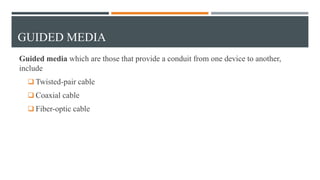
GUIDED MEDIA
Guided media which are those that provide a conduit from one device to another,
include
 Twisted-pair cable
 Coaxial cable
 Fiber-optic cable
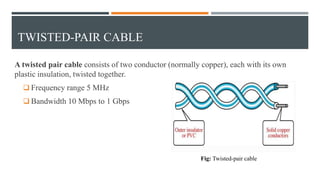
TWISTED-PAIR CABLE
A twisted pair cable consists of two conductor (normally copper), each with its own
plastic insulation, twisted together.
 Frequency range 5 MHz
 Bandwidth 10 Mbps to 1 Gbps
Fig: Twisted-pair cable
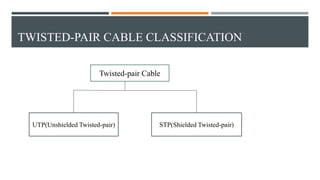
TWISTED-PAIR CABLE CLASSIFICATION
Twisted-pair Cable
UTP(Unshielded Twisted-pair) STP(Shielded Twisted-pair)
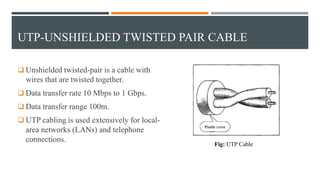
UTP-UNSHIELDED TWISTED PAIR CABLE
 Unshielded twisted-pair is a cable with
wires that are twisted together.
 Data transfer rate 10 Mbps to 1 Gbps.
 Data transfer range 100m.
 UTP cabling is used extensively for local-
area networks (LANs) and telephone
connections.
Fig: UTP Cable
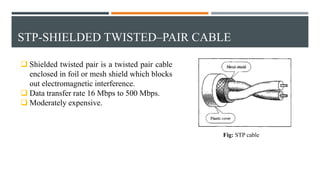
STP-SHIELDED TWISTED–PAIR CABLE
Fig: STP cable
 Shielded twisted pair is a twisted pair cable
enclosed in foil or mesh shield which blocks
out electromagnetic interference.
 Data transfer rate 16 Mbps to 500 Mbps.
 Moderately expensive.
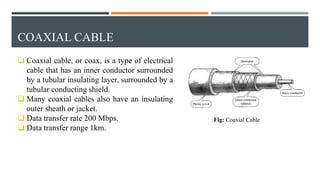
COAXIAL CABLE
 Coaxial cable, or coax, is a type of electrical
cable that has an inner conductor surrounded
by a tubular insulating layer, surrounded by a
tubular conducting shield.
 Many coaxial cables also have an insulating
outer sheath or jacket.
 Data transfer rate 200 Mbps.
 Data transfer range 1km.
Fig: Coaxial Cable
Advantages
 High transmission rate.
 Low noise.
 Easy to setup and install.
 Use high TV network.
 Cheaper than fiber-optic cable.
 Frequency 500 MHz.
Disadvantages
 More Expensive than twisted-pair
cable.
 Without repeater data can not send
more than 1km.
COAXIAL CABLE
FIBER-OPTIC CABLE
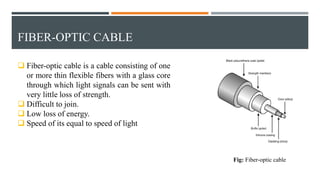
 Fiber-optic cable is a cable consisting of one
or more thin flexible fibers with a glass core
through which light signals can be sent with
very little loss of strength.
 Difficult to join.
 Low loss of energy.
 Speed of its equal to speed of light
Fig: Fiber-optic cable
OPTICAL-FIBER COMMUNICATION SYSTEM
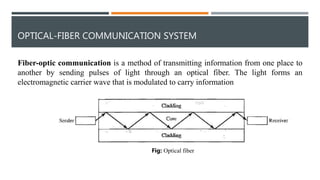
Fiber-optic communication is a method of transmitting information from one place to
another by sending pulses of light through an optical fiber. The light forms an
electromagnetic carrier wave that is modulated to carry information
Fig: Optical fiber
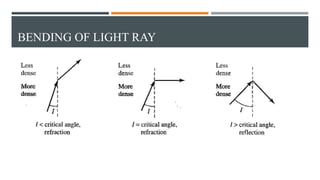
BENDING OF LIGHT RAY
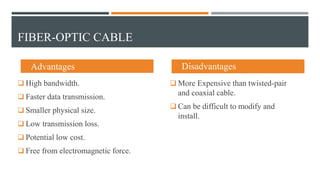
FIBER-OPTIC CABLE
 Advantages
 High bandwidth.
 Faster data transmission.
 Smaller physical size.
 Low transmission loss.
 Potential low cost.
 Free from electromagnetic force.
 Disadvantages
 More Expensive than twisted-pair
and coaxial cable.
 Can be difficult to modify and
install.
SUMMARY
 Transmission Media
 Wired Transmission Media
 Twisted-Pair Cable
 Coaxial Cable
 Fiber-optic Cable
 Advantage and Disadvantage
THANK YOU
ANY QUESTIONS?
REFERENCES
 Book: Data Communication and networking by Behrouz_A_Forouzan, 4th edition
 https://en.wikipedia.org/wiki/Data_transmission

Wired transmission media

  • 1.
    WIRED TRANSMISSION MEDIA PRESENTEDBY Md. Tutul Haque Roll: 160129 Department of Computer Science & Engineering Jashore University of Science & Technology
  • 2.
    OBJECTIVES  Transmission Media Wired Transmission Media  Twisted-Pair Cable  Coaxial Cable  Fiber-optic Cable  Advantage and Disadvantage
  • 3.
    TRANSMISSION MEDIA  Transmissionmedia is a pathway that carries the information from sender to receiver.  Transmission media are actually located below the physical layer and directly controlled by the physical layer. Fig: Transmission medium and Physical layer
  • 4.
  • 5.
    GUIDED MEDIA Guided mediawhich are those that provide a conduit from one device to another, include  Twisted-pair cable  Coaxial cable  Fiber-optic cable
  • 6.
    TWISTED-PAIR CABLE A twistedpair cable consists of two conductor (normally copper), each with its own plastic insulation, twisted together.  Frequency range 5 MHz  Bandwidth 10 Mbps to 1 Gbps Fig: Twisted-pair cable
  • 7.
    TWISTED-PAIR CABLE CLASSIFICATION Twisted-pairCable UTP(Unshielded Twisted-pair) STP(Shielded Twisted-pair)
  • 8.
    UTP-UNSHIELDED TWISTED PAIRCABLE  Unshielded twisted-pair is a cable with wires that are twisted together.  Data transfer rate 10 Mbps to 1 Gbps.  Data transfer range 100m.  UTP cabling is used extensively for local- area networks (LANs) and telephone connections. Fig: UTP Cable
  • 9.
    STP-SHIELDED TWISTED–PAIR CABLE Fig:STP cable  Shielded twisted pair is a twisted pair cable enclosed in foil or mesh shield which blocks out electromagnetic interference.  Data transfer rate 16 Mbps to 500 Mbps.  Moderately expensive.
  • 10.
    COAXIAL CABLE  Coaxialcable, or coax, is a type of electrical cable that has an inner conductor surrounded by a tubular insulating layer, surrounded by a tubular conducting shield.  Many coaxial cables also have an insulating outer sheath or jacket.  Data transfer rate 200 Mbps.  Data transfer range 1km. Fig: Coaxial Cable
  • 11.
    Advantages  High transmissionrate.  Low noise.  Easy to setup and install.  Use high TV network.  Cheaper than fiber-optic cable.  Frequency 500 MHz. Disadvantages  More Expensive than twisted-pair cable.  Without repeater data can not send more than 1km. COAXIAL CABLE
  • 12.
    FIBER-OPTIC CABLE  Fiber-opticcable is a cable consisting of one or more thin flexible fibers with a glass core through which light signals can be sent with very little loss of strength.  Difficult to join.  Low loss of energy.  Speed of its equal to speed of light Fig: Fiber-optic cable
  • 13.
    OPTICAL-FIBER COMMUNICATION SYSTEM Fiber-opticcommunication is a method of transmitting information from one place to another by sending pulses of light through an optical fiber. The light forms an electromagnetic carrier wave that is modulated to carry information Fig: Optical fiber
  • 14.
  • 15.
    FIBER-OPTIC CABLE  Advantages High bandwidth.  Faster data transmission.  Smaller physical size.  Low transmission loss.  Potential low cost.  Free from electromagnetic force.  Disadvantages  More Expensive than twisted-pair and coaxial cable.  Can be difficult to modify and install.
  • 16.
    SUMMARY  Transmission Media Wired Transmission Media  Twisted-Pair Cable  Coaxial Cable  Fiber-optic Cable  Advantage and Disadvantage
  • 17.
  • 18.
  • 19.
    REFERENCES  Book: DataCommunication and networking by Behrouz_A_Forouzan, 4th edition  https://en.wikipedia.org/wiki/Data_transmission