1
Physical Transmission
NETWORKING
2
 The transmission of data from
one computer to another, or from one device
to another.
 A communications device, therefore, is any
machine that assists data transmission. For
example, modems, cables, and ports are
all communications devices
Computer Communication
 Anything that can carry information from a
source to a destination or from one point to
other point.
3
Transmission Media/Channel/Link
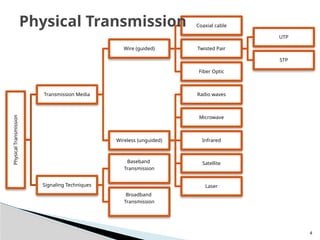
Physical
Transmission
Transmission Media
Wire (guided)
Coaxial cable
Twisted Pair
UTP
STP
Fiber Optic
Wireless (unguided)
Radio waves
Microwave
Infrared
Satellite
Laser
Signaling Techniques
Baseband
Transmission
Broadband
Transmission
4
Physical Transmission
5
 There are two categories of Transmission
media:
1. Wired (Guided) media
 In wired media, communication devices are directly
connected with each other by
using some physical media like wires. Wireless
(Unguided) media
 Unguided media transport signals without using a
physical media.
Transmission Media
6
• For Guided Medium
—The medium is more important
• For Unguided
—The bandwidth produced by the antenna is more important
Overview
7
 Bandwidth:
 The amount of data that can be transferred
through a communication medium in a given
time is called bandwidth.
 The bandwidth of digital signal is measured in
bits per second 0" Bytes per second.
Design Factors for Transmission Media
8
1. Wired (Guided) media
There are three categories of guided media:
1. Twisted Pair :
1. Unshielded twisted pair (UTP)
2. Shielded twisted pair (STP)
2. Coaxial Cable
3. Fiber Optic Cable
9
I. Wired (Guided) media:
10
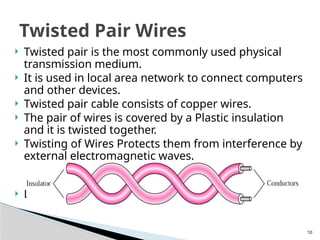
 Twisted pair is the most commonly used physical
transmission medium.
 It is used in local area network to connect computers
and other devices.
 Twisted pair cable consists of copper wires.
 The pair of wires is covered by a Plastic insulation
and it is twisted together.
 Twisting of Wires Protects them from interference by
external electromagnetic waves.
 Low frequency transmission medium
Twisted Pair Wires
11
 STP (shielded twisted pair)
◦ the pair is wrapped with metallic foil or braid to
prevent the pair from electromagnetic interference
 UTP (unshielded twisted pair)
◦ each wire is insulated with plastic wrap, but the pair is
encased in an outer covering
Types of Twisted Pair
12
Twisted Pair Cable
13
Twisted Pair Advantages & Disadvantages
Advantages Disadvantages
 Inexpensive and
available
 Flexible and light weight
 Easy to work with and
install
 Sensitivity to
interference and noise
 Relatively low
bandwidth (3000Hz)
14
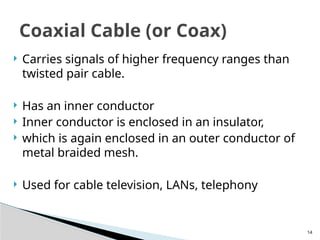
 Carries signals of higher frequency ranges than
twisted pair cable.
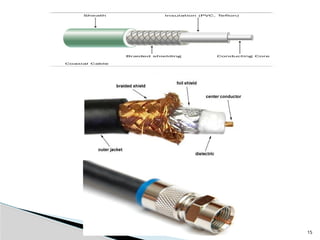
 Has an inner conductor
 Inner conductor is enclosed in an insulator,
 which is again enclosed in an outer conductor of
metal braided mesh.
 Used for cable television, LANs, telephony
Coaxial Cable (or Coax)
15
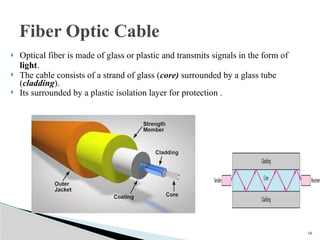
 Optical fiber is made of glass or plastic and transmits signals in the form of
light.
 The cable consists of a strand of glass (core) surrounded by a glass tube
(cladding).
 Its surrounded by a plastic isolation layer for protection .
16
Fiber Optic Cable
 Relatively new transmission medium used by telephone
companies in place of long-distance trunk lines
 Fiber Optic works on the properties of light
 From one end of it light is emitted, it travels through it
and at the other end light detector detects light stream and
converts it to electric data form.
 Fiber Optic provides the highest mode of speed.
17
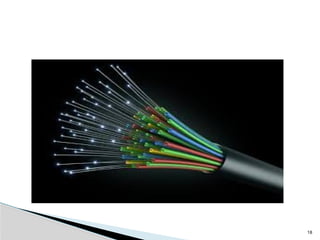
Fiber Optic Cable
18

lecture_4_-_transmission_media_-_part1.pptx

  • 1.
  • 2.
    2  The transmissionof data from one computer to another, or from one device to another.  A communications device, therefore, is any machine that assists data transmission. For example, modems, cables, and ports are all communications devices Computer Communication
  • 3.
     Anything thatcan carry information from a source to a destination or from one point to other point. 3 Transmission Media/Channel/Link
  • 4.
    Physical Transmission Transmission Media Wire (guided) Coaxialcable Twisted Pair UTP STP Fiber Optic Wireless (unguided) Radio waves Microwave Infrared Satellite Laser Signaling Techniques Baseband Transmission Broadband Transmission 4 Physical Transmission
  • 5.
    5  There aretwo categories of Transmission media: 1. Wired (Guided) media  In wired media, communication devices are directly connected with each other by using some physical media like wires. Wireless (Unguided) media  Unguided media transport signals without using a physical media. Transmission Media
  • 6.
    6 • For GuidedMedium —The medium is more important • For Unguided —The bandwidth produced by the antenna is more important Overview
  • 7.
    7  Bandwidth:  Theamount of data that can be transferred through a communication medium in a given time is called bandwidth.  The bandwidth of digital signal is measured in bits per second 0" Bytes per second. Design Factors for Transmission Media
  • 8.
  • 9.
    There are threecategories of guided media: 1. Twisted Pair : 1. Unshielded twisted pair (UTP) 2. Shielded twisted pair (STP) 2. Coaxial Cable 3. Fiber Optic Cable 9 I. Wired (Guided) media:
  • 10.
    10  Twisted pairis the most commonly used physical transmission medium.  It is used in local area network to connect computers and other devices.  Twisted pair cable consists of copper wires.  The pair of wires is covered by a Plastic insulation and it is twisted together.  Twisting of Wires Protects them from interference by external electromagnetic waves.  Low frequency transmission medium Twisted Pair Wires
  • 11.
    11  STP (shieldedtwisted pair) ◦ the pair is wrapped with metallic foil or braid to prevent the pair from electromagnetic interference  UTP (unshielded twisted pair) ◦ each wire is insulated with plastic wrap, but the pair is encased in an outer covering Types of Twisted Pair
  • 12.
  • 13.
    13 Twisted Pair Advantages& Disadvantages Advantages Disadvantages  Inexpensive and available  Flexible and light weight  Easy to work with and install  Sensitivity to interference and noise  Relatively low bandwidth (3000Hz)
  • 14.
    14  Carries signalsof higher frequency ranges than twisted pair cable.  Has an inner conductor  Inner conductor is enclosed in an insulator,  which is again enclosed in an outer conductor of metal braided mesh.  Used for cable television, LANs, telephony Coaxial Cable (or Coax)
  • 15.
  • 16.
     Optical fiberis made of glass or plastic and transmits signals in the form of light.  The cable consists of a strand of glass (core) surrounded by a glass tube (cladding).  Its surrounded by a plastic isolation layer for protection . 16 Fiber Optic Cable
  • 17.
     Relatively newtransmission medium used by telephone companies in place of long-distance trunk lines  Fiber Optic works on the properties of light  From one end of it light is emitted, it travels through it and at the other end light detector detects light stream and converts it to electric data form.  Fiber Optic provides the highest mode of speed. 17 Fiber Optic Cable
  • 18.