This presentation is owned by
ABUL KALAM AZAD PATWARY
“for class 9-10[accounting]”
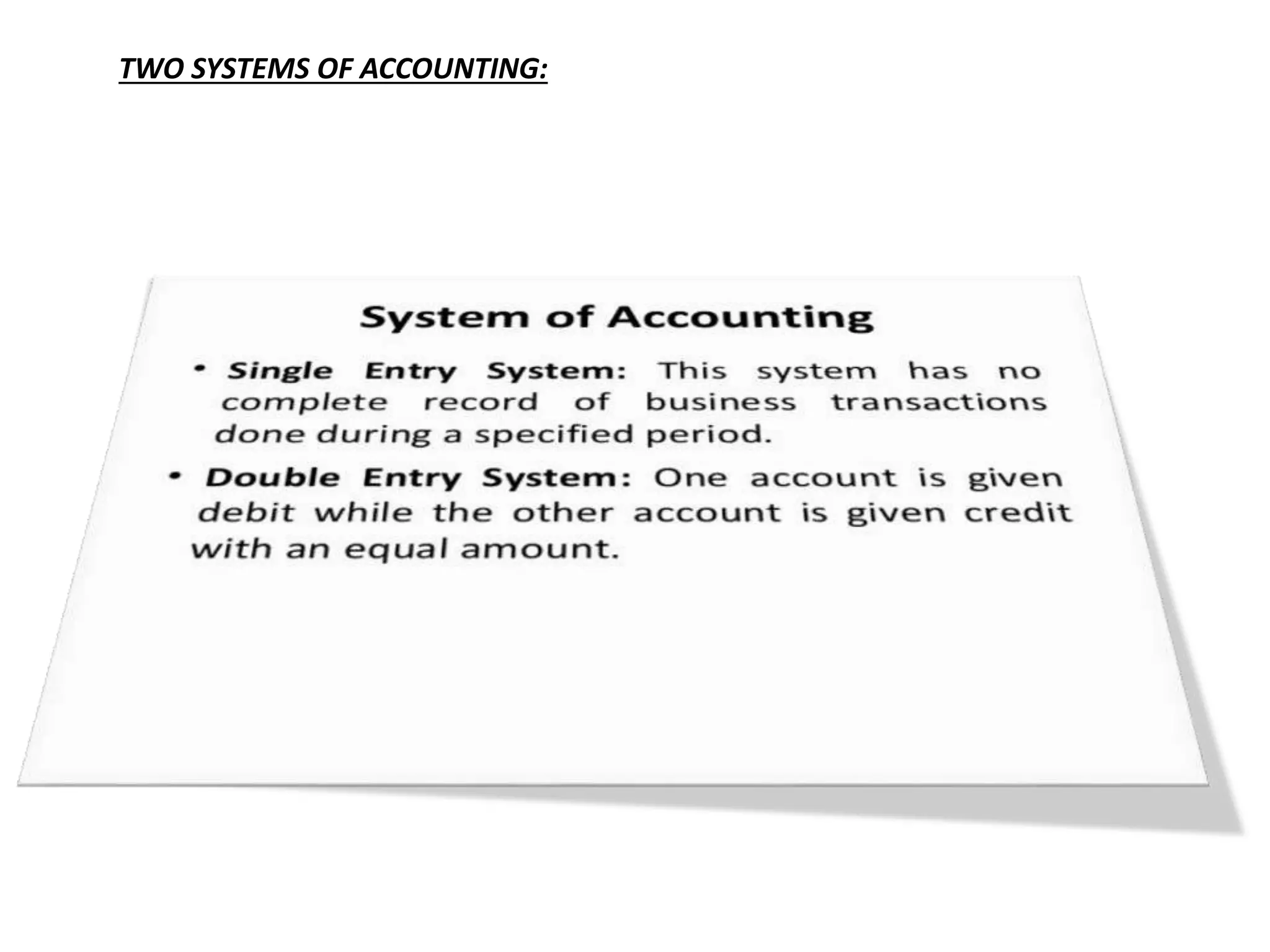
TWO SYSTEMS OF ACCOUNTING:
The double entry system of accounting or bookkeeping means that every business
transaction will involve two accounts (or more). For example, when a company
borrows money from its bank, the company's Cash account will increase and its
liability account Loans Payable will increase. If a company pays $200 for an
advertisement, its Cash account will decrease and its account Advertising Expense
will increase.
Double entry also allows for the accounting equation (assets = liabilities + owner's
equity) to always be in balance.
In our example involving Advertising Expense, the accounting equation remained in
balance because expenses cause owner's equity to decrease.
In that example, the asset Cash decreased and the owner's capital account within
owner's equity also decreased.
A third aspect of double entry is that the amounts entered into the general ledger
accounts as debits must be equal to the amounts entered as credits.
DOUBLE ENTRY SYSTEM :
SINGLE ENTRY SYSTEM :
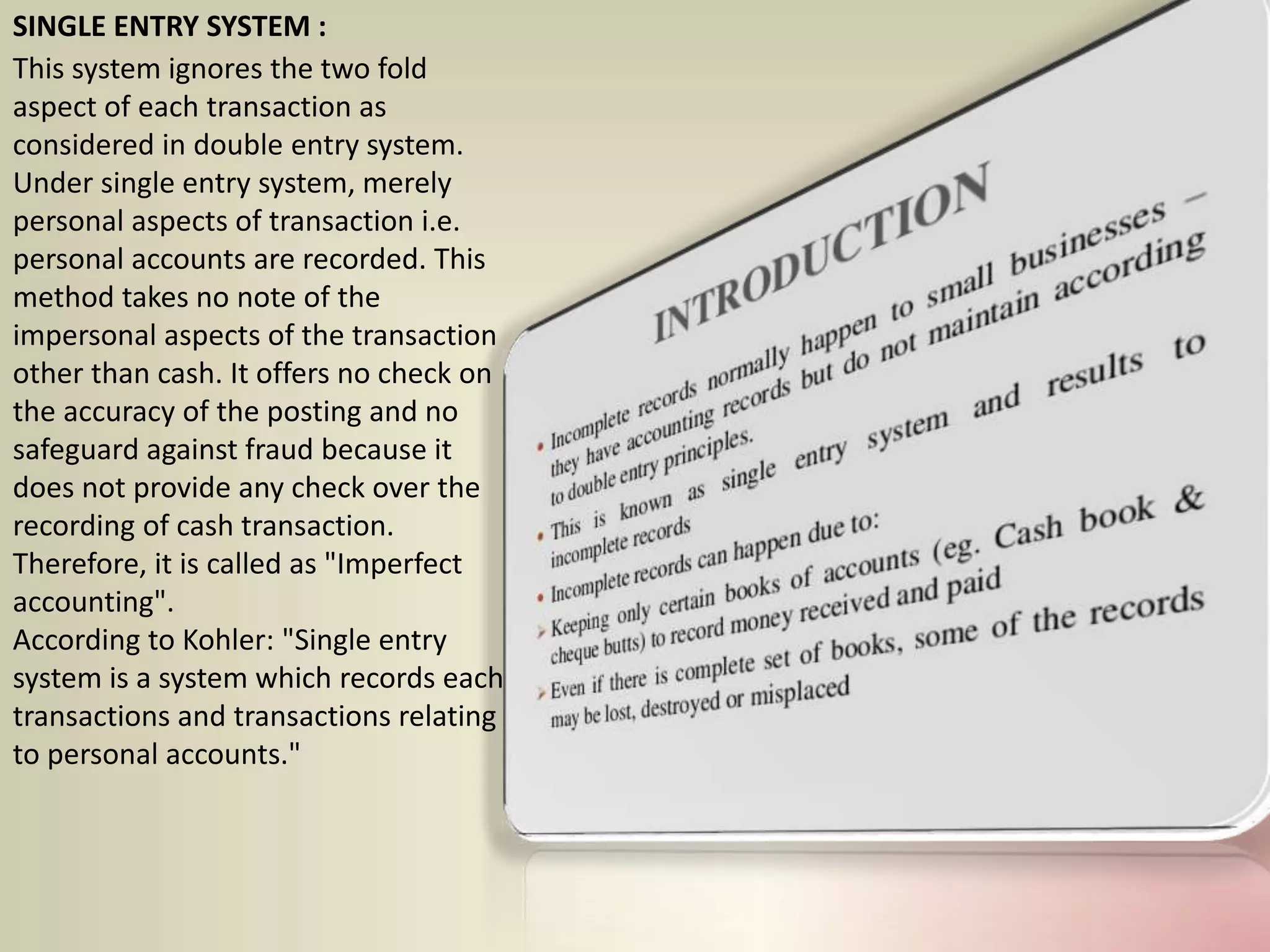
This system ignores the two fold
aspect of each transaction as
considered in double entry system.
Under single entry system, merely
personal aspects of transaction i.e.
personal accounts are recorded. This
method takes no note of the
impersonal aspects of the transaction
other than cash. It offers no check on
the accuracy of the posting and no
safeguard against fraud because it
does not provide any check over the
recording of cash transaction.
Therefore, it is called as "Imperfect
accounting".
According to Kohler: "Single entry
system is a system which records each
transactions and transactions relating
to personal accounts."
Features of double entry
system :
The features of double entry system are as follows:
1) Two parties: transaction takes place only if there are two parties- one party
receiving the benefit other party giving or parting with the benefit.
2) Each party is affected (by the transaction) in opposite direction but with the
same amount.
3) Each transaction affects at least two items in an accounting equation.
Accounting equation is composed of three elements namely Assets, Liabilities and
Capital.
4) Account receiving the benefit is debited and recorded on the left hand side and
the account rendering the benefit is credited and recorded on the right hand side.
5) For each transaction debit amount is equal to the credit amount.
Advantages of Double Entry System
i) Scientific system: This system is the only scientific system of recording
business transactions in a set of accounting records. It helps to attain the objectives of
accounting.
ii) Complete record of transactions: This system maintains a complete
record of all business transactions.
iii) A check on the accuracy of accounts: By use of this system the accuracy
of accounting book can be established through the device called a Trail balance.
iv) Ascertainment of profit or loss: The profit earned or loss suffered during
a period can be ascertained together with details by the preparation of Profit and Loss
Account.
v) Knowledge of the financial position of the business: The financial
position of the firm can be ascertained at the end of each period, through the
preparation of balance sheet.
vi) Full details for purposes of control: This system permits accounts to be
prepared or kept in as much detail as necessary and, therefore, affords significant
information for purposes of control etc.
vii) Comparative study is possible: Results of one year may be compared
with those of the precious year and reasons for the change may be ascertained.
viii) Helps management in decision making: The management may be also
to obtain good information for its work, specially for making decisions.
ix) No scope for fraud: The firm is saved from frauds and misappropriations
since full information about all assets and liabilities will be available.
Procedure of Identifying Debit and Credit:
The term ‘debit’ is supposed to have derived from ‘debit’ and the
term ‘credit’ from ‘creditable’. For convenience ‘Dr’ is used for debit
and ‘Cr’ is used for credit. Recording of transactions require a
thorough understanding of the rules of debit and credit relating to
accounts. Both debit and credit may represent either increase or
decrease, depending upon the nature of account.
The main elements of accounting equation are asset,
liability, and owner’s
equity. The income of the business increases owner’s
equity while the expense
decreases the same.
ASSETS: INCREASE IN DEBIT- DECREASE IN
CREDIT.
LIABILITIES: INCREASE IN CREDIT- DECREASE IN
DEBIT.
EXPENSE: INCREASE IN DEBIT – DECREASE IN
CREDIT.
INCOME : INCREASE IN CREDIT- DECREASE IN
DEBIT.
CAPITAL : INCREASE IN CREDIT - DECREASE IN DEBIT.
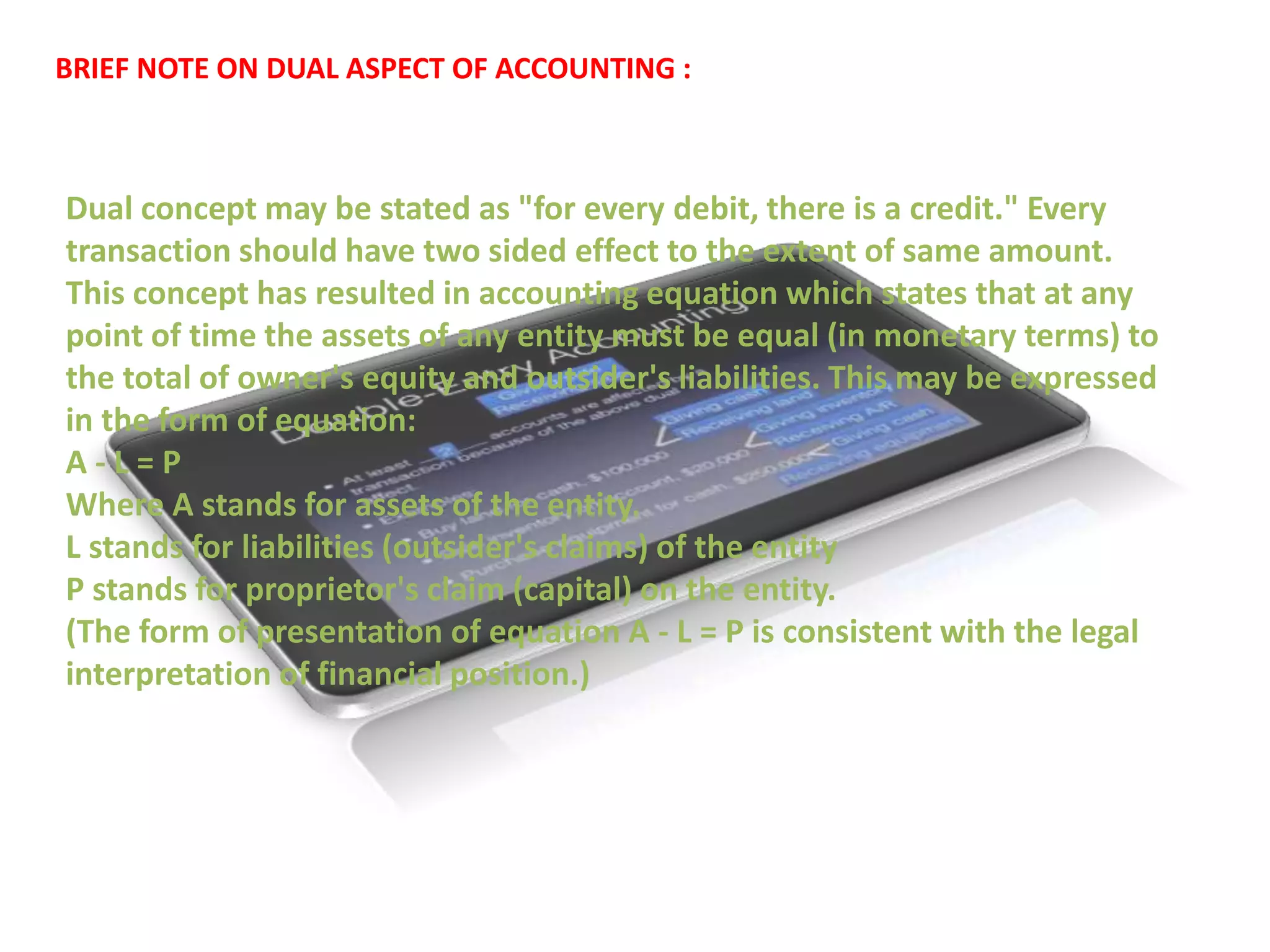
BRIEF NOTE ON DUAL ASPECT OF ACCOUNTING :
Dual concept may be stated as "for every debit, there is a credit." Every
transaction should have two sided effect to the extent of same amount.
This concept has resulted in accounting equation which states that at any
point of time the assets of any entity must be equal (in monetary terms) to
the total of owner's equity and outsider's liabilities. This may be expressed
in the form of equation:
A - L = P
Where A stands for assets of the entity.
L stands for liabilities (outsider's claims) of the entity
P stands for proprietor's claim (capital) on the entity.
(The form of presentation of equation A - L = P is consistent with the legal
interpretation of financial position.)
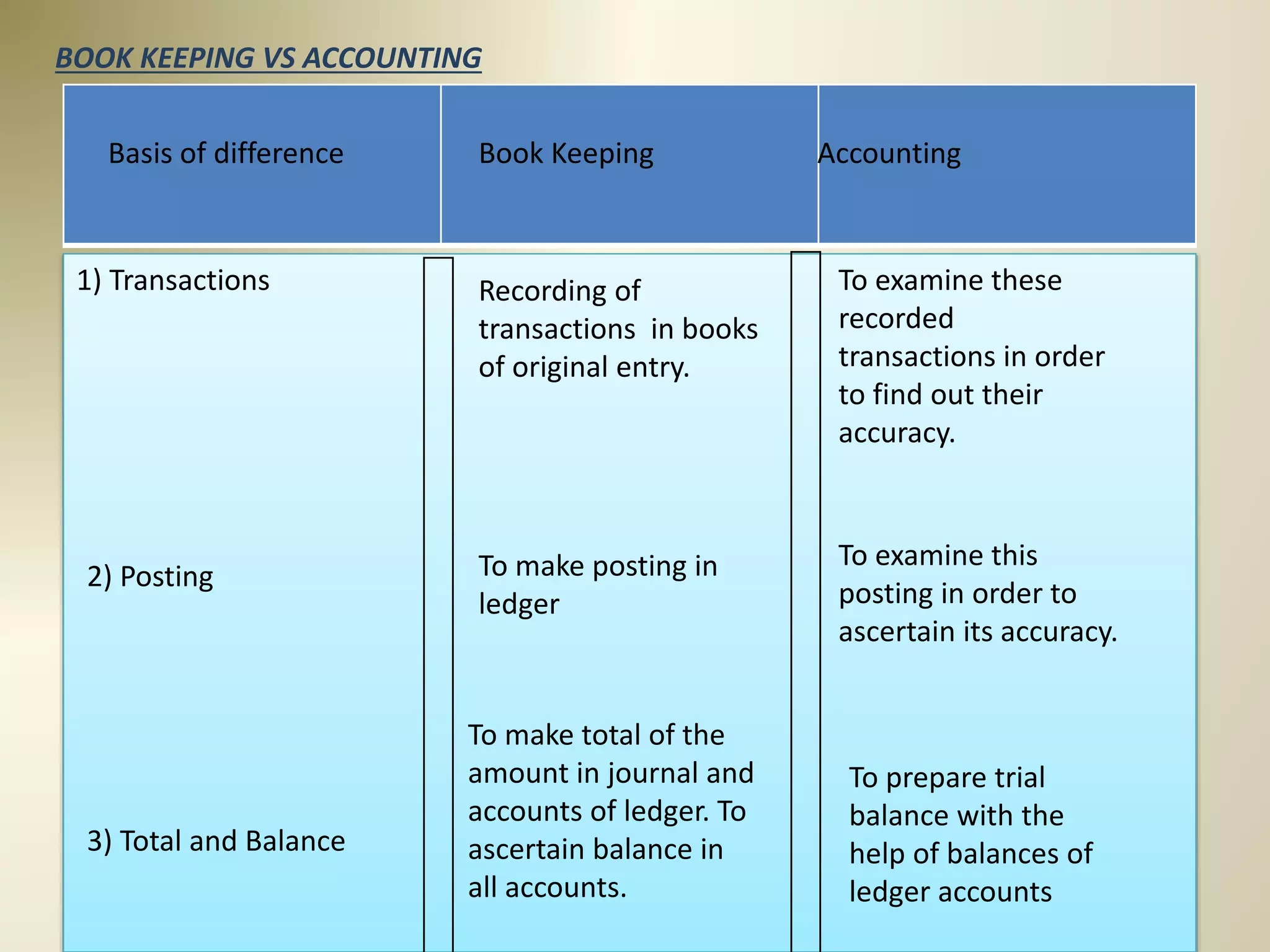
BOOK KEEPING VS ACCOUNTING
1) Transactions
Basis of difference Book Keeping Accounting
Recording of
transactions in books
of original entry.
To examine these
recorded
transactions in order
to find out their
accuracy.
2) Posting To make posting in
ledger
To examine this
posting in order to
ascertain its accuracy.
3) Total and Balance
To make total of the
amount in journal and
accounts of ledger. To
ascertain balance in
all accounts.
To prepare trial
balance with the
help of balances of
ledger accounts
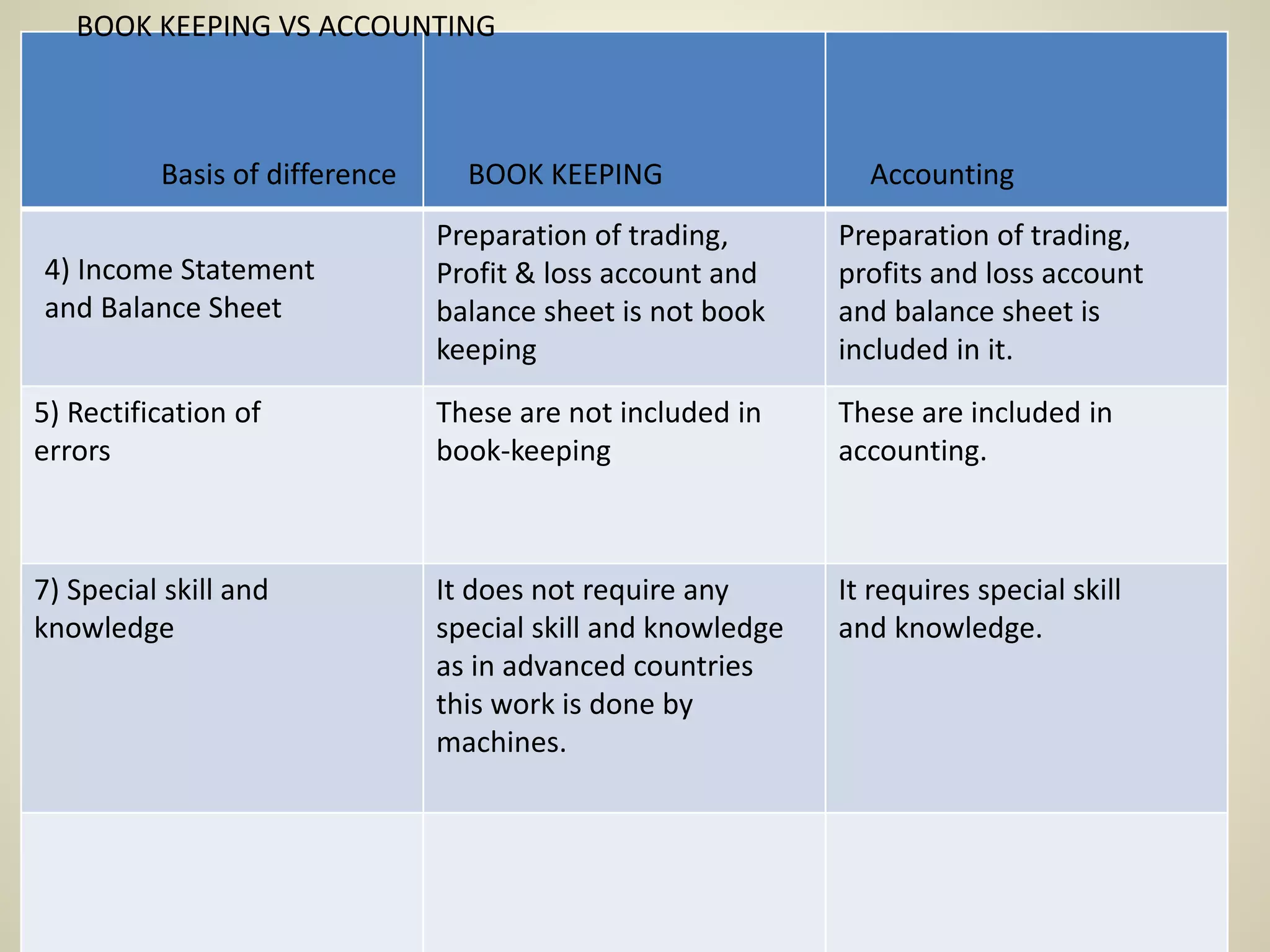
Preparation of trading,
Profit & loss account and
balance sheet is not book
keeping
Preparation of trading,
profits and loss account
and balance sheet is
included in it.
5) Rectification of
errors
These are not included in
book-keeping
These are included in
accounting.
7) Special skill and
knowledge
It does not require any
special skill and knowledge
as in advanced countries
this work is done by
machines.
It requires special skill
and knowledge.
BOOK KEEPING VS ACCOUNTING
Basis of difference BOOK KEEPING Accounting
4) Income Statement
and Balance Sheet
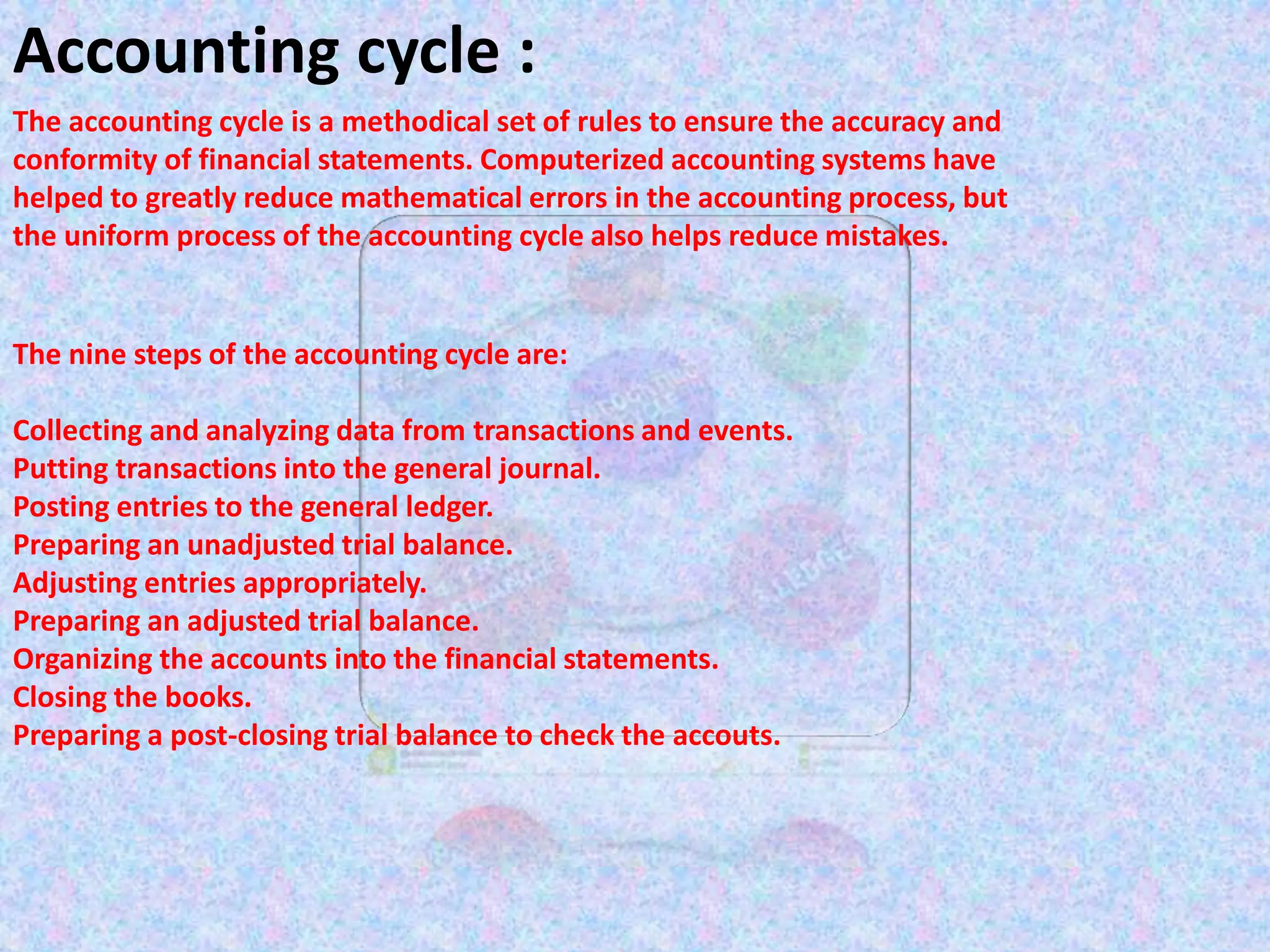
Accounting cycle :
The accounting cycle is a methodical set of rules to ensure the accuracy and
conformity of financial statements. Computerized accounting systems have
helped to greatly reduce mathematical errors in the accounting process, but
the uniform process of the accounting cycle also helps reduce mistakes.
The nine steps of the accounting cycle are:
Collecting and analyzing data from transactions and events.
Putting transactions into the general journal.
Posting entries to the general ledger.
Preparing an unadjusted trial balance.
Adjusting entries appropriately.
Preparing an adjusted trial balance.
Organizing the accounts into the financial statements.
Closing the books.
Preparing a post-closing trial balance to check the accouts.
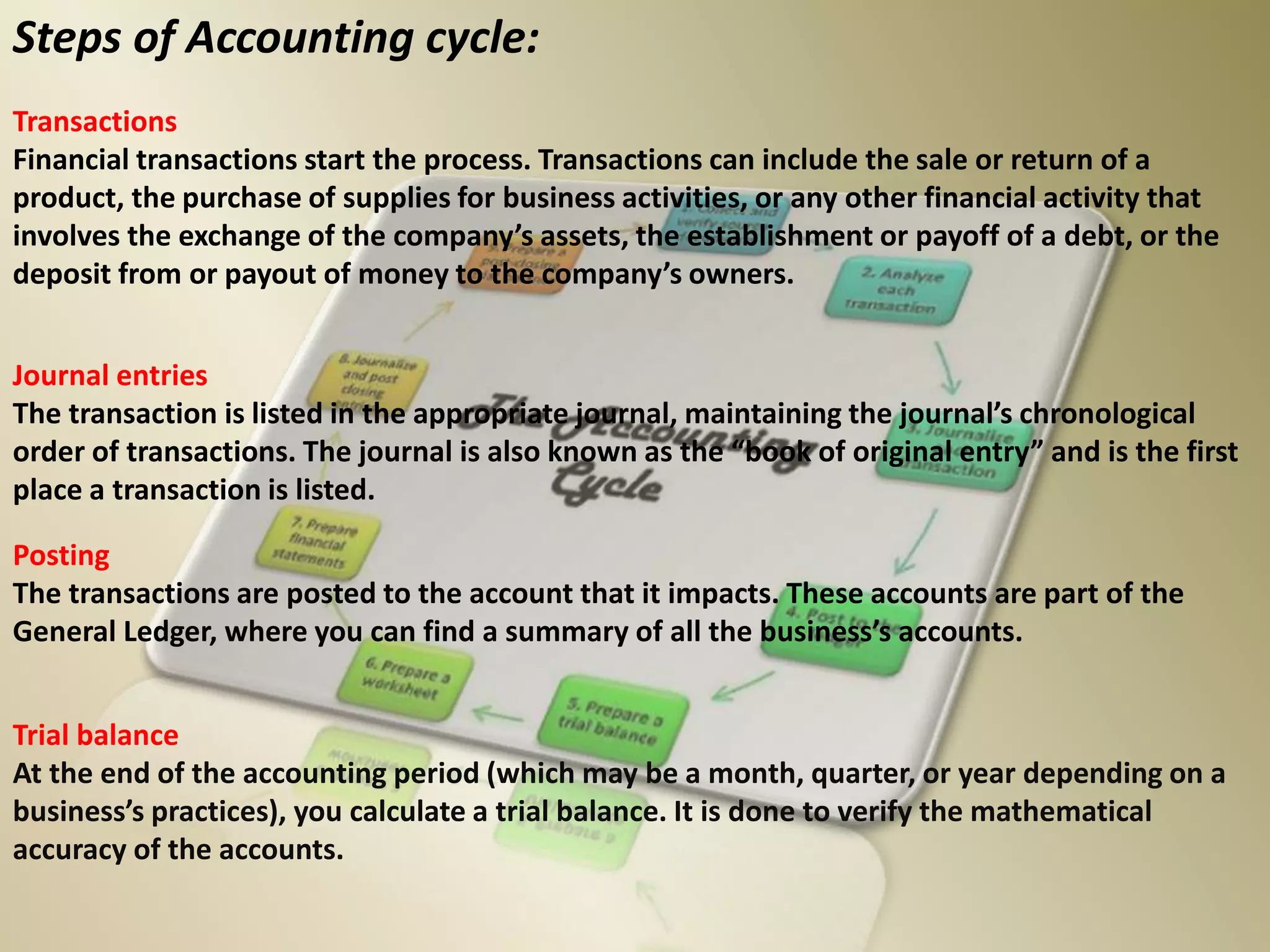
Steps of Accounting cycle:
Transactions
Financial transactions start the process. Transactions can include the sale or return of a
product, the purchase of supplies for business activities, or any other financial activity that
involves the exchange of the company’s assets, the establishment or payoff of a debt, or the
deposit from or payout of money to the company’s owners.
Journal entries
The transaction is listed in the appropriate journal, maintaining the journal’s chronological
order of transactions. The journal is also known as the “book of original entry” and is the first
place a transaction is listed.
Posting
The transactions are posted to the account that it impacts. These accounts are part of the
General Ledger, where you can find a summary of all the business’s accounts.
Trial balance
At the end of the accounting period (which may be a month, quarter, or year depending on a
business’s practices), you calculate a trial balance. It is done to verify the mathematical
accuracy of the accounts.
Worksheet
Unfortunately, many times your first calculation of the trial balance shows that the books
aren’t in balance. If that’s the case, you look for errors and make corrections
called adjustments, which are tracked on a worksheet.
Adjustments:
Adjustments are also made to account for the depreciation of assets and to adjust for one-
time payments (such as insurance) that should be allocated on a monthly basis to more
accurately match monthly expenses with monthly revenues. After you make and record
adjustments, you take another trial balance to be sure the accounts are in balance.
Adjusting journal entries
You post any corrections needed to the affected accounts once your trial balance shows the
accounts will be balanced once the adjustments needed are made to the accounts. You don’t
need to make adjusting entries until the trial balance process is completed and all needed
corrections and adjustments have been identified.
Financial statements
You prepare the balance sheet and income statement using the corrected account balances.
Closing the books
You close the books for the revenue and expense accounts and begin the
entire cycle again with zero balances in those accounts.
As a businessperson, you want to be able to gauge your profit or loss on month by
month, quarter by quarter, and year by year bases. To do that, Revenue and
Expense accounts must start with a zero balance at the beginning of each
accounting period. In contrast, you carry over Asset, Liability, and Equity account
balances from cycle to cycle.
Accounting chapter-3

Accounting chapter-3

  • 2.
    This presentation isowned by ABUL KALAM AZAD PATWARY “for class 9-10[accounting]”
  • 3.
    TWO SYSTEMS OFACCOUNTING:
  • 4.
    The double entrysystem of accounting or bookkeeping means that every business transaction will involve two accounts (or more). For example, when a company borrows money from its bank, the company's Cash account will increase and its liability account Loans Payable will increase. If a company pays $200 for an advertisement, its Cash account will decrease and its account Advertising Expense will increase. Double entry also allows for the accounting equation (assets = liabilities + owner's equity) to always be in balance. In our example involving Advertising Expense, the accounting equation remained in balance because expenses cause owner's equity to decrease. In that example, the asset Cash decreased and the owner's capital account within owner's equity also decreased. A third aspect of double entry is that the amounts entered into the general ledger accounts as debits must be equal to the amounts entered as credits. DOUBLE ENTRY SYSTEM :
  • 5.
    SINGLE ENTRY SYSTEM: This system ignores the two fold aspect of each transaction as considered in double entry system. Under single entry system, merely personal aspects of transaction i.e. personal accounts are recorded. This method takes no note of the impersonal aspects of the transaction other than cash. It offers no check on the accuracy of the posting and no safeguard against fraud because it does not provide any check over the recording of cash transaction. Therefore, it is called as "Imperfect accounting". According to Kohler: "Single entry system is a system which records each transactions and transactions relating to personal accounts."
  • 6.
    Features of doubleentry system : The features of double entry system are as follows: 1) Two parties: transaction takes place only if there are two parties- one party receiving the benefit other party giving or parting with the benefit. 2) Each party is affected (by the transaction) in opposite direction but with the same amount. 3) Each transaction affects at least two items in an accounting equation. Accounting equation is composed of three elements namely Assets, Liabilities and Capital. 4) Account receiving the benefit is debited and recorded on the left hand side and the account rendering the benefit is credited and recorded on the right hand side. 5) For each transaction debit amount is equal to the credit amount.
  • 7.
    Advantages of DoubleEntry System i) Scientific system: This system is the only scientific system of recording business transactions in a set of accounting records. It helps to attain the objectives of accounting. ii) Complete record of transactions: This system maintains a complete record of all business transactions. iii) A check on the accuracy of accounts: By use of this system the accuracy of accounting book can be established through the device called a Trail balance. iv) Ascertainment of profit or loss: The profit earned or loss suffered during a period can be ascertained together with details by the preparation of Profit and Loss Account. v) Knowledge of the financial position of the business: The financial position of the firm can be ascertained at the end of each period, through the preparation of balance sheet.
  • 8.
    vi) Full detailsfor purposes of control: This system permits accounts to be prepared or kept in as much detail as necessary and, therefore, affords significant information for purposes of control etc. vii) Comparative study is possible: Results of one year may be compared with those of the precious year and reasons for the change may be ascertained. viii) Helps management in decision making: The management may be also to obtain good information for its work, specially for making decisions. ix) No scope for fraud: The firm is saved from frauds and misappropriations since full information about all assets and liabilities will be available.
  • 9.
    Procedure of IdentifyingDebit and Credit: The term ‘debit’ is supposed to have derived from ‘debit’ and the term ‘credit’ from ‘creditable’. For convenience ‘Dr’ is used for debit and ‘Cr’ is used for credit. Recording of transactions require a thorough understanding of the rules of debit and credit relating to accounts. Both debit and credit may represent either increase or decrease, depending upon the nature of account. The main elements of accounting equation are asset, liability, and owner’s equity. The income of the business increases owner’s equity while the expense decreases the same.
  • 10.
    ASSETS: INCREASE INDEBIT- DECREASE IN CREDIT. LIABILITIES: INCREASE IN CREDIT- DECREASE IN DEBIT. EXPENSE: INCREASE IN DEBIT – DECREASE IN CREDIT. INCOME : INCREASE IN CREDIT- DECREASE IN DEBIT. CAPITAL : INCREASE IN CREDIT - DECREASE IN DEBIT.
  • 11.
    BRIEF NOTE ONDUAL ASPECT OF ACCOUNTING : Dual concept may be stated as "for every debit, there is a credit." Every transaction should have two sided effect to the extent of same amount. This concept has resulted in accounting equation which states that at any point of time the assets of any entity must be equal (in monetary terms) to the total of owner's equity and outsider's liabilities. This may be expressed in the form of equation: A - L = P Where A stands for assets of the entity. L stands for liabilities (outsider's claims) of the entity P stands for proprietor's claim (capital) on the entity. (The form of presentation of equation A - L = P is consistent with the legal interpretation of financial position.)
  • 12.
    BOOK KEEPING VSACCOUNTING 1) Transactions Basis of difference Book Keeping Accounting Recording of transactions in books of original entry. To examine these recorded transactions in order to find out their accuracy. 2) Posting To make posting in ledger To examine this posting in order to ascertain its accuracy. 3) Total and Balance To make total of the amount in journal and accounts of ledger. To ascertain balance in all accounts. To prepare trial balance with the help of balances of ledger accounts
  • 13.
    Preparation of trading, Profit& loss account and balance sheet is not book keeping Preparation of trading, profits and loss account and balance sheet is included in it. 5) Rectification of errors These are not included in book-keeping These are included in accounting. 7) Special skill and knowledge It does not require any special skill and knowledge as in advanced countries this work is done by machines. It requires special skill and knowledge. BOOK KEEPING VS ACCOUNTING Basis of difference BOOK KEEPING Accounting 4) Income Statement and Balance Sheet
  • 14.
    Accounting cycle : Theaccounting cycle is a methodical set of rules to ensure the accuracy and conformity of financial statements. Computerized accounting systems have helped to greatly reduce mathematical errors in the accounting process, but the uniform process of the accounting cycle also helps reduce mistakes. The nine steps of the accounting cycle are: Collecting and analyzing data from transactions and events. Putting transactions into the general journal. Posting entries to the general ledger. Preparing an unadjusted trial balance. Adjusting entries appropriately. Preparing an adjusted trial balance. Organizing the accounts into the financial statements. Closing the books. Preparing a post-closing trial balance to check the accouts.
  • 15.
    Steps of Accountingcycle: Transactions Financial transactions start the process. Transactions can include the sale or return of a product, the purchase of supplies for business activities, or any other financial activity that involves the exchange of the company’s assets, the establishment or payoff of a debt, or the deposit from or payout of money to the company’s owners. Journal entries The transaction is listed in the appropriate journal, maintaining the journal’s chronological order of transactions. The journal is also known as the “book of original entry” and is the first place a transaction is listed. Posting The transactions are posted to the account that it impacts. These accounts are part of the General Ledger, where you can find a summary of all the business’s accounts. Trial balance At the end of the accounting period (which may be a month, quarter, or year depending on a business’s practices), you calculate a trial balance. It is done to verify the mathematical accuracy of the accounts.
  • 16.
    Worksheet Unfortunately, many timesyour first calculation of the trial balance shows that the books aren’t in balance. If that’s the case, you look for errors and make corrections called adjustments, which are tracked on a worksheet. Adjustments: Adjustments are also made to account for the depreciation of assets and to adjust for one- time payments (such as insurance) that should be allocated on a monthly basis to more accurately match monthly expenses with monthly revenues. After you make and record adjustments, you take another trial balance to be sure the accounts are in balance. Adjusting journal entries You post any corrections needed to the affected accounts once your trial balance shows the accounts will be balanced once the adjustments needed are made to the accounts. You don’t need to make adjusting entries until the trial balance process is completed and all needed corrections and adjustments have been identified. Financial statements You prepare the balance sheet and income statement using the corrected account balances.
  • 17.
    Closing the books Youclose the books for the revenue and expense accounts and begin the entire cycle again with zero balances in those accounts. As a businessperson, you want to be able to gauge your profit or loss on month by month, quarter by quarter, and year by year bases. To do that, Revenue and Expense accounts must start with a zero balance at the beginning of each accounting period. In contrast, you carry over Asset, Liability, and Equity account balances from cycle to cycle.