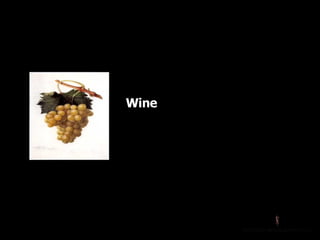
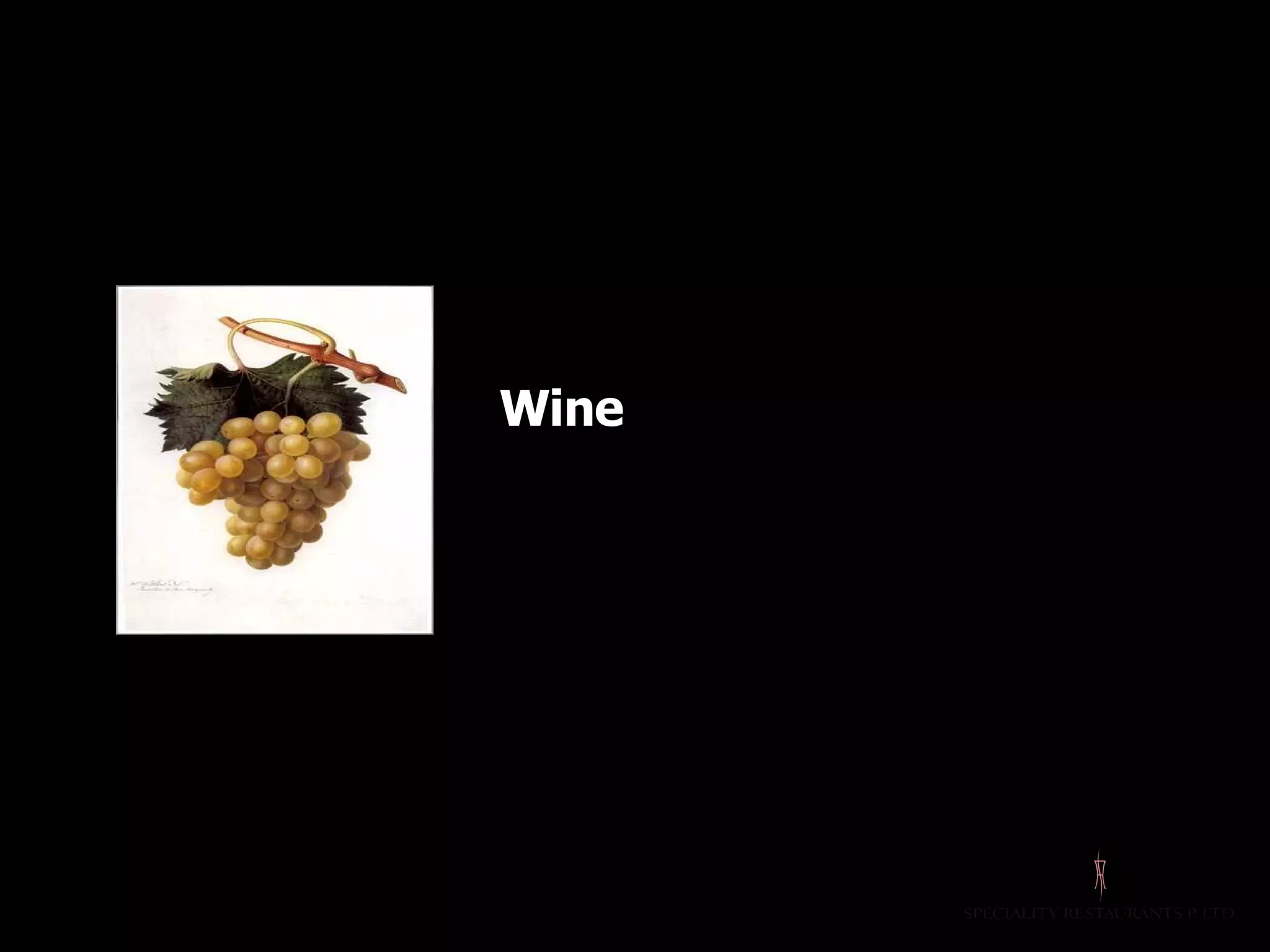
Wine
WHAT   IS WINE? WINE IS FERMENTED GRAPE JUICE CAN ALSO BE MADE  FROM FRUITS, BERRIES AND ARE KNOWN AS FRUIT WINES. SUGAR IS TRANSFORMED TO ALCOHOL
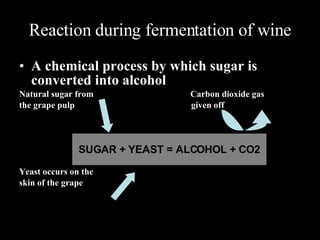
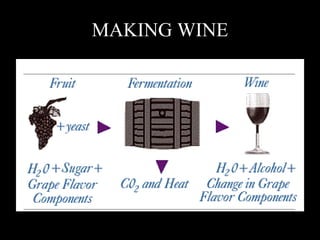
Reaction during fermentation of wine A chemical process by which sugar is converted into alcohol Natural sugar from    Carbon dioxide gas  the grape pulp  given off Yeast occurs on the skin of the grape SUGAR + YEAST = ALCOHOL + CO2
MAKING WINE
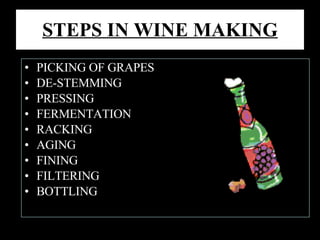
STEPS IN WINE MAKING PICKING OF GRAPES DE-STEMMING PRESSING FERMENTATION RACKING AGING FINING FILTERING BOTTLING
Wine Wine is an alcoholic beverage obtain from the fermentation of juice of freshly gathered grapes. Wines are broadly classified as follows Table wines or Still Wines Fortified wines Aromatised wines (Vermouths) Sparkling wines
Classification of Wine Table Wines They are classified into three Red Wine White Wine Rose Wine
Classification of Wine Red Wines They are almost  exclusive dry Range from light to full bodied, with distinctive taste To produce from red wines, grapes are crushed, not pressed. Skin is left with the juice during fermentation Contain 9-14% alcohol, and the taste ranges from very dry to very sweet. The service temperature of red wine is 16-18 degrees centigrade
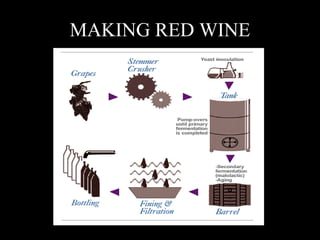
MAKING RED WINE
Classification of Wine Rose wines  These are produced exactly as red wines except that wine is drawn off from the fermenting red grapes after 2-3 days when enough red colour has been absorbed by the wine to give it a pink tinge.  They contain 9-14 % alcohol, and the taste ranges from very dry to very sweet.  The service temperature of rose wine is 13 – 16 degrees centigrade.
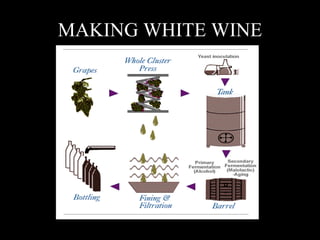
Classification of Wine White Wine Light and delicate in flavour, goes well with seafood and lightly flavoured food as rich food overpowers their taste.  - The grapes are pressed and the juice is drawn off immediately without the skins in to the cask for fermentation.  -Sweet white wines: The sugar content is very high, hence are preferred at the end of a meal. -They contain 9-14 % alcohol, and the taste ranges from very dry to very sweet. -The service temperature of white wine is 11 – 13 degrees centigrade .
MAKING WHITE WINE
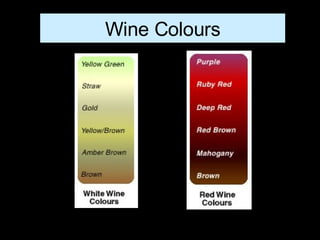
Wine Colours                            
Classification of Wine Sparkling wine The most famous one is Champagne. This is made by the methode Champenoise (second fermentation in the bottle) in the Champagne region of northeastern France. Effervescent wines made outside the Champagne region are called sparkling wines. Sparkling wines are made in France, Spain, Italy, America, Australia, Germany and many other countries.   View Presentation  on Champagne
Classification of Wine Sparkling wine Sparkling wines vary in their sweetness: Brut (very dry) Sec (medium dry) Demi sec (medium sweet) Doux (sweet) Semi sparkling wines are known by the term ‘perlant’ Service Temperature for Sparkling Wine is 7 – 10 degrees centigrade
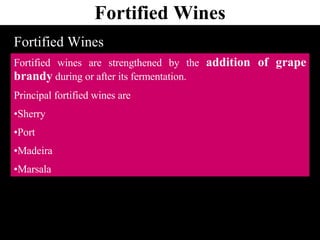
Fortified Wines Fortified Wines Fortified wines are strengthened by the  addition of grape brandy  during or after its fermentation. Principal fortified wines are Sherry Port Madeira Marsala
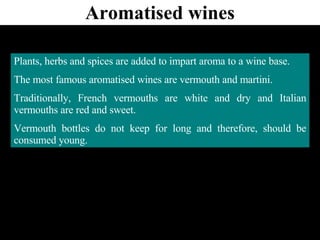
Aromatised wines Plants, herbs and spices are added to impart aroma to a wine base. The most famous aromatised wines are vermouth and martini. Traditionally, French vermouths are white and dry and Italian vermouths are red and sweet. Vermouth bottles do not keep for long and therefore, should be consumed young.
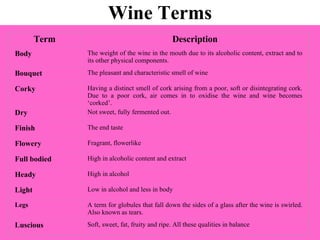
Wine Terms Term Description Body The weight of the wine in the mouth due to its alcoholic content, extract and to its other physical components. Bouquet The pleasant and characteristic smell of wine Corky Having a distinct smell of cork arising from a poor, soft or disintegrating cork. Due to a poor cork, air comes in to oxidise the wine and wine becomes ‘corked’.  Dry Not sweet, fully fermented out. Finish The end taste Flowery Fragrant, flowerlike Full bodied High in alcoholic content and extract Heady High in alcohol Light Low in alcohol and less in body Legs A term for globules that fall down the sides of a glass after the wine is swirled. Also known as tears. Luscious Soft, sweet, fat, fruity and ripe. All these qualities in balance
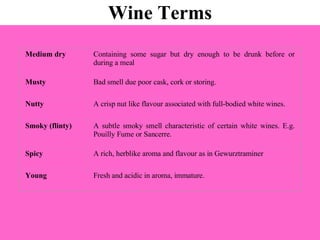
Wine Terms Medium dry Containing some sugar but dry enough to be drunk before or during a meal Musty Bad smell due poor cask, cork or storing. Nutty A crisp nut like flavour associated with full-bodied white wines. Smoky (flinty) A subtle smoky smell characteristic of certain white wines. E.g. Pouilly Fume or Sancerre. Spicy A rich, herblike aroma and flavour as in Gewurztraminer Young Fresh and acidic in aroma, immature.
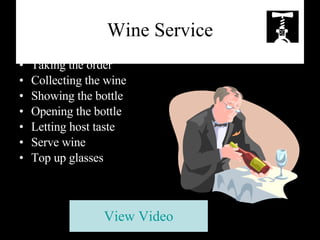
Wine Service Taking the order Collecting the wine Showing the bottle Opening the bottle Letting host taste Serve wine Top up glasses View Video
Wine  Serving Aids Wine Opener/ Corkscrew Wine baskets - red wine Wine buckets - lower or maintain temperature 3/4 full - 1 part water to 2 part ice Is this bottle chilled to your liking? Glassware - Wine glasses ( white/ red), champagne saucer/flute/ tulip, Sherry glass White wine - 1/2 full Red wine 1/3 full

Wine

  • 1.
  • 2.
    WHAT IS WINE? WINE IS FERMENTED GRAPE JUICE CAN ALSO BE MADE FROM FRUITS, BERRIES AND ARE KNOWN AS FRUIT WINES. SUGAR IS TRANSFORMED TO ALCOHOL
  • 3.
    Reaction during fermentationof wine A chemical process by which sugar is converted into alcohol Natural sugar from Carbon dioxide gas the grape pulp given off Yeast occurs on the skin of the grape SUGAR + YEAST = ALCOHOL + CO2
  • 4.
  • 5.
    STEPS IN WINEMAKING PICKING OF GRAPES DE-STEMMING PRESSING FERMENTATION RACKING AGING FINING FILTERING BOTTLING
  • 6.
    Wine Wine isan alcoholic beverage obtain from the fermentation of juice of freshly gathered grapes. Wines are broadly classified as follows Table wines or Still Wines Fortified wines Aromatised wines (Vermouths) Sparkling wines
  • 7.
    Classification of WineTable Wines They are classified into three Red Wine White Wine Rose Wine
  • 8.
    Classification of WineRed Wines They are almost exclusive dry Range from light to full bodied, with distinctive taste To produce from red wines, grapes are crushed, not pressed. Skin is left with the juice during fermentation Contain 9-14% alcohol, and the taste ranges from very dry to very sweet. The service temperature of red wine is 16-18 degrees centigrade
  • 9.
  • 10.
    Classification of WineRose wines  These are produced exactly as red wines except that wine is drawn off from the fermenting red grapes after 2-3 days when enough red colour has been absorbed by the wine to give it a pink tinge.  They contain 9-14 % alcohol, and the taste ranges from very dry to very sweet.  The service temperature of rose wine is 13 – 16 degrees centigrade.
  • 11.
    Classification of WineWhite Wine Light and delicate in flavour, goes well with seafood and lightly flavoured food as rich food overpowers their taste. - The grapes are pressed and the juice is drawn off immediately without the skins in to the cask for fermentation. -Sweet white wines: The sugar content is very high, hence are preferred at the end of a meal. -They contain 9-14 % alcohol, and the taste ranges from very dry to very sweet. -The service temperature of white wine is 11 – 13 degrees centigrade .
  • 12.
  • 13.
    Wine Colours                           
  • 14.
    Classification of WineSparkling wine The most famous one is Champagne. This is made by the methode Champenoise (second fermentation in the bottle) in the Champagne region of northeastern France. Effervescent wines made outside the Champagne region are called sparkling wines. Sparkling wines are made in France, Spain, Italy, America, Australia, Germany and many other countries.   View Presentation on Champagne
  • 15.
    Classification of WineSparkling wine Sparkling wines vary in their sweetness: Brut (very dry) Sec (medium dry) Demi sec (medium sweet) Doux (sweet) Semi sparkling wines are known by the term ‘perlant’ Service Temperature for Sparkling Wine is 7 – 10 degrees centigrade
  • 16.
    Fortified Wines FortifiedWines Fortified wines are strengthened by the addition of grape brandy during or after its fermentation. Principal fortified wines are Sherry Port Madeira Marsala
  • 17.
    Aromatised wines Plants,herbs and spices are added to impart aroma to a wine base. The most famous aromatised wines are vermouth and martini. Traditionally, French vermouths are white and dry and Italian vermouths are red and sweet. Vermouth bottles do not keep for long and therefore, should be consumed young.
  • 18.
    Wine Terms TermDescription Body The weight of the wine in the mouth due to its alcoholic content, extract and to its other physical components. Bouquet The pleasant and characteristic smell of wine Corky Having a distinct smell of cork arising from a poor, soft or disintegrating cork. Due to a poor cork, air comes in to oxidise the wine and wine becomes ‘corked’. Dry Not sweet, fully fermented out. Finish The end taste Flowery Fragrant, flowerlike Full bodied High in alcoholic content and extract Heady High in alcohol Light Low in alcohol and less in body Legs A term for globules that fall down the sides of a glass after the wine is swirled. Also known as tears. Luscious Soft, sweet, fat, fruity and ripe. All these qualities in balance
  • 19.
    Wine Terms Mediumdry Containing some sugar but dry enough to be drunk before or during a meal Musty Bad smell due poor cask, cork or storing. Nutty A crisp nut like flavour associated with full-bodied white wines. Smoky (flinty) A subtle smoky smell characteristic of certain white wines. E.g. Pouilly Fume or Sancerre. Spicy A rich, herblike aroma and flavour as in Gewurztraminer Young Fresh and acidic in aroma, immature.
  • 20.
    Wine Service Takingthe order Collecting the wine Showing the bottle Opening the bottle Letting host taste Serve wine Top up glasses View Video
  • 21.
    Wine ServingAids Wine Opener/ Corkscrew Wine baskets - red wine Wine buckets - lower or maintain temperature 3/4 full - 1 part water to 2 part ice Is this bottle chilled to your liking? Glassware - Wine glasses ( white/ red), champagne saucer/flute/ tulip, Sherry glass White wine - 1/2 full Red wine 1/3 full