5 week
 Wine Course
    Red Nose Wine
Clonmel Business Park
www.rednosewine.com
Course Details
• €75 per person
• 5 weeks starting Thursday October 11th
• 7.30-9pm in Shop
• At least one night will be offsite ( not
  included in price – Food & Wine extra )
• Set agenda – but open to change
• Cheese night – Nov 1st
• Food night – Nov 8th
Course Outline
•   What is wine ?
•   How to Taste & Assess Wine
•   Wine Serving & Storage
•   Grapes – 3 White & 3 Red
•   Wine & Food & Cheese
•   Wine Regions
•   Wine Styles
•   Anything else we think of
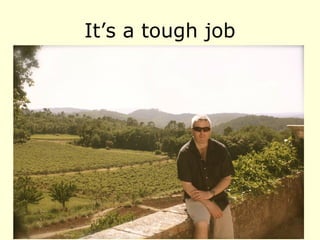
It’s a tough job
Wine Philosophy
• Wine should reflect the land where the
  grapes are grown and also the people who
  tend the vines and make the wine
• Wine is an organic living entity that
  changes constantly
• It is not a production line product
  – Different should be good, not bad
• Try to mix up the type of wines you drink
  – There is huge diversity out there
Wine Quotes
• “Wine is bottled poetry”.Robert Louis
  Stevenson
• “The best use of bad wine is to drive away
  poor relations”. French proverb
• "In water one sees one's own face; But in
  wine, one beholds the heart of another.“
  French proverb
• “Wine is one of the most civilized things in
  the world” Ernest Hemingway
• “Wine improves with age. The older I get,
  the better I like it”. Anonymous
Wine
• Alcoholic beverage made from fermented
  grape juice
• Yeast + Sugar = Alcohol + Carbon Dioxide
• Most wines are Light Wines
• Except
  – Sparkling  Champagne, Cava, Prosecco
  – Fortified  Port, Sherry, Madeira
  – Aromatised  Vermouth
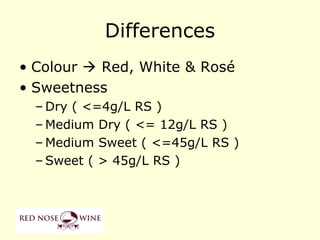
Differences
• Colour  Red, White & Rosé
• Sweetness
  – Dry ( <=4g/L RS )
  – Medium Dry ( <= 12g/L RS )
  – Medium Sweet ( <=45g/L RS )
  – Sweet ( > 45g/L RS )
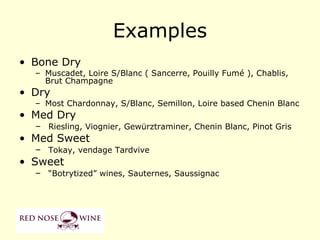
Examples
• Bone Dry
  – Muscadet, Loire S/Blanc ( Sancerre, Pouilly Fumé ), Chablis,
    Brut Champagne
• Dry
  – Most Chardonnay, S/Blanc, Semillon, Loire based Chenin Blanc
• Med Dry
  – Riesling, Viognier, Gewürztraminer, Chenin Blanc, Pinot Gris
• Med Sweet
  – Tokay, vendage Tardvive
• Sweet
  – “Botrytized” wines, Sauternes, Saussignac
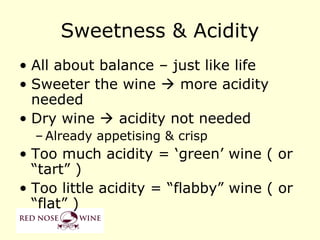
Sweetness & Acidity
• All about balance – just like life
• Sweeter the wine  more acidity
  needed
• Dry wine  acidity not needed
  – Already appetising & crisp
• Too much acidity = ‘green’ wine ( or
  “tart” )
• Too little acidity = “flabby” wine ( or
  “flat” )
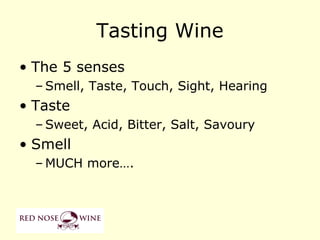
Tasting Wine
• The 5 senses
  – Smell, Taste, Touch, Sight, Hearing
• Taste
  – Sweet, Acid, Bitter, Salt, Savoury
• Smell
  – MUCH more….
The Jelly Bean Test
1. Close your eyes
2. Pinch your nose
3. Start eating a jelly bean
  • What do you taste
1. Let go of your nose
  • What happens?
1. The difference?
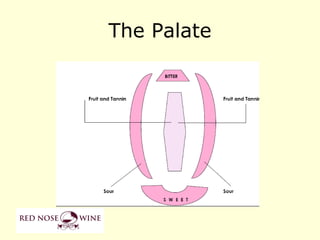
The Palate
Tasting
• Quality
  – Cleanliness
     • Cork taint, Sulphur Dioxide, Oxidised
  – Balance
     • Acidity, sweetness, tannin and alcohol
  – Length
     • Flavours linger long after the wine
• Environment
  – Avoid  Perfume, Smoke
  – Correct temperature
     • ( 10° - 13°(W) OR 15° - 18°(R) )
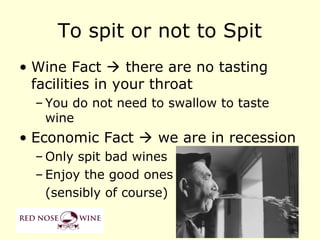
To spit or not to Spit
• Wine Fact  there are no tasting
  facilities in your throat
  – You do not need to swallow to taste
    wine
• Economic Fact  we are in recession
  – Only spit bad wines
  – Enjoy the good ones
    (sensibly of course)
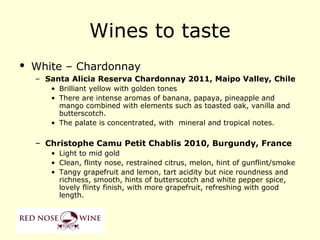
Wines to taste
• White – Chardonnay
  – Santa Alicia Reserva Chardonnay 2011, Maipo Valley, Chile
     • Brilliant yellow with golden tones
     • There are intense aromas of banana, papaya, pineapple and
       mango combined with elements such as toasted oak, vanilla and
       butterscotch.
     • The palate is concentrated, with mineral and tropical notes.

  – Christophe Camu Petit Chablis 2010, Burgundy, France
     • Light to mid gold
     • Clean, flinty nose, restrained citrus, melon, hint of gunflint/smoke
     • Tangy grapefruit and lemon, tart acidity but nice roundness and
       richness, smooth, hints of butterscotch and white pepper spice,
       lovely flinty finish, with more grapefruit, refreshing with good
       length.
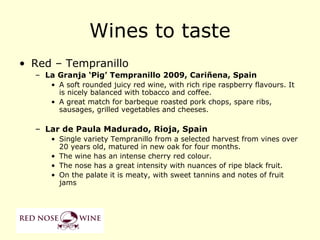
Wines to taste
• Red – Tempranillo
  – La Granja ‘Pig’ Tempranillo 2009, Cariñena, Spain
     • A soft rounded juicy red wine, with rich ripe raspberry flavours. It
       is nicely balanced with tobacco and coffee.
     • A great match for barbeque roasted pork chops, spare ribs,
       sausages, grilled vegetables and cheeses.

  – Lar de Paula Madurado, Rioja, Spain
     • Single variety Tempranillo from a selected harvest from vines over
       20 years old, matured in new oak for four months.
     • The wine has an intense cherry red colour.
     • The nose has a great intensity with nuances of ripe black fruit.
     • On the palate it is meaty, with sweet tannins and notes of fruit
       jams
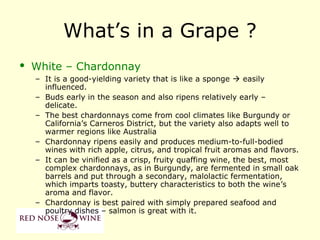
What’s in a Grape ?
• White – Chardonnay
  – It is a good-yielding variety that is like a sponge  easily
    influenced.
  – Buds early in the season and also ripens relatively early –
    delicate.
  – The best chardonnays come from cool climates like Burgundy or
    California’s Carneros District, but the variety also adapts well to
    warmer regions like Australia
  – Chardonnay ripens easily and produces medium-to-full-bodied
    wines with rich apple, citrus, and tropical fruit aromas and flavors.
  – It can be vinified as a crisp, fruity quaffing wine, the best, most
    complex chardonnays, as in Burgundy, are fermented in small oak
    barrels and put through a secondary, malolactic fermentation,
    which imparts toasty, buttery characteristics to both the wine’s
    aroma and flavor.
  – Chardonnay is best paired with simply prepared seafood and
    poultry dishes – salmon is great with it.
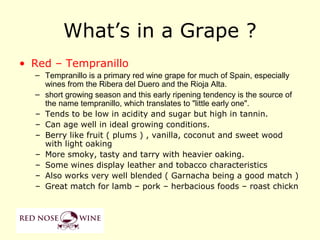
What’s in a Grape ?
• Red – Tempranillo
  – Tempranillo is a primary red wine grape for much of Spain, especially
    wines from the Ribera del Duero and the Rioja Alta.
  – short growing season and this early ripening tendency is the source of
    the name tempranillo, which translates to "little early one".
  – Tends to be low in acidity and sugar but high in tannin.
  – Can age well in ideal growing conditions.
  – Berry like fruit ( plums ) , vanilla, coconut and sweet wood
    with light oaking
  – More smoky, tasty and tarry with heavier oaking.
  – Some wines display leather and tobacco characteristics
  – Also works very well blended ( Garnacha being a good match )
  – Great match for lamb – pork – herbacious foods – roast chickn

Red nose wine course wk 1 2012

  • 1.
    5 week WineCourse Red Nose Wine Clonmel Business Park www.rednosewine.com
  • 2.
    Course Details • €75per person • 5 weeks starting Thursday October 11th • 7.30-9pm in Shop • At least one night will be offsite ( not included in price – Food & Wine extra ) • Set agenda – but open to change • Cheese night – Nov 1st • Food night – Nov 8th
  • 3.
    Course Outline • What is wine ? • How to Taste & Assess Wine • Wine Serving & Storage • Grapes – 3 White & 3 Red • Wine & Food & Cheese • Wine Regions • Wine Styles • Anything else we think of
  • 4.
  • 5.
    Wine Philosophy • Wineshould reflect the land where the grapes are grown and also the people who tend the vines and make the wine • Wine is an organic living entity that changes constantly • It is not a production line product – Different should be good, not bad • Try to mix up the type of wines you drink – There is huge diversity out there
  • 6.
    Wine Quotes • “Wineis bottled poetry”.Robert Louis Stevenson • “The best use of bad wine is to drive away poor relations”. French proverb • "In water one sees one's own face; But in wine, one beholds the heart of another.“ French proverb • “Wine is one of the most civilized things in the world” Ernest Hemingway • “Wine improves with age. The older I get, the better I like it”. Anonymous
  • 7.
    Wine • Alcoholic beveragemade from fermented grape juice • Yeast + Sugar = Alcohol + Carbon Dioxide • Most wines are Light Wines • Except – Sparkling  Champagne, Cava, Prosecco – Fortified  Port, Sherry, Madeira – Aromatised  Vermouth
  • 8.
    Differences • Colour Red, White & Rosé • Sweetness – Dry ( <=4g/L RS ) – Medium Dry ( <= 12g/L RS ) – Medium Sweet ( <=45g/L RS ) – Sweet ( > 45g/L RS )
  • 9.
    Examples • Bone Dry – Muscadet, Loire S/Blanc ( Sancerre, Pouilly Fumé ), Chablis, Brut Champagne • Dry – Most Chardonnay, S/Blanc, Semillon, Loire based Chenin Blanc • Med Dry – Riesling, Viognier, Gewürztraminer, Chenin Blanc, Pinot Gris • Med Sweet – Tokay, vendage Tardvive • Sweet – “Botrytized” wines, Sauternes, Saussignac
  • 10.
    Sweetness & Acidity •All about balance – just like life • Sweeter the wine  more acidity needed • Dry wine  acidity not needed – Already appetising & crisp • Too much acidity = ‘green’ wine ( or “tart” ) • Too little acidity = “flabby” wine ( or “flat” )
  • 11.
    Tasting Wine • The5 senses – Smell, Taste, Touch, Sight, Hearing • Taste – Sweet, Acid, Bitter, Salt, Savoury • Smell – MUCH more….
  • 12.
    The Jelly BeanTest 1. Close your eyes 2. Pinch your nose 3. Start eating a jelly bean • What do you taste 1. Let go of your nose • What happens? 1. The difference?
  • 13.
  • 14.
    Tasting • Quality – Cleanliness • Cork taint, Sulphur Dioxide, Oxidised – Balance • Acidity, sweetness, tannin and alcohol – Length • Flavours linger long after the wine • Environment – Avoid  Perfume, Smoke – Correct temperature • ( 10° - 13°(W) OR 15° - 18°(R) )
  • 15.
    To spit ornot to Spit • Wine Fact  there are no tasting facilities in your throat – You do not need to swallow to taste wine • Economic Fact  we are in recession – Only spit bad wines – Enjoy the good ones (sensibly of course)
  • 16.
    Wines to taste •White – Chardonnay – Santa Alicia Reserva Chardonnay 2011, Maipo Valley, Chile • Brilliant yellow with golden tones • There are intense aromas of banana, papaya, pineapple and mango combined with elements such as toasted oak, vanilla and butterscotch. • The palate is concentrated, with mineral and tropical notes. – Christophe Camu Petit Chablis 2010, Burgundy, France • Light to mid gold • Clean, flinty nose, restrained citrus, melon, hint of gunflint/smoke • Tangy grapefruit and lemon, tart acidity but nice roundness and richness, smooth, hints of butterscotch and white pepper spice, lovely flinty finish, with more grapefruit, refreshing with good length.
  • 17.
    Wines to taste •Red – Tempranillo – La Granja ‘Pig’ Tempranillo 2009, Cariñena, Spain • A soft rounded juicy red wine, with rich ripe raspberry flavours. It is nicely balanced with tobacco and coffee. • A great match for barbeque roasted pork chops, spare ribs, sausages, grilled vegetables and cheeses. – Lar de Paula Madurado, Rioja, Spain • Single variety Tempranillo from a selected harvest from vines over 20 years old, matured in new oak for four months. • The wine has an intense cherry red colour. • The nose has a great intensity with nuances of ripe black fruit. • On the palate it is meaty, with sweet tannins and notes of fruit jams
  • 18.
    What’s in aGrape ? • White – Chardonnay – It is a good-yielding variety that is like a sponge  easily influenced. – Buds early in the season and also ripens relatively early – delicate. – The best chardonnays come from cool climates like Burgundy or California’s Carneros District, but the variety also adapts well to warmer regions like Australia – Chardonnay ripens easily and produces medium-to-full-bodied wines with rich apple, citrus, and tropical fruit aromas and flavors. – It can be vinified as a crisp, fruity quaffing wine, the best, most complex chardonnays, as in Burgundy, are fermented in small oak barrels and put through a secondary, malolactic fermentation, which imparts toasty, buttery characteristics to both the wine’s aroma and flavor. – Chardonnay is best paired with simply prepared seafood and poultry dishes – salmon is great with it.
  • 19.
    What’s in aGrape ? • Red – Tempranillo – Tempranillo is a primary red wine grape for much of Spain, especially wines from the Ribera del Duero and the Rioja Alta. – short growing season and this early ripening tendency is the source of the name tempranillo, which translates to "little early one". – Tends to be low in acidity and sugar but high in tannin. – Can age well in ideal growing conditions. – Berry like fruit ( plums ) , vanilla, coconut and sweet wood with light oaking – More smoky, tasty and tarry with heavier oaking. – Some wines display leather and tobacco characteristics – Also works very well blended ( Garnacha being a good match ) – Great match for lamb – pork – herbacious foods – roast chickn

Editor's Notes

  • #3 Stick your head into a vat of fermenting wine – see what happens
  • #4 Stick your head into a vat of fermenting wine – see what happens
  • #5 Stick your head into a vat of fermenting wine – see what happens
  • #8 Stick your head into a vat of fermenting wine – see what happens
  • #9 Most wines are dry… but some are sweet Residual Sugar is left in the wine ( always some, even in bone dry wines ) Cheaper wines can be sweeter as the sugar masks the rough edges of poor wine
  • #10 Red Wines Bone Dry  Red Loire, Medoc, Hermitage, Italian wines ( Barolo, Barberesco, Brunello, Chianti Classico ) Dry  85% of all reds Med Dry  Varietal Merlot &amp; Pinot Noir, California Cab Sab, C-D-Pape, Australian Shiraz, inexpensive brand reds Med Sweet  Sangria, late harvest Zinfadel
  • #11 A well balanced wine is one that has no single component standing out Acidity, sweetness, tannin or alchol
  • #12 Sight can help when accessing age of a wine and clarity, but not important for tasting When you have a cold, you don ’ t taste so much The mouth and the nose are both integral to the taste experience ALWAYS smell your food when you eat it – double the pleasure!