

WINE 101
WINE TASTING & CATERING
ANTHIMOS GEORGIOU
Gastronomy Lover & Wine Connoisseur
Citizen of the World. Limassol, New York, Thessaloniki,
Luzern! Teaching Hospitality and Food & Beverage
Management in a Swiss Hotel School in Luzern!
I am offering Wine Tastings with wines of your choice
but also with wines that I will carefully select to match
your taste and budget. I also cater with cheese,
charcuterie and finger food to pair the wines and bring
the most out of them.
Become a member of my Gastronomy Network to learn
more about Wines and Gastronomy.
gastronomy.mightybell.com
Basic wine information
•a significant proportion of the total revenue from
alcoholic beverage.
•Wine is the product obtained from the total or
partial alcoholic fermentation of fresh grapes,
whether or not crushed, or of grape must –
European Community
Beverages
Basic wine information
There are two types of grapes:
•white and black/red grapes
•Black grapes have coloring in the skin and are
used in the production of both red, white & rosé
wines
Beverages
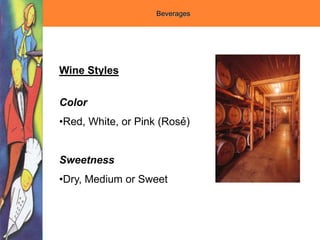
Wine Styles
Color
•Red, White, or Pink (Rosẻ)
Sweetness
•Dry, Medium or Sweet
Beverages
Major Wine Producing Nations
1. Italy and France
2. Spain and Portugal
3. Greece and Cyprus
4. Germany and Switzerland
5. United States and Canada
6. Argentina and Chile
7. Australia and New Zealand
8. South Africa
9. Lebanon and Israel
Beverages
Beverages
PRODUCING WINE
The quality of wine depends on
•the grape variety
•the climate
•annual weather conditions
•the type of soil
•Viticulture (method of growing the vine)
•Vinification (method of turning grapes into
wine)
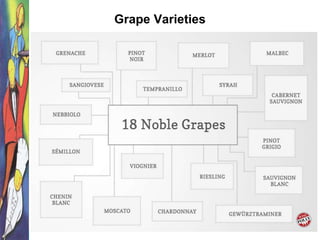
Grape Varieties
Beverages
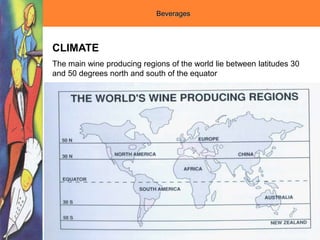
CLIMATE
The main wine producing regions of the world lie between latitudes 30
and 50 degrees north and south of the equator
Beverages
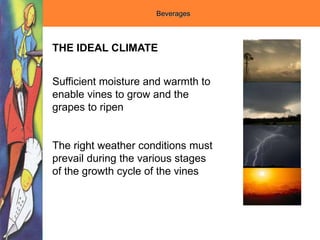
THE IDEAL CLIMATE
Sufficient moisture and warmth to
enable vines to grow and the
grapes to ripen
The right weather conditions must
prevail during the various stages
of the growth cycle of the vines
Beverages
THE PERFECT CLIMATE
•A cold winter to inhibit growth and rest the vine. Frosts to
kill diseases, but not to severly kill the vine. Enough rain to
build moisture reserves in the soil
•A mild warm spring with gentle rain to encourage the vine‘s
growth
•A warm settled period during the vine‘s flowering, followed
by a hot sunny summer with a little rain to swell the
developing fruit
•A long, fine, dry autumn to complete the ripening of the
grape, and for the vintage
Beverages
MAIN CLIMATIC DANGERS
•Frost can destroy growing shoots in the spring and
is particularly dangerous at the time of the budding
•Hail can break and damage young growth and
espescially during late summer, burst developing
grapes allowing rot to set it
•Wind is disastrous at flowering preventing
pollination. It can also break young shoots
Beverages
SOIL
Grape vines often thrive where other plants fail
POOR SOIL – LOW YIELDS OF FINE QUALITY
WINE
RICH SOIL – HIGHER YIELDS OF LESS GOOD
QUALITY WINE
THE BEST SOILS PROVIDE GOOD DRAINAGE NATURALLY
Beverages
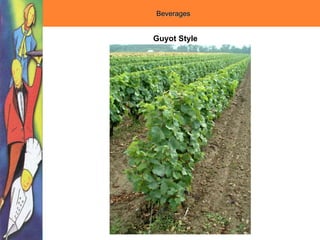
Guyot Style
Beverages
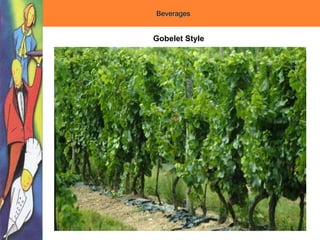
Gobelet Style
Beverages
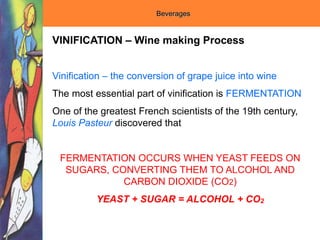
VINIFICATION – Wine making Process
Vinification – the conversion of grape juice into wine
The most essential part of vinification is FERMENTATION
One of the greatest French scientists of the 19th century,
Louis Pasteur discovered that
FERMENTATION OCCURS WHEN YEAST FEEDS ON
SUGARS, CONVERTING THEM TO ALCOHOL AND
CARBON DIOXIDE (CO2)
YEAST + SUGAR = ALCOHOL + CO2
Beverages
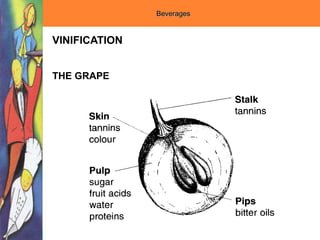
VINIFICATION
THE GRAPE
Beverages
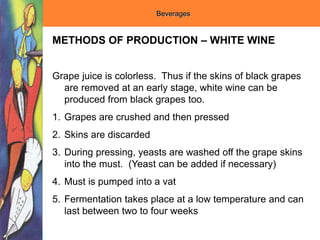
METHODS OF PRODUCTION – WHITE WINE
Grape juice is colorless. Thus if the skins of black grapes
are removed at an early stage, white wine can be
produced from black grapes too.
1. Grapes are crushed and then pressed
2. Skins are discarded
3. During pressing, yeasts are washed off the grape skins
into the must. (Yeast can be added if necessary)
4. Must is pumped into a vat
5. Fermentation takes place at a low temperature and can
last between two to four weeks
Beverages
METHODS OF PRODUCTION – RED WINE
Made from the juice and the skins of black grapes. The
colour comes from the pigments of the grape
1. Grapes are crushed and then pressed
2. Skins are also used
3. During pressing, yeasts are washed off the grape skins
into the must. (Yeast can be added if necessary)
4. Must is pumped into a vat
5. Fermentation takes place at temperature between 25 and
30º C.
6. As fermentation creates alcohol, the alcohol itself extracts
first color and then tannin from the skins
Beverages
METHODS OF PRODUCTION
– RED WINE
• The amount of color and tannin
in the finished wine depends on
how long the new wine is kept
in contact with the skins
• As little as five days for light
wines (Beaujolais)
• About two weeks for full bodied
wines (Bordeaux)
• Rose wines – 14 to 24 hours
Beverages
METHODS OF PRODUCTION – RED WINE
1. When colour and tannin are sufficient, the free run wine is
drawn from the skins in a clean vat.
2. Skins are then pressed, yielding a further quantitiy of wine
(known as press wine).
3. Press wine contains higher level of tannin, and is blended
with the original wine. The amount depends on the
character the winemaker wants to achieve.
Beverages
METHODS OF PRODUCTION – RED WINE
• Racking: the sediment accumulated at the end of the
vessel (lees) is removed
• Fining: Bentonite, gelatine of white of egg are used to
push to the bottom of the vessel certain natural hazardous
substances
• Maturation – wine is allowed to rest, and flavor to develop.
This occurs during storage in large stainless steel vessels
or in oak casks
• Before bottling most wines will be chilled to form a
sediment which is removed
How To Taste And Evaluate Wine
• Appearance
• Smell
• Taste
• Final Impressions
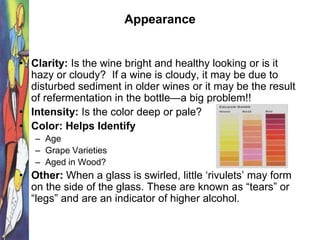
Appearance
• Clarity: Is the wine bright and healthy looking or is it
hazy or cloudy? If a wine is cloudy, it may be due to
disturbed sediment in older wines or it may be the result
of refermentation in the bottle—a big problem!!
• Intensity: Is the color deep or pale?
• Color: Helps Identify
– Age
– Grape Varieties
– Aged in Wood?
• Other: When a glass is swirled, little ‘rivulets’ may form
on the side of the glass. These are known as “tears” or
“legs” and are an indicator of higher alcohol.
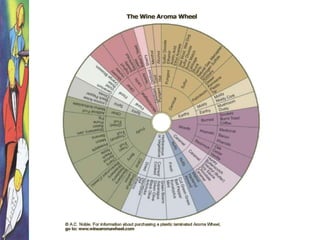
Smell “The Nose”
• Average person can identify over 2000
scents, wine has over 200.
• Aroma=Smell of the grapes
• Bouquet=Total smell of wine
• Smell helps identify
– Age
– Faults
– Varietal
Nose – Aromas
Characteristic Aromas of Wines
 Chardonnay
 Vanilla / citrus / wood
 Chenin Blanc
 Ripe melon / honey
 Sauvignon Blanc
 grass / green apple /
grapefruit
 Riesling
 ripe fruits / lemon
 Gewurztraminer
 ripe fruits / exotic
spices / perfume
 Carbernet Sauvignon
 dark fruits / wood / leather
 Zindandel
 red or dark fruits / pepper
 Merlot
 ripe grapes / plums
 Grenache
 dark fruits / pepper
 Pinot Noir
 red fruits / wood /
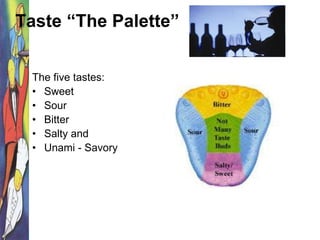
Taste “The Palette”
The five tastes:
• Sweet
• Sour
• Bitter
• Salty and
• Unami - Savory
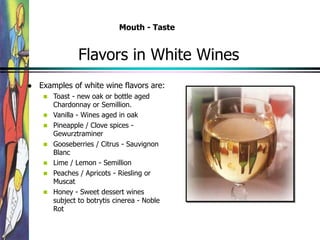
Flavors in White Wines
 Examples of white wine flavors are:
 Toast - new oak or bottle aged
Chardonnay or Semillion.
 Vanilla - Wines aged in oak
 Pineapple / Clove spices -
Gewurztraminer
 Gooseberries / Citrus - Sauvignon
Blanc
 Lime / Lemon - Semillion
 Peaches / Apricots - Riesling or
Muscat
 Honey - Sweet dessert wines
subject to botrytis cinerea - Noble
Rot
Mouth - Taste
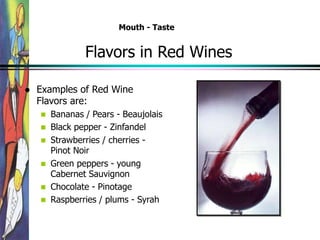
Flavors in Red Wines
 Examples of Red Wine
Flavors are:
 Bananas / Pears - Beaujolais
 Black pepper - Zinfandel
 Strawberries / cherries -
Pinot Noir
 Green peppers - young
Cabernet Sauvignon
 Chocolate - Pinotage
 Raspberries / plums - Syrah
Mouth - Taste
• Want to know more about Wine and
Gastronomy?
Join the Gastronomy Network
• https://gastronomy.mightybell.com

Wine presentation

  • 1.
  • 2.
    WINE TASTING &CATERING ANTHIMOS GEORGIOU Gastronomy Lover & Wine Connoisseur Citizen of the World. Limassol, New York, Thessaloniki, Luzern! Teaching Hospitality and Food & Beverage Management in a Swiss Hotel School in Luzern! I am offering Wine Tastings with wines of your choice but also with wines that I will carefully select to match your taste and budget. I also cater with cheese, charcuterie and finger food to pair the wines and bring the most out of them. Become a member of my Gastronomy Network to learn more about Wines and Gastronomy. gastronomy.mightybell.com
  • 3.
    Basic wine information •asignificant proportion of the total revenue from alcoholic beverage. •Wine is the product obtained from the total or partial alcoholic fermentation of fresh grapes, whether or not crushed, or of grape must – European Community Beverages
  • 4.
    Basic wine information Thereare two types of grapes: •white and black/red grapes •Black grapes have coloring in the skin and are used in the production of both red, white & rosé wines Beverages
  • 5.
    Wine Styles Color •Red, White,or Pink (Rosẻ) Sweetness •Dry, Medium or Sweet Beverages
  • 6.
    Major Wine ProducingNations 1. Italy and France 2. Spain and Portugal 3. Greece and Cyprus 4. Germany and Switzerland 5. United States and Canada 6. Argentina and Chile 7. Australia and New Zealand 8. South Africa 9. Lebanon and Israel Beverages
  • 7.
    Beverages PRODUCING WINE The qualityof wine depends on •the grape variety •the climate •annual weather conditions •the type of soil •Viticulture (method of growing the vine) •Vinification (method of turning grapes into wine)
  • 8.
  • 9.
    Beverages CLIMATE The main wineproducing regions of the world lie between latitudes 30 and 50 degrees north and south of the equator
  • 10.
    Beverages THE IDEAL CLIMATE Sufficientmoisture and warmth to enable vines to grow and the grapes to ripen The right weather conditions must prevail during the various stages of the growth cycle of the vines
  • 11.
    Beverages THE PERFECT CLIMATE •Acold winter to inhibit growth and rest the vine. Frosts to kill diseases, but not to severly kill the vine. Enough rain to build moisture reserves in the soil •A mild warm spring with gentle rain to encourage the vine‘s growth •A warm settled period during the vine‘s flowering, followed by a hot sunny summer with a little rain to swell the developing fruit •A long, fine, dry autumn to complete the ripening of the grape, and for the vintage
  • 12.
    Beverages MAIN CLIMATIC DANGERS •Frostcan destroy growing shoots in the spring and is particularly dangerous at the time of the budding •Hail can break and damage young growth and espescially during late summer, burst developing grapes allowing rot to set it •Wind is disastrous at flowering preventing pollination. It can also break young shoots
  • 13.
    Beverages SOIL Grape vines oftenthrive where other plants fail POOR SOIL – LOW YIELDS OF FINE QUALITY WINE RICH SOIL – HIGHER YIELDS OF LESS GOOD QUALITY WINE THE BEST SOILS PROVIDE GOOD DRAINAGE NATURALLY
  • 14.
  • 15.
  • 16.
    Beverages VINIFICATION – Winemaking Process Vinification – the conversion of grape juice into wine The most essential part of vinification is FERMENTATION One of the greatest French scientists of the 19th century, Louis Pasteur discovered that FERMENTATION OCCURS WHEN YEAST FEEDS ON SUGARS, CONVERTING THEM TO ALCOHOL AND CARBON DIOXIDE (CO2) YEAST + SUGAR = ALCOHOL + CO2
  • 17.
  • 18.
    Beverages METHODS OF PRODUCTION– WHITE WINE Grape juice is colorless. Thus if the skins of black grapes are removed at an early stage, white wine can be produced from black grapes too. 1. Grapes are crushed and then pressed 2. Skins are discarded 3. During pressing, yeasts are washed off the grape skins into the must. (Yeast can be added if necessary) 4. Must is pumped into a vat 5. Fermentation takes place at a low temperature and can last between two to four weeks
  • 19.
    Beverages METHODS OF PRODUCTION– RED WINE Made from the juice and the skins of black grapes. The colour comes from the pigments of the grape 1. Grapes are crushed and then pressed 2. Skins are also used 3. During pressing, yeasts are washed off the grape skins into the must. (Yeast can be added if necessary) 4. Must is pumped into a vat 5. Fermentation takes place at temperature between 25 and 30º C. 6. As fermentation creates alcohol, the alcohol itself extracts first color and then tannin from the skins
  • 20.
    Beverages METHODS OF PRODUCTION –RED WINE • The amount of color and tannin in the finished wine depends on how long the new wine is kept in contact with the skins • As little as five days for light wines (Beaujolais) • About two weeks for full bodied wines (Bordeaux) • Rose wines – 14 to 24 hours
  • 21.
    Beverages METHODS OF PRODUCTION– RED WINE 1. When colour and tannin are sufficient, the free run wine is drawn from the skins in a clean vat. 2. Skins are then pressed, yielding a further quantitiy of wine (known as press wine). 3. Press wine contains higher level of tannin, and is blended with the original wine. The amount depends on the character the winemaker wants to achieve.
  • 22.
    Beverages METHODS OF PRODUCTION– RED WINE • Racking: the sediment accumulated at the end of the vessel (lees) is removed • Fining: Bentonite, gelatine of white of egg are used to push to the bottom of the vessel certain natural hazardous substances • Maturation – wine is allowed to rest, and flavor to develop. This occurs during storage in large stainless steel vessels or in oak casks • Before bottling most wines will be chilled to form a sediment which is removed
  • 23.
    How To TasteAnd Evaluate Wine • Appearance • Smell • Taste • Final Impressions
  • 24.
    Appearance • Clarity: Isthe wine bright and healthy looking or is it hazy or cloudy? If a wine is cloudy, it may be due to disturbed sediment in older wines or it may be the result of refermentation in the bottle—a big problem!! • Intensity: Is the color deep or pale? • Color: Helps Identify – Age – Grape Varieties – Aged in Wood? • Other: When a glass is swirled, little ‘rivulets’ may form on the side of the glass. These are known as “tears” or “legs” and are an indicator of higher alcohol.
  • 25.
    Smell “The Nose” •Average person can identify over 2000 scents, wine has over 200. • Aroma=Smell of the grapes • Bouquet=Total smell of wine • Smell helps identify – Age – Faults – Varietal
  • 26.
    Nose – Aromas CharacteristicAromas of Wines  Chardonnay  Vanilla / citrus / wood  Chenin Blanc  Ripe melon / honey  Sauvignon Blanc  grass / green apple / grapefruit  Riesling  ripe fruits / lemon  Gewurztraminer  ripe fruits / exotic spices / perfume  Carbernet Sauvignon  dark fruits / wood / leather  Zindandel  red or dark fruits / pepper  Merlot  ripe grapes / plums  Grenache  dark fruits / pepper  Pinot Noir  red fruits / wood /
  • 28.
    Taste “The Palette” Thefive tastes: • Sweet • Sour • Bitter • Salty and • Unami - Savory
  • 29.
    Flavors in WhiteWines  Examples of white wine flavors are:  Toast - new oak or bottle aged Chardonnay or Semillion.  Vanilla - Wines aged in oak  Pineapple / Clove spices - Gewurztraminer  Gooseberries / Citrus - Sauvignon Blanc  Lime / Lemon - Semillion  Peaches / Apricots - Riesling or Muscat  Honey - Sweet dessert wines subject to botrytis cinerea - Noble Rot Mouth - Taste
  • 30.
    Flavors in RedWines  Examples of Red Wine Flavors are:  Bananas / Pears - Beaujolais  Black pepper - Zinfandel  Strawberries / cherries - Pinot Noir  Green peppers - young Cabernet Sauvignon  Chocolate - Pinotage  Raspberries / plums - Syrah Mouth - Taste
  • 31.
    • Want toknow more about Wine and Gastronomy? Join the Gastronomy Network • https://gastronomy.mightybell.com