Peeping
Inside
Windows…
An Inside View
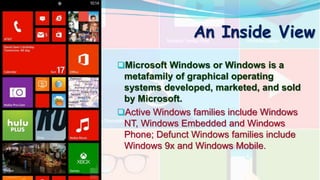
Microsoft Windows or Windows is a
metafamily of graphical operating
systems developed, marketed, and sold
by Microsoft.
Active Windows families include Windows
NT, Windows Embedded and Windows
Phone; Defunct Windows families include
Windows 9x and Windows Mobile.
Birth of Windows
 The history of Windows dates
back to September 1981,
when Chase Bishop, a
computer scientist, designed
the first model of an
electronic device and project
"Interface Manager" was
started.
 It was announced in
November 1983 (after
the Apple Lisa) under the
name "Windows“.
EARLY DAYS…
 Windows 1.0 was released on November 1985.It
was to compete with Apple's operating system.
Windows 1.0 was not a complete operating
system.
 Components included Calculator, Calendar,
Clock, Notepad, Paint, Reversi,Terminal,Write
and Control panel.
 Windows 2.0 was released in December 1987
and was more popular than its predecessor. It
introduced the terminology of "Minimize" and
"Maximize",

 Windows 3.0 / 3.1 released in 1990, improved the
design, because of virtual memory and loadable
virtual device drivers .
 It also featured improvements to the user
interface. Microsoft rewrote critical operations
from C into assembly.
 It is the first Windows version to achieve broad
commercial success, selling 2 million copies in
the first six months.
WINDOWS 3/3.1
WINDOWS NT [9X/2000/ME]
In September 2000, Microsoft introduced
Windows ME (Millennium Edition), which
upgraded Windows 98 with enhanced
multimedia and Internet features. It also
introduced the first version of System Restore
On 25 June 1998, Microsoft released Windows 98.
It included new hardware drivers and better
support for the FAT32 file system which allows
support for disk partitions larger than the 2 GB
maximum accepted by Windows 95.
WINDOWS XP
WindowsXP wasproducedbyMicrosoftaspartof
theWindowsNTfamilyofoperatingsystems and
releasedonAugust24,2001.
Itintroduced redesignedGUIandwasthefirst
versionofWindowstouseproductactivation inan
efforttoreducesoftwarepiracy.
 WindowsXPremainedpopularevenafterthe
releaseofnewerversions
In 2005 , Microsoft launched “Longhorn” ,
a Metro-OS project which in 2007 was
called “Windows Vista”. It was the first
step towards an all new environment but
it failed to gain public dominance.
New features of Windows Vista include an
updated GUI and visual style, a new
search component called Windows Search,
redesigned networking, audio, print and
display sub-systems, and new multimedia
tools including Windows DVD Maker.
 On July 22, 2009, Windows 7 was released
to the public .Windows 7 was intended to be
a more focused, incremental upgrade to the
Windows line.
 features were added to the operating
system, including libraries and support
for multitouch input.
 A new "Action Center" interface was also
added to provide an overview of system
security and maintenance information.
 Windows 7 also shipped with updated
versions of applications, including Internet
Explorer, Windows Media Player,
and Windows Media Center.
Windows Phone 7
WINDOWS 8/8.1
 Windows 8, was released on
October 26, 2012. Changes were
made on Windows 8, These
changes include the Start screen,
which uses large tiles that are
more convenient for touch
interactions and allow for the
display of continually updated
information, and a new class of
apps which are designed
primarily for use on touch-based
devices.
WINDOWS 10
On September 30, 2014, Microsoft announced Windows 10 as the
successor to Windows 8.1. It will be released in late 2015 and addresses
shortcomings in the user interface first introduced with Windows 8..
Changes include the return of the Start
Menu, a virtual desktop system, and the
ability to run Windows Store apps within
windows on the desktop rather than in
full-screen mode.
A Presentation By-
Anish Ranjan Jha
A 12
Roll – 1405285
Branch – Computer Science and Engineering
Windows Timeline

Windows Timeline

  • 1.
  • 2.
    An Inside View MicrosoftWindows or Windows is a metafamily of graphical operating systems developed, marketed, and sold by Microsoft. Active Windows families include Windows NT, Windows Embedded and Windows Phone; Defunct Windows families include Windows 9x and Windows Mobile.
  • 3.
    Birth of Windows The history of Windows dates back to September 1981, when Chase Bishop, a computer scientist, designed the first model of an electronic device and project "Interface Manager" was started.  It was announced in November 1983 (after the Apple Lisa) under the name "Windows“.
  • 4.
    EARLY DAYS…  Windows1.0 was released on November 1985.It was to compete with Apple's operating system. Windows 1.0 was not a complete operating system.  Components included Calculator, Calendar, Clock, Notepad, Paint, Reversi,Terminal,Write and Control panel.  Windows 2.0 was released in December 1987 and was more popular than its predecessor. It introduced the terminology of "Minimize" and "Maximize",
  • 5.
      Windows 3.0/ 3.1 released in 1990, improved the design, because of virtual memory and loadable virtual device drivers .  It also featured improvements to the user interface. Microsoft rewrote critical operations from C into assembly.  It is the first Windows version to achieve broad commercial success, selling 2 million copies in the first six months. WINDOWS 3/3.1
  • 6.
    WINDOWS NT [9X/2000/ME] InSeptember 2000, Microsoft introduced Windows ME (Millennium Edition), which upgraded Windows 98 with enhanced multimedia and Internet features. It also introduced the first version of System Restore On 25 June 1998, Microsoft released Windows 98. It included new hardware drivers and better support for the FAT32 file system which allows support for disk partitions larger than the 2 GB maximum accepted by Windows 95.
  • 7.
    WINDOWS XP WindowsXP wasproducedbyMicrosoftaspartof theWindowsNTfamilyofoperatingsystemsand releasedonAugust24,2001. Itintroduced redesignedGUIandwasthefirst versionofWindowstouseproductactivation inan efforttoreducesoftwarepiracy.  WindowsXPremainedpopularevenafterthe releaseofnewerversions
  • 8.
    In 2005 ,Microsoft launched “Longhorn” , a Metro-OS project which in 2007 was called “Windows Vista”. It was the first step towards an all new environment but it failed to gain public dominance. New features of Windows Vista include an updated GUI and visual style, a new search component called Windows Search, redesigned networking, audio, print and display sub-systems, and new multimedia tools including Windows DVD Maker.
  • 9.
     On July22, 2009, Windows 7 was released to the public .Windows 7 was intended to be a more focused, incremental upgrade to the Windows line.  features were added to the operating system, including libraries and support for multitouch input.  A new "Action Center" interface was also added to provide an overview of system security and maintenance information.  Windows 7 also shipped with updated versions of applications, including Internet Explorer, Windows Media Player, and Windows Media Center. Windows Phone 7
  • 10.
    WINDOWS 8/8.1  Windows8, was released on October 26, 2012. Changes were made on Windows 8, These changes include the Start screen, which uses large tiles that are more convenient for touch interactions and allow for the display of continually updated information, and a new class of apps which are designed primarily for use on touch-based devices.
  • 11.
    WINDOWS 10 On September30, 2014, Microsoft announced Windows 10 as the successor to Windows 8.1. It will be released in late 2015 and addresses shortcomings in the user interface first introduced with Windows 8.. Changes include the return of the Start Menu, a virtual desktop system, and the ability to run Windows Store apps within windows on the desktop rather than in full-screen mode.
  • 12.
    A Presentation By- AnishRanjan Jha A 12 Roll – 1405285 Branch – Computer Science and Engineering