Positive occupational health 
The challenge for the future 
Wilmar Schaufeli 
Utrecht University 
The Netherlands 
& 
University of Leuven 
Belgium 
Jorma Rantanen lecture, FIOH, 21 November 2014 - 1
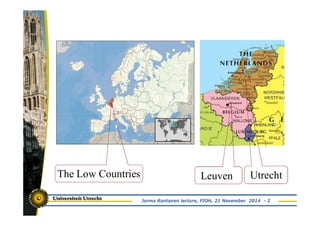
The Low Countries Leuven Utrecht 
Jorma Rantanen lecture, FIOH, 21 November 2014 - 2
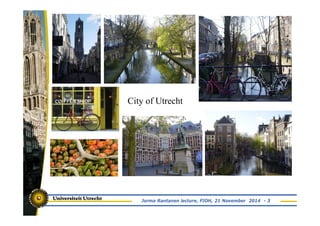
City of Utrecht 
Jorma Rantanen lecture, FIOH, 21 November 2014 - 3
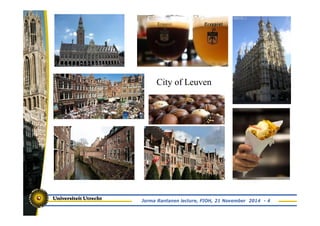
City of Leuven 
Jorma Rantanen lecture, FIOH, 21 November 2014 - 4
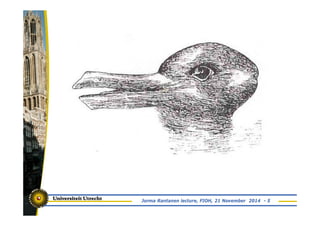
Jorma Rantanen lecture, FIOH, 21 November 2014 - 5
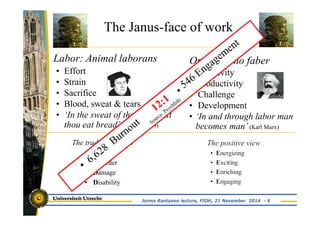
The Janus-face of work 
Labor: Animal laborans 
• Effort 
• Strain 
• Sacrifice 
• Blood, sweat & tears 
• ‘In the sweat of thy face shalt 
thou eat bread’ (Genesis 3:19) 
The traditional view 
• Disease 
• Disorder 
• Damage 
• Disability 
Opus: Homo faber 
• Creativity 
• Productivity 
• Challenge 
• Development 
• ‘In and through labor man 
becomes man’ (Karl Marx) 
Jorma Rantanen lecture, FIOH, 21 November 2014 - 6
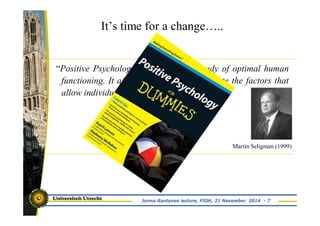
“Positive Psychology is the scientific study of optimal human 
functioning. It aims to discover and promote the factors that 
allow individuals and communities to thrive” 
Martin Seligman (1999) 
It’s time for a change….. 
Jorma Rantanen lecture, FIOH, 21 November 2014 - 7
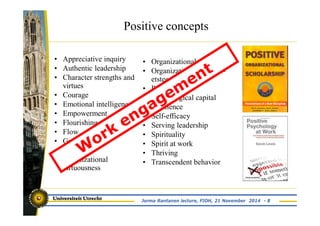
Positive concepts 
• Appreciative inquiry 
• Authentic leadership 
• Character strengths and 
virtues 
• Courage 
• Emotional intelligence 
• Empowerment 
• Flourishing 
• Flow 
• Gratitude 
• Hope 
• Organizational 
virtuousness 
• Organizational spontaneity 
• Organization based self-etsteem 
• Passion 
• Psychological capital 
• Resilience 
• Self-efficacy 
• Serving leadership 
• Spirituality 
• Spirit at work 
• Thriving 
• Transcendent behavior 
Jorma Rantanen lecture, FIOH, 21 November 2014 - 8
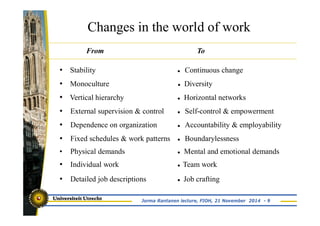
Changes in the world of work 
From To 
• Stability ● Continuous change 
• Monoculture ● Diversity 
• Vertical hierarchy ● Horizontal networks 
• External supervision & control ● Self-control & empowerment 
• Dependence on organization ● Accountability & employability 
• Fixed schedules & work patterns ● Boundarylessness 
• Physical demands ● Mental and emotional demands 
• Individual work ● Team work 
• Detailed job descriptions ● Job crafting 
Jorma Rantanen lecture, FIOH, 21 November 2014 - 9
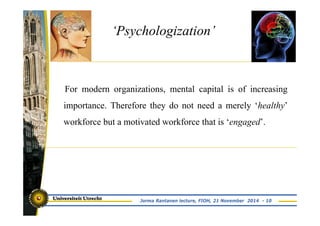
‘Psychologization’ 
For modern organizations, mental capital is of increasing 
importance. Therefore they do not need a merely ‘healthy’ 
workforce but a motivated workforce that is ‘engaged’. 
Jorma Rantanen lecture, FIOH, 21 November 2014 - 10
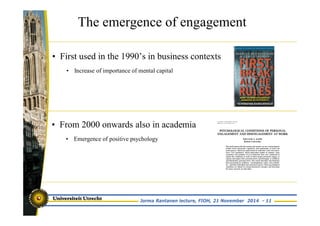
The emergence of engagement 
• First used in the 1990’s in business contexts 
• Increase of importance of mental capital 
• From 2000 onwards also in academia 
• Emergence of positive psychology 
Jorma Rantanen lecture, FIOH, 21 November 2014 - 11
Engagement = business 
• 2,030,000 hits (in 0.19 sec.) 
• All major consultancy firms are involved 
Jorma Rantanen lecture, FIOH, 21 November 2014 - 12
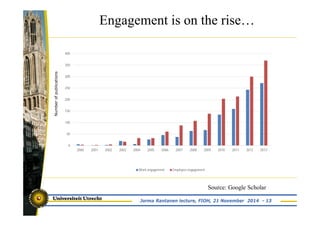
Engagement is on the rise… 
Source: Google Scholar 
400 
350 
300 
250 
200 
150 
100 
50 
0 
2000 2001 2002 2003 2004 2005 2006 2007 2008 2009 2010 2011 2012 2013 
Work engagement Employee engagement 
Jorma Rantanen lecture, FIOH, 21 November 2014 - 13 
Number of publications
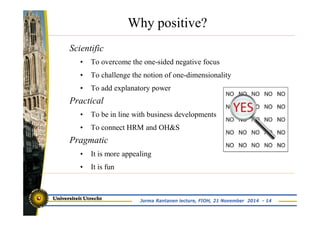
Why positive? 
Jorma Rantanen lecture, FIOH, 21 November 2014 - 14 
Scientific 
• To overcome the one-sided negative focus 
• To challenge the notion of one-dimensionality 
• To add explanatory power 
Practical 
• To be in line with business developments 
• To connect HRM and OH&S 
Pragmatic 
• It is more appealing 
• It is fun
What is engagement? 
Concept and measurement 
Jorma Rantanen lecture, FIOH, 21 November 2014 - 15
Jorma Rantanen lecture, FIOH, 21 November 2014 - 16
Engagement in business 
: “Engaged employees consistently demonstrate three general 
behaviors. They: (1) Say – consistently speak positively about the 
organization to co-workers, potential employees, and customers; (2) 
Stay – have an intense desire to be a member of the organization despite 
opportunities to work elsewhere; (3) Strive – exert extra time, effort, 
and initiative to contribute to business success” (www.hewittassociates.com). 
Employee engagement is usually defined in terms of: 
• Organizational commitment (affective – say and continuance - stay) 
• Extra-role behavior (discretionary effort - strive) 
Jorma Rantanen lecture, FIOH, 21 November 2014 - 17
Engagement in academia 
“Work engagement is a positive, affective-motivational state of 
fulfillment that is characterized by vigor, dedication, and 
absorption” (p. 74). 
Schaufeli et al. (2002) 
Jorma Rantanen lecture, FIOH, 21 November 2014 - 18
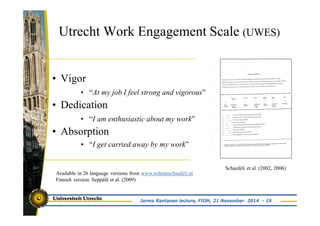
Utrecht Work Engagement Scale (UWES) 
• Vigor 
• “At my job I feel strong and vigorous” 
• Dedication 
• “I am enthusiastic about my work” 
• Absorption 
• “I get carried away by my work” 
Available in 26 language versions from www.wilmarschaufeli.nl 
Finnish version: Seppälä et al. (2009) 
Schaufeli et al. (2002, 2006) 
Jorma Rantanen lecture, FIOH, 21 November 2014 - 19
What do we know? 
Jorma Rantanen lecture, FIOH, 21 November 2014 - 20
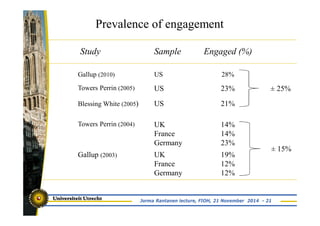
Prevalence of engagement 
Study Sample Engaged (%) 
Gallup (2010) US 28% 
Towers Perrin (2005) US 23% 
Blessing White (2005) US 21% 
Towers Perrin (2004) UK 
France 
Germany 
14% 
14% 
23% 
Gallup (2003) UK 
France 
Germany 
19% 
12% 
12% 
± 25% 
± 15% 
Jorma Rantanen lecture, FIOH, 21 November 2014 - 21
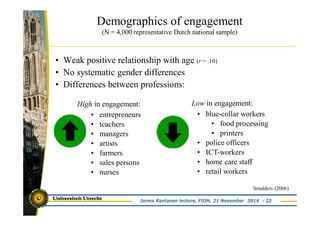
Demographics of engagement 
(N = 4,000 representative Dutch national sample) 
• Weak positive relationship with age (r = .10) 
• No systematic gender differences 
• Differences between professions: 
Smulders (2006) 
High in engagement: 
• entrepreneurs 
• teachers 
• managers 
• artists 
• farmers 
• sales persons 
• nurses 
Low in engagement: 
• blue-collar workers 
• food processing 
• printers 
• police officers 
• ICT-workers 
• home care staff 
• retail workers 
Jorma Rantanen lecture, FIOH, 21 November 2014 - 22
Development of engagement across time 
• Engagement is relatively stable across time (Mauno et al., 2007; Seppälä et al., 
2009) 
• Engagement and workaholism develop separately, job change 
has positive effect (Mäkikangas et al., 2013) 
• Vigor and exhaustion do not develop in tandem, but dedication 
and cynicism do (Mäkikangas et al., 2012) 
• Two profiles: Engaged and Exhausted-Workaholic (Innanen et al., 2014) 
Jorma Rantanen lecture, FIOH, 21 November 2014 - 23
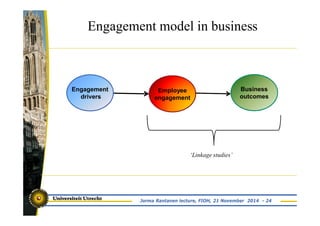
Engagement model in business 
‘Linkage studies’ 
Engagement 
drivers 
Employee 
engagement 
Business 
outcomes 
Jorma Rantanen lecture, FIOH, 21 November 2014 - 24
Drivers of engagement 
• Trust and integrity of management 
• Personal relationship with manager 
• Co-workers and team (support, climate) 
• Challenging job (autonomy, participation) 
• Skill development 
• Career opportunities 
• Line-of-sight between individual and company performance 
• Pride about the company 
Source: Gibbons (2006), based on 12 studies using over 500,000 employees around the globe 
Jorma Rantanen lecture, FIOH, 21 November 2014 - 25
Business outcomes (linkage studies) 
• Sales performance at team level (Bates, 2004 Fleming et al. 2005) 
• Customer service productivity (Conference Board, 2003) 
• Customer satisfaction (Coco & Jamison, 2011) 
• Company’s financial performance (Hewitt, 2004) 
• Individual job performance (CLC, 2004) 
• Customer’s discretionary purchases (Oakley, 2005) 
• Retention and turnover (Towers Perrin, 2005) 
For additional case studies see the report to the UK government of MacLeod & Clarke (2010). Engaging 
for success: Enhancing performance through engagement. 
Jorma Rantanen lecture, FIOH, 21 November 2014 - 26
Engaged vs. non-engaged units 
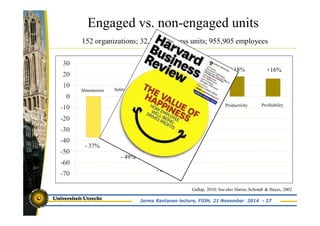
152 organizations; 32,394 business units; 955,905 employees 
Gallup, 2010; See also Harter, Schmidt & Hayes, 2002 
Absenteeism Safety incidents Quality (defects) 
Customer 
satisfaction Productivity Profitability 
- 37% 
- 49% 
- 60% 
+12% 
+18% +16% 
Jorma Rantanen lecture, FIOH, 21 November 2014 - 27
Academic studies 
• Is engagement something specific? 
• What are its antecedents and consequences 
• How can it be explained? 
Jorma Rantanen lecture, FIOH, 21 November 2014 - 28
Types of affective employee well-being 
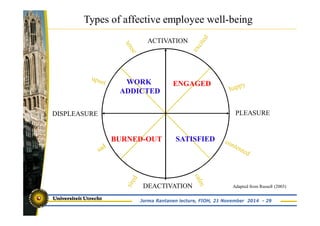
ACTIVATION 
DISPLEASURE PLEASURE 
DEACTIVATION 
Adapted from Russell (2003) 
SATISFIED 
WORK 
ADDICTED 
BURNED-OUT 
ENGAGED 
Jorma Rantanen lecture, FIOH, 21 November 2014 - 29
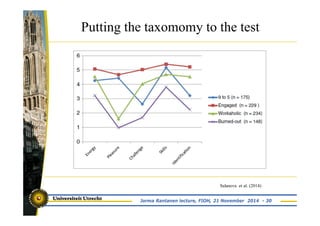
Putting the taxomomy to the test 
Salanova et al. (2014) 
Jorma Rantanen lecture, FIOH, 21 November 2014 - 30
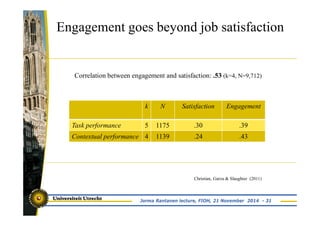
Engagement goes beyond job satisfaction 
Correlation between engagement and satisfaction: .53 (k=4, N=9,712) 
k N Satisfaction Engagement 
Task performance 5 1175 .30 .39 
Contextual performance 4 1139 .24 .43 
Christian, Garza & Slaughter (2011) 
Jorma Rantanen lecture, FIOH, 21 November 2014 - 31
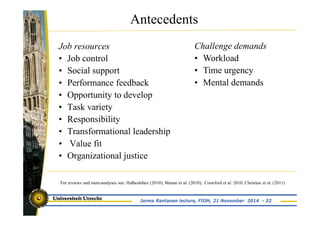
Antecedents 
Job resources 
• Job control 
• Social support 
• Performance feedback 
• Opportunity to develop 
• Task variety 
• Responsibility 
• Transformational leadership 
• Value fit 
• Organizational justice 
Challenge demands 
• Workload 
• Time urgency 
• Mental demands 
For reviews and meta-analyses see: Halbesleben (2010); Mauno et al. (2010); Crawford et al. 2010; Christian et al. (2011) 
Jorma Rantanen lecture, FIOH, 21 November 2014 - 32
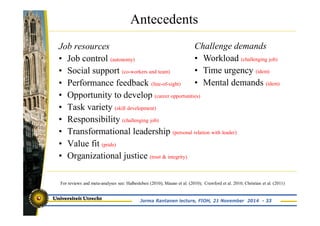
Antecedents 
Challenge demands 
• Workload (challenging job) 
• Time urgency (idem) 
• Mental demands (idem) 
Job resources 
• Job control (autonomy) 
• Social support (co-workers and team) 
• Performance feedback (line-of-sight) 
• Opportunity to develop (career opportunities) 
• Task variety (skill development) 
• Responsibility (challenging job) 
• Transformational leadership (personal relation with leader) 
• Value fit (pride) 
• Organizational justice (trust & integrity) 
For reviews and meta-analyses see: Halbesleben (2010); Mauno et al. (2010); Crawford et al. 2010; Christian et al. (2011) 
Jorma Rantanen lecture, FIOH, 21 November 2014 - 33
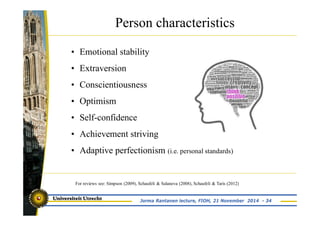
Person characteristics 
• Emotional stability 
• Extraversion 
• Conscientiousness 
• Optimism 
• Self-confidence 
• Achievement striving 
• Adaptive perfectionism (i.e. personal standards) 
For reviews see: Simpson (2009), Schaufeli & Salanova (2008), Schaufeli & Taris (2012) 
Jorma Rantanen lecture, FIOH, 21 November 2014 - 34
Individual outcomes 
Physical 
• Reactivity of the HPA (Hypothalamic-Pituitary-Adrenal) –axis (Langelaan et al. 2006) 
• Cardiac autonomic activity (Seppälä et al., 2012) 
Mental 
• Low levels depression (Hakanen & Schaufeli, 2012; Anxiety (Innstrand, 2012) 
• Perceived physical/psychosomatic health (Schaufeli, Taris, van Rhenen, 2008) 
• Sleep quality (Kubota et al., 20l1); Sleep hygiene (Barber et al., 2013) 
Behavioral 
• Workability(Airila et al. 2012) 
• Proactive behavior (Salanova & Schaufeli, 2008) 
Jorma Rantanen lecture, FIOH, 21 November 2014 - 35
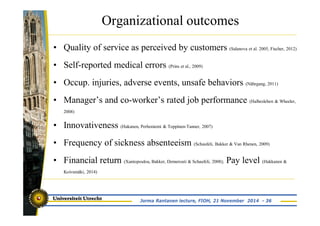
Organizational outcomes 
• Quality of service as perceived by customers (Salanova et al. 2005, Fischer, 2012) 
• Self-reported medical errors (Prins et al., 2009) 
• Occup. injuries, adverse events, unsafe behaviors (Nährgang, 2011) 
• Manager’s and co-worker’s rated job performance (Halbesleben & Wheeler, 
2008) 
• Innovativeness (Hakanen, Perhoniemi & Toppinen-Tanner, 2007) 
• Frequency of sickness absenteeism (Schaufeli, Bakker & Van Rhenen, 2009) 
• Financial return (Xantopoulou, Bakker, Demerouti & Schaufeli, 2008); Pay level (Hakkanen & 
Koivumäki, 2014) 
Jorma Rantanen lecture, FIOH, 21 November 2014 - 36
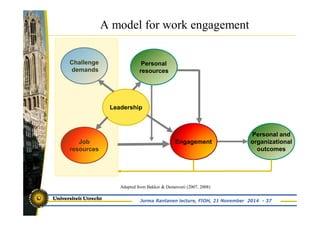
A model for work engagement 
Challenge 
demands 
Job 
resources 
Personal and 
organizational 
outcomes 
Engagement 
Personal 
resources 
Leadership 
Adapted from Bakker & Demerouti (2007, 2008) 
Jorma Rantanen lecture, FIOH, 21 November 2014 - 37
What we know… 
• Work engagement differs from workaholism and job satisfaction 
• Similar antecedents of work engagement are identified by business and 
academic research 
• Business research shows linkage with business outcomes 
• Academic research shows links with person characteristics and individual 
outcomes and – to a lesser degree – organizational outcomes 
• A dynamic psychological motivation process seems to exist 
• Leadership might play a crucial (indirect) role 
Jorma Rantanen lecture, FIOH, 21 November 2014 - 38
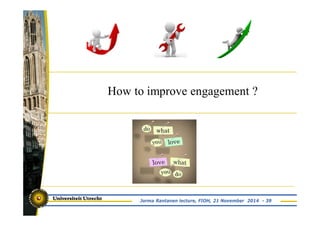
How to improve engagement ? 
Jorma Rantanen lecture, FIOH, 21 November 2014 - 39
Interventions 
Treatment à Prevention à‘Amplition’ 
Jorma Rantanen lecture, FIOH, 21 November 2014 - 40
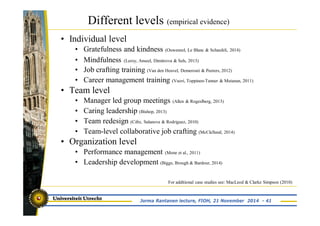
Different levels (empirical evidence) 
• Individual level 
• Gratefulness and kindness (Ouweneel, Le Blanc & Schaufeli, 2014) 
• Mindfulness (Leroy, Anseel, Dimitrova & Sels, 2013) 
• Job crafting training (Van den Heuvel, Demerouti & Peeters, 2012) 
• Career management training (Vuori, Toppinen-Tanner & Mutanan, 2011) 
• Team level 
• Manager led group meetings (Allen & Rogeslberg, 2013) 
• Caring leadership (Bishop, 2013) 
• Team redesign (Cifre, Salanova & Rodriguez, 2010) 
• Team-level collaborative job crafting (McClelland, 2014) 
• Organization level 
• Performance management (Mone et al., 2011) 
• Leadership development (Biggs, Brough & Bardour, 2014) 
For additional case studies see: MacLeod & Clarke Simpson (2010) 
Jorma Rantanen lecture, FIOH, 21 November 2014 - 41
Key-factors for success (consultancy experience) 
1. Systematic, stepwise approach 
2. Combination of approaches 
3. Participation 
4. Communication 
5. Commitment from top-management 
6. Focus on operational leadership 
There is neither a ‘silver bullet’ nor a ‘quick fix’ 
Jorma Rantanen lecture, FIOH, 21 November 2014 - 42
Work engagement….. 
• … seems to be a unique construct 
• … can be measured in a valid and reliable way 
• ... is fostered by job and personal resources 
• … has positive consequences for employee and organization 
• … may be improved by interventions at different levels 
Jorma Rantanen lecture, FIOH, 21 November 2014 - 43
Paljon kiitoksia mielenkiinnostanne! 
More information 
Academic: www.wilmarschaufeli.nl 
Consultancy: www.3ihc.nl 
Jorma Rantanen lecture, FIOH, 21 November 2014 - 44

Wilmar Schaufeli: Employee Engagement

  • 1.
    Positive occupational health The challenge for the future Wilmar Schaufeli Utrecht University The Netherlands & University of Leuven Belgium Jorma Rantanen lecture, FIOH, 21 November 2014 - 1
  • 2.
    The Low CountriesLeuven Utrecht Jorma Rantanen lecture, FIOH, 21 November 2014 - 2
  • 3.
    City of Utrecht Jorma Rantanen lecture, FIOH, 21 November 2014 - 3
  • 4.
    City of Leuven Jorma Rantanen lecture, FIOH, 21 November 2014 - 4
  • 5.
    Jorma Rantanen lecture,FIOH, 21 November 2014 - 5
  • 6.
    The Janus-face ofwork Labor: Animal laborans • Effort • Strain • Sacrifice • Blood, sweat & tears • ‘In the sweat of thy face shalt thou eat bread’ (Genesis 3:19) The traditional view • Disease • Disorder • Damage • Disability Opus: Homo faber • Creativity • Productivity • Challenge • Development • ‘In and through labor man becomes man’ (Karl Marx) Jorma Rantanen lecture, FIOH, 21 November 2014 - 6
  • 7.
    “Positive Psychology isthe scientific study of optimal human functioning. It aims to discover and promote the factors that allow individuals and communities to thrive” Martin Seligman (1999) It’s time for a change….. Jorma Rantanen lecture, FIOH, 21 November 2014 - 7
  • 8.
    Positive concepts •Appreciative inquiry • Authentic leadership • Character strengths and virtues • Courage • Emotional intelligence • Empowerment • Flourishing • Flow • Gratitude • Hope • Organizational virtuousness • Organizational spontaneity • Organization based self-etsteem • Passion • Psychological capital • Resilience • Self-efficacy • Serving leadership • Spirituality • Spirit at work • Thriving • Transcendent behavior Jorma Rantanen lecture, FIOH, 21 November 2014 - 8
  • 9.
    Changes in theworld of work From To • Stability ● Continuous change • Monoculture ● Diversity • Vertical hierarchy ● Horizontal networks • External supervision & control ● Self-control & empowerment • Dependence on organization ● Accountability & employability • Fixed schedules & work patterns ● Boundarylessness • Physical demands ● Mental and emotional demands • Individual work ● Team work • Detailed job descriptions ● Job crafting Jorma Rantanen lecture, FIOH, 21 November 2014 - 9
  • 10.
    ‘Psychologization’ For modernorganizations, mental capital is of increasing importance. Therefore they do not need a merely ‘healthy’ workforce but a motivated workforce that is ‘engaged’. Jorma Rantanen lecture, FIOH, 21 November 2014 - 10
  • 11.
    The emergence ofengagement • First used in the 1990’s in business contexts • Increase of importance of mental capital • From 2000 onwards also in academia • Emergence of positive psychology Jorma Rantanen lecture, FIOH, 21 November 2014 - 11
  • 12.
    Engagement = business • 2,030,000 hits (in 0.19 sec.) • All major consultancy firms are involved Jorma Rantanen lecture, FIOH, 21 November 2014 - 12
  • 13.
    Engagement is onthe rise… Source: Google Scholar 400 350 300 250 200 150 100 50 0 2000 2001 2002 2003 2004 2005 2006 2007 2008 2009 2010 2011 2012 2013 Work engagement Employee engagement Jorma Rantanen lecture, FIOH, 21 November 2014 - 13 Number of publications
  • 14.
    Why positive? JormaRantanen lecture, FIOH, 21 November 2014 - 14 Scientific • To overcome the one-sided negative focus • To challenge the notion of one-dimensionality • To add explanatory power Practical • To be in line with business developments • To connect HRM and OH&S Pragmatic • It is more appealing • It is fun
  • 15.
    What is engagement? Concept and measurement Jorma Rantanen lecture, FIOH, 21 November 2014 - 15
  • 16.
    Jorma Rantanen lecture,FIOH, 21 November 2014 - 16
  • 17.
    Engagement in business : “Engaged employees consistently demonstrate three general behaviors. They: (1) Say – consistently speak positively about the organization to co-workers, potential employees, and customers; (2) Stay – have an intense desire to be a member of the organization despite opportunities to work elsewhere; (3) Strive – exert extra time, effort, and initiative to contribute to business success” (www.hewittassociates.com). Employee engagement is usually defined in terms of: • Organizational commitment (affective – say and continuance - stay) • Extra-role behavior (discretionary effort - strive) Jorma Rantanen lecture, FIOH, 21 November 2014 - 17
  • 18.
    Engagement in academia “Work engagement is a positive, affective-motivational state of fulfillment that is characterized by vigor, dedication, and absorption” (p. 74). Schaufeli et al. (2002) Jorma Rantanen lecture, FIOH, 21 November 2014 - 18
  • 19.
    Utrecht Work EngagementScale (UWES) • Vigor • “At my job I feel strong and vigorous” • Dedication • “I am enthusiastic about my work” • Absorption • “I get carried away by my work” Available in 26 language versions from www.wilmarschaufeli.nl Finnish version: Seppälä et al. (2009) Schaufeli et al. (2002, 2006) Jorma Rantanen lecture, FIOH, 21 November 2014 - 19
  • 20.
    What do weknow? Jorma Rantanen lecture, FIOH, 21 November 2014 - 20
  • 21.
    Prevalence of engagement Study Sample Engaged (%) Gallup (2010) US 28% Towers Perrin (2005) US 23% Blessing White (2005) US 21% Towers Perrin (2004) UK France Germany 14% 14% 23% Gallup (2003) UK France Germany 19% 12% 12% ± 25% ± 15% Jorma Rantanen lecture, FIOH, 21 November 2014 - 21
  • 22.
    Demographics of engagement (N = 4,000 representative Dutch national sample) • Weak positive relationship with age (r = .10) • No systematic gender differences • Differences between professions: Smulders (2006) High in engagement: • entrepreneurs • teachers • managers • artists • farmers • sales persons • nurses Low in engagement: • blue-collar workers • food processing • printers • police officers • ICT-workers • home care staff • retail workers Jorma Rantanen lecture, FIOH, 21 November 2014 - 22
  • 23.
    Development of engagementacross time • Engagement is relatively stable across time (Mauno et al., 2007; Seppälä et al., 2009) • Engagement and workaholism develop separately, job change has positive effect (Mäkikangas et al., 2013) • Vigor and exhaustion do not develop in tandem, but dedication and cynicism do (Mäkikangas et al., 2012) • Two profiles: Engaged and Exhausted-Workaholic (Innanen et al., 2014) Jorma Rantanen lecture, FIOH, 21 November 2014 - 23
  • 24.
    Engagement model inbusiness ‘Linkage studies’ Engagement drivers Employee engagement Business outcomes Jorma Rantanen lecture, FIOH, 21 November 2014 - 24
  • 25.
    Drivers of engagement • Trust and integrity of management • Personal relationship with manager • Co-workers and team (support, climate) • Challenging job (autonomy, participation) • Skill development • Career opportunities • Line-of-sight between individual and company performance • Pride about the company Source: Gibbons (2006), based on 12 studies using over 500,000 employees around the globe Jorma Rantanen lecture, FIOH, 21 November 2014 - 25
  • 26.
    Business outcomes (linkagestudies) • Sales performance at team level (Bates, 2004 Fleming et al. 2005) • Customer service productivity (Conference Board, 2003) • Customer satisfaction (Coco & Jamison, 2011) • Company’s financial performance (Hewitt, 2004) • Individual job performance (CLC, 2004) • Customer’s discretionary purchases (Oakley, 2005) • Retention and turnover (Towers Perrin, 2005) For additional case studies see the report to the UK government of MacLeod & Clarke (2010). Engaging for success: Enhancing performance through engagement. Jorma Rantanen lecture, FIOH, 21 November 2014 - 26
  • 27.
    Engaged vs. non-engagedunits 152 organizations; 32,394 business units; 955,905 employees Gallup, 2010; See also Harter, Schmidt & Hayes, 2002 Absenteeism Safety incidents Quality (defects) Customer satisfaction Productivity Profitability - 37% - 49% - 60% +12% +18% +16% Jorma Rantanen lecture, FIOH, 21 November 2014 - 27
  • 28.
    Academic studies •Is engagement something specific? • What are its antecedents and consequences • How can it be explained? Jorma Rantanen lecture, FIOH, 21 November 2014 - 28
  • 29.
    Types of affectiveemployee well-being ACTIVATION DISPLEASURE PLEASURE DEACTIVATION Adapted from Russell (2003) SATISFIED WORK ADDICTED BURNED-OUT ENGAGED Jorma Rantanen lecture, FIOH, 21 November 2014 - 29
  • 30.
    Putting the taxomomyto the test Salanova et al. (2014) Jorma Rantanen lecture, FIOH, 21 November 2014 - 30
  • 31.
    Engagement goes beyondjob satisfaction Correlation between engagement and satisfaction: .53 (k=4, N=9,712) k N Satisfaction Engagement Task performance 5 1175 .30 .39 Contextual performance 4 1139 .24 .43 Christian, Garza & Slaughter (2011) Jorma Rantanen lecture, FIOH, 21 November 2014 - 31
  • 32.
    Antecedents Job resources • Job control • Social support • Performance feedback • Opportunity to develop • Task variety • Responsibility • Transformational leadership • Value fit • Organizational justice Challenge demands • Workload • Time urgency • Mental demands For reviews and meta-analyses see: Halbesleben (2010); Mauno et al. (2010); Crawford et al. 2010; Christian et al. (2011) Jorma Rantanen lecture, FIOH, 21 November 2014 - 32
  • 33.
    Antecedents Challenge demands • Workload (challenging job) • Time urgency (idem) • Mental demands (idem) Job resources • Job control (autonomy) • Social support (co-workers and team) • Performance feedback (line-of-sight) • Opportunity to develop (career opportunities) • Task variety (skill development) • Responsibility (challenging job) • Transformational leadership (personal relation with leader) • Value fit (pride) • Organizational justice (trust & integrity) For reviews and meta-analyses see: Halbesleben (2010); Mauno et al. (2010); Crawford et al. 2010; Christian et al. (2011) Jorma Rantanen lecture, FIOH, 21 November 2014 - 33
  • 34.
    Person characteristics •Emotional stability • Extraversion • Conscientiousness • Optimism • Self-confidence • Achievement striving • Adaptive perfectionism (i.e. personal standards) For reviews see: Simpson (2009), Schaufeli & Salanova (2008), Schaufeli & Taris (2012) Jorma Rantanen lecture, FIOH, 21 November 2014 - 34
  • 35.
    Individual outcomes Physical • Reactivity of the HPA (Hypothalamic-Pituitary-Adrenal) –axis (Langelaan et al. 2006) • Cardiac autonomic activity (Seppälä et al., 2012) Mental • Low levels depression (Hakanen & Schaufeli, 2012; Anxiety (Innstrand, 2012) • Perceived physical/psychosomatic health (Schaufeli, Taris, van Rhenen, 2008) • Sleep quality (Kubota et al., 20l1); Sleep hygiene (Barber et al., 2013) Behavioral • Workability(Airila et al. 2012) • Proactive behavior (Salanova & Schaufeli, 2008) Jorma Rantanen lecture, FIOH, 21 November 2014 - 35
  • 36.
    Organizational outcomes •Quality of service as perceived by customers (Salanova et al. 2005, Fischer, 2012) • Self-reported medical errors (Prins et al., 2009) • Occup. injuries, adverse events, unsafe behaviors (Nährgang, 2011) • Manager’s and co-worker’s rated job performance (Halbesleben & Wheeler, 2008) • Innovativeness (Hakanen, Perhoniemi & Toppinen-Tanner, 2007) • Frequency of sickness absenteeism (Schaufeli, Bakker & Van Rhenen, 2009) • Financial return (Xantopoulou, Bakker, Demerouti & Schaufeli, 2008); Pay level (Hakkanen & Koivumäki, 2014) Jorma Rantanen lecture, FIOH, 21 November 2014 - 36
  • 37.
    A model forwork engagement Challenge demands Job resources Personal and organizational outcomes Engagement Personal resources Leadership Adapted from Bakker & Demerouti (2007, 2008) Jorma Rantanen lecture, FIOH, 21 November 2014 - 37
  • 38.
    What we know… • Work engagement differs from workaholism and job satisfaction • Similar antecedents of work engagement are identified by business and academic research • Business research shows linkage with business outcomes • Academic research shows links with person characteristics and individual outcomes and – to a lesser degree – organizational outcomes • A dynamic psychological motivation process seems to exist • Leadership might play a crucial (indirect) role Jorma Rantanen lecture, FIOH, 21 November 2014 - 38
  • 39.
    How to improveengagement ? Jorma Rantanen lecture, FIOH, 21 November 2014 - 39
  • 40.
    Interventions Treatment àPrevention à‘Amplition’ Jorma Rantanen lecture, FIOH, 21 November 2014 - 40
  • 41.
    Different levels (empiricalevidence) • Individual level • Gratefulness and kindness (Ouweneel, Le Blanc & Schaufeli, 2014) • Mindfulness (Leroy, Anseel, Dimitrova & Sels, 2013) • Job crafting training (Van den Heuvel, Demerouti & Peeters, 2012) • Career management training (Vuori, Toppinen-Tanner & Mutanan, 2011) • Team level • Manager led group meetings (Allen & Rogeslberg, 2013) • Caring leadership (Bishop, 2013) • Team redesign (Cifre, Salanova & Rodriguez, 2010) • Team-level collaborative job crafting (McClelland, 2014) • Organization level • Performance management (Mone et al., 2011) • Leadership development (Biggs, Brough & Bardour, 2014) For additional case studies see: MacLeod & Clarke Simpson (2010) Jorma Rantanen lecture, FIOH, 21 November 2014 - 41
  • 42.
    Key-factors for success(consultancy experience) 1. Systematic, stepwise approach 2. Combination of approaches 3. Participation 4. Communication 5. Commitment from top-management 6. Focus on operational leadership There is neither a ‘silver bullet’ nor a ‘quick fix’ Jorma Rantanen lecture, FIOH, 21 November 2014 - 42
  • 43.
    Work engagement….. •… seems to be a unique construct • … can be measured in a valid and reliable way • ... is fostered by job and personal resources • … has positive consequences for employee and organization • … may be improved by interventions at different levels Jorma Rantanen lecture, FIOH, 21 November 2014 - 43
  • 44.
    Paljon kiitoksia mielenkiinnostanne! More information Academic: www.wilmarschaufeli.nl Consultancy: www.3ihc.nl Jorma Rantanen lecture, FIOH, 21 November 2014 - 44