Device to device communications
with Wi-Fi Direct : An Overview

Under The Guidance of:
Dr. D. G. Savakar Sir

Presented By:
Ashutosh Kumar Jha (2BL09CS009)
CONTENTS
 Introduction

 Wi-Fi Direct: A Technical Overview
•
•
•
•
•

Architecture
Group Formation
Security
Layer Two Service Discovery
Power Saving

 Conclusion
 References
INTRODUCTION
 Wi-Fi Direct , defined by the Wi-Fi Alliance aimed at enhancing direct

device to device communications in Wi-Fi.

 Directly data transfer with reduced setup.
 Setup generally consists of bringing two Wi-Fi Direct devices together and
then triggering a "pairing" between them

 Given the wide adoption of Wi-Fi in many kinds of devices, a natural way
for the technology to progress is to target device to device connectivity, i.e.
without requiring the presence of an Access Point (AP), traditionally provided
by other technologies.
 By taking this decision, Wi-Fi Direct immediately inherits all the enhanced QoS,
power saving, and security mechanisms developed for the Wi-Fi infrastructure
mode in the past years.
 Wi-Fi Direct builds upon the successful IEEE 802.11 infrastructure mode and
lets devices negotiate who will take over the AP-like functionalities
 Wi-Fi Direct being a recent specification, its deployment is still on a very early
stage
WI-FI Direct: A Technical Overview
In a typical Wi-Fi network, clients discover and associate to WLANs, which are
created and announced by Access Points (APs).
In this way, a device unambiguously behaves either as an AP or as a client, each
of these roles involving a different set of functionality.

In Wi-Fi Direct these roles are specified as dynamic, and hence a Wi-Fi Direct
device has to implement both the role of a client and the role of an AP
(sometimes referred to as Soft- AP).
These roles are therefore logical roles that could even be executed imultaneously
by the same device either by time sharing the channel or using different
frequencies.
ARCHITECTURE
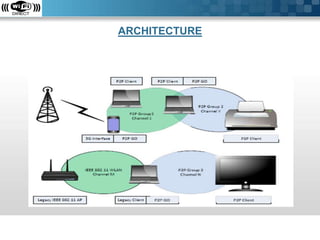
•The first group is created by a mobile phone sharing its 3G connection
with two laptops; for this first group, the phone is acting as P2P GO
while the two laptops behave as P2P Clients.
•In order to extend the network, one of the laptops establishes a second
P2P Group with a printer; for this second group, the laptop acts as P2P
GO.
•In order to act both as P2P Client and as P2P GO the laptop will
typically alternate between the two roles by time-sharing the Wi-Fi
interface.
•The case of a laptop accessing the Internet through a legacy
infrastructure AP while at the same time streaming content to a TV
set by establishing a P2P Group, where the laptop acts as P2P GO.
•The P2P GO is required to run a Dynamic Host Configuration
Protocol (DHCP) server to provide P2P Clients with IP addresses.
•Finally, Wi-Fi Direct does not allow transferring the role of P2P
GO within a P2P Group.

•In this way, if the P2P GO leaves the P2P Group then the group is
torn down, and has to be re-established using some of the specified
procedures.
GROUP FORMATION

There are several ways in which two devices can establish a P2P Group.
Here we describe three group formation cases, namely,

Standard

Autonomous

Persistent
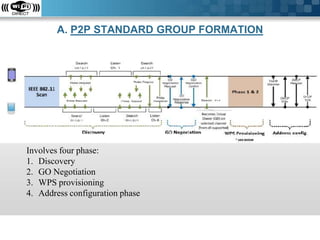
A. P2P STANDARD GROUP FORMATION

Involves four phase:
1. Discovery
2. GO Negotiation
3. WPS provisioning
4. Address configuration phase
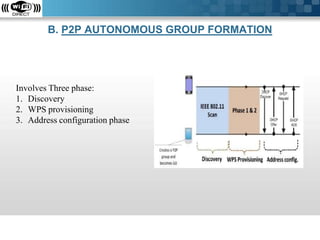
B. P2P AUTONOMOUS GROUP FORMATION

Involves Three phase:
1. Discovery
2. WPS provisioning
3. Address configuration phase
C. P2P PERSISTENT GROUP FORMATION

Involves four phase:
1. Discovery
2. GO Negotiation
3. WPS provisioning
4. Address configuration phase
SECURITY

Security provisioning starts after discovery of devices has taken place.
Wi-Fi Direct devices are required to implement Wi-Fi Protected Setup (WPS)
to support a secure connection with minimal user intervention.
Following WPS terminology, the P2P GO is required to implement an internal
Registrar, and the P2P Client is required to implement an Enrollee.
In particular, WPS allows to establish a secure connection by, e.g., introducing
a PIN in the P2P Client, or pushing a button in the two P2P Devices
The operation of WPS is composed of two parts. In the first part, denoted as
“Phase 1” ,the internal Registrar is in charge of generating and issuing the
network credentials, i.e., security keys, to the Enrollee.
WPS is based on WPA-2 security and uses Advanced Encryption Standard
(AES)-CCMP as cipher, and a randomly generated Pre-Shared Key (PSK)
for mutual authentication.
In the second part, depicted as “Phase 2” in Figure 2, the Enrollee (P2P
Client) disassociates and reconnects using its new Authentication
credentials.
In this way, if two devices already have the required network credentials
(this is the case in the Persistent group formation), there is no need to trigger
the first phase, and they can directly perform the authentication.
LINK TWO SERVICE DISCOVERY
A salient feature of Wi-Fi Direct is the ability to support service
discovery at the link layer.
 In this way, prior to the establishment of a P2P Group, P2P Devices can
exchange queries to discover the set of available services and, based on
this, decide whether to continue the group formation or not.
GAS is a layer two query/response protocol implemented through the use
of public action frames, that allows two non-associated 802.11 devices to
exchange queries belonging to a higher layer protocol (e.g. a service
discovery protocol).
 GAS is implemented by means of a generic container that provides
fragmentation and re- assembly, and allows the recipient device to identify
the higher layer protocol being transported
POWER SAVING
Using Wi-Fi Direct, battery-constrained devices may typically act as P2P
GO (soft-AP), and therefore energy efficiency is of capital importance.
In order to support energy savings for the AP, Wi-Fi Direct defines two
new power saving mechanisms:

OPS

• Opportunistic Power
Save protocol

NoA

• Notice of Absence
protocol
CONCLUSION
The widespread adoption of Wi-Fi in new classes of smaller devices has
made the need for ad hoc networking much more important. Even without a
central Wi-Fi hub or router, it would be useful for a laptop computer to be
able to wirelessly connect to a local printer.
Another use for Wi-Fi Direct is to provide a wireless connection to
peripherals.
Wireless mice, keyboards, remote controls, headsets, speakers, displays
and many other functions can be implemented with Wi-Fi Direct.
Google announced Wi-fi Direct support in Android 4.0 in October, 2011.
The Galaxy Nexus(released November 2011) was the first Android device
to ship with Google's implementation of this feature.
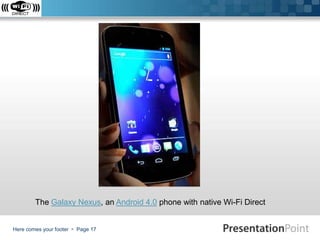
The Galaxy Nexus, an Android 4.0 phone with native Wi-Fi Direct
Here comes your footer  Page 17
REFERENCES
[1] IEEE 802.11z-2010 - Wireless LAN Medium Access Control (MAC) and
Physical Layer (PHY) specifications Amendment 7: Extensions to Direct-Link
Setup (DLS).
[2] Jin-Shyan Lee; Yu-Wei Su; Chung-Chou Shen, A Comparative Study of
Wireless Protocols: Bluetooth, UWB, ZigBee, and Wi-Fi, Industrial Electronics
Society, 2007. IECON 2007.
[3] Wi-Fi Alliance, P2P Technical Group, Wi-Fi Peer-to-Peer (P2P) Technical
Specification v1.0, December 2009.
[4] D. Camps-Mur, X. Perez-Costa, S. Sallent-Ribes, Designing en-ergy efficient
Access Points with Wi-Fi Direct, Computer Networks, September 2011.
Thank You
now

Any Queries

Presented By:
Ashutosh Kumar Jha
USN- 2BL09CS009
Dept. Computer Science & Engineering,
BLDEA’s V.P Dr. P.G.H Colg of Engg &Tech.

Wi-Fi Direct

  • 1.
    Device to devicecommunications with Wi-Fi Direct : An Overview Under The Guidance of: Dr. D. G. Savakar Sir Presented By: Ashutosh Kumar Jha (2BL09CS009)
  • 2.
    CONTENTS  Introduction  Wi-FiDirect: A Technical Overview • • • • • Architecture Group Formation Security Layer Two Service Discovery Power Saving  Conclusion  References
  • 3.
    INTRODUCTION  Wi-Fi Direct, defined by the Wi-Fi Alliance aimed at enhancing direct device to device communications in Wi-Fi.  Directly data transfer with reduced setup.  Setup generally consists of bringing two Wi-Fi Direct devices together and then triggering a "pairing" between them  Given the wide adoption of Wi-Fi in many kinds of devices, a natural way for the technology to progress is to target device to device connectivity, i.e. without requiring the presence of an Access Point (AP), traditionally provided by other technologies.
  • 4.
     By takingthis decision, Wi-Fi Direct immediately inherits all the enhanced QoS, power saving, and security mechanisms developed for the Wi-Fi infrastructure mode in the past years.  Wi-Fi Direct builds upon the successful IEEE 802.11 infrastructure mode and lets devices negotiate who will take over the AP-like functionalities  Wi-Fi Direct being a recent specification, its deployment is still on a very early stage
  • 5.
    WI-FI Direct: ATechnical Overview In a typical Wi-Fi network, clients discover and associate to WLANs, which are created and announced by Access Points (APs). In this way, a device unambiguously behaves either as an AP or as a client, each of these roles involving a different set of functionality. In Wi-Fi Direct these roles are specified as dynamic, and hence a Wi-Fi Direct device has to implement both the role of a client and the role of an AP (sometimes referred to as Soft- AP). These roles are therefore logical roles that could even be executed imultaneously by the same device either by time sharing the channel or using different frequencies.
  • 6.
  • 7.
    •The first groupis created by a mobile phone sharing its 3G connection with two laptops; for this first group, the phone is acting as P2P GO while the two laptops behave as P2P Clients. •In order to extend the network, one of the laptops establishes a second P2P Group with a printer; for this second group, the laptop acts as P2P GO. •In order to act both as P2P Client and as P2P GO the laptop will typically alternate between the two roles by time-sharing the Wi-Fi interface. •The case of a laptop accessing the Internet through a legacy infrastructure AP while at the same time streaming content to a TV set by establishing a P2P Group, where the laptop acts as P2P GO. •The P2P GO is required to run a Dynamic Host Configuration Protocol (DHCP) server to provide P2P Clients with IP addresses. •Finally, Wi-Fi Direct does not allow transferring the role of P2P GO within a P2P Group. •In this way, if the P2P GO leaves the P2P Group then the group is torn down, and has to be re-established using some of the specified procedures.
  • 8.
    GROUP FORMATION There areseveral ways in which two devices can establish a P2P Group. Here we describe three group formation cases, namely, Standard Autonomous Persistent
  • 9.
    A. P2P STANDARDGROUP FORMATION Involves four phase: 1. Discovery 2. GO Negotiation 3. WPS provisioning 4. Address configuration phase
  • 10.
    B. P2P AUTONOMOUSGROUP FORMATION Involves Three phase: 1. Discovery 2. WPS provisioning 3. Address configuration phase
  • 11.
    C. P2P PERSISTENTGROUP FORMATION Involves four phase: 1. Discovery 2. GO Negotiation 3. WPS provisioning 4. Address configuration phase
  • 12.
    SECURITY Security provisioning startsafter discovery of devices has taken place. Wi-Fi Direct devices are required to implement Wi-Fi Protected Setup (WPS) to support a secure connection with minimal user intervention. Following WPS terminology, the P2P GO is required to implement an internal Registrar, and the P2P Client is required to implement an Enrollee. In particular, WPS allows to establish a secure connection by, e.g., introducing a PIN in the P2P Client, or pushing a button in the two P2P Devices The operation of WPS is composed of two parts. In the first part, denoted as “Phase 1” ,the internal Registrar is in charge of generating and issuing the network credentials, i.e., security keys, to the Enrollee.
  • 13.
    WPS is basedon WPA-2 security and uses Advanced Encryption Standard (AES)-CCMP as cipher, and a randomly generated Pre-Shared Key (PSK) for mutual authentication. In the second part, depicted as “Phase 2” in Figure 2, the Enrollee (P2P Client) disassociates and reconnects using its new Authentication credentials. In this way, if two devices already have the required network credentials (this is the case in the Persistent group formation), there is no need to trigger the first phase, and they can directly perform the authentication.
  • 14.
    LINK TWO SERVICEDISCOVERY A salient feature of Wi-Fi Direct is the ability to support service discovery at the link layer.  In this way, prior to the establishment of a P2P Group, P2P Devices can exchange queries to discover the set of available services and, based on this, decide whether to continue the group formation or not. GAS is a layer two query/response protocol implemented through the use of public action frames, that allows two non-associated 802.11 devices to exchange queries belonging to a higher layer protocol (e.g. a service discovery protocol).  GAS is implemented by means of a generic container that provides fragmentation and re- assembly, and allows the recipient device to identify the higher layer protocol being transported
  • 15.
    POWER SAVING Using Wi-FiDirect, battery-constrained devices may typically act as P2P GO (soft-AP), and therefore energy efficiency is of capital importance. In order to support energy savings for the AP, Wi-Fi Direct defines two new power saving mechanisms: OPS • Opportunistic Power Save protocol NoA • Notice of Absence protocol
  • 16.
    CONCLUSION The widespread adoptionof Wi-Fi in new classes of smaller devices has made the need for ad hoc networking much more important. Even without a central Wi-Fi hub or router, it would be useful for a laptop computer to be able to wirelessly connect to a local printer. Another use for Wi-Fi Direct is to provide a wireless connection to peripherals. Wireless mice, keyboards, remote controls, headsets, speakers, displays and many other functions can be implemented with Wi-Fi Direct. Google announced Wi-fi Direct support in Android 4.0 in October, 2011. The Galaxy Nexus(released November 2011) was the first Android device to ship with Google's implementation of this feature.
  • 17.
    The Galaxy Nexus,an Android 4.0 phone with native Wi-Fi Direct Here comes your footer  Page 17
  • 18.
    REFERENCES [1] IEEE 802.11z-2010- Wireless LAN Medium Access Control (MAC) and Physical Layer (PHY) specifications Amendment 7: Extensions to Direct-Link Setup (DLS). [2] Jin-Shyan Lee; Yu-Wei Su; Chung-Chou Shen, A Comparative Study of Wireless Protocols: Bluetooth, UWB, ZigBee, and Wi-Fi, Industrial Electronics Society, 2007. IECON 2007. [3] Wi-Fi Alliance, P2P Technical Group, Wi-Fi Peer-to-Peer (P2P) Technical Specification v1.0, December 2009. [4] D. Camps-Mur, X. Perez-Costa, S. Sallent-Ribes, Designing en-ergy efficient Access Points with Wi-Fi Direct, Computer Networks, September 2011.
  • 19.
    Thank You now Any Queries PresentedBy: Ashutosh Kumar Jha USN- 2BL09CS009 Dept. Computer Science & Engineering, BLDEA’s V.P Dr. P.G.H Colg of Engg &Tech.