Introduction to Wi-Fi Direct
Wei-Tsung Su (蘇維宗)
ellington.su@gmail.com

11/22/2012

Ubiquitous Computing and Ambient Networking Laboratory

Page : 1
References
• Wi-Fi Alliance – Wi-Fi Direct
– http://www.wi-fi.org/discover-and-learn/wi-fi-direct

• Wi-Fi Direct Industry Whitepaper
– http://www.wi-fi.org/knowledge-center/white-papers/wi-ficertified-wi-fi-direct%E2%84%A2-personal-portable-wifi%C2%AE-technology-2010

• Wi-Fi Direct Consumer Whitepaper
– http://www.wi-fi.org/knowledge-center/white-papers/wi-ficertified-wi-fi-direct%E2%84%A2-personal-portable-wifi%C2%AE-connect-devices

• HUGHES Systique Wi-Fi Direct Whitepaper
– http://hsc.com/Portals/0/Uploads/Articles/WFD_Technology_
Whitepaper_v_1.7635035318321315728.pdf
11/22/2012

Ubiquitous Computing and Ambient Networking Laboratory

Page : 2
Purpose
• Create direct connections between Wi-Fi client
devices without a traditional Wi-Fi infrastructure
network.
• For example,
– Users can print documents directly to a Wi-Fi printer
with their laptops.
– Users can cast videos directly to a Wi-Fi TV with their
smart phones.
11/22/2012

Ubiquitous Computing and Ambient Networking Laboratory

Page : 3
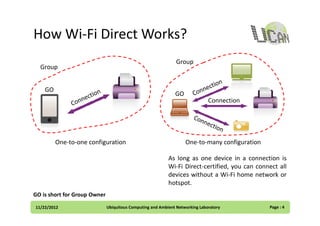
How Wi-Fi Direct Works?
Group

Group
GO

GO
Connection

One-to-one configuration

One-to-many configuration
As long as one device in a connection is
Wi-Fi Direct-certified, you can connect all
devices without a Wi-Fi home network or
hotspot.

GO is short for Group Owner
11/22/2012

Ubiquitous Computing and Ambient Networking Laboratory

Page : 4
Key Mechanisms
Key Mechanisms

Mandatory

Device Discovery

X

Service Discovery

Optional

X

Group Formation

X

Invitation

X

Client Discovery

X

Power Management
P2P-PS and P2P-WMM-PS

X

Notice of Absence

X

Opportunistic Power Save

X

11/22/2012

Ubiquitous Computing and Ambient Networking Laboratory

Page : 5
Device Discovery
• Identify other Wi-Fi Direct devices and establish
a connection
– If the target is not in a Group, a new Group is formed
• GO is negotiated.

– If the target is already part of a Group, the searching
device may attempt to join the existing Group.

• Wi-Fi Protected Setup (WPS) is used to obtain
credentials and authenticate the searching
device.
11/22/2012

Ubiquitous Computing and Ambient Networking Laboratory

Page : 6
Service Discovery (Optional)
• Advertise the higher layer applications to other
Wi-Fi Direct devices (even before a connection is
formed).
– For example, Wi-Fi printer can advertise its printing
services to other Wi-Fi Devices

• Implementation is vender-specific.

11/22/2012

Ubiquitous Computing and Ambient Networking Laboratory

Page : 8
Group Formation
• Once a Wi-Fi Direct connection is established between two Wi-Fi Direct
devices, a Group is formed.
• However, a Group may be created by a single Wi-Fi Direct device
– Required when connecting a legacy device
– Desirable when creating a Group to offer a specific service (e.g. Internet
connection sharing.)

• Once a Group is formed, other devices can join this Group as join a AP.
• A Group can be
– temporary Group (single instance)
– Persistent Group (multiple, recurring use)

11/22/2012

Ubiquitous Computing and Ambient Networking Laboratory

Page : 9
Invitation (Optional)
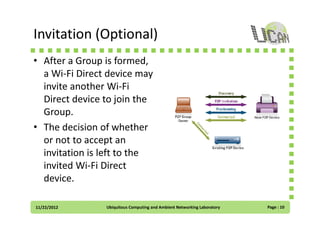
• After a Group is formed,
a Wi-Fi Direct device may
invite another Wi-Fi
Direct device to join the
Group.
• The decision of whether
or not to accept an
invitation is left to the
invited Wi-Fi Direct
device.
11/22/2012

Ubiquitous Computing and Ambient Networking Laboratory

Page : 10
Client Discovery
• Enabling a Wi-Fi Direct device to discover which
Wi-Fi Direct devices are in an existing Group.
• Locate and connect to a specific device or device
type.
– For example, a camera can query to see if any Wi-Fi
devices are printers in a Group.

11/22/2012

Ubiquitous Computing and Ambient Networking Laboratory

Page : 11
Power Management
• P2P-PS and P2P-WMM-PS
– based on Wi-Fi Power Save (PS) and WMM-PS

• Notice of Absence
– Signal a planned absence

• Opportunistic Power Save
– Save power by entering doze state
– Group owner is available on a periodic basis.

• If legacy devices are present, these power
management functions cannot be employed.
11/22/2012

Ubiquitous Computing and Ambient Networking Laboratory

Page : 12
Important Capabilities

Mandatory

Optional

Persistent Group

X

Concurrent Connection

X

Multiple Groups

X

Cross-connection

X

Managed Device
11/22/2012

X
Ubiquitous Computing and Ambient Networking Laboratory

Page : 13
Persistent Group (Optional)
• Persistent Group may be restarted without
provisioning, eliminating the need to repeat
tasks such as entering a WPS PIN.
• Persistent Group are invoked using Invitation
mechanism. That is, all Wi-Fi Direct devices must
support Invitation in a Persistent Group.

11/22/2012

Ubiquitous Computing and Ambient Networking Laboratory

Page : 14
Concurrent Connection (Optional)
• Concurrent connection
– Concurrent devices can be in a group while maintaining a
WLAN infrastructure connection at the same time.
• Multiple group
– Join multiple Groups

• Cross-connection
– Provide infrastructure access to other devices in the Group

– Concurrent operation requires support for multiple and
distinct MAC entities.
• One for operation as a WLAN-STA
• One for operation as a Wi-Fi Direct device

• Implementation is vender-specific
11/22/2012

Ubiquitous Computing and Ambient Networking Laboratory

Page : 15
Managed Environments (Optional)
• A Wi-Fi AP may implement capabilities that allow
it to manage Wi-Fi Direct devices for efficiency
and security issues. For example,
– enforce Wi-Fi Direct devices do not use 802.11b for
data and management frames.
– de-authentication any Wi-Fi Direct device from the
infrastructure network for our-of-policy behavior.
• For example, all client devices that Cross-connection is not
allowed if they attempt to access infrastructure network
resources.
11/22/2012

Ubiquitous Computing and Ambient Networking Laboratory

Page : 16
Wi-Fi Direct Certification Program
• Wi-Fi CERTIFIED Wi-Fi Direct devices must
implement Wi-Fi Peer-to-Peer technology (P2P).
• Wi-Fi CERTIFIED Wi-Fi Direct devices must pass the
following certification tests
– Baseline Wi-Fi certification tests
• At least 802.11g as well as WPA2-Personal

– Wi-Fi Multimedia (WMM) and Wi-Fi Protected Setup
(WPS) certification tests
• WMM and WPS are optional Wi-Fi Alliance certification, but
both are mandatory for Wi-Fi Direct certification

– All mandatory certification tests
– Optional features certification tests. (tested if
implemented.)
11/22/2012

Ubiquitous Computing and Ambient Networking Laboratory

Page : 17

Introduction to Wi-Fi Direct

  • 1.
    Introduction to Wi-FiDirect Wei-Tsung Su (蘇維宗) ellington.su@gmail.com 11/22/2012 Ubiquitous Computing and Ambient Networking Laboratory Page : 1
  • 2.
    References • Wi-Fi Alliance– Wi-Fi Direct – http://www.wi-fi.org/discover-and-learn/wi-fi-direct • Wi-Fi Direct Industry Whitepaper – http://www.wi-fi.org/knowledge-center/white-papers/wi-ficertified-wi-fi-direct%E2%84%A2-personal-portable-wifi%C2%AE-technology-2010 • Wi-Fi Direct Consumer Whitepaper – http://www.wi-fi.org/knowledge-center/white-papers/wi-ficertified-wi-fi-direct%E2%84%A2-personal-portable-wifi%C2%AE-connect-devices • HUGHES Systique Wi-Fi Direct Whitepaper – http://hsc.com/Portals/0/Uploads/Articles/WFD_Technology_ Whitepaper_v_1.7635035318321315728.pdf 11/22/2012 Ubiquitous Computing and Ambient Networking Laboratory Page : 2
  • 3.
    Purpose • Create directconnections between Wi-Fi client devices without a traditional Wi-Fi infrastructure network. • For example, – Users can print documents directly to a Wi-Fi printer with their laptops. – Users can cast videos directly to a Wi-Fi TV with their smart phones. 11/22/2012 Ubiquitous Computing and Ambient Networking Laboratory Page : 3
  • 4.
    How Wi-Fi DirectWorks? Group Group GO GO Connection One-to-one configuration One-to-many configuration As long as one device in a connection is Wi-Fi Direct-certified, you can connect all devices without a Wi-Fi home network or hotspot. GO is short for Group Owner 11/22/2012 Ubiquitous Computing and Ambient Networking Laboratory Page : 4
  • 5.
    Key Mechanisms Key Mechanisms Mandatory DeviceDiscovery X Service Discovery Optional X Group Formation X Invitation X Client Discovery X Power Management P2P-PS and P2P-WMM-PS X Notice of Absence X Opportunistic Power Save X 11/22/2012 Ubiquitous Computing and Ambient Networking Laboratory Page : 5
  • 6.
    Device Discovery • Identifyother Wi-Fi Direct devices and establish a connection – If the target is not in a Group, a new Group is formed • GO is negotiated. – If the target is already part of a Group, the searching device may attempt to join the existing Group. • Wi-Fi Protected Setup (WPS) is used to obtain credentials and authenticate the searching device. 11/22/2012 Ubiquitous Computing and Ambient Networking Laboratory Page : 6
  • 7.
    Service Discovery (Optional) •Advertise the higher layer applications to other Wi-Fi Direct devices (even before a connection is formed). – For example, Wi-Fi printer can advertise its printing services to other Wi-Fi Devices • Implementation is vender-specific. 11/22/2012 Ubiquitous Computing and Ambient Networking Laboratory Page : 8
  • 8.
    Group Formation • Oncea Wi-Fi Direct connection is established between two Wi-Fi Direct devices, a Group is formed. • However, a Group may be created by a single Wi-Fi Direct device – Required when connecting a legacy device – Desirable when creating a Group to offer a specific service (e.g. Internet connection sharing.) • Once a Group is formed, other devices can join this Group as join a AP. • A Group can be – temporary Group (single instance) – Persistent Group (multiple, recurring use) 11/22/2012 Ubiquitous Computing and Ambient Networking Laboratory Page : 9
  • 9.
    Invitation (Optional) • Aftera Group is formed, a Wi-Fi Direct device may invite another Wi-Fi Direct device to join the Group. • The decision of whether or not to accept an invitation is left to the invited Wi-Fi Direct device. 11/22/2012 Ubiquitous Computing and Ambient Networking Laboratory Page : 10
  • 10.
    Client Discovery • Enablinga Wi-Fi Direct device to discover which Wi-Fi Direct devices are in an existing Group. • Locate and connect to a specific device or device type. – For example, a camera can query to see if any Wi-Fi devices are printers in a Group. 11/22/2012 Ubiquitous Computing and Ambient Networking Laboratory Page : 11
  • 11.
    Power Management • P2P-PSand P2P-WMM-PS – based on Wi-Fi Power Save (PS) and WMM-PS • Notice of Absence – Signal a planned absence • Opportunistic Power Save – Save power by entering doze state – Group owner is available on a periodic basis. • If legacy devices are present, these power management functions cannot be employed. 11/22/2012 Ubiquitous Computing and Ambient Networking Laboratory Page : 12
  • 12.
    Important Capabilities Important Capabilities Mandatory Optional PersistentGroup X Concurrent Connection X Multiple Groups X Cross-connection X Managed Device 11/22/2012 X Ubiquitous Computing and Ambient Networking Laboratory Page : 13
  • 13.
    Persistent Group (Optional) •Persistent Group may be restarted without provisioning, eliminating the need to repeat tasks such as entering a WPS PIN. • Persistent Group are invoked using Invitation mechanism. That is, all Wi-Fi Direct devices must support Invitation in a Persistent Group. 11/22/2012 Ubiquitous Computing and Ambient Networking Laboratory Page : 14
  • 14.
    Concurrent Connection (Optional) •Concurrent connection – Concurrent devices can be in a group while maintaining a WLAN infrastructure connection at the same time. • Multiple group – Join multiple Groups • Cross-connection – Provide infrastructure access to other devices in the Group – Concurrent operation requires support for multiple and distinct MAC entities. • One for operation as a WLAN-STA • One for operation as a Wi-Fi Direct device • Implementation is vender-specific 11/22/2012 Ubiquitous Computing and Ambient Networking Laboratory Page : 15
  • 15.
    Managed Environments (Optional) •A Wi-Fi AP may implement capabilities that allow it to manage Wi-Fi Direct devices for efficiency and security issues. For example, – enforce Wi-Fi Direct devices do not use 802.11b for data and management frames. – de-authentication any Wi-Fi Direct device from the infrastructure network for our-of-policy behavior. • For example, all client devices that Cross-connection is not allowed if they attempt to access infrastructure network resources. 11/22/2012 Ubiquitous Computing and Ambient Networking Laboratory Page : 16
  • 16.
    Wi-Fi Direct CertificationProgram • Wi-Fi CERTIFIED Wi-Fi Direct devices must implement Wi-Fi Peer-to-Peer technology (P2P). • Wi-Fi CERTIFIED Wi-Fi Direct devices must pass the following certification tests – Baseline Wi-Fi certification tests • At least 802.11g as well as WPA2-Personal – Wi-Fi Multimedia (WMM) and Wi-Fi Protected Setup (WPS) certification tests • WMM and WPS are optional Wi-Fi Alliance certification, but both are mandatory for Wi-Fi Direct certification – All mandatory certification tests – Optional features certification tests. (tested if implemented.) 11/22/2012 Ubiquitous Computing and Ambient Networking Laboratory Page : 17