WIFI AWARE
BY
RESHMI HARIDAS M
1
What is WIFI Aware?
Wi-Fi Aware is a new Wi-Fi Alliance certification program
that extends Wi-Fi’s capabilities with a real-time and
energy-efficient discovery mechanism.
Wi-Fi Aware lets a device broadcast short pings so that
other devices can know a little bit about it without
establishing a two-way connection.
It is optimized to work well even in crowded
environments.
2
 Wi-Fi Aware also known as Neighbor Awareness
networking (NAN) .
NAN protocol is designed to run in the background
and continuously scan the environment .
NAN can avoid dependency on GPS, cellular or
hotspot connections by providing a continual
background discovery of devices.
Since NAN is based on Wi-Fi which is widely available
in mobile devices hence many innovative proximity
based services can be modeled over it. 3
NAN ARCHITECTURE
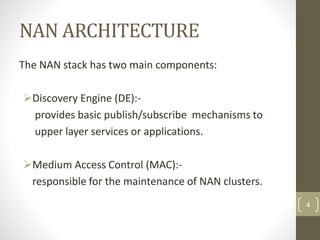
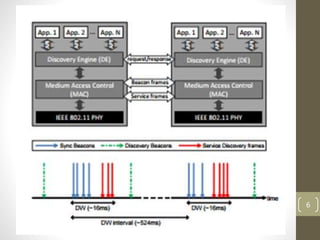
The NAN stack has two main components:
Discovery Engine (DE):-
provides basic publish/subscribe mechanisms to
upper layer services or applications.
Medium Access Control (MAC):-
responsible for the maintenance of NAN clusters.
4
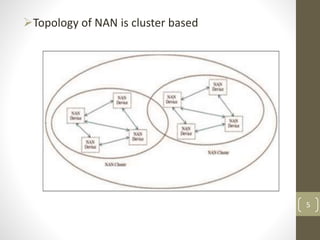
Topology of NAN is cluster based
NAN cluster
5
6
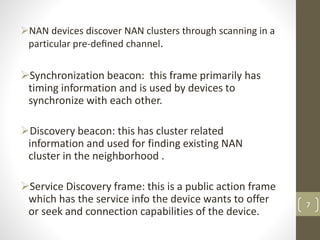
NAN devices discover NAN clusters through scanning in a
particular pre-defined channel.
Synchronization beacon: this frame primarily has
timing information and is used by devices to
synchronize with each other.
Discovery beacon: this has cluster related
information and used for finding existing NAN
cluster in the neighborhood .
Service Discovery frame: this is a public action frame
which has the service info the device wants to offer
or seek and connection capabilities of the device.
7
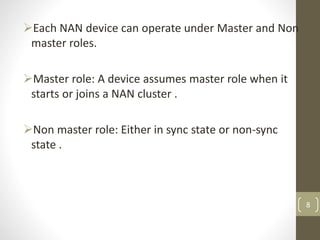
Each NAN device can operate under Master and Non
master roles.
Master role: A device assumes master role when it
starts or joins a NAN cluster .
Non master role: Either in sync state or non-sync
state .
8
The key functional elements of Wi-Fi aware are :
Discovery
Proximity
Personalization
Application driven
9
INTERNET OF THINGS
The vast network of devices connected to the
Internet, including smart phones and tablets and
almost anything with a sensor on it can collect
and exchange data.
Applications of IOT
Smart home
Smart grid
wearable's
Connected car 10
Connected health
Smart city
Smart retail
Smart farming
11
REQUIREMENTSOF IOT DEVICES
Low Power consumption
Low memory footprint
Range of communication
Inter operability with the existing devices
12
APPILICATIONS
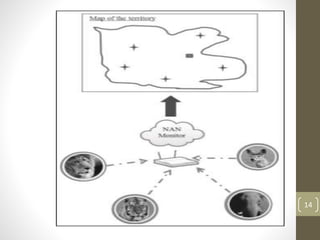
1. SMART TRACKING
Tracking animals in the forest when people go for
jungle safari.
All Animals are pinned with a NAN only IoT
sensor on their body.
The vehicle is installed with a NAN enabled
display.
The dashboard of the Safari we can have
locations of all the animals in the nearest vicinity.
13
14
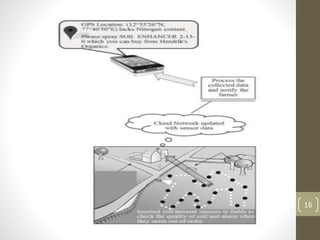
2. SMART AGRICULTURE
system capable of adapting to environmental changes
Entire field is installed with soil monitor sensors with
NAN capabilities.
sensors collect all the data from the soil and transmit
it to the local NAN enabled coordinator .
This coordinator being connected to cloud services
can analyze the data collected and can inform the
farmer .
15
16
3.SmartNotifications–Patientemergencyandhealth
monitoring
 All patients are provided with a wrist band which
acts as continuous health monitor.
 The hospital hallways can have access points which
continuously get data from the bands and it can
upload the data on hospital’s intranet.
 And when the doctor or nurse gets notified they
can come prepared with necessary equipment to
cater the need of the patient without any delay as
they have all the relevant information conveyed to
them.
17
REFERENCES
 WiFi-Aware as a Connectivity Solution for IoT Pairing IoT with
Wi-Fi Aware technology: Enabling New proximity based
Services .
 WiFi Aware Networking Specification from WiFi Alliance -
Draft 15.
 Gil Reiter, “Wireless connectivity for the Internet of Things”
White paper published by Texas Instruments.
 Oleg Logvinov. (2014, Sep 11). Open Standards will enable
IoT’s growth . Available: http://electronicdesign.com/
 Craig Mathias. WiFi and the Internet of Things: Much more
than you think . Available: http://www.WiFi.org
 Bradley Mitchell. Introduction to the Internet of Things
Available: http://compnetworking.about.com 18

wifi aware

  • 1.
  • 2.
    What is WIFIAware? Wi-Fi Aware is a new Wi-Fi Alliance certification program that extends Wi-Fi’s capabilities with a real-time and energy-efficient discovery mechanism. Wi-Fi Aware lets a device broadcast short pings so that other devices can know a little bit about it without establishing a two-way connection. It is optimized to work well even in crowded environments. 2
  • 3.
     Wi-Fi Awarealso known as Neighbor Awareness networking (NAN) . NAN protocol is designed to run in the background and continuously scan the environment . NAN can avoid dependency on GPS, cellular or hotspot connections by providing a continual background discovery of devices. Since NAN is based on Wi-Fi which is widely available in mobile devices hence many innovative proximity based services can be modeled over it. 3
  • 4.
    NAN ARCHITECTURE The NANstack has two main components: Discovery Engine (DE):- provides basic publish/subscribe mechanisms to upper layer services or applications. Medium Access Control (MAC):- responsible for the maintenance of NAN clusters. 4
  • 5.
    Topology of NANis cluster based NAN cluster 5
  • 6.
  • 7.
    NAN devices discoverNAN clusters through scanning in a particular pre-defined channel. Synchronization beacon: this frame primarily has timing information and is used by devices to synchronize with each other. Discovery beacon: this has cluster related information and used for finding existing NAN cluster in the neighborhood . Service Discovery frame: this is a public action frame which has the service info the device wants to offer or seek and connection capabilities of the device. 7
  • 8.
    Each NAN devicecan operate under Master and Non master roles. Master role: A device assumes master role when it starts or joins a NAN cluster . Non master role: Either in sync state or non-sync state . 8
  • 9.
    The key functionalelements of Wi-Fi aware are : Discovery Proximity Personalization Application driven 9
  • 10.
    INTERNET OF THINGS Thevast network of devices connected to the Internet, including smart phones and tablets and almost anything with a sensor on it can collect and exchange data. Applications of IOT Smart home Smart grid wearable's Connected car 10
  • 11.
  • 12.
    REQUIREMENTSOF IOT DEVICES LowPower consumption Low memory footprint Range of communication Inter operability with the existing devices 12
  • 13.
    APPILICATIONS 1. SMART TRACKING Trackinganimals in the forest when people go for jungle safari. All Animals are pinned with a NAN only IoT sensor on their body. The vehicle is installed with a NAN enabled display. The dashboard of the Safari we can have locations of all the animals in the nearest vicinity. 13
  • 14.
  • 15.
    2. SMART AGRICULTURE systemcapable of adapting to environmental changes Entire field is installed with soil monitor sensors with NAN capabilities. sensors collect all the data from the soil and transmit it to the local NAN enabled coordinator . This coordinator being connected to cloud services can analyze the data collected and can inform the farmer . 15
  • 16.
  • 17.
    3.SmartNotifications–Patientemergencyandhealth monitoring  All patientsare provided with a wrist band which acts as continuous health monitor.  The hospital hallways can have access points which continuously get data from the bands and it can upload the data on hospital’s intranet.  And when the doctor or nurse gets notified they can come prepared with necessary equipment to cater the need of the patient without any delay as they have all the relevant information conveyed to them. 17
  • 18.
    REFERENCES  WiFi-Aware asa Connectivity Solution for IoT Pairing IoT with Wi-Fi Aware technology: Enabling New proximity based Services .  WiFi Aware Networking Specification from WiFi Alliance - Draft 15.  Gil Reiter, “Wireless connectivity for the Internet of Things” White paper published by Texas Instruments.  Oleg Logvinov. (2014, Sep 11). Open Standards will enable IoT’s growth . Available: http://electronicdesign.com/  Craig Mathias. WiFi and the Internet of Things: Much more than you think . Available: http://www.WiFi.org  Bradley Mitchell. Introduction to the Internet of Things Available: http://compnetworking.about.com 18