By
GI-FI TECHNOLOGY
NEXT GENERATION
WIRELESS TECHNOLOGY
OVERVIEW
• Why we go for Gi-Fi
• Wireless Network generation
• Introduction
• Architecture
• Working of Gi-Fi
• Features
• Gi-Fi devices
• Applications
• conclusion
WHY WE GO FOR GI-FI
The reason for pushing into Gi-Fi technology is because of
1. slow rate
2. high power consumption
3. low range of frequency operation of earlier technologies.
i.e. bluetooth and Wi-Fi
WIRELESS NETWORK GENERATION
19TH
CENTUARY
IN 2001
INVENTED
IN 1991
IN 1994
IN 1980’SFIRST
DEVELOPED
IN 1970’S
INTRODUCTION
• Gi-Fi stands for Gigabit wireless
• 5mm chip
• audio video data at faster speed at home or office
• Data rate ,5 Gb/sec
• Area coverage, 10 meters
• Operates at 60 GHz on CMOS process
• Cost is about Rs.380
• Power ,2W
• IEEE 802.15.3C
• Developed by NICTA (National Information & Communication
Technology Reasearch Centre in Melbourne,Australia)
GI-FI CHIP
WORKING PRINCIPLE USED IN GI-FI
POWER
AMPLIFIERMIXER
Mm
TRANSCEIVER
antenna
IF SIGNAL
MIXER
ORIGINAL
DATA
RF 60GHZ
RF SIGNAL
IF 5GHZ
IF S/L
TIME DIVISION
DUPLEX
FEATURES
• High speed data transfer
• Low Power Consumption
• High Security
• Cost-effective
• High level of frequency re-use
• Highly portable
• Line of sight operation
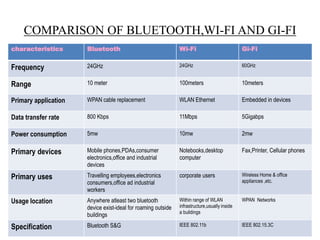
COMPARISON OF BLUETOOTH,WI-FI AND GI-FI
characteristics Bluetooth Wi-Fi Gi-Fi
Frequency 24GHz 24GHz 60GHz
Range 10 meter 100meters 10meters
Primary application WPAN cable replacement WLAN Ethernet Embedded in devices
Data transfer rate 800 Kbps 11Mbps 5Gigabps
Power consumption 5mw 10mw 2mw
Primary devices Mobile phones,PDAs,consumer
electronics,office and industrial
devices
Notebooks,desktop
computer
Fax,Printer, Cellular phones
Primary uses Travelling employees,electronics
consumers,office ad industrial
workers
corporate users Wireless Home & office
appliances ,etc.
Usage location Anywhere atleast two bluetooth
device exist-ideal for roaming outside
buildings
Within range of WLAN
infrastructure,usually inside
a buildings
WPAN Networks
Specification Bluetooth S&G IEEE 802.11b IEEE 802.15.3C
GI-FI DEVICES
APPLICATIONS
• Home appliances
APPLICATIONS
• Office appliances
APPLICATIONS
•Information
transfer
APPLICATIONS
• Inter-vehicle communication system
FUTURE SCOPE
• The Gi-Fi integrated transceiver chip is may be launched by
starting of next year by NICTA,Australia will be first .
• Due to less cost of chip so many companies are forward to launch with
lower cost.
• The potential of mw-WPAN for ultra fast data exchange has prompted
companies like Intel, LG, Matsushita (Panasonic), NEC, Samsung,
SiBEAM, Sony and Toshiba to form WirelessHD, an industry-led
effort to define a specification for the next generation consumer
electronics products.
CONCLUTION
• Within five years, we expect Gi-Fi to be the dominant technology
for wireless networking.
• By that time it will be to provide services with low-cost, high
broadband access, and with very high speed large files swapped
within seconds which will develop wireless home and office of
future.
• If the success of Wi-Fi and the imminent wide usage of WiMAX is
any indication, Gi-Fi potentially can bring wireless broadband to the
enterprise in an entirely new way.
Gi - fi technology

Gi - fi technology

  • 1.
  • 2.
  • 3.
    OVERVIEW • Why wego for Gi-Fi • Wireless Network generation • Introduction • Architecture • Working of Gi-Fi • Features • Gi-Fi devices • Applications • conclusion
  • 4.
    WHY WE GOFOR GI-FI The reason for pushing into Gi-Fi technology is because of 1. slow rate 2. high power consumption 3. low range of frequency operation of earlier technologies. i.e. bluetooth and Wi-Fi
  • 5.
    WIRELESS NETWORK GENERATION 19TH CENTUARY IN2001 INVENTED IN 1991 IN 1994 IN 1980’SFIRST DEVELOPED IN 1970’S
  • 6.
    INTRODUCTION • Gi-Fi standsfor Gigabit wireless • 5mm chip • audio video data at faster speed at home or office • Data rate ,5 Gb/sec • Area coverage, 10 meters • Operates at 60 GHz on CMOS process • Cost is about Rs.380 • Power ,2W • IEEE 802.15.3C • Developed by NICTA (National Information & Communication Technology Reasearch Centre in Melbourne,Australia)
  • 7.
  • 8.
    WORKING PRINCIPLE USEDIN GI-FI POWER AMPLIFIERMIXER Mm TRANSCEIVER antenna IF SIGNAL MIXER ORIGINAL DATA RF 60GHZ RF SIGNAL IF 5GHZ IF S/L TIME DIVISION DUPLEX
  • 9.
    FEATURES • High speeddata transfer • Low Power Consumption • High Security • Cost-effective • High level of frequency re-use • Highly portable • Line of sight operation
  • 10.
    COMPARISON OF BLUETOOTH,WI-FIAND GI-FI characteristics Bluetooth Wi-Fi Gi-Fi Frequency 24GHz 24GHz 60GHz Range 10 meter 100meters 10meters Primary application WPAN cable replacement WLAN Ethernet Embedded in devices Data transfer rate 800 Kbps 11Mbps 5Gigabps Power consumption 5mw 10mw 2mw Primary devices Mobile phones,PDAs,consumer electronics,office and industrial devices Notebooks,desktop computer Fax,Printer, Cellular phones Primary uses Travelling employees,electronics consumers,office ad industrial workers corporate users Wireless Home & office appliances ,etc. Usage location Anywhere atleast two bluetooth device exist-ideal for roaming outside buildings Within range of WLAN infrastructure,usually inside a buildings WPAN Networks Specification Bluetooth S&G IEEE 802.11b IEEE 802.15.3C
  • 11.
  • 12.
  • 13.
  • 14.
  • 15.
  • 16.
    FUTURE SCOPE • TheGi-Fi integrated transceiver chip is may be launched by starting of next year by NICTA,Australia will be first . • Due to less cost of chip so many companies are forward to launch with lower cost. • The potential of mw-WPAN for ultra fast data exchange has prompted companies like Intel, LG, Matsushita (Panasonic), NEC, Samsung, SiBEAM, Sony and Toshiba to form WirelessHD, an industry-led effort to define a specification for the next generation consumer electronics products.
  • 17.
    CONCLUTION • Within fiveyears, we expect Gi-Fi to be the dominant technology for wireless networking. • By that time it will be to provide services with low-cost, high broadband access, and with very high speed large files swapped within seconds which will develop wireless home and office of future. • If the success of Wi-Fi and the imminent wide usage of WiMAX is any indication, Gi-Fi potentially can bring wireless broadband to the enterprise in an entirely new way.