Services in a
           Converged WAN


           Accessing the WAN – Chapter 1


ITE I Chapter 6   © 2006 Cisco Systems, Inc. All rights reserved.   Cisco Public   1
Objectives
            Describe how the Cisco Enterprise Composite
             Model (ECNM) provides integrated services
             over an Enterprise network.
            Describe the key WAN technology concepts.
            Identify the appropriate WAN technologies to
             use when matching ECNM best practices with
             typical enterprise requirements for WAN
             communications.


ITE 1 Chapter 6   © 2006 Cisco Systems, Inc. All rights reserved.   Cisco Public   2
1.1 Providing Integrated
           Services to the Enterprise


           Accessing the WAN – Chapter 1


ITE I Chapter 6   © 2006 Cisco Systems, Inc. All rights reserved.   Cisco Public   3
The purpose and function of WANs


ITE 1 Chapter 6   © 2006 Cisco Systems, Inc. All rights reserved.   Cisco Public   4
The purpose and function of WANs
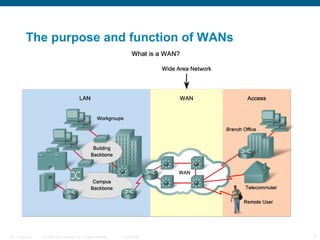
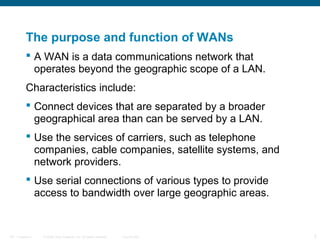
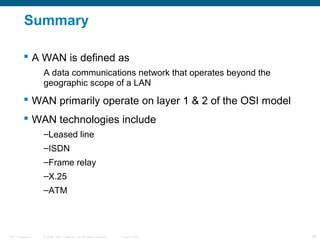
            A WAN is a data communications network that
             operates beyond the geographic scope of a LAN.
           Characteristics include:
            Connect devices that are separated by a broader
             geographical area than can be served by a LAN.
            Use the services of carriers, such as telephone
             companies, cable companies, satellite systems, and
             network providers.
            Use serial connections of various types to provide
             access to bandwidth over large geographic areas.


ITE 1 Chapter 6   © 2006 Cisco Systems, Inc. All rights reserved.   Cisco Public   5
The Evolving Enterprise Network
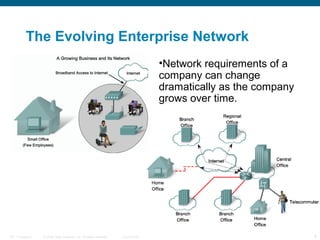
                                                                                   •Network requirements of a
                                                                                   company can change
                                                                                   dramatically as the company
                                                                                   grows over time.


ITE 1 Chapter 6   © 2006 Cisco Systems, Inc. All rights reserved.   Cisco Public                                 6
The Hierarchical Design Model


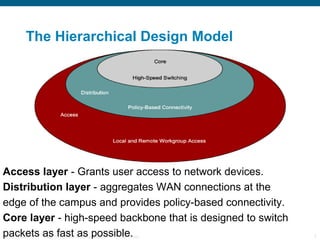
Access layer - Grants user access to network devices.
Distribution layer - aggregates WAN connections at the
edge of the campus and provides policy-based connectivity.
Core layer - high-speed backbone that is designed to switch
packets as fast as possible.
 ITE 1 Chapter 6   © 2006 Cisco Systems, Inc. All rights reserved.   Cisco Public   7
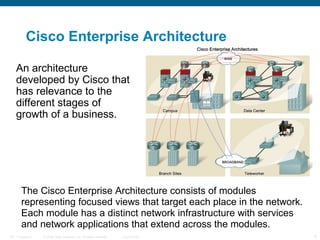
Cisco Enterprise Architecture

    An architecture
    developed by Cisco that
    has relevance to the
    different stages of
    growth of a business.


        The Cisco Enterprise Architecture consists of modules
        representing focused views that target each place in the network.
        Each module has a distinct network infrastructure with services
        and network applications that extend across the modules.
ITE 1 Chapter 6   © 2006 Cisco Systems, Inc. All rights reserved.   Cisco Public   8
Modules in the Enterprise Architecture
          •Enterprise Campus Architecture - describes the recommended
          methods to create a scalable network, while addressing the
          needs of campus-style business operations.

          •Enterprise Edge Architecture - enables the enterprise to use
          Internet and partner resources, and provide resources for its
          customers.

          •Enterprise Branch Architecture - allows businesses to extend the
          applications and services found at the campus to remote
          locations and users or to a small group of branches.

          •Enterprise Data Center Architecture – manages and maintains
          centralized data systems for the entire enterprise

          •Enterprise Teleworker Architecture – connects individual
          employees to network resources remotely, typically from home.
ITE 1 Chapter 6   © 2006 Cisco Systems, Inc. All rights reserved.   Cisco Public   9
1.2 WAN technology
           overview


           Accessing the WAN – Chapter 1


ITE I Chapter 6   © 2006 Cisco Systems, Inc. All rights reserved.   Cisco Public   10
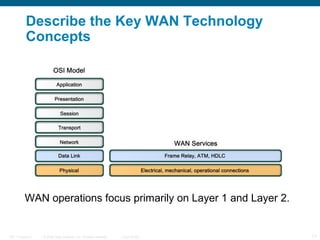
Describe the Key WAN Technology
           Concepts


          WAN operations focus primarily on Layer 1 and Layer 2.


ITE 1 Chapter 6   © 2006 Cisco Systems, Inc. All rights reserved.   Cisco Public   11
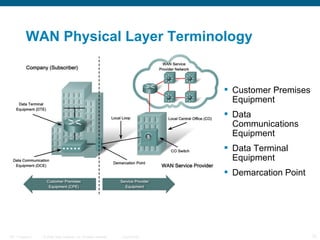
WAN Physical Layer Terminology


                                                                                    Customer Premises
                                                                                     Equipment
                                                                                    Data
                                                                                     Communications
                                                                                     Equipment
                                                                                    Data Terminal
                                                                                     Equipment
                                                                                    Demarcation Point


ITE 1 Chapter 6   © 2006 Cisco Systems, Inc. All rights reserved.   Cisco Public                         12
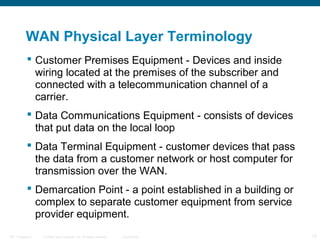
WAN Physical Layer Terminology
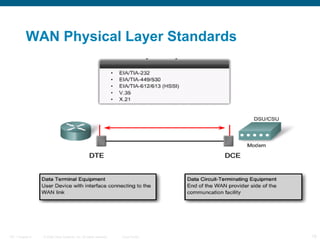
            Customer Premises Equipment - Devices and inside
             wiring located at the premises of the subscriber and
             connected with a telecommunication channel of a
             carrier.
            Data Communications Equipment - consists of devices
             that put data on the local loop
            Data Terminal Equipment - customer devices that pass
             the data from a customer network or host computer for
             transmission over the WAN.
            Demarcation Point - a point established in a building or
             complex to separate customer equipment from service
             provider equipment.
ITE 1 Chapter 6   © 2006 Cisco Systems, Inc. All rights reserved.   Cisco Public   13
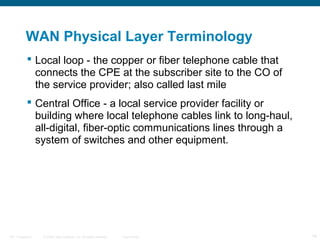
WAN Physical Layer Terminology
            Local loop - the copper or fiber telephone cable that
             connects the CPE at the subscriber site to the CO of
             the service provider; also called last mile
            Central Office - a local service provider facility or
             building where local telephone cables link to long-haul,
             all-digital, fiber-optic communications lines through a
             system of switches and other equipment.


ITE 1 Chapter 6   © 2006 Cisco Systems, Inc. All rights reserved.   Cisco Public   14
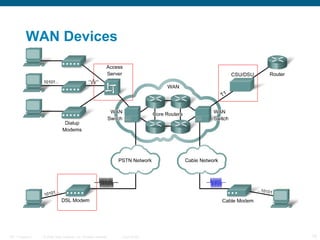
WAN Devices


ITE 1 Chapter 6   © 2006 Cisco Systems, Inc. All rights reserved.   Cisco Public   15
WAN Devices
            Modem - Modulates an analog carrier signal to encode
             digital information, and also demodulates the carrier
             signal to decode the transmitted information.
            CSU/DSU- used on T1 and T3 lines; The CSU
             provides termination for the digital signal and ensures
             integrity through error correction. The DSU converts
             the T-carrier line frames into frames that the LAN can
             interpret.
            Access Server - concentrates dial-in and dial-out user
             communications.


ITE 1 Chapter 6   © 2006 Cisco Systems, Inc. All rights reserved.   Cisco Public   16
WAN Devices
            WAN switch - a multiport internetworking device used
             in carrier networks; typically switches traffic like Frame
             Relay, ATM, or X.25; operates at the data link layer of
             the OSI model
            Modem - Modulates an analog carrier signal to encode
             digital information, and also demodulates the carrier
             signal to decode the transmitted information.
            Router- provides internetworking and WAN access
             interface ports that are used to connect to the service
             provider network.
            Core router-A router that resides within the middle or
             backbone of the WAN
ITE 1 Chapter 6   © 2006 Cisco Systems, Inc. All rights reserved.   Cisco Public   17
WAN Physical Layer Standards


ITE 1 Chapter 6   © 2006 Cisco Systems, Inc. All rights reserved.   Cisco Public   18
WAN Physical Layer Standards
            EIA/TIA-232- allows signal speeds of up to 64 kbps on
             a 25-pin D-connector over short distances
             (RS232/V.24)
            EIA/TIA-449/530 - a faster version of EIA/TIA-232. It
             uses a 36-pin D-connector and is capable of longer
             cable runs.
            EIA/TIA-612/613 - Describes the High-Speed Serial
             Interface (HSSI) protocol, which provides access to
             services up to 52 Mb/s on a 60-pin D-connector.


ITE 1 Chapter 6   © 2006 Cisco Systems, Inc. All rights reserved.   Cisco Public   19
WAN Physical Layer Standards
            V.35 - the ITU-T standard for synchronous
             communications between a network access device and
             a packet network.
            X.21 - an ITU-T standard for synchronous digital
             communications. It uses a 15-pin D-connector.


ITE 1 Chapter 6   © 2006 Cisco Systems, Inc. All rights reserved.   Cisco Public   20
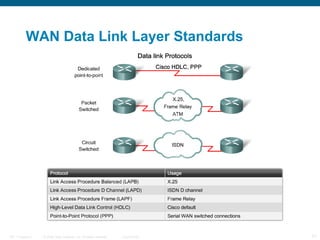
WAN Data Link Layer Standards


ITE 1 Chapter 6   © 2006 Cisco Systems, Inc. All rights reserved.   Cisco Public   21
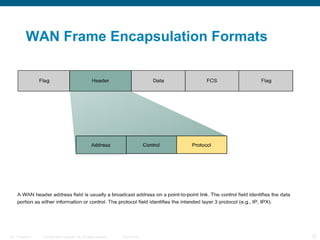
WAN Frame Encapsulation Formats


ITE 1 Chapter 6   © 2006 Cisco Systems, Inc. All rights reserved.   Cisco Public   22
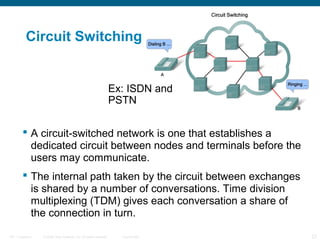
Circuit Switching


                                                                    Ex: ISDN and
                                                                    PSTN


         A circuit-switched network is one that establishes a
          dedicated circuit between nodes and terminals before the
          users may communicate.
         The internal path taken by the circuit between exchanges
          is shared by a number of conversations. Time division
          multiplexing (TDM) gives each conversation a share of
          the connection in turn.

ITE 1 Chapter 6   © 2006 Cisco Systems, Inc. All rights reserved.     Cisco Public   23
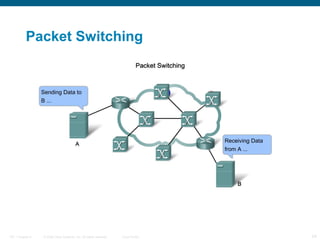
Packet Switching


ITE 1 Chapter 6   © 2006 Cisco Systems, Inc. All rights reserved.   Cisco Public   24
Packet Switching
            Packet switching splits traffic data into packets that are
             routed over a shared network.
            Packet-switching networks do not require a circuit to be
             established, and they allow many pairs of nodes to
             communicate over the same channel.
            The switches in a packet-switched network determine which
             link the packet must be sent on next from the addressing
             information in each packet.
            Packet-switched networks may establish routes through the
             switches for particular end-to-end connections called virtual
             circuits. A VC is a logical circuit created within a shared
             network between two network devices. Two types of VCs
             exist: PVC and SVC (more on Ch. 3)

ITE 1 Chapter 6   © 2006 Cisco Systems, Inc. All rights reserved.   Cisco Public   25
1.3 Internet Connection Options


           Accessing the WAN – Chapter 1


ITE I Chapter 6   © 2006 Cisco Systems, Inc. All rights reserved.   Cisco Public   26
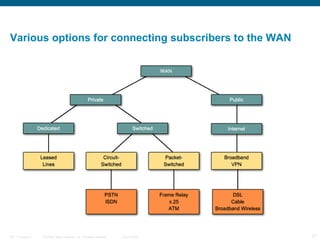
Various options for connecting subscribers to the WAN


ITE 1 Chapter 6   © 2006 Cisco Systems, Inc. All rights reserved.   Cisco Public   27
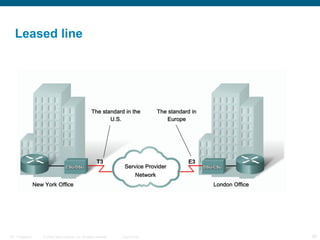
Leased line


ITE 1 Chapter 6   © 2006 Cisco Systems, Inc. All rights reserved.   Cisco Public   28
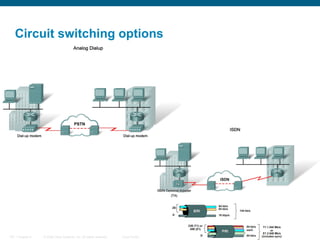
Circuit switching options


ITE 1 Chapter 6   © 2006 Cisco Systems, Inc. All rights reserved.   Cisco Public   29
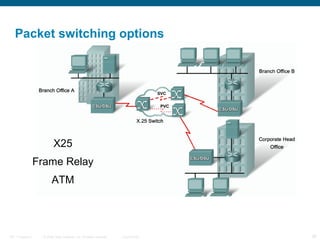
Packet switching options


                           X25
                  Frame Relay
                         ATM


ITE 1 Chapter 6     © 2006 Cisco Systems, Inc. All rights reserved.   Cisco Public   30
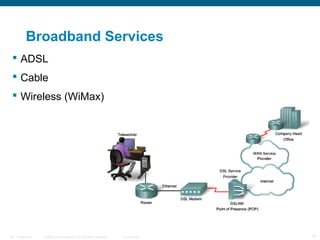
Broadband Services
  ADSL
  Cable
  Wireless (WiMax)


ITE 1 Chapter 6   © 2006 Cisco Systems, Inc. All rights reserved.   Cisco Public   31
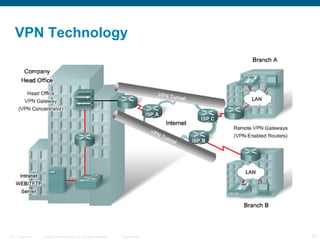
VPN Technology


ITE 1 Chapter 6   © 2006 Cisco Systems, Inc. All rights reserved.   Cisco Public   32
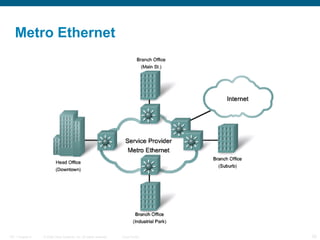
Metro Ethernet


ITE 1 Chapter 6   © 2006 Cisco Systems, Inc. All rights reserved.   Cisco Public   33
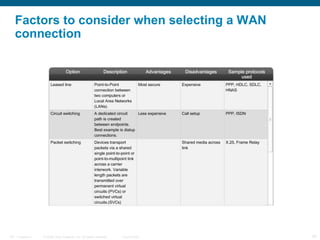
Factors to consider when selecting a WAN
   connection


ITE 1 Chapter 6   © 2006 Cisco Systems, Inc. All rights reserved.   Cisco Public   34
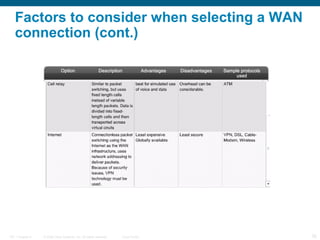
Factors to consider when selecting a WAN
   connection (cont.)


ITE 1 Chapter 6   © 2006 Cisco Systems, Inc. All rights reserved.   Cisco Public   35
Summary

          A WAN is defined as
                  A data communications network that operates beyond the
                  geographic scope of a LAN
          WAN primarily operate on layer 1 & 2 of the OSI model
          WAN technologies include
                  –Leased line
                  –ISDN
                  –Frame relay
                  –X.25
                  –ATM


ITE 1 Chapter 6   © 2006 Cisco Systems, Inc. All rights reserved.   Cisco Public   36
Summary
            Cisco Enterprise Architecture
                   –This is an expansion of the hierarchical model that further
                   divides the enterprise network into
                            •Physical areas
                            •Logical areas
                            •Functional areas

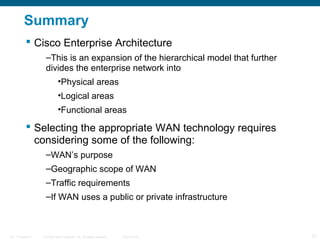
            Selecting the appropriate WAN technology requires
             considering some of the following:
                   –WAN’s purpose
                   –Geographic scope of WAN
                   –Traffic requirements
                   –If WAN uses a public or private infrastructure


ITE 1 Chapter 6   © 2006 Cisco Systems, Inc. All rights reserved.   Cisco Public   37
Next Module


ITE 1 Chapter 6   © 2006 Cisco Systems, Inc. All rights reserved.   Cisco Public   38
ITE 1 Chapter 6   © 2006 Cisco Systems, Inc. All rights reserved.   Cisco Public   39

Chapter1 rev1.0

  • 1.
    Services in a Converged WAN Accessing the WAN – Chapter 1 ITE I Chapter 6 © 2006 Cisco Systems, Inc. All rights reserved. Cisco Public 1
  • 2.
    Objectives  Describe how the Cisco Enterprise Composite Model (ECNM) provides integrated services over an Enterprise network.  Describe the key WAN technology concepts.  Identify the appropriate WAN technologies to use when matching ECNM best practices with typical enterprise requirements for WAN communications. ITE 1 Chapter 6 © 2006 Cisco Systems, Inc. All rights reserved. Cisco Public 2
  • 3.
    1.1 Providing Integrated Services to the Enterprise Accessing the WAN – Chapter 1 ITE I Chapter 6 © 2006 Cisco Systems, Inc. All rights reserved. Cisco Public 3
  • 4.
    The purpose andfunction of WANs ITE 1 Chapter 6 © 2006 Cisco Systems, Inc. All rights reserved. Cisco Public 4
  • 5.
    The purpose andfunction of WANs  A WAN is a data communications network that operates beyond the geographic scope of a LAN. Characteristics include:  Connect devices that are separated by a broader geographical area than can be served by a LAN.  Use the services of carriers, such as telephone companies, cable companies, satellite systems, and network providers.  Use serial connections of various types to provide access to bandwidth over large geographic areas. ITE 1 Chapter 6 © 2006 Cisco Systems, Inc. All rights reserved. Cisco Public 5
  • 6.
    The Evolving EnterpriseNetwork •Network requirements of a company can change dramatically as the company grows over time. ITE 1 Chapter 6 © 2006 Cisco Systems, Inc. All rights reserved. Cisco Public 6
  • 7.
    The Hierarchical DesignModel Access layer - Grants user access to network devices. Distribution layer - aggregates WAN connections at the edge of the campus and provides policy-based connectivity. Core layer - high-speed backbone that is designed to switch packets as fast as possible. ITE 1 Chapter 6 © 2006 Cisco Systems, Inc. All rights reserved. Cisco Public 7
  • 8.
    Cisco Enterprise Architecture An architecture developed by Cisco that has relevance to the different stages of growth of a business. The Cisco Enterprise Architecture consists of modules representing focused views that target each place in the network. Each module has a distinct network infrastructure with services and network applications that extend across the modules. ITE 1 Chapter 6 © 2006 Cisco Systems, Inc. All rights reserved. Cisco Public 8
  • 9.
    Modules in theEnterprise Architecture •Enterprise Campus Architecture - describes the recommended methods to create a scalable network, while addressing the needs of campus-style business operations. •Enterprise Edge Architecture - enables the enterprise to use Internet and partner resources, and provide resources for its customers. •Enterprise Branch Architecture - allows businesses to extend the applications and services found at the campus to remote locations and users or to a small group of branches. •Enterprise Data Center Architecture – manages and maintains centralized data systems for the entire enterprise •Enterprise Teleworker Architecture – connects individual employees to network resources remotely, typically from home. ITE 1 Chapter 6 © 2006 Cisco Systems, Inc. All rights reserved. Cisco Public 9
  • 10.
    1.2 WAN technology overview Accessing the WAN – Chapter 1 ITE I Chapter 6 © 2006 Cisco Systems, Inc. All rights reserved. Cisco Public 10
  • 11.
    Describe the KeyWAN Technology Concepts WAN operations focus primarily on Layer 1 and Layer 2. ITE 1 Chapter 6 © 2006 Cisco Systems, Inc. All rights reserved. Cisco Public 11
  • 12.
    WAN Physical LayerTerminology  Customer Premises Equipment  Data Communications Equipment  Data Terminal Equipment  Demarcation Point ITE 1 Chapter 6 © 2006 Cisco Systems, Inc. All rights reserved. Cisco Public 12
  • 13.
    WAN Physical LayerTerminology  Customer Premises Equipment - Devices and inside wiring located at the premises of the subscriber and connected with a telecommunication channel of a carrier.  Data Communications Equipment - consists of devices that put data on the local loop  Data Terminal Equipment - customer devices that pass the data from a customer network or host computer for transmission over the WAN.  Demarcation Point - a point established in a building or complex to separate customer equipment from service provider equipment. ITE 1 Chapter 6 © 2006 Cisco Systems, Inc. All rights reserved. Cisco Public 13
  • 14.
    WAN Physical LayerTerminology  Local loop - the copper or fiber telephone cable that connects the CPE at the subscriber site to the CO of the service provider; also called last mile  Central Office - a local service provider facility or building where local telephone cables link to long-haul, all-digital, fiber-optic communications lines through a system of switches and other equipment. ITE 1 Chapter 6 © 2006 Cisco Systems, Inc. All rights reserved. Cisco Public 14
  • 15.
    WAN Devices ITE 1Chapter 6 © 2006 Cisco Systems, Inc. All rights reserved. Cisco Public 15
  • 16.
    WAN Devices  Modem - Modulates an analog carrier signal to encode digital information, and also demodulates the carrier signal to decode the transmitted information.  CSU/DSU- used on T1 and T3 lines; The CSU provides termination for the digital signal and ensures integrity through error correction. The DSU converts the T-carrier line frames into frames that the LAN can interpret.  Access Server - concentrates dial-in and dial-out user communications. ITE 1 Chapter 6 © 2006 Cisco Systems, Inc. All rights reserved. Cisco Public 16
  • 17.
    WAN Devices  WAN switch - a multiport internetworking device used in carrier networks; typically switches traffic like Frame Relay, ATM, or X.25; operates at the data link layer of the OSI model  Modem - Modulates an analog carrier signal to encode digital information, and also demodulates the carrier signal to decode the transmitted information.  Router- provides internetworking and WAN access interface ports that are used to connect to the service provider network.  Core router-A router that resides within the middle or backbone of the WAN ITE 1 Chapter 6 © 2006 Cisco Systems, Inc. All rights reserved. Cisco Public 17
  • 18.
    WAN Physical LayerStandards ITE 1 Chapter 6 © 2006 Cisco Systems, Inc. All rights reserved. Cisco Public 18
  • 19.
    WAN Physical LayerStandards  EIA/TIA-232- allows signal speeds of up to 64 kbps on a 25-pin D-connector over short distances (RS232/V.24)  EIA/TIA-449/530 - a faster version of EIA/TIA-232. It uses a 36-pin D-connector and is capable of longer cable runs.  EIA/TIA-612/613 - Describes the High-Speed Serial Interface (HSSI) protocol, which provides access to services up to 52 Mb/s on a 60-pin D-connector. ITE 1 Chapter 6 © 2006 Cisco Systems, Inc. All rights reserved. Cisco Public 19
  • 20.
    WAN Physical LayerStandards  V.35 - the ITU-T standard for synchronous communications between a network access device and a packet network.  X.21 - an ITU-T standard for synchronous digital communications. It uses a 15-pin D-connector. ITE 1 Chapter 6 © 2006 Cisco Systems, Inc. All rights reserved. Cisco Public 20
  • 21.
    WAN Data LinkLayer Standards ITE 1 Chapter 6 © 2006 Cisco Systems, Inc. All rights reserved. Cisco Public 21
  • 22.
    WAN Frame EncapsulationFormats ITE 1 Chapter 6 © 2006 Cisco Systems, Inc. All rights reserved. Cisco Public 22
  • 23.
    Circuit Switching Ex: ISDN and PSTN  A circuit-switched network is one that establishes a dedicated circuit between nodes and terminals before the users may communicate.  The internal path taken by the circuit between exchanges is shared by a number of conversations. Time division multiplexing (TDM) gives each conversation a share of the connection in turn. ITE 1 Chapter 6 © 2006 Cisco Systems, Inc. All rights reserved. Cisco Public 23
  • 24.
    Packet Switching ITE 1Chapter 6 © 2006 Cisco Systems, Inc. All rights reserved. Cisco Public 24
  • 25.
    Packet Switching  Packet switching splits traffic data into packets that are routed over a shared network.  Packet-switching networks do not require a circuit to be established, and they allow many pairs of nodes to communicate over the same channel.  The switches in a packet-switched network determine which link the packet must be sent on next from the addressing information in each packet.  Packet-switched networks may establish routes through the switches for particular end-to-end connections called virtual circuits. A VC is a logical circuit created within a shared network between two network devices. Two types of VCs exist: PVC and SVC (more on Ch. 3) ITE 1 Chapter 6 © 2006 Cisco Systems, Inc. All rights reserved. Cisco Public 25
  • 26.
    1.3 Internet ConnectionOptions Accessing the WAN – Chapter 1 ITE I Chapter 6 © 2006 Cisco Systems, Inc. All rights reserved. Cisco Public 26
  • 27.
    Various options forconnecting subscribers to the WAN ITE 1 Chapter 6 © 2006 Cisco Systems, Inc. All rights reserved. Cisco Public 27
  • 28.
    Leased line ITE 1Chapter 6 © 2006 Cisco Systems, Inc. All rights reserved. Cisco Public 28
  • 29.
    Circuit switching options ITE1 Chapter 6 © 2006 Cisco Systems, Inc. All rights reserved. Cisco Public 29
  • 30.
    Packet switching options X25 Frame Relay ATM ITE 1 Chapter 6 © 2006 Cisco Systems, Inc. All rights reserved. Cisco Public 30
  • 31.
    Broadband Services ADSL  Cable  Wireless (WiMax) ITE 1 Chapter 6 © 2006 Cisco Systems, Inc. All rights reserved. Cisco Public 31
  • 32.
    VPN Technology ITE 1Chapter 6 © 2006 Cisco Systems, Inc. All rights reserved. Cisco Public 32
  • 33.
    Metro Ethernet ITE 1Chapter 6 © 2006 Cisco Systems, Inc. All rights reserved. Cisco Public 33
  • 34.
    Factors to considerwhen selecting a WAN connection ITE 1 Chapter 6 © 2006 Cisco Systems, Inc. All rights reserved. Cisco Public 34
  • 35.
    Factors to considerwhen selecting a WAN connection (cont.) ITE 1 Chapter 6 © 2006 Cisco Systems, Inc. All rights reserved. Cisco Public 35
  • 36.
    Summary  A WAN is defined as A data communications network that operates beyond the geographic scope of a LAN  WAN primarily operate on layer 1 & 2 of the OSI model  WAN technologies include –Leased line –ISDN –Frame relay –X.25 –ATM ITE 1 Chapter 6 © 2006 Cisco Systems, Inc. All rights reserved. Cisco Public 36
  • 37.
    Summary  Cisco Enterprise Architecture –This is an expansion of the hierarchical model that further divides the enterprise network into •Physical areas •Logical areas •Functional areas  Selecting the appropriate WAN technology requires considering some of the following: –WAN’s purpose –Geographic scope of WAN –Traffic requirements –If WAN uses a public or private infrastructure ITE 1 Chapter 6 © 2006 Cisco Systems, Inc. All rights reserved. Cisco Public 37
  • 38.
    Next Module ITE 1Chapter 6 © 2006 Cisco Systems, Inc. All rights reserved. Cisco Public 38
  • 39.
    ITE 1 Chapter6 © 2006 Cisco Systems, Inc. All rights reserved. Cisco Public 39

Editor's Notes

  • #5 Graphic 1.1.1.1
  • #6 Graphic 1.1.1.1
  • #7 Graphic 1.1.2.1
  • #9 Graphic 1.1.3.2
  • #10 Graphic 1.1.3.3
  • #12 Graphic 1.2.1.1
  • #13 Graphic 1.2.2.1 If space permits add graphics 1.2.2.2 & 1.2.2.3 (if forced to make a choice between the 2 graphic pick 1.2.2.2)
  • #22 Graphic 1.2.3.1
  • #24 Graphic 1.2.4.1 Alternative graphic can be found at the following URL (not necessary to use – just a thought): http://www.cisco.com/image/jpg/en/us/guest/products/ps6438/c1244/cdccont_0900aecd802c2010_0900aecd802c2010-08.jpg graphic 1.2.4.2
  • #25 Graphic 1.2.4.1 Alternative graphic can be found at the following URL (not necessary to use – just a thought): http://www.cisco.com/image/jpg/en/us/guest/products/ps6438/c1244/cdccont_0900aecd802c2010_0900aecd802c2010-08.jpg graphic 1.2.4.2
  • #28 Graphic 1.3.1.1
  • #29 Graphic 1.3.2.1
  • #30 Graphics 1.3.3.1 & 1.3.3.2
  • #31 Graphic 1.3.4.1
  • #33 Graphic 1.3.4.1
  • #34 Graphic 1.3.4.1
  • #35 The objective stated above does not make sense to me. Reword the above objective as follows: List factors to consider when selecting a WAN connection Graphic 1.3.5.4
  • #36 The objective stated above does not make sense to me. Reword the above objective as follows: List factors to consider when selecting a WAN connection Graphic 1.3.5.4