© 2007 Cisco Systems, Inc. All rights reserved. ICND1 v1.0—-5-1
WAN Connections
Enabling RIP
© 2007 Cisco Systems, Inc. All rights reserved. ICND1 v1.0—5-2
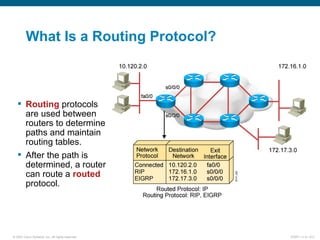
 Routing protocols
are used between
routers to determine
paths and maintain
routing tables.
 After the path is
determined, a router
can route a routed
protocol.
What Is a Routing Protocol?
© 2007 Cisco Systems, Inc. All rights reserved. ICND1 v1.0—5-3
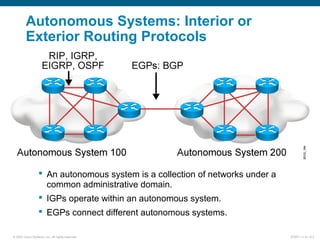
 An autonomous system is a collection of networks under a
common administrative domain.
 IGPs operate within an autonomous system.
 EGPs connect different autonomous systems.
Autonomous Systems: Interior or
Exterior Routing Protocols
© 2007 Cisco Systems, Inc. All rights reserved. ICND1 v1.0—5-4
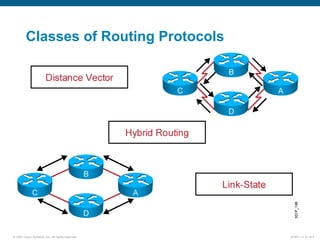
Classes of Routing Protocols
© 2007 Cisco Systems, Inc. All rights reserved. ICND1 v1.0—5-5
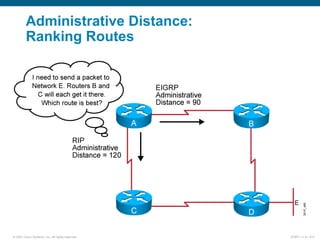
Administrative Distance:
Ranking Routes
© 2007 Cisco Systems, Inc. All rights reserved. ICND1 v1.0—5-6
Classful Routing Protocol
 Classful routing protocols do not include the subnet mask with the
route advertisement.
 Within the same network, consistency of the subnet masks is
assumed.
 Summary routes are exchanged between foreign networks.
 These are examples of classful routing protocols:
– RIPv1
– IGRP
© 2007 Cisco Systems, Inc. All rights reserved. ICND1 v1.0—5-7
Classless Routing Protocol
 Classless routing protocols include the subnet mask with the
route advertisement.
 Classless routing protocols support a variable-length subnet mask
(VLSM).
 Summary routes can be manually controlled within the network.
 These are examples of classless routing protocols:
– RIPv2
– EIGRP
– OSPF
– IS-IS
© 2007 Cisco Systems, Inc. All rights reserved. ICND1 v1.0—5-8
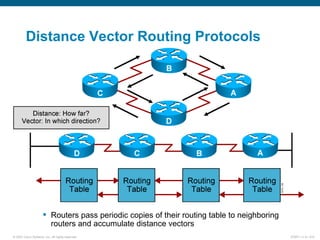
 Routers pass periodic copies of their routing table to neighboring
routers and accumulate distance vectors
Distance Vector Routing Protocols
© 2007 Cisco Systems, Inc. All rights reserved. ICND1 v1.0—5-9
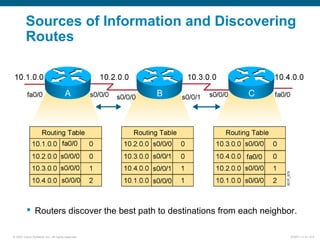
 Routers discover the best path to destinations from each neighbor.
Sources of Information and Discovering
Routes
© 2007 Cisco Systems, Inc. All rights reserved. ICND1 v1.0—5-10
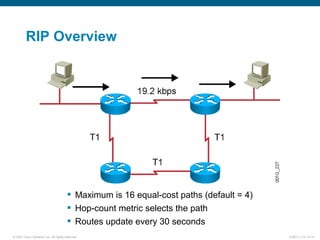
 Maximum is 16 equal-cost paths (default = 4)
 Hop-count metric selects the path
 Routes update every 30 seconds
RIP Overview
© 2007 Cisco Systems, Inc. All rights reserved. ICND1 v1.0—5-11
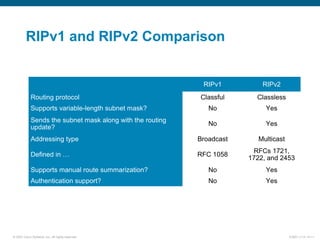
RIPv1 and RIPv2 Comparison
RIPv1 RIPv2
Routing protocol Classful Classless
Supports variable-length subnet mask? No Yes
Sends the subnet mask along with the routing
update?
No Yes
Addressing type Broadcast Multicast
Defined in … RFC 1058
RFCs 1721,
1722, and 2453
Supports manual route summarization? No Yes
Authentication support? No Yes
© 2007 Cisco Systems, Inc. All rights reserved. ICND1 v1.0—5-12
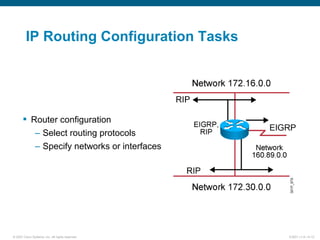
 Router configuration
– Select routing protocols
– Specify networks or interfaces
IP Routing Configuration Tasks
© 2007 Cisco Systems, Inc. All rights reserved. ICND1 v1.0—5-13
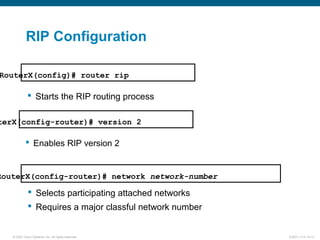
 Starts the RIP routing process
RouterX(config)# router rip
RouterX(config-router)# network network-number
 Selects participating attached networks
 Requires a major classful network number
RIP Configuration
 Enables RIP version 2
terX(config-router)# version 2
© 2007 Cisco Systems, Inc. All rights reserved. ICND1 v1.0—5-14
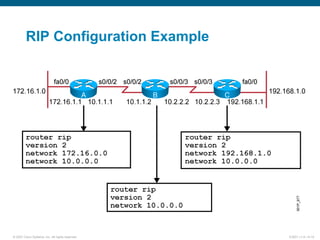
RIP Configuration Example
© 2007 Cisco Systems, Inc. All rights reserved. ICND1 v1.0—5-15
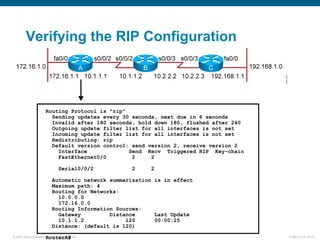
Verifying the RIP Configuration
Routing Protocol is "rip"
Sending updates every 30 seconds, next due in 6 seconds
Invalid after 180 seconds, hold down 180, flushed after 240
Outgoing update filter list for all interfaces is not set
Incoming update filter list for all interfaces is not set
Redistributing: rip
Default version control: send version 2, receive version 2
Interface Send Recv Triggered RIP Key-chain
FastEthernet0/0 2 2
Serial0/0/2 2 2
Automatic network summarization is in effect
Maximum path: 4
Routing for Networks:
10.0.0.0
172.16.0.0
Routing Information Sources:
Gateway Distance Last Update
10.1.1.2 120 00:00:25
Distance: (default is 120)
RouterA#
© 2007 Cisco Systems, Inc. All rights reserved. ICND1 v1.0—5-16
Displaying the IP Routing Table
RouterA# show ip route
Codes: C - connected, S - static, I - IGRP, R - RIP, M - mobile, B - BGP
D - EIGRP, EX - EIGRP external, O - OSPF, IA - OSPF inter area
N1 - OSPF NSSA external type 1, N2 - OSPF NSSA external type 2
E1 - OSPF external type 1, E2 - OSPF external type 2, E - EGP
i - IS-IS, L1 - IS-IS level-1, L2 - IS-IS level-2, * - candidate default
U - per-user static route, o - ODR
T - traffic engineered route
Gateway of last resort is not set
172.16.0.0/24 is subnetted, 1 subnets
C 172.16.1.0 is directly connected, fastethernet0/0
10.0.0.0/24 is subnetted, 2 subnets
R 10.2.2.0 [120/1] via 10.1.1.2, 00:00:07, Serial0/0/2
C 10.1.1.0 is directly connected, Serial0/0/2
R 192.168.1.0/24 [120/2] via 10.1.1.2, 00:00:07, Serial0/0/2
© 2007 Cisco Systems, Inc. All rights reserved. ICND1 v1.0—5-17
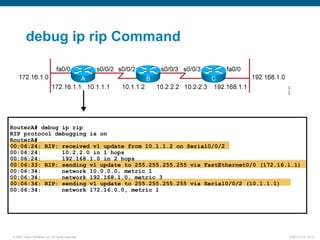
debug ip rip Command
RouterA# debug ip rip
RIP protocol debugging is on
RouterA#
00:06:24: RIP: received v1 update from 10.1.1.2 on Serial0/0/2
00:06:24: 10.2.2.0 in 1 hops
00:06:24: 192.168.1.0 in 2 hops
00:06:33: RIP: sending v1 update to 255.255.255.255 via FastEthernet0/0 (172.16.1.1)
00:06:34: network 10.0.0.0, metric 1
00:06:34: network 192.168.1.0, metric 3
00:06:34: RIP: sending v1 update to 255.255.255.255 via Serial0/0/2 (10.1.1.1)
00:06:34: network 172.16.0.0, metric 1
© 2007 Cisco Systems, Inc. All rights reserved. ICND1 v1.0—5-18
Summary
 Routing is the process by which items get from one location to
another.
 Dynamic routing protocols determine how updates are conveyed,
what knowledge is conveyed, when to convey knowledge, and
how to locate recipients of the updates.
 A routing protocol that has a lower administrative value is more
trustworthy than a protocol that has a higher administrative value.
 There are three classes of routing protocols: distance vector, link-
state, and balanced hybrid.
 The ip classless command can be used to prevent a router from
dropping a packet that is destined for an unknown subnetwork of
a directly attached network if a default route is configured.
© 2007 Cisco Systems, Inc. All rights reserved. ICND1 v1.0—5-19
Summary (Cont.)
 RIP is a distance vector routing protocol that uses hop count as
the matrix for route selection and broadcasts updates every 30
seconds.
 RIPv1 uses classful routing protocol; RIPv2 uses classless
routing protocol. RIPv2 supports VLSM, manual route
summarization, and authentication; RIPv1 does not support these
activities.
 To enable a dynamic routing protocol, first a routing protocol is
selected, then IP network numbers are assigned without values
being specified (except OSPF).
 The router command starts the routing process. The network
command allows the routing process to determine which
interfaces will participate in sending and receiving the routing
updates.
© 2007 Cisco Systems, Inc. All rights reserved. ICND1 v1.0—5-20
Summary (Cont.)
 The router RIP command selects RIP as the routing protocol.
The network command identifies a participating attached
network.
 The show ip command displays information about routing
protocols and the routing table.
 The debug ip rip command displays information on RIP routing
transactions.
© 2007 Cisco Systems, Inc. All rights reserved. ICND1 v1.0—5-21

CCNA Icnd110 s05l05

  • 1.
    © 2007 CiscoSystems, Inc. All rights reserved. ICND1 v1.0—-5-1 WAN Connections Enabling RIP
  • 2.
    © 2007 CiscoSystems, Inc. All rights reserved. ICND1 v1.0—5-2  Routing protocols are used between routers to determine paths and maintain routing tables.  After the path is determined, a router can route a routed protocol. What Is a Routing Protocol?
  • 3.
    © 2007 CiscoSystems, Inc. All rights reserved. ICND1 v1.0—5-3  An autonomous system is a collection of networks under a common administrative domain.  IGPs operate within an autonomous system.  EGPs connect different autonomous systems. Autonomous Systems: Interior or Exterior Routing Protocols
  • 4.
    © 2007 CiscoSystems, Inc. All rights reserved. ICND1 v1.0—5-4 Classes of Routing Protocols
  • 5.
    © 2007 CiscoSystems, Inc. All rights reserved. ICND1 v1.0—5-5 Administrative Distance: Ranking Routes
  • 6.
    © 2007 CiscoSystems, Inc. All rights reserved. ICND1 v1.0—5-6 Classful Routing Protocol  Classful routing protocols do not include the subnet mask with the route advertisement.  Within the same network, consistency of the subnet masks is assumed.  Summary routes are exchanged between foreign networks.  These are examples of classful routing protocols: – RIPv1 – IGRP
  • 7.
    © 2007 CiscoSystems, Inc. All rights reserved. ICND1 v1.0—5-7 Classless Routing Protocol  Classless routing protocols include the subnet mask with the route advertisement.  Classless routing protocols support a variable-length subnet mask (VLSM).  Summary routes can be manually controlled within the network.  These are examples of classless routing protocols: – RIPv2 – EIGRP – OSPF – IS-IS
  • 8.
    © 2007 CiscoSystems, Inc. All rights reserved. ICND1 v1.0—5-8  Routers pass periodic copies of their routing table to neighboring routers and accumulate distance vectors Distance Vector Routing Protocols
  • 9.
    © 2007 CiscoSystems, Inc. All rights reserved. ICND1 v1.0—5-9  Routers discover the best path to destinations from each neighbor. Sources of Information and Discovering Routes
  • 10.
    © 2007 CiscoSystems, Inc. All rights reserved. ICND1 v1.0—5-10  Maximum is 16 equal-cost paths (default = 4)  Hop-count metric selects the path  Routes update every 30 seconds RIP Overview
  • 11.
    © 2007 CiscoSystems, Inc. All rights reserved. ICND1 v1.0—5-11 RIPv1 and RIPv2 Comparison RIPv1 RIPv2 Routing protocol Classful Classless Supports variable-length subnet mask? No Yes Sends the subnet mask along with the routing update? No Yes Addressing type Broadcast Multicast Defined in … RFC 1058 RFCs 1721, 1722, and 2453 Supports manual route summarization? No Yes Authentication support? No Yes
  • 12.
    © 2007 CiscoSystems, Inc. All rights reserved. ICND1 v1.0—5-12  Router configuration – Select routing protocols – Specify networks or interfaces IP Routing Configuration Tasks
  • 13.
    © 2007 CiscoSystems, Inc. All rights reserved. ICND1 v1.0—5-13  Starts the RIP routing process RouterX(config)# router rip RouterX(config-router)# network network-number  Selects participating attached networks  Requires a major classful network number RIP Configuration  Enables RIP version 2 terX(config-router)# version 2
  • 14.
    © 2007 CiscoSystems, Inc. All rights reserved. ICND1 v1.0—5-14 RIP Configuration Example
  • 15.
    © 2007 CiscoSystems, Inc. All rights reserved. ICND1 v1.0—5-15 Verifying the RIP Configuration Routing Protocol is "rip" Sending updates every 30 seconds, next due in 6 seconds Invalid after 180 seconds, hold down 180, flushed after 240 Outgoing update filter list for all interfaces is not set Incoming update filter list for all interfaces is not set Redistributing: rip Default version control: send version 2, receive version 2 Interface Send Recv Triggered RIP Key-chain FastEthernet0/0 2 2 Serial0/0/2 2 2 Automatic network summarization is in effect Maximum path: 4 Routing for Networks: 10.0.0.0 172.16.0.0 Routing Information Sources: Gateway Distance Last Update 10.1.1.2 120 00:00:25 Distance: (default is 120) RouterA#
  • 16.
    © 2007 CiscoSystems, Inc. All rights reserved. ICND1 v1.0—5-16 Displaying the IP Routing Table RouterA# show ip route Codes: C - connected, S - static, I - IGRP, R - RIP, M - mobile, B - BGP D - EIGRP, EX - EIGRP external, O - OSPF, IA - OSPF inter area N1 - OSPF NSSA external type 1, N2 - OSPF NSSA external type 2 E1 - OSPF external type 1, E2 - OSPF external type 2, E - EGP i - IS-IS, L1 - IS-IS level-1, L2 - IS-IS level-2, * - candidate default U - per-user static route, o - ODR T - traffic engineered route Gateway of last resort is not set 172.16.0.0/24 is subnetted, 1 subnets C 172.16.1.0 is directly connected, fastethernet0/0 10.0.0.0/24 is subnetted, 2 subnets R 10.2.2.0 [120/1] via 10.1.1.2, 00:00:07, Serial0/0/2 C 10.1.1.0 is directly connected, Serial0/0/2 R 192.168.1.0/24 [120/2] via 10.1.1.2, 00:00:07, Serial0/0/2
  • 17.
    © 2007 CiscoSystems, Inc. All rights reserved. ICND1 v1.0—5-17 debug ip rip Command RouterA# debug ip rip RIP protocol debugging is on RouterA# 00:06:24: RIP: received v1 update from 10.1.1.2 on Serial0/0/2 00:06:24: 10.2.2.0 in 1 hops 00:06:24: 192.168.1.0 in 2 hops 00:06:33: RIP: sending v1 update to 255.255.255.255 via FastEthernet0/0 (172.16.1.1) 00:06:34: network 10.0.0.0, metric 1 00:06:34: network 192.168.1.0, metric 3 00:06:34: RIP: sending v1 update to 255.255.255.255 via Serial0/0/2 (10.1.1.1) 00:06:34: network 172.16.0.0, metric 1
  • 18.
    © 2007 CiscoSystems, Inc. All rights reserved. ICND1 v1.0—5-18 Summary  Routing is the process by which items get from one location to another.  Dynamic routing protocols determine how updates are conveyed, what knowledge is conveyed, when to convey knowledge, and how to locate recipients of the updates.  A routing protocol that has a lower administrative value is more trustworthy than a protocol that has a higher administrative value.  There are three classes of routing protocols: distance vector, link- state, and balanced hybrid.  The ip classless command can be used to prevent a router from dropping a packet that is destined for an unknown subnetwork of a directly attached network if a default route is configured.
  • 19.
    © 2007 CiscoSystems, Inc. All rights reserved. ICND1 v1.0—5-19 Summary (Cont.)  RIP is a distance vector routing protocol that uses hop count as the matrix for route selection and broadcasts updates every 30 seconds.  RIPv1 uses classful routing protocol; RIPv2 uses classless routing protocol. RIPv2 supports VLSM, manual route summarization, and authentication; RIPv1 does not support these activities.  To enable a dynamic routing protocol, first a routing protocol is selected, then IP network numbers are assigned without values being specified (except OSPF).  The router command starts the routing process. The network command allows the routing process to determine which interfaces will participate in sending and receiving the routing updates.
  • 20.
    © 2007 CiscoSystems, Inc. All rights reserved. ICND1 v1.0—5-20 Summary (Cont.)  The router RIP command selects RIP as the routing protocol. The network command identifies a participating attached network.  The show ip command displays information about routing protocols and the routing table.  The debug ip rip command displays information on RIP routing transactions.
  • 21.
    © 2007 CiscoSystems, Inc. All rights reserved. ICND1 v1.0—5-21

Editor's Notes

  • #3 Purpose: This figure introduces students to routing protocols and compares routing protocols to routed protocols. Emphasize: If network 10.120.2.0 wants to know about network 172.16.2.0, it must learn it from its S0 (or possibly S1) interface. Note: The two routing protocols that will be taught in this course are RIP and IGRP. They are both distance vector routing protocols.
  • #4 Purpose: This figure discusses autonomous systems, IGPs and EGPs. Emphasize: Introduce the interior/exterior distinctions for routing protocols, as follows: Interior routing protocols are used within a single autonomous system Exterior routing protocols are used to communicate between autonomous systems The design criteria for an interior routing protocol require it to find the best path through the network. In other words, the metric and how that metric is used is the most important element in an interior routing protocol. Exterior protocols are used to exchange routing information between networks that do not share a common administration. IP exterior gateway protocols require the following three sets of information before routing can begin: A list of neighbor (or peer) routers or access servers with which to exchange routing information A list of networks to advertise as directly reachable The autonomous system number of the local router
  • #5 Purpose: This figure introduces the three classes of routing protocols. Emphasize: There is no single best routing protocol. Note: Distance vector routing protocol operation is covered in detail later in this course. Link state and hybrid are only briefly explained after the distance vector discussion. Refer students to the ACRC to learn more about link-state and hybrid routing protocols.
  • #6 Purpose: This figure introduces administrative distance. Emphasize: An administrative distance is a rating of the trustworthiness of a routing information source, such as an individual router or a group of routers. In a large network, some routing protocols and some routers can be more reliable than others as sources of routing information. The default administrative distance for static routes and various routing protocols is listed in the Student Guide. The lower the distance, the more trustworthy the route is. For example, in the figure, the packet would learn the route learned via IGRP.
  • #9 Purpose: This figure introduces the distance vector routing algorithm, the first of the classes of routing protocols, and outlines how it operates. Emphasize: Distance vector algorithms do not allow a router to know the exact topology of an internetwork. This information is somewhat analogous to the information found on signs at a highway intersection. A sign points toward a road leading away from the intersection and indicates the distance to the destination. Further down the highway, another sign also points toward the destination, but now the distance to the destination is shorter. As long as each successive point on the path shows that the distance to the destination is successively shorter, the traffic is following the best path.
  • #10 Layer 3 of 3 Emphasize: Layer 3 adds the final entries received some time later that have distances of 2 from routers A and C.
  • #11 Purpose: This figure presents general information about RIP. Emphasize: The figure shows a network. The arrows highlight the path RIP selects. RIP selects the best path based on the shortest hop count, so it ignores the path with the faster T1 links. Be sure that you do not disparage RIP. It was developed in a homogeneous network. If everything is connected via a single media type, then bandwidth-based metrics reduce to hop count. In some cases, RIP is more appropriate than other protocols. It is extremely well tested.
  • #12 Purpose: This figure presents general information about RIP. Emphasize: The figure shows a network. The arrows highlight the path RIP selects. RIP selects the best path based on the shortest hop count, so it ignores the path with the faster T1 links. Be sure that you do not disparage RIP. It was developed in a homogeneous network. If everything is connected via a single media type, then bandwidth-based metrics reduce to hop count. In some cases, RIP is more appropriate than other protocols. It is extremely well tested.
  • #13 Purpose: This figure defines the tasks needed to configure IP routing. Emphasize: This is a general overview of tasks, so the graphic shows both IGRP and RIP in the protocol box. Tell your students that the router is able to route using both RIP and IGRP. It is possible to run IGRP and RIP concurrently. The IGRP information will override the RIP information by default because of IGRP’s administrative distance. However, running IGRP and RIP concurrently does not work well when the network topology changes. Because IGRP and RIP have different update timers, and because they require different amounts of time to propagate routing updates, one part of the network may end up believing IGRP routes and another part may end up believing RIP routes. This will result in routing loops. Review the fundamentals of router-configuration and interface-configuration modes. Transition: The command to enable dynamic routing follows.
  • #14 Purpose: This figure presents the Cisco IOS™ commands used to configure RIP. Emphasize: The figure shows the router rip command and the network network-number command. A proper understanding of these commands will save many problems in the lab. Point out that the network statement contains no subnetting information. Networks are directly connected and are specified as a Class A, B, or C network number. Transition: An example of configuration follows.
  • #15 Purpose: The figure shows how the RIP commands operate on the example network. Emphasize: An administrator only specifies directly connected networks that should be published to other routers. Without the network command, nothing is advertised. With a network command, the router will advertise every subnet within the Class A, B, or C network specified in the configuration.
  • #16 Purpose: This figure shows how the show ip protocol command is used to monitor RIP operation. Emphasize: The command displays the routing protocols that are active on the router for IP. It also gives network and timer information. Point out the timing information. Point out the list of networks for which the router is injecting routes. Point out the administrative distance metric.
  • #17 Purpose: This figure displays the show ip route command, which displays the contents of the router’s IP routing table. Emphasize: Discuss the IP routing table in detail. Show the locations of the hop count (metric) and the administrative distance (120). Discuss the following fields: R—Refers to routes learned from RIP. via—Refers to the router that informed us about this route. 00:00:07 timer value—RIP updates are every 30 seconds. Ask, “How long until the next update?” The interfaces used for the best path
  • #18 Purpose: This figure shows the debug ip rip command. Emphasize: Explain that debug commands also provide information for monitoring IP. The first highlighted line lists the source of the updates. The router returned information about two destinations. The last highlighted line shows the broadcast address to which the router sent updates.
  • #19 Purpose: This slide discuss the initial configurations on the routers and switches. Note: There is no setup mode on the Catalyst 1900 switch.
  • #20 Purpose: This slide discuss the initial configurations on the routers and switches. Note: There is no setup mode on the Catalyst 1900 switch.
  • #21 Purpose: This slide discuss the initial configurations on the routers and switches. Note: There is no setup mode on the Catalyst 1900 switch.