 A Local Area Network (LAN) can span a single building or campus,
 A Metropolitan Area Network (MAN) can span a single city,
 A Wide Area Network (WAN) can span sites in multiple cities, countries, continents.
 1957 ARPA(Advanced Research Projects Agency) project starts as a military research for satellite
communications, and in 1972 first public demonstration of ARPANET introduces networks into our
lives. Of many competing systems created at this time, Ethernet and ARCNET were the most popular.
Local area network technologies have become the most popular form of computer networks. LANs now
connect more computers than any other type of network.
 The fundamental difference between a WAN and a LAN is the scalability, WANs can be able to connect
as many computers and networks as possible.
 The most popular example of WAN is the internet.
 A WAN is constructed from many switches to which individual computers connect. Additional switches
can be added as needed to connect additional sites or additional computers.
2
3
 In the 1960’s there was great concern that
a nuclear strike would render all
traditional communications useless.
 As a result, the US Department of Defense
funded the ARPAnet in the development
of a decentralized, resilient, and self-
configuring communications network.
4
The first ARPANET links
were between UCLA and
the Stanford Research
Institute in November
1969. A month later links
to the University of Utah
and the UC Santa Barbara
were added.
Len Kleinrock standing next to the
first Inter Message Processor (IMP) at
UCLA
5
After widespread
commercialization of the
Internet in the 1980’s,
Internet use grew and
continues to grow at an
exponential rate.
6
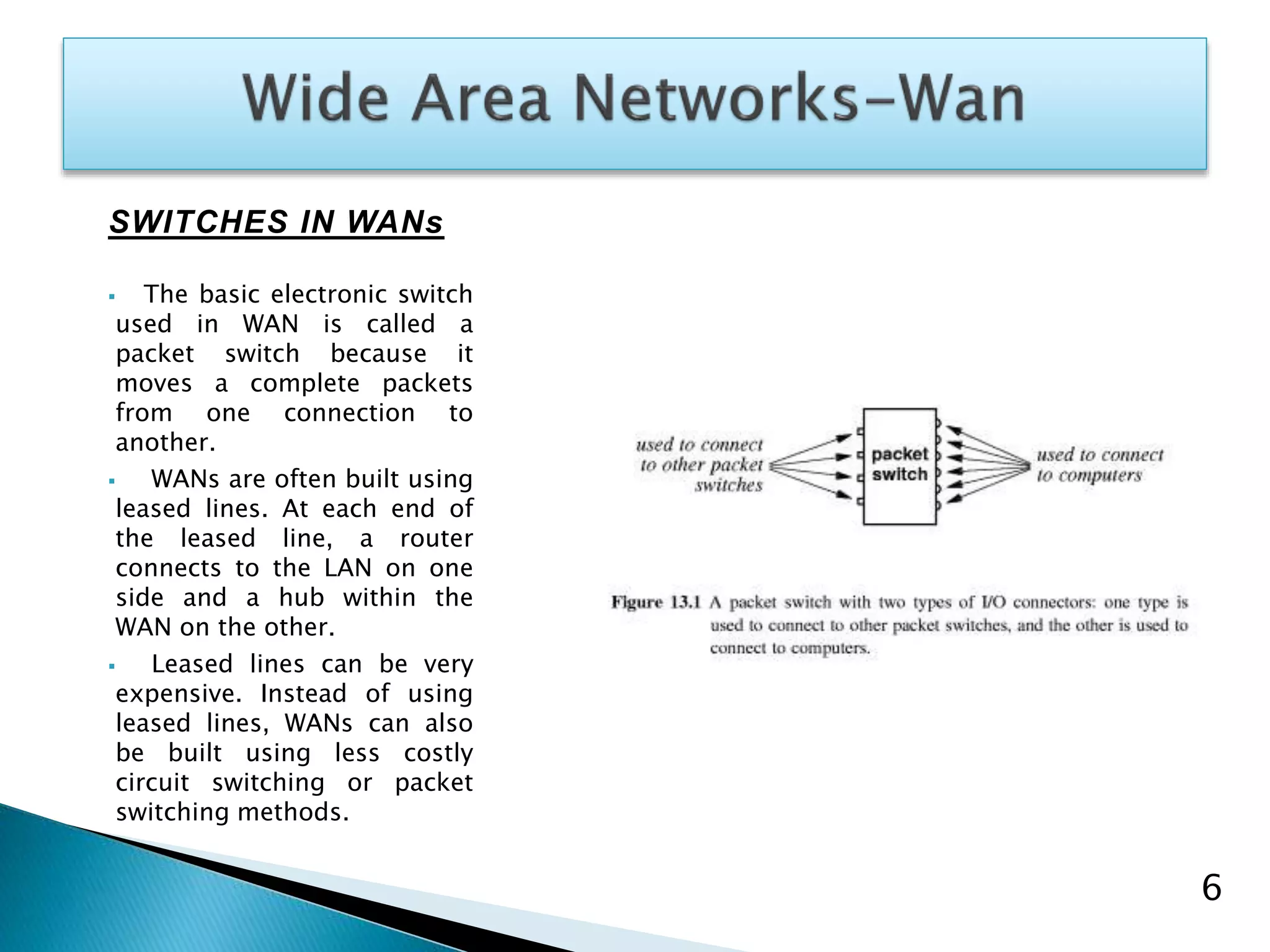
 The basic electronic switch
used in WAN is called a
packet switch because it
moves a complete packets
from one connection to
another.
 WANs are often built using
leased lines. At each end of
the leased line, a router
connects to the LAN on one
side and a hub within the
WAN on the other.
 Leased lines can be very
expensive. Instead of using
leased lines, WANs can also
be built using less costly
circuit switching or packet
switching methods.
SWITCHES IN WANs
 Local Area Networks (LANs)
◦ On the customer premises
 Wide Area Networks (WANs)
◦ Connect sites across a region, country, the world
 Metropolitan Area Networks (MANs)
◦ Connect sites in a single metropolitan area (a city
and its suburbs)
◦ A type of WAN
7
LAN MAN WAN
Sites Within Between Between
Implementation Self Carrier Carrier
Ability to choose
technology
High Low Low
Who does the work of
operating the network?
Self Carrier Carrier
8
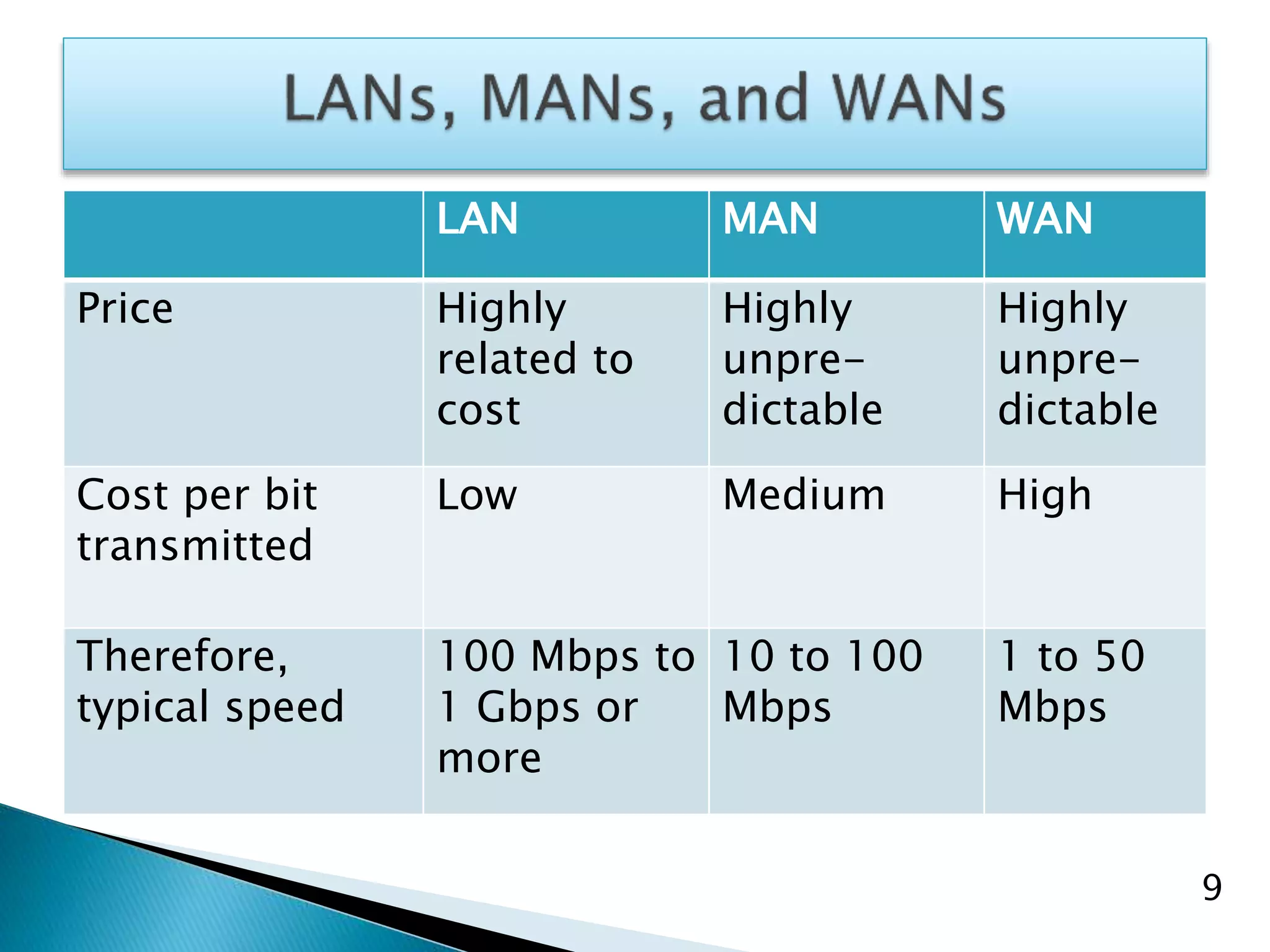
LAN MAN WAN
Price Highly
related to
cost
Highly
unpre-
dictable
Highly
unpre-
dictable
Cost per bit
transmitted
Low Medium High
Therefore,
typical speed
100 Mbps to
1 Gbps or
more
10 to 100
Mbps
1 to 50
Mbps
9
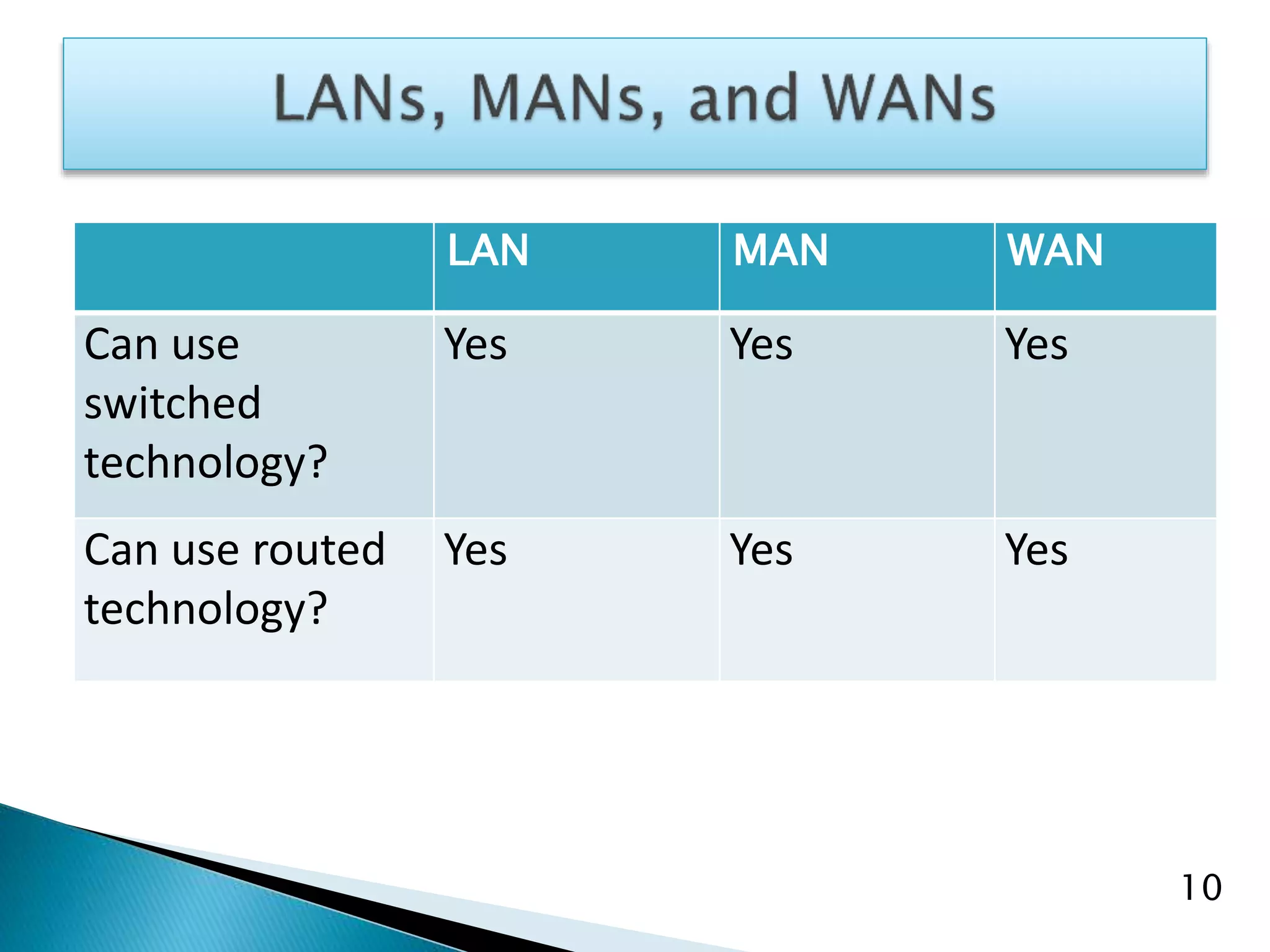
LAN MAN WAN
Can use
switched
technology?
Yes Yes Yes
Can use routed
technology?
Yes Yes Yes
10
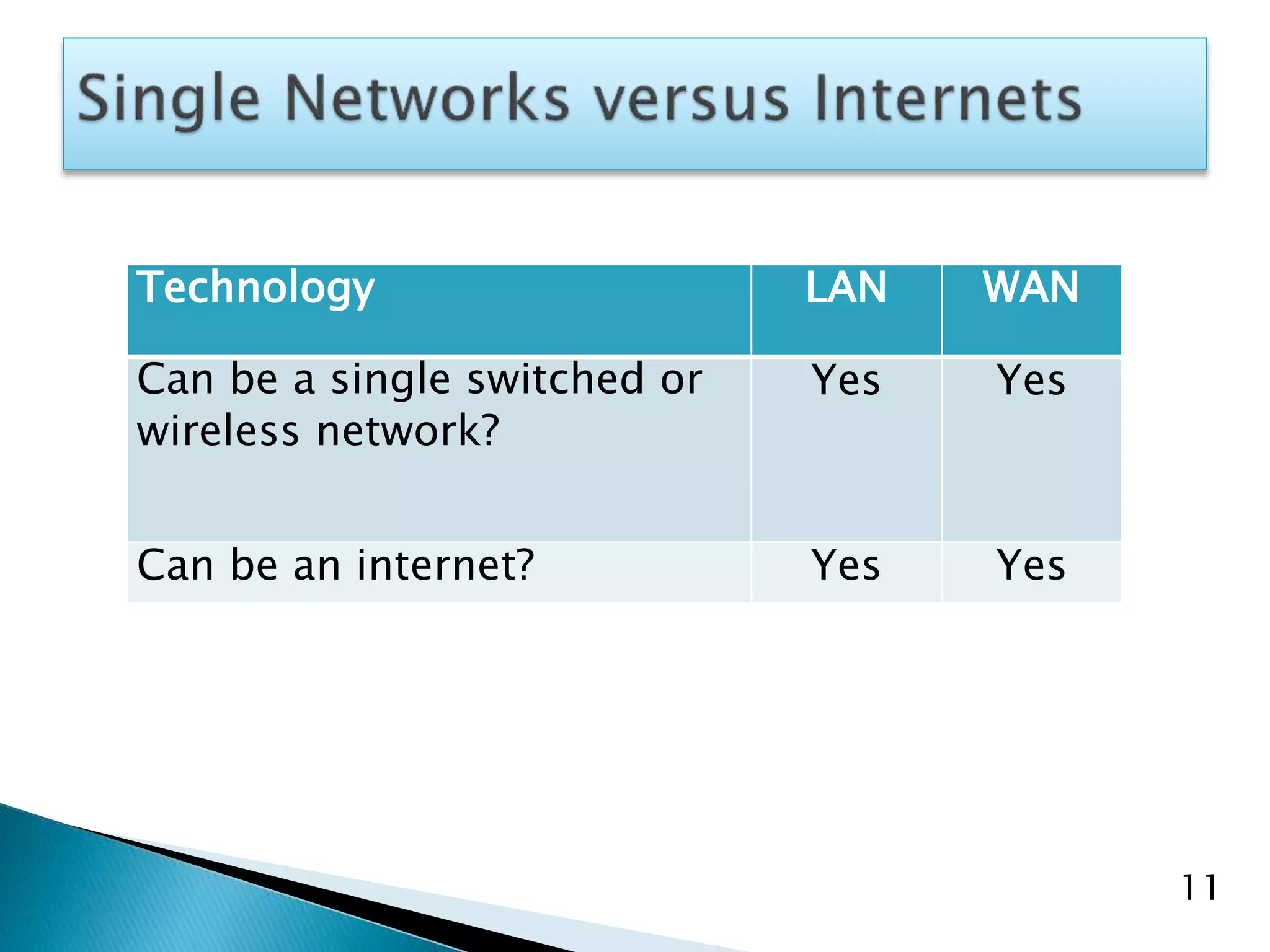
Technology LAN WAN
Can be a single switched or
wireless network?
Yes Yes
Can be an internet? Yes Yes
11
12
 Metropolitan Area Ethernet
◦ Metropolitan area network (MAN): city & environs
◦ Smaller distances than national or international
WANs, so lower prices and higher speeds
◦ Speeds of 1 Mbps to 100 Mbps
◦ Little learning is needed because all firms are
familiar with Ethernet
◦ Carrier can provision or re-provision service
speed rapidly, giving flexibility
◦ The only PSDN service growing rapidly
13
 To connect different sites within an
organization
14
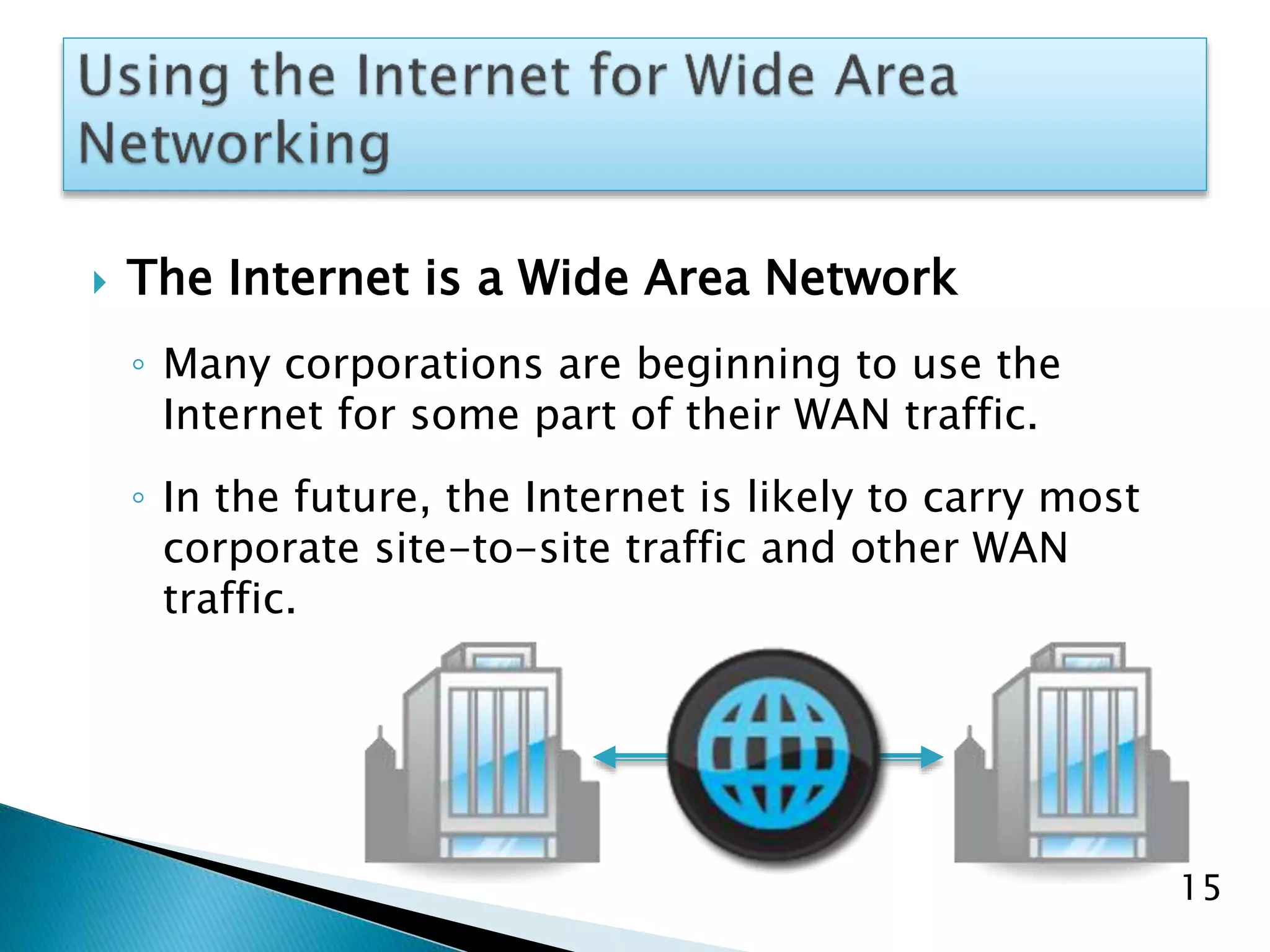
 The Internet is a Wide Area Network
◦ Many corporations are beginning to use the
Internet for some part of their WAN traffic.
◦ In the future, the Internet is likely to carry most
corporate site-to-site traffic and other WAN
traffic.
15
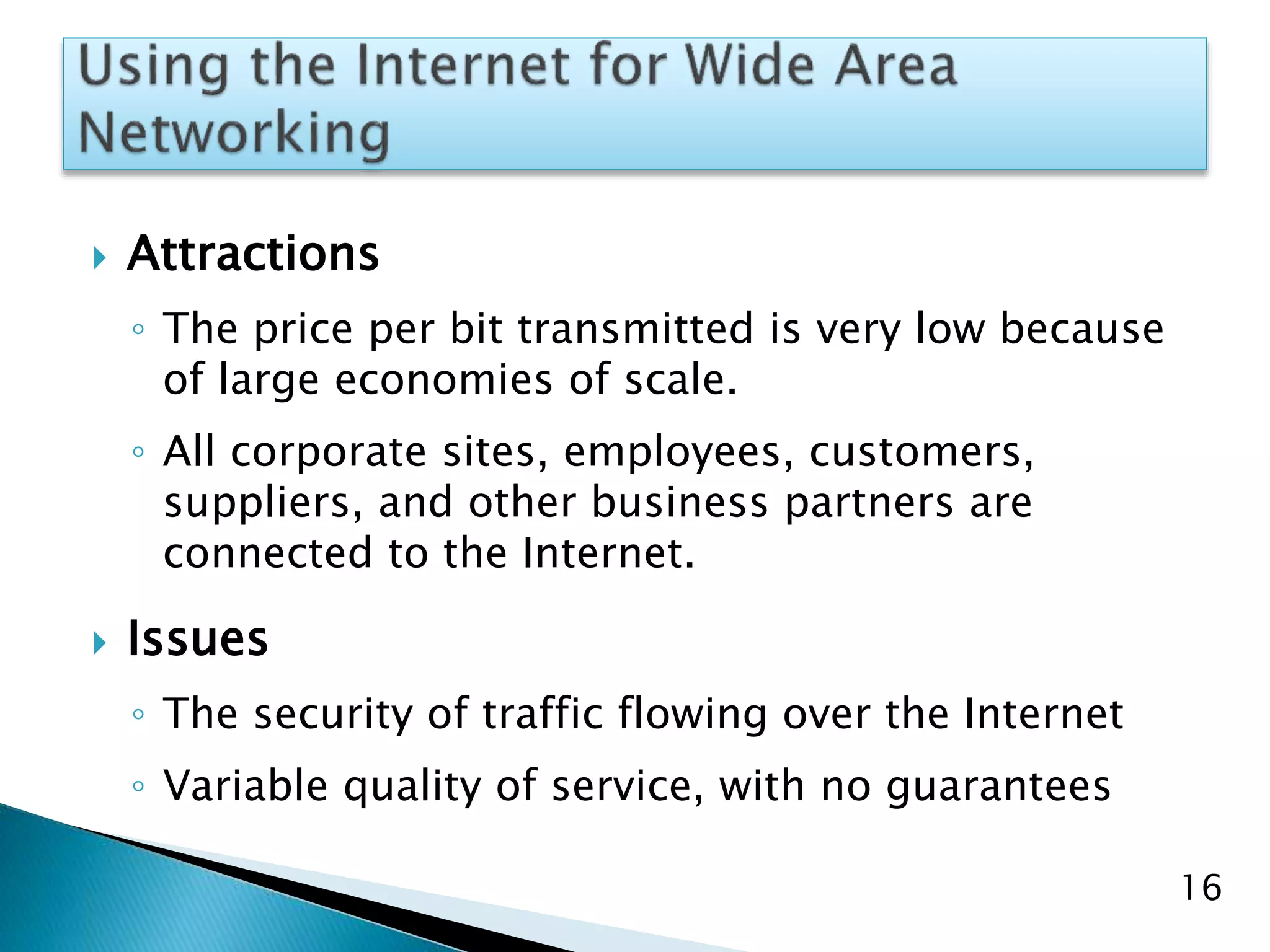
 Attractions
◦ The price per bit transmitted is very low because
of large economies of scale.
◦ All corporate sites, employees, customers,
suppliers, and other business partners are
connected to the Internet.
 Issues
◦ The security of traffic flowing over the Internet
◦ Variable quality of service, with no guarantees
16
 Border firewall at each site
 Virtual private networks
◦ IPsec encryption for sensitive information
◦ SSL/TLS for less sensitive information
 Antivirus filtering
17
18
If all sites connect
to a single ISP, the
ISP can provide QoS
guarantees.
 Most companies have multiple WAN
technology components
◦ Leased line networks
◦ PSDNs of different types
◦ Internet transmission
◦ Cellular transmission
◦ Different access link technologies
19
 Traditionally, each component has been
managed separately.
◦ However, traffic between hosts often passes
through multiple components.
◦ This makes it difficult to manage overall
performance and efficiency.
20
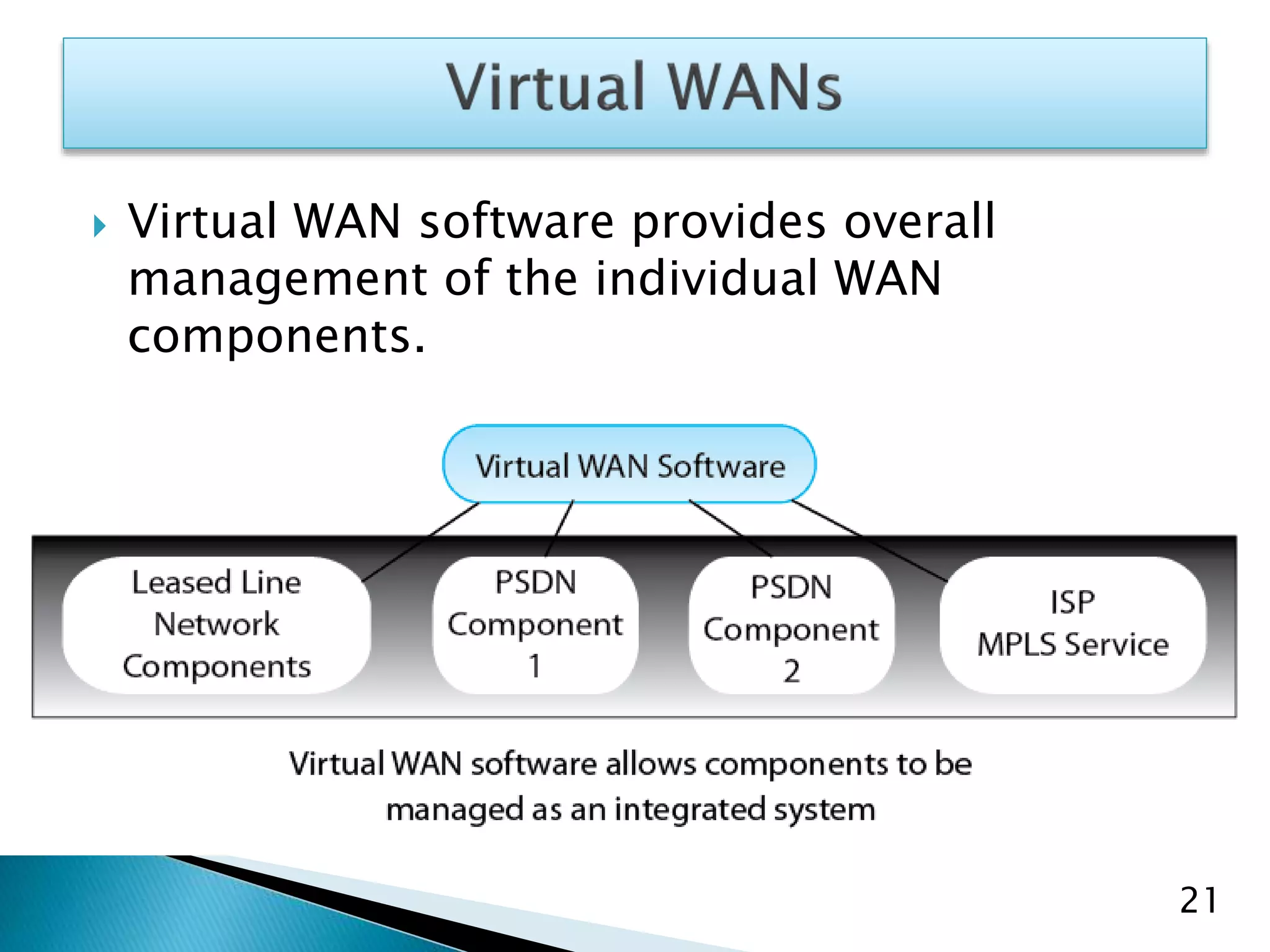
 Virtual WAN software provides overall
management of the individual WAN
components.
21
 Virtual WAN software provides overall
management of the individual WAN
components.
◦ Allows the overall management of performance
and efficiency.
◦ Individual components can be added, dropped, or
changed easily as technology changes.
◦ It may be possible to simulate the effects of
changes before implementation.
22
23

Wide area network (wan)

  • 2.
     A LocalArea Network (LAN) can span a single building or campus,  A Metropolitan Area Network (MAN) can span a single city,  A Wide Area Network (WAN) can span sites in multiple cities, countries, continents.  1957 ARPA(Advanced Research Projects Agency) project starts as a military research for satellite communications, and in 1972 first public demonstration of ARPANET introduces networks into our lives. Of many competing systems created at this time, Ethernet and ARCNET were the most popular. Local area network technologies have become the most popular form of computer networks. LANs now connect more computers than any other type of network.  The fundamental difference between a WAN and a LAN is the scalability, WANs can be able to connect as many computers and networks as possible.  The most popular example of WAN is the internet.  A WAN is constructed from many switches to which individual computers connect. Additional switches can be added as needed to connect additional sites or additional computers. 2
  • 3.
    3  In the1960’s there was great concern that a nuclear strike would render all traditional communications useless.  As a result, the US Department of Defense funded the ARPAnet in the development of a decentralized, resilient, and self- configuring communications network.
  • 4.
    4 The first ARPANETlinks were between UCLA and the Stanford Research Institute in November 1969. A month later links to the University of Utah and the UC Santa Barbara were added. Len Kleinrock standing next to the first Inter Message Processor (IMP) at UCLA
  • 5.
    5 After widespread commercialization ofthe Internet in the 1980’s, Internet use grew and continues to grow at an exponential rate.
  • 6.
    6  The basicelectronic switch used in WAN is called a packet switch because it moves a complete packets from one connection to another.  WANs are often built using leased lines. At each end of the leased line, a router connects to the LAN on one side and a hub within the WAN on the other.  Leased lines can be very expensive. Instead of using leased lines, WANs can also be built using less costly circuit switching or packet switching methods. SWITCHES IN WANs
  • 7.
     Local AreaNetworks (LANs) ◦ On the customer premises  Wide Area Networks (WANs) ◦ Connect sites across a region, country, the world  Metropolitan Area Networks (MANs) ◦ Connect sites in a single metropolitan area (a city and its suburbs) ◦ A type of WAN 7
  • 8.
    LAN MAN WAN SitesWithin Between Between Implementation Self Carrier Carrier Ability to choose technology High Low Low Who does the work of operating the network? Self Carrier Carrier 8
  • 9.
    LAN MAN WAN PriceHighly related to cost Highly unpre- dictable Highly unpre- dictable Cost per bit transmitted Low Medium High Therefore, typical speed 100 Mbps to 1 Gbps or more 10 to 100 Mbps 1 to 50 Mbps 9
  • 10.
    LAN MAN WAN Canuse switched technology? Yes Yes Yes Can use routed technology? Yes Yes Yes 10
  • 11.
    Technology LAN WAN Canbe a single switched or wireless network? Yes Yes Can be an internet? Yes Yes 11
  • 12.
  • 13.
     Metropolitan AreaEthernet ◦ Metropolitan area network (MAN): city & environs ◦ Smaller distances than national or international WANs, so lower prices and higher speeds ◦ Speeds of 1 Mbps to 100 Mbps ◦ Little learning is needed because all firms are familiar with Ethernet ◦ Carrier can provision or re-provision service speed rapidly, giving flexibility ◦ The only PSDN service growing rapidly 13
  • 14.
     To connectdifferent sites within an organization 14
  • 15.
     The Internetis a Wide Area Network ◦ Many corporations are beginning to use the Internet for some part of their WAN traffic. ◦ In the future, the Internet is likely to carry most corporate site-to-site traffic and other WAN traffic. 15
  • 16.
     Attractions ◦ Theprice per bit transmitted is very low because of large economies of scale. ◦ All corporate sites, employees, customers, suppliers, and other business partners are connected to the Internet.  Issues ◦ The security of traffic flowing over the Internet ◦ Variable quality of service, with no guarantees 16
  • 17.
     Border firewallat each site  Virtual private networks ◦ IPsec encryption for sensitive information ◦ SSL/TLS for less sensitive information  Antivirus filtering 17
  • 18.
    18 If all sitesconnect to a single ISP, the ISP can provide QoS guarantees.
  • 19.
     Most companieshave multiple WAN technology components ◦ Leased line networks ◦ PSDNs of different types ◦ Internet transmission ◦ Cellular transmission ◦ Different access link technologies 19
  • 20.
     Traditionally, eachcomponent has been managed separately. ◦ However, traffic between hosts often passes through multiple components. ◦ This makes it difficult to manage overall performance and efficiency. 20
  • 21.
     Virtual WANsoftware provides overall management of the individual WAN components. 21
  • 22.
     Virtual WANsoftware provides overall management of the individual WAN components. ◦ Allows the overall management of performance and efficiency. ◦ Individual components can be added, dropped, or changed easily as technology changes. ◦ It may be possible to simulate the effects of changes before implementation. 22
  • 23.