HexA in Pulping and
Bleaching
FWT - KU
Presentation Outline
 Hexenuronic Acid (HexA)
 Properties of Hexenuronic Acids
 Chemical reactivity of Hexenuronic Acids
 Effects of HexA in pulping
 Removal of HexA
 Effects of HexA Removal on Pulp Yield
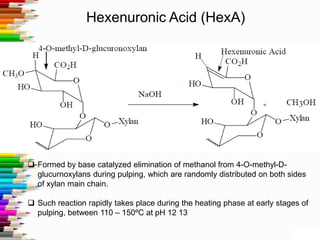
Hexenuronic Acid (HexA)
 Formed by base catalyzed elimination of methanol from 4-O-methyl-D-
glucurnoxylans during pulping, which are randomly distributed on both sides
of xylan main chain.
 Such reaction rapidly takes place during the heating phase at early stages of
pulping, between 110 – 150ºC at pH 12 13
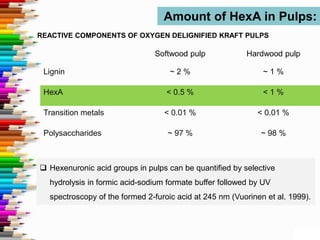
Amount of HexA in Pulps:
REACTIVE COMPONENTS OF OXYGEN DELIGNIFIED KRAFT PULPS
Softwood pulp Hardwood pulp
Lignin ~ 2 % ~ 1 %
HexA < 0.5 % < 1 %
Transition metals < 0.01 % < 0.01 %
Polysaccharides ~ 97 % ~ 98 %
 Hexenuronic acid groups in pulps can be quantified by selective
hydrolysis in formic acid-sodium formate buffer followed by UV
spectroscopy of the formed 2-furoic acid at 245 nm (Vuorinen et al. 1999).
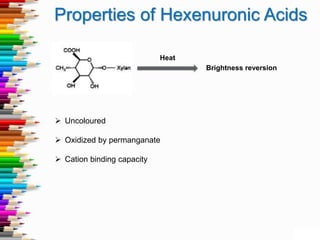
Properties of Hexenuronic Acids
Heat
Brightness reversion
 Uncoloured
 Oxidized by permanganate
 Cation binding capacity
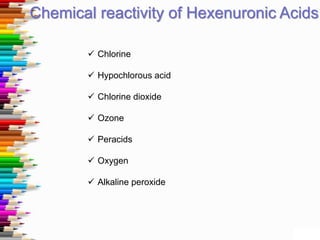
Chemical reactivity of Hexenuronic Acids
 Chlorine
 Hypochlorous acid
 Chlorine dioxide
 Ozone
 Peracids
 Oxygen
 Alkaline peroxide
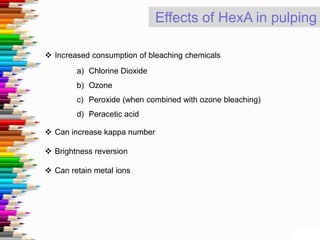
Effects of HexA in pulping
 Increased consumption of bleaching chemicals
a) Chlorine Dioxide
b) Ozone
c) Peroxide (when combined with ozone bleaching)
d) Peracetic acid
 Can increase kappa number
 Brightness reversion
 Can retain metal ions
Removal of HexA
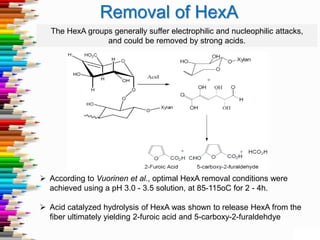
The HexA groups generally suffer electrophilic and nucleophilic attacks,
and could be removed by strong acids.
 According to Vuorinen et al., optimal HexA removal conditions were
achieved using a pH 3.0 - 3.5 solution, at 85-115oC for 2 - 4h.
 Acid catalyzed hydrolysis of HexA was shown to release HexA from the
fiber ultimately yielding 2-furoic acid and 5-carboxy-2-furaldehdye
Removal of HexA
 Peroximonosulphuric acid (Ps) is a low cost and selective agents for
HexA removal.
 Ps is a peracid derived from hydrogen peroxide when a hydrogen atom
is replaced by a SO3H group.
 In Elemental Chlorine-Free (ECF) bleaching of kraft pulp, an acid
hydrolysis stage prior to final stage could lead to a 50% reduction in
bleaching costs.
 The elimination of HexA in kraft pulps is also beneficial to Totally
Chlorine Free (TCF) pulp bleaching operations and allowed for higher
brightness values to be achieved.
Effects of HexA Removal on Pulp Yield
 The effect of the hot acid treatment on pulp yields remains an issue of
extreme concern.
 Early research activities had noted that experimental yields for treating
kraft pulps with formic acid/sodium formate buffer (pH 3) at 100oC were
usually in the range 98 – 98.6% (Ragauskas et al.).
HexA in pulping and bleaching

HexA in pulping and bleaching

  • 1.
    HexA in Pulpingand Bleaching FWT - KU
  • 2.
    Presentation Outline  HexenuronicAcid (HexA)  Properties of Hexenuronic Acids  Chemical reactivity of Hexenuronic Acids  Effects of HexA in pulping  Removal of HexA  Effects of HexA Removal on Pulp Yield
  • 3.
    Hexenuronic Acid (HexA) Formed by base catalyzed elimination of methanol from 4-O-methyl-D- glucurnoxylans during pulping, which are randomly distributed on both sides of xylan main chain.  Such reaction rapidly takes place during the heating phase at early stages of pulping, between 110 – 150ºC at pH 12 13
  • 4.
    Amount of HexAin Pulps: REACTIVE COMPONENTS OF OXYGEN DELIGNIFIED KRAFT PULPS Softwood pulp Hardwood pulp Lignin ~ 2 % ~ 1 % HexA < 0.5 % < 1 % Transition metals < 0.01 % < 0.01 % Polysaccharides ~ 97 % ~ 98 %  Hexenuronic acid groups in pulps can be quantified by selective hydrolysis in formic acid-sodium formate buffer followed by UV spectroscopy of the formed 2-furoic acid at 245 nm (Vuorinen et al. 1999).
  • 5.
    Properties of HexenuronicAcids Heat Brightness reversion  Uncoloured  Oxidized by permanganate  Cation binding capacity
  • 6.
    Chemical reactivity ofHexenuronic Acids  Chlorine  Hypochlorous acid  Chlorine dioxide  Ozone  Peracids  Oxygen  Alkaline peroxide
  • 7.
    Effects of HexAin pulping  Increased consumption of bleaching chemicals a) Chlorine Dioxide b) Ozone c) Peroxide (when combined with ozone bleaching) d) Peracetic acid  Can increase kappa number  Brightness reversion  Can retain metal ions
  • 8.
    Removal of HexA TheHexA groups generally suffer electrophilic and nucleophilic attacks, and could be removed by strong acids.  According to Vuorinen et al., optimal HexA removal conditions were achieved using a pH 3.0 - 3.5 solution, at 85-115oC for 2 - 4h.  Acid catalyzed hydrolysis of HexA was shown to release HexA from the fiber ultimately yielding 2-furoic acid and 5-carboxy-2-furaldehdye
  • 9.
    Removal of HexA Peroximonosulphuric acid (Ps) is a low cost and selective agents for HexA removal.  Ps is a peracid derived from hydrogen peroxide when a hydrogen atom is replaced by a SO3H group.  In Elemental Chlorine-Free (ECF) bleaching of kraft pulp, an acid hydrolysis stage prior to final stage could lead to a 50% reduction in bleaching costs.  The elimination of HexA in kraft pulps is also beneficial to Totally Chlorine Free (TCF) pulp bleaching operations and allowed for higher brightness values to be achieved.
  • 10.
    Effects of HexARemoval on Pulp Yield  The effect of the hot acid treatment on pulp yields remains an issue of extreme concern.  Early research activities had noted that experimental yields for treating kraft pulps with formic acid/sodium formate buffer (pH 3) at 100oC were usually in the range 98 – 98.6% (Ragauskas et al.).