Wi-Fi
Technology
 BY DILIP BHARDWAJ
Wi-Fi ?
The term Wi-Fi suggests Wireless Fidelity, resembling
the long-established audio-equipment classification
term high fidelity (in use since the 1930s) or Hi-Fi (used
since 1950)

The term Wi-Fi, first used commercially in August 1999,was
coined by a brand-consulting firm called Interbrand Corporation
that the Alliance had hired to determine a name that was "a
little catchier than Direct Sequence'".
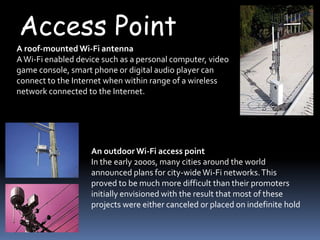
Access Point
A roof-mounted Wi-Fi antenna
A Wi-Fi enabled device such as a personal computer, video
game console, smart phone or digital audio player can
connect to the Internet when within range of a wireless
network connected to the Internet.


                    An outdoor Wi-Fi access point
                    In the early 2000s, many cities around the world
                    announced plans for city-wide Wi-Fi networks. This
                    proved to be much more difficult than their promoters
                    initially envisioned with the result that most of these
                    projects were either canceled or placed on indefinite hold
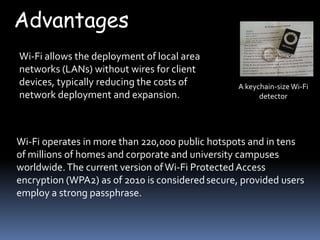
Advantages
Wi-Fi allows the deployment of local area
networks (LANs) without wires for client
devices, typically reducing the costs of          A keychain-size Wi-Fi
network deployment and expansion.                       detector


Wi-Fi operates in more than 220,000 public hotspots and in tens
of millions of homes and corporate and university campuses
worldwide. The current version of Wi-Fi Protected Access
encryption (WPA2) as of 2010 is considered secure, provided users
employ a strong passphrase.
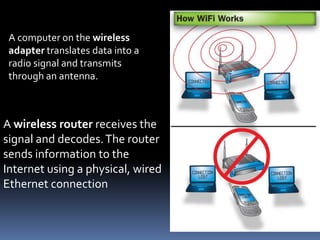
A computer on the wireless
 adapter translates data into a
 radio signal and transmits
 through an antenna.


A wireless router receives the
signal and decodes. The router
sends information to the
Internet using a physical, wired
Ethernet connection
Limitations

Wi-Fi networks have limited range. A typical wireless router using 802.11b or
802.11g with a stock antenna might have a range of 32 m (120 ft) indoors and
95 m (300 ft) outdoors.


The most common wireless encryption-standard, Wired Equivalent Privacy
(WEP), has been shown to be easily breakable even when correctly configured.
Wi-Fi Protected Access (WPA and WPA2) encryption, which became available in
devices in 2003, aimed to solve this problem.
Hardware


An embedded Router Board 112 with U.FL-RSMA pigtail
and R52 mini PCI Wi-Fi card widely used by wireless
Internet service providers
                                                      USB wireless
                                                        adapter


OSBRiDGE 3GN - 802.11n Access Point
and UMTS/GSM Gateway in one device
Home Networking

If you have multiple computers networked in your home, you can
create a wireless network with a wireless access point. If you have
multiple computers that are not networked, or if you want to
replace your Ethernet network, you need a wireless router. It is a
single unit that contains:
1. A port to connect to your cable modem
2. A router
3. An Ethernet hub
4. A firewall
5. A wireless access point

Wi Fi Technology

  • 1.
  • 2.
    Wi-Fi ? The termWi-Fi suggests Wireless Fidelity, resembling the long-established audio-equipment classification term high fidelity (in use since the 1930s) or Hi-Fi (used since 1950) The term Wi-Fi, first used commercially in August 1999,was coined by a brand-consulting firm called Interbrand Corporation that the Alliance had hired to determine a name that was "a little catchier than Direct Sequence'".
  • 3.
    Access Point A roof-mountedWi-Fi antenna A Wi-Fi enabled device such as a personal computer, video game console, smart phone or digital audio player can connect to the Internet when within range of a wireless network connected to the Internet. An outdoor Wi-Fi access point In the early 2000s, many cities around the world announced plans for city-wide Wi-Fi networks. This proved to be much more difficult than their promoters initially envisioned with the result that most of these projects were either canceled or placed on indefinite hold
  • 4.
    Advantages Wi-Fi allows thedeployment of local area networks (LANs) without wires for client devices, typically reducing the costs of A keychain-size Wi-Fi network deployment and expansion. detector Wi-Fi operates in more than 220,000 public hotspots and in tens of millions of homes and corporate and university campuses worldwide. The current version of Wi-Fi Protected Access encryption (WPA2) as of 2010 is considered secure, provided users employ a strong passphrase.
  • 5.
    A computer onthe wireless adapter translates data into a radio signal and transmits through an antenna. A wireless router receives the signal and decodes. The router sends information to the Internet using a physical, wired Ethernet connection
  • 6.
    Limitations Wi-Fi networks havelimited range. A typical wireless router using 802.11b or 802.11g with a stock antenna might have a range of 32 m (120 ft) indoors and 95 m (300 ft) outdoors. The most common wireless encryption-standard, Wired Equivalent Privacy (WEP), has been shown to be easily breakable even when correctly configured. Wi-Fi Protected Access (WPA and WPA2) encryption, which became available in devices in 2003, aimed to solve this problem.
  • 7.
    Hardware An embedded RouterBoard 112 with U.FL-RSMA pigtail and R52 mini PCI Wi-Fi card widely used by wireless Internet service providers USB wireless adapter OSBRiDGE 3GN - 802.11n Access Point and UMTS/GSM Gateway in one device
  • 8.
    Home Networking If youhave multiple computers networked in your home, you can create a wireless network with a wireless access point. If you have multiple computers that are not networked, or if you want to replace your Ethernet network, you need a wireless router. It is a single unit that contains: 1. A port to connect to your cable modem 2. A router 3. An Ethernet hub 4. A firewall 5. A wireless access point