Presented by:
Anil Pokhrel
BscCSIT 5th
sem
1
Contents

Introduction

Need of Wi-Fi Technology

Purpose

Element of wifi network

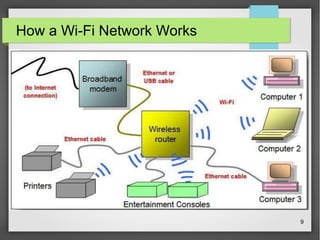
How a Wi-Fi Network Works

Topologies & Configurations

Applications

Wi-Fi Security

Advantages & Limitations

Innovations

Conclusion
2
Introduction

Wireless Technology is an alternative to Wired
Technology, which is commonly used, for connecting
devices in wireless mode.

Wi-Fi is a generic term that refers to the IEEE 802.11
communications standard for Wireless Local Area
Networks (WLANs).

Wi-Fi Network connect computers to each other, to the
internet and to the wired network.
3
Need of Wi-Fi Technology

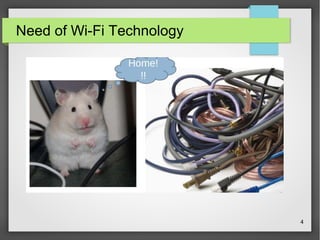
Rat’s Nest Of Wires
4

Cables for Keyboard, Mouse, Power, etc.
5
Freedom from wires!!
6
Purpose

The purpose of Wi-Fi is to hide complexity by enabling
wireless access to applications and data, media and
streams.

The main aims of Wi-Fi are:
i. make access to information easier
ii. eliminate complex cabling
iii. eliminate switches, adapters, plugs, pins and connectors
7
Elements of a WI-FI Network

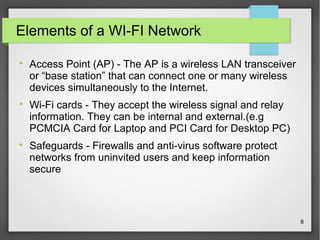
Access Point (AP) - The AP is a wireless LAN transceiver
or “base station” that can connect one or many wireless
devices simultaneously to the Internet.

Wi-Fi cards - They accept the wireless signal and relay
information. They can be internal and external.(e.g
PCMCIA Card for Laptop and PCI Card for Desktop PC)

Safeguards - Firewalls and anti-virus software protect
networks from uninvited users and keep information
secure
8
How a Wi-Fi Network Works
9
Topologies & Configurations
10
Peer-to-Peer topology
11
Point to Multipoint bridge Topology
12
Wi-Fi Configurations
Wi-Fi is composed of three main sectors:
I. Home (individual residences and apartment buildings)
II. Public (Round about 70,000 “hotspots” through out the
world)
III.Enterprise (corporations, universities, office parks)
13
Applications
14
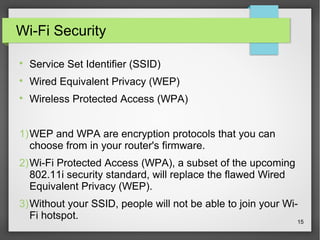
Wi-Fi Security

Service Set Identifier (SSID)

Wired Equivalent Privacy (WEP)

Wireless Protected Access (WPA)
1)WEP and WPA are encryption protocols that you can
choose from in your router's firmware.
2)Wi-Fi Protected Access (WPA), a subset of the upcoming
802.11i security standard, will replace the flawed Wired
Equivalent Privacy (WEP).
3)Without your SSID, people will not be able to join your Wi-
Fi hotspot. 15
Advantages
Mobility
productivity
expandability
Cost
Security
16
Limitations

security

Limited range

High power consumption

Speed
17
Innovations…..
18
WiFi Phone

A Wi-Fi phone is a
wireless device that gives
you the dual benefits of
wireless connectivity and
the cost savings of VoIP.
From this angle, Wi-Fi
phone looks like the next
big thing in the telecom
revolution.
19
Wi-Fi Camera
20
Conclusion

Wifi is the simple, cost-effective way to connect to the
internet, without the need of physically connecting wires

Security is the huge challenge for Wifi network

It is growing in popularity because of decreasing cost and
the freedom it gives to the users

Almost every device used these days are compatible to
wifi
21
References

https://www.google.com/search?
client=ubuntu&channel=fs&q=wifi+technology+conclusio+
&ie=utf-8&oe=utf-8ss

https://computer.howstuffworks.com/wireless-network.htm

https://www.lynda.com/Hardware-tutorials/Up-Running-
Wireless-Networking/191089-2.html
22
Thank
You 23

Computer network wifi