Literacy
Strategies At The
Core Of Content
Mindi Rench, Literacy Coach, Northbrook Junior High
mrench@northbrook28.net Find me on Twitter @mindi_r
Pam Mendelson, 7th Grade Science, Northbrook Junior High
pmendelson@northbrook28.net

http://slideshare.net/mindi_r

1

Thursday, October 31, 13
Strategy #1: Get them
talking!
S & L 1: Prepare for and participate effectively in a range of conversations and collaborations with diverse partners, building on
others’ ideas and expressing their own clearly and persuasively.

Giving students time to talk collaboratively provides important
opportunity for rehearsal before writing or large-group discussions.
Human beings are social creatures who learn best through
conversation. Teens, especially, are social, and leveraging that need
increases engagement.
“Oral language is a cornerstone on which we build our literacy and
learning throughout life.” (Zwiers & Crawford, 2011)

2

Thursday, October 31, 13
Strategy 2: Close read
images
R 1: Read closely to determine what the text says explicitly and to make logical inferences from it; cite specific textual
evidence when writing or speaking to support conclusions drawn from the text.

Turn to p. 5 of your packet and get ready to write.

3

Thursday, October 31, 13
Strategy 3: The Written
Conversation
W 4: Produce clear and coherent writing in which the development, organization, and style are appropriate to task,
purpose, and audience.

Take a few minutes to read the text, “Oil Bloom” from Science
World, September 2, 2013.
Read with the following question in mind: “How might Sara’s
research change our future?”
On the notebook paper in your packet, write “Log In: Your Name” in
the left hand margin. Then write your thinking about the question.

10

Thursday, October 31, 13
Trade with a partner. Read your partner’s thinking and
then write a response. Be sure to “log in” in the margin
before you start writing.
Trade as directed until activity comes to an end.

11

Thursday, October 31, 13
Strategy 4: Read-ShareCompare
R1: Reading closely to determine what the text says explicitly and to make logical inferences from it; cite specific textual
evidence when writing or speaking to support conclusions drawn from the text.
R9: Analyze how two or more texts address similar themes or topics and build knowledge or compare the approaches
authors take.
S & L4: Present information, findings and supporting evidence such that listeners can follow the line of reasoning and the
organization, development, and style are appropriate to task, purpose, and audience.

Turn and talk with a neighbor about cloning. What do you know or
think you know about cloning?

12

Thursday, October 31, 13
The articles you are about to read deal with cloning pets. What
do you think an article like this would probably include? What
questions about dog or cat cloning would you want to answer?
Find the articles in your packet. Decide with your partner
which of you will read “Koreans Produce World’s First Cloned
Dog” and which will read “Scientists Successfully Clone Cat”
Read your article and annotate your text with our questions in
mind.
When you’ve finished, talk with your partner about your text.
Share your learning. Answer each other’s questions. Go back
into the text to support your discussion.
13

Thursday, October 31, 13
Strategy 5:

Listen, Sketch,
Draft

R2: Determine central ideas or themes of a text and analyze their development; summarize the key supporting details and
ideas.

Listen, Sketch, Draft is one way to improve students’ listening
comprehension. They must listen to a text read aloud without the
benefit of illustrations or pictures to help them.
Students must focus on visualization and thinking about key ideas
and themes in order to know what to sketch and summarize.
Turn and talks built in allow all students to share and perhaps
revise their thinking.

14

Thursday, October 31, 13
Wrap It Up
Turn and Talk: What are you thinking now? What can you take and
use in your classroom?
What questions do you have for us?

15

Thursday, October 31, 13
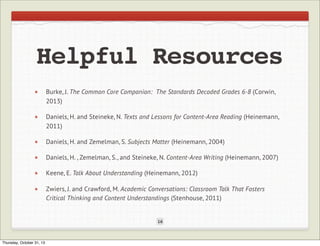
Helpful Resources
Burke, J. The Common Core Companion: The Standards Decoded Grades 6-8 (Corwin,
2013)
Daniels, H. and Steineke, N. Texts and Lessons for Content-Area Reading (Heinemann,
2011)
Daniels, H. and Zemelman, S. Subjects Matter (Heinemann, 2004)
Daniels, H. , Zemelman, S., and Steineke, N. Content-Area Writing (Heinemann, 2007)
Keene, E. Talk About Understanding (Heinemann, 2012)
Zwiers, J. and Crawford, M. Academic Conversations: Classroom Talk That Fosters
Critical Thinking and Content Understandings (Stenhouse, 2011)

16

Thursday, October 31, 13

Literacystrategiesatthecoreofcontent

  • 1.
    Literacy Strategies At The CoreOf Content Mindi Rench, Literacy Coach, Northbrook Junior High mrench@northbrook28.net Find me on Twitter @mindi_r Pam Mendelson, 7th Grade Science, Northbrook Junior High pmendelson@northbrook28.net http://slideshare.net/mindi_r 1 Thursday, October 31, 13
  • 2.
    Strategy #1: Getthem talking! S & L 1: Prepare for and participate effectively in a range of conversations and collaborations with diverse partners, building on others’ ideas and expressing their own clearly and persuasively. Giving students time to talk collaboratively provides important opportunity for rehearsal before writing or large-group discussions. Human beings are social creatures who learn best through conversation. Teens, especially, are social, and leveraging that need increases engagement. “Oral language is a cornerstone on which we build our literacy and learning throughout life.” (Zwiers & Crawford, 2011) 2 Thursday, October 31, 13
  • 3.
    Strategy 2: Closeread images R 1: Read closely to determine what the text says explicitly and to make logical inferences from it; cite specific textual evidence when writing or speaking to support conclusions drawn from the text. Turn to p. 5 of your packet and get ready to write. 3 Thursday, October 31, 13
  • 4.
  • 5.
  • 6.
  • 7.
  • 8.
  • 9.
  • 10.
    Strategy 3: TheWritten Conversation W 4: Produce clear and coherent writing in which the development, organization, and style are appropriate to task, purpose, and audience. Take a few minutes to read the text, “Oil Bloom” from Science World, September 2, 2013. Read with the following question in mind: “How might Sara’s research change our future?” On the notebook paper in your packet, write “Log In: Your Name” in the left hand margin. Then write your thinking about the question. 10 Thursday, October 31, 13
  • 11.
    Trade with apartner. Read your partner’s thinking and then write a response. Be sure to “log in” in the margin before you start writing. Trade as directed until activity comes to an end. 11 Thursday, October 31, 13
  • 12.
    Strategy 4: Read-ShareCompare R1:Reading closely to determine what the text says explicitly and to make logical inferences from it; cite specific textual evidence when writing or speaking to support conclusions drawn from the text. R9: Analyze how two or more texts address similar themes or topics and build knowledge or compare the approaches authors take. S & L4: Present information, findings and supporting evidence such that listeners can follow the line of reasoning and the organization, development, and style are appropriate to task, purpose, and audience. Turn and talk with a neighbor about cloning. What do you know or think you know about cloning? 12 Thursday, October 31, 13
  • 13.
    The articles youare about to read deal with cloning pets. What do you think an article like this would probably include? What questions about dog or cat cloning would you want to answer? Find the articles in your packet. Decide with your partner which of you will read “Koreans Produce World’s First Cloned Dog” and which will read “Scientists Successfully Clone Cat” Read your article and annotate your text with our questions in mind. When you’ve finished, talk with your partner about your text. Share your learning. Answer each other’s questions. Go back into the text to support your discussion. 13 Thursday, October 31, 13
  • 14.
    Strategy 5: Listen, Sketch, Draft R2:Determine central ideas or themes of a text and analyze their development; summarize the key supporting details and ideas. Listen, Sketch, Draft is one way to improve students’ listening comprehension. They must listen to a text read aloud without the benefit of illustrations or pictures to help them. Students must focus on visualization and thinking about key ideas and themes in order to know what to sketch and summarize. Turn and talks built in allow all students to share and perhaps revise their thinking. 14 Thursday, October 31, 13
  • 15.
    Wrap It Up Turnand Talk: What are you thinking now? What can you take and use in your classroom? What questions do you have for us? 15 Thursday, October 31, 13
  • 16.
    Helpful Resources Burke, J.The Common Core Companion: The Standards Decoded Grades 6-8 (Corwin, 2013) Daniels, H. and Steineke, N. Texts and Lessons for Content-Area Reading (Heinemann, 2011) Daniels, H. and Zemelman, S. Subjects Matter (Heinemann, 2004) Daniels, H. , Zemelman, S., and Steineke, N. Content-Area Writing (Heinemann, 2007) Keene, E. Talk About Understanding (Heinemann, 2012) Zwiers, J. and Crawford, M. Academic Conversations: Classroom Talk That Fosters Critical Thinking and Content Understandings (Stenhouse, 2011) 16 Thursday, October 31, 13