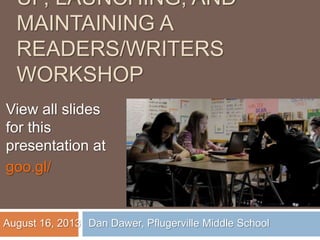
SETTING UP, LAUNCHING,
AND MAINTAINING A
READERS/WRITERS
WORKSHOP
August 16, 2013
View all slides
for this
presentation at
goo.gl/aNCkzq
Dan Dawer, Pflugerville Middle School
Outcomes
In this session, participants will:
• Understand how the Reading/Writing
Workshop structure can help students
become better readers and writers.
• Examine some of the materials,
procedures, and strategies essential to
the Workshop structure.
Agenda (session 1)
Personal Reflection 8:30 – 8:45
Presentation 8:45 – 9:25
Discussion #1 9:25 – 9:40
Discussion #2 9:40 – 9:55
Creative Task 9:55 – 10:00
Agenda (session 2)
Personal Reflection 10:15 – 10:30
Presentation 10:30 – 11:10
Discussion #1 11:10 – 11:25
Discussion #2 11:25 – 11:40
Creative Task 11:40 – 11:45
Personal Reflection
Topic 1
What overarching goals
do you have for student
readers in your
classes?
What class structures,
activities, or
instructional strategies
enable you and your
students to achieve
Topic 2
What overarching goals
do you have for student
writers in your classes?
What class structures,
activities, or
instructional strategies
enable you and your
students to achieve
those goals? Why?
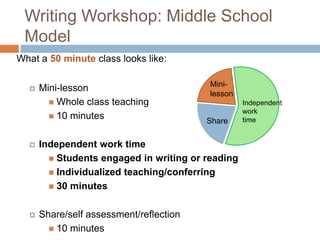
Writing Workshop: Middle School
Model
What a 50 minute class looks like:
 Mini-lesson
 Whole class teaching
 10 minutes
 Independent work time
 Students engaged in writing or reading
 Individualized teaching/conferring
 30 minutes
 Share/self assessment/reflection
 10 minutes
Mini-
lesson
Independent
work
timeShare
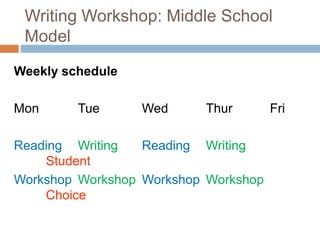
Writing Workshop: Middle School
Model
Weekly schedule
Mon Tue Wed Thur Fri
Reading Writing Reading Writing
Student
Workshop Workshop Workshop Workshop
Choice
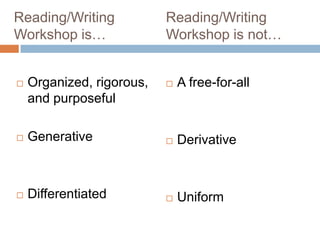
Reading/Writing
Workshop is…
 Organized, rigorous,
and purposeful
 Generative
 Differentiated
Reading/Writing
Workshop is not…
 A free-for-all
 Derivative
 Uniform
Video
http://www.youtube.com/watch?v=l0cejtxxoNo
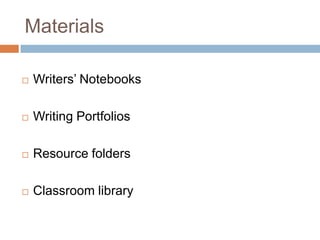
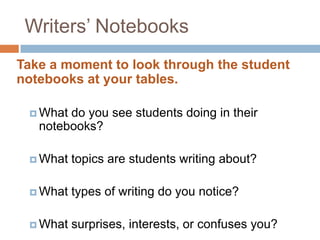
Writers’ Notebooks
Take a moment to look through the student
notebooks at your tables.
 What do you see students doing in their
notebooks?
 What topics are students writing about?
 What types of writing do you notice?
 What surprises, interests, or confuses you?
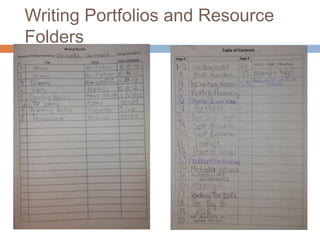
Writing Portfolios and Resource
Folders
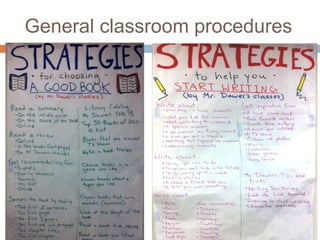
General classroom procedures
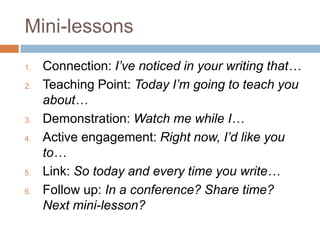
Mini-lessons
1. Connection: I’ve noticed in your writing that…
2. Teaching Point: Today I’m going to teach you
about…
3. Demonstration: Watch me while I…
4. Active engagement: Right now, I’d like you
to…
5. Link: So today and every time you write…
6. Follow up: In a conference? Share time?
Next mini-lesson?
Conferences
1. How is it going?
2. What is the student
working on?
3. What is the student
doing well?
4. What is one
teaching point I can
share with this
student?
1. What book are you
reading?
2. What page are you
on?
3. Tell me about your
book.
4. What is one
teaching point I can
share with this
student?
Share Time
 Partner share
 Small group
 Whole class
 Exit ticket
 Google forms: goo.gl/dl7hI
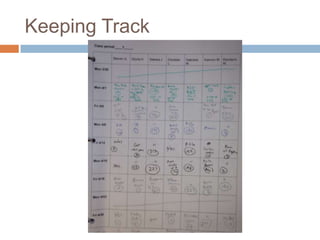
Keeping Track
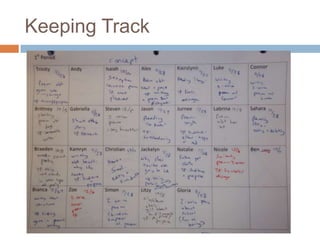
Keeping Track
Discussion #1
What overarching goals do you have for student
readers in your classes?
What class structures, activities, or instructional
strategies enable you and your students to
achieve those goals? Why?
How does the Reading Workshop fit in with your
current thinking about reading instruction?
Discussion #2
What overarching goals do you have for student
writers in your classes?
What class structures, activities, or instructional
strategies enable you and your students to
achieve those goals? Why?
How does the Writing Workshop fit in with your
current thinking about reading instruction?
Creative Task
What is one change you might make to improve
reading or writing instruction in your classroom?
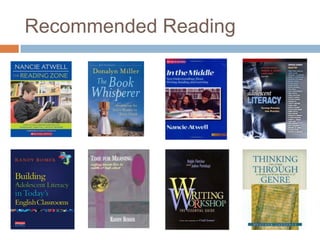
Recommended Reading

Readers writers workshop

  • 1.
    SETTING UP, LAUNCHING, ANDMAINTAINING A READERS/WRITERS WORKSHOP August 16, 2013 View all slides for this presentation at goo.gl/aNCkzq Dan Dawer, Pflugerville Middle School
  • 2.
    Outcomes In this session,participants will: • Understand how the Reading/Writing Workshop structure can help students become better readers and writers. • Examine some of the materials, procedures, and strategies essential to the Workshop structure.
  • 3.
    Agenda (session 1) PersonalReflection 8:30 – 8:45 Presentation 8:45 – 9:25 Discussion #1 9:25 – 9:40 Discussion #2 9:40 – 9:55 Creative Task 9:55 – 10:00
  • 4.
    Agenda (session 2) PersonalReflection 10:15 – 10:30 Presentation 10:30 – 11:10 Discussion #1 11:10 – 11:25 Discussion #2 11:25 – 11:40 Creative Task 11:40 – 11:45
  • 5.
    Personal Reflection Topic 1 Whatoverarching goals do you have for student readers in your classes? What class structures, activities, or instructional strategies enable you and your students to achieve Topic 2 What overarching goals do you have for student writers in your classes? What class structures, activities, or instructional strategies enable you and your students to achieve those goals? Why?
  • 6.
    Writing Workshop: MiddleSchool Model What a 50 minute class looks like:  Mini-lesson  Whole class teaching  10 minutes  Independent work time  Students engaged in writing or reading  Individualized teaching/conferring  30 minutes  Share/self assessment/reflection  10 minutes Mini- lesson Independent work timeShare
  • 7.
    Writing Workshop: MiddleSchool Model Weekly schedule Mon Tue Wed Thur Fri Reading Writing Reading Writing Student Workshop Workshop Workshop Workshop Choice
  • 8.
    Reading/Writing Workshop is…  Organized,rigorous, and purposeful  Generative  Differentiated Reading/Writing Workshop is not…  A free-for-all  Derivative  Uniform
  • 9.
  • 10.
    Writers’ Notebooks Take amoment to look through the student notebooks at your tables.  What do you see students doing in their notebooks?  What topics are students writing about?  What types of writing do you notice?  What surprises, interests, or confuses you?
  • 11.
    Writing Portfolios andResource Folders
  • 12.
  • 13.
    Mini-lessons 1. Connection: I’venoticed in your writing that… 2. Teaching Point: Today I’m going to teach you about… 3. Demonstration: Watch me while I… 4. Active engagement: Right now, I’d like you to… 5. Link: So today and every time you write… 6. Follow up: In a conference? Share time? Next mini-lesson?
  • 14.
    Conferences 1. How isit going? 2. What is the student working on? 3. What is the student doing well? 4. What is one teaching point I can share with this student? 1. What book are you reading? 2. What page are you on? 3. Tell me about your book. 4. What is one teaching point I can share with this student?
  • 15.
    Share Time  Partnershare  Small group  Whole class  Exit ticket  Google forms: goo.gl/dl7hI
  • 16.
  • 17.
  • 18.
    Discussion #1 What overarchinggoals do you have for student readers in your classes? What class structures, activities, or instructional strategies enable you and your students to achieve those goals? Why? How does the Reading Workshop fit in with your current thinking about reading instruction?
  • 19.
    Discussion #2 What overarchinggoals do you have for student writers in your classes? What class structures, activities, or instructional strategies enable you and your students to achieve those goals? Why? How does the Writing Workshop fit in with your current thinking about reading instruction?
  • 20.
    Creative Task What isone change you might make to improve reading or writing instruction in your classroom?
  • 21.