Facilitating Choice Within
 Curriculum Constraints
Jillian Heise, 7th & 8th grade Language Arts Teacher,
        Indian Community School of Milwaukee
   Melinda Rench, Middle School Literacy Coach,
     Northbrook Junior High, Northbrook, Illinois

          http://slideshare.net/mindi_r
Our Understandings
   More reading = improved skills, increased vocabulary, & higher
   test scores
(Allington, 2001; Krashen 2001 and Stanovich, 2000 as cited in Allington, 2002; Nippold et
                                                                                    al., 2005)
• Move from teacher-chosen 4 books/year, to students actively
  reading more at own level. Less "stuff " & more real reading
  every day.
  (Allington, 2001; Ivey & Broaddus, 2001; Miller, 2009; Worthy, Turner, & Moorman, 1998)
• As students increase grade level, reading attitude decreases.
  Need engagement & interest to increase motivation.
(Turner, 1995 as cited in Allington, 2002; McKenna, Kear, and Ellsworth, 1995; Pitcher et al.,
                                                                  2007; Guthrie et al., 2006)
• Allow choice = meet these requirements(Allington, 2005)
Every Child, Every Day               (Allington and Gabriel, 2012)


 Six Elements for Every Child
• Books: Choice, accuracy, understanding
• Talk: with peers about reading
• Listens: fluent adult read aloud
• Writes: personally meaningful topics
What do the Common
Core State Standards
    What to read and who decides:
• Through reading a diverse array of classic and contemporary literature as
  well as challenging informational texts in a range of subjects, students are
  expected to build knowledge, gain insights, explore possibilities, and
  broaden their perspective.
• Given space limitations, the illustrative texts listed are meant only to show
  individual titles that are representative of a range of topics and
  genres. At a curricular or instructional level, within and across grade
  levels, texts need to be selected around topics or themes that
  generate knowledge and allow students to study those topics or
  themes in depth. (CCSS ELA page 58)
• The standards appropriately defer the many remaining decisions
  about what and how to teach to states, districts, and schools.
What do the Common
Core State Standards
     A focus on results rather than means (CCSS ELA page 4):
By emphasizing required achievements, the Standards leave room for teachers, curriculum
developers, and states to determine how those goals should be reached and what additional
topics should be addressed. Thus, the Standards do not mandate such things as a particular
writing process or the full range of metacognitive strategies that students may need to monitor
and direct their thinking and learning. Teachers are thus free to provide students with
whatever tools and knowledge their professional judgment and experience identify as
most helpful for meeting the goals set out in the Standards.

Distribution of types of reading (CCSS ELA page 5):
     8th grade 45% Literary & 55% Informational
     12th grade 30% Literary & 70% Informational
The percentages on the table reflect the sum of student reading, not just reading in ELA
settings. Teachers of senior English classes, for example, are not required to devote 70 percent
of reading to informational texts. Rather, 70 percent of student reading across the grade should
be informational.
What do the Common
Core State Standards
     Text complexity and the growth of comprehension (CCSS ELA
     page 8):

The Reading standards place equal emphasis on the sophistication of what students read
and the skill with which they read. Whatever they are reading, students must also show a
steadily growing ability to discern more from and make fuller use of text, including
making an increasing number of connections among ideas and between texts,
considering a wider range of textual evidence, and becoming more sensitive to
inconsistencies, ambiguities, and poor reasoning in texts.
Note on range and content of student reading (CCSS ELA page 35):
To become college and career ready, students must grapple with works of exceptional craft
and thought whose range extends across genres, cultures, and centuries. Such works offer
profound insights into the human condition and serve as models for students’ own thinking and
writing. Along with high-quality contemporary works, these texts should be chosen from
among seminal U.S. documents, the classics of American literature, and the timeless dramas of
Shakespeare. Through wide and deep reading of literature and literary nonfiction of steadily
increasing sophistication, students gain a reservoir of literary and cultural knowledge, references,
and images; the ability to evaluate intricate arguments; and the capacity to surmount the
challenges posed by complex texts.
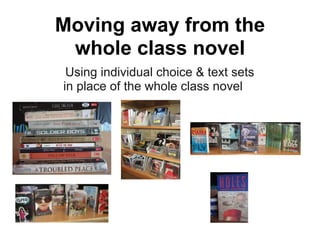
Moving away from the
 whole class novel
 Using individual choice & text sets
in place of the whole class novel
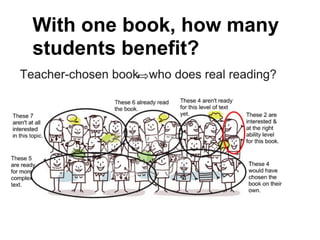
With one book, how many
students benefit?
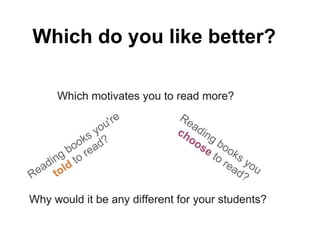
Which do you like better?
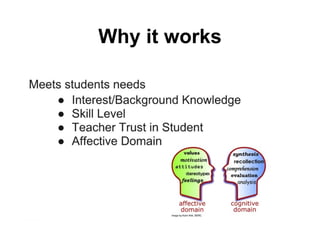
Why it works
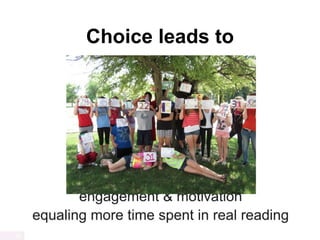
Choice leads to
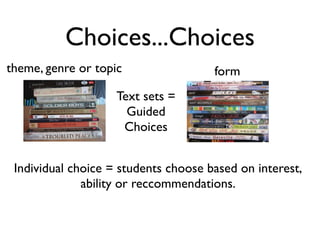
Choices...Choices
theme, genre or topic                 form
                    Text sets =
                      Guided
                     Choices


 Individual choice = students choose based on interest,
              ability or reccommendations.
What to do with the books

•   READ
   Get rid of the "stuff" and let them read!
• Confer with Teacher
• Respond in Writing
• Book Talk
• Share Favorites
• Discussions with Classmates
  ◦ Students still talk about what they've read
     ■ Same book groups
What am I teaching?

I teach reading;
                                             I don't teach books
What is the curriculum?
                                            the book or the skill
What is my goal?
                                 think like I do or think for self
                    answering questions or critical thinking
giving same answer as all or giving support for own answer
What the students say
about having a choice
"There was never a time this year that I read a book I
wasn't interested in. It inspires me to continue reading this
summer and throughout my time at the high school."
"This year I learned so much about myself when I read
books. It has made me a lot more interested in book
genres that I never even knew existed. My perspective has
changed of books this year. I enjoy them so much more
than I used to."
"I hope that most of the books that I read here will be in the
high school because some of the books I read in here are
series books. And I can't get enough of them."
"Finding books that I liked resulted in reading more at
home & in school, therefore improving my reading habits."
What about the tangled or
dormant readers?

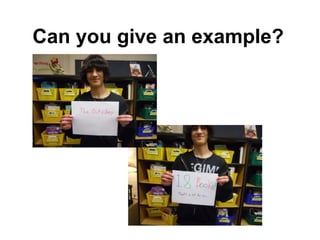
• Ask: “What was the last thing you read
  that you really liked?”
• Use that as your starting point to find “read
  alikes” that will get the reader going.
• It’s not easy, but you can’t give up!
Can you give an example?
What about reading level?

• Reading levels are a guide to appropriate
  text, and have their uses when grouping
  students for small group instruction.
• Students are able to read more difficult and
  complex text when they are motivated or
  interested in a topic.
  • For example... Gaming magazines!
Okay, you’ve sold me...
     where do I start?
• Build your classroom library.
   • Use the Scholastic Book Club to get free/cheap
      books. Also, check out their warehouse sale.
   • Go to your local Goodwill or
      Salvation Army store to find           books.
   • Look for teacher discounts                  at
      bookstores
• Read. A lot. Share your reading
  life with your students.
What books should I
         get for my library?
Middle School                                        •    13 Reasons Why (Asher)
 • The Strange Case of Origami Yoda (Angleberger)    •    Perfect Chemistry (Elkeles)
 • The Unwanteds (McMann)                            •    Divergent (Roth)
 • Runner (Deuker)                                   •    Clarity (Harrington)
 • Percy Jackson & the Olympians (Riordan)           •    Legend (Lu)
 • The Hunger Games (Collins)                        •    The Ranger's Apprentice series (Flanagan)
 • I Am Number Four (Lore)                           •    The Alex Rider series (Horowitz)
 • The One and Only Ivan (Applegate)                 •    Gordon Korman books
 • Wonder (Palacio)                                  •    The Fourth Stall (Rylander)
 • I Heart You, You Haunt Me (Schroeder)             •    Sidekicks (Santat)
 • Speak (Halse Anderson)                            •    Zita the Space Girl (Hatke)
 • What My Mother Doesn't Know (Sones)               •    Amulet (5 book series) (Kibuishi)
 • Smile and Drama (Telgemeier)
 • The 39 Clues series
 • Mike Lupica sports books
 • Kate Messner books
 • Tommy Joe Jackson's Guide to Not Reading (Greenwald)
•Out of My Mind (Draper)
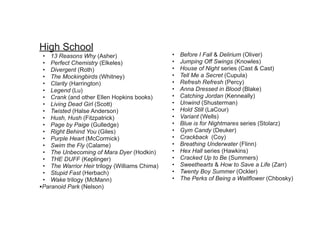
High School
 • 13 Reasons Why (Asher)                      •   Before I Fall & Delirium (Oliver)
 • Perfect Chemistry (Elkeles)                 •   Jumping Off Swings (Knowles)
 • Divergent (Roth)                            •   House of Night series (Cast & Cast)
 • The Mockingbirds (Whitney)                  •   Tell Me a Secret (Cupula)
 • Clarity (Harrington)                        •   Refresh Refresh (Percy)
 • Legend (Lu)                                 •   Anna Dressed in Blood (Blake)
 • Crank (and other Ellen Hopkins books)       •   Catching Jordan (Kenneally)
 • Living Dead Girl (Scott)                    •   Unwind (Shusterman)
 • Twisted (Halse Anderson)                    •   Hold Still (LaCour)
 • Hush, Hush (Fitzpatrick)                    •   Variant (Wells)
 • Page by Paige (Gulledge)                    •   Blue is for Nightmares series (Stolarz)
 • Right Behind You (Giles)                    •   Gym Candy (Deuker)
 • Purple Heart (McCormick)                    •   Crackback (Coy)
 • Swim the Fly (Calame)                       •   Breathing Underwater (Flinn)
 • The Unbecoming of Mara Dyer (Hodkin)        •   Hex Hall series (Hawkins)
 • THE DUFF (Keplinger)                        •   Cracked Up to Be (Summers)
 • The Warrior Heir trilogy (Williams Chima)   •   Sweethearts & How to Save a Life (Zarr)
 • Stupid Fast (Herbach)                       •   Twenty Boy Summer (Ockler)
 • Wake trilogy (McMann)                       •   The Perks of Being a Wallflower (Chbosky)
•Paranoid Park (Nelson)
How do I start?

•   Find time in your day to let students read
    books of their choice.

     •   The only way to get better at reading (and
         consequently writing) is by reading!

•   Seek out professional books and journals. Use
    the research that supports student-selected
    reading when you talk to your administration
    and colleagues.
Remember... you’re not in
this alone.
• Find a whole community of like-minded
  educators on Twitter! (We’re there as
  @mindi_r and @heisereads
• Connect on other social networks such as the
  English Companion Ning or Goodreads.
• Contact us:
       Jillian: jillian.heise@ics-milw.org
      Mindi: mrench@northbrook28.net

Wcte2012

  • 1.
    Facilitating Choice Within Curriculum Constraints Jillian Heise, 7th & 8th grade Language Arts Teacher, Indian Community School of Milwaukee Melinda Rench, Middle School Literacy Coach, Northbrook Junior High, Northbrook, Illinois http://slideshare.net/mindi_r
  • 2.
    Our Understandings More reading = improved skills, increased vocabulary, & higher test scores (Allington, 2001; Krashen 2001 and Stanovich, 2000 as cited in Allington, 2002; Nippold et al., 2005) • Move from teacher-chosen 4 books/year, to students actively reading more at own level. Less "stuff " & more real reading every day. (Allington, 2001; Ivey & Broaddus, 2001; Miller, 2009; Worthy, Turner, & Moorman, 1998) • As students increase grade level, reading attitude decreases. Need engagement & interest to increase motivation. (Turner, 1995 as cited in Allington, 2002; McKenna, Kear, and Ellsworth, 1995; Pitcher et al., 2007; Guthrie et al., 2006) • Allow choice = meet these requirements(Allington, 2005)
  • 3.
    Every Child, EveryDay (Allington and Gabriel, 2012) Six Elements for Every Child • Books: Choice, accuracy, understanding • Talk: with peers about reading • Listens: fluent adult read aloud • Writes: personally meaningful topics
  • 4.
    What do theCommon Core State Standards What to read and who decides: • Through reading a diverse array of classic and contemporary literature as well as challenging informational texts in a range of subjects, students are expected to build knowledge, gain insights, explore possibilities, and broaden their perspective. • Given space limitations, the illustrative texts listed are meant only to show individual titles that are representative of a range of topics and genres. At a curricular or instructional level, within and across grade levels, texts need to be selected around topics or themes that generate knowledge and allow students to study those topics or themes in depth. (CCSS ELA page 58) • The standards appropriately defer the many remaining decisions about what and how to teach to states, districts, and schools.
  • 5.
    What do theCommon Core State Standards A focus on results rather than means (CCSS ELA page 4): By emphasizing required achievements, the Standards leave room for teachers, curriculum developers, and states to determine how those goals should be reached and what additional topics should be addressed. Thus, the Standards do not mandate such things as a particular writing process or the full range of metacognitive strategies that students may need to monitor and direct their thinking and learning. Teachers are thus free to provide students with whatever tools and knowledge their professional judgment and experience identify as most helpful for meeting the goals set out in the Standards. Distribution of types of reading (CCSS ELA page 5): 8th grade 45% Literary & 55% Informational 12th grade 30% Literary & 70% Informational The percentages on the table reflect the sum of student reading, not just reading in ELA settings. Teachers of senior English classes, for example, are not required to devote 70 percent of reading to informational texts. Rather, 70 percent of student reading across the grade should be informational.
  • 6.
    What do theCommon Core State Standards Text complexity and the growth of comprehension (CCSS ELA page 8): The Reading standards place equal emphasis on the sophistication of what students read and the skill with which they read. Whatever they are reading, students must also show a steadily growing ability to discern more from and make fuller use of text, including making an increasing number of connections among ideas and between texts, considering a wider range of textual evidence, and becoming more sensitive to inconsistencies, ambiguities, and poor reasoning in texts. Note on range and content of student reading (CCSS ELA page 35): To become college and career ready, students must grapple with works of exceptional craft and thought whose range extends across genres, cultures, and centuries. Such works offer profound insights into the human condition and serve as models for students’ own thinking and writing. Along with high-quality contemporary works, these texts should be chosen from among seminal U.S. documents, the classics of American literature, and the timeless dramas of Shakespeare. Through wide and deep reading of literature and literary nonfiction of steadily increasing sophistication, students gain a reservoir of literary and cultural knowledge, references, and images; the ability to evaluate intricate arguments; and the capacity to surmount the challenges posed by complex texts.
  • 7.
    Moving away fromthe whole class novel Using individual choice & text sets in place of the whole class novel
  • 8.
    With one book,how many students benefit?
  • 9.
    Which do youlike better?
  • 10.
  • 11.
  • 12.
    Choices...Choices theme, genre ortopic form Text sets = Guided Choices Individual choice = students choose based on interest, ability or reccommendations.
  • 13.
    What to dowith the books • READ Get rid of the "stuff" and let them read! • Confer with Teacher • Respond in Writing • Book Talk • Share Favorites • Discussions with Classmates ◦ Students still talk about what they've read ■ Same book groups
  • 14.
    What am Iteaching? I teach reading; I don't teach books What is the curriculum? the book or the skill What is my goal? think like I do or think for self answering questions or critical thinking giving same answer as all or giving support for own answer
  • 15.
    What the studentssay about having a choice "There was never a time this year that I read a book I wasn't interested in. It inspires me to continue reading this summer and throughout my time at the high school." "This year I learned so much about myself when I read books. It has made me a lot more interested in book genres that I never even knew existed. My perspective has changed of books this year. I enjoy them so much more than I used to." "I hope that most of the books that I read here will be in the high school because some of the books I read in here are series books. And I can't get enough of them." "Finding books that I liked resulted in reading more at home & in school, therefore improving my reading habits."
  • 16.
    What about thetangled or dormant readers? • Ask: “What was the last thing you read that you really liked?” • Use that as your starting point to find “read alikes” that will get the reader going. • It’s not easy, but you can’t give up!
  • 17.
    Can you givean example?
  • 18.
    What about readinglevel? • Reading levels are a guide to appropriate text, and have their uses when grouping students for small group instruction. • Students are able to read more difficult and complex text when they are motivated or interested in a topic. • For example... Gaming magazines!
  • 19.
    Okay, you’ve soldme... where do I start? • Build your classroom library. • Use the Scholastic Book Club to get free/cheap books. Also, check out their warehouse sale. • Go to your local Goodwill or Salvation Army store to find books. • Look for teacher discounts at bookstores • Read. A lot. Share your reading life with your students.
  • 20.
    What books shouldI get for my library? Middle School • 13 Reasons Why (Asher) • The Strange Case of Origami Yoda (Angleberger) • Perfect Chemistry (Elkeles) • The Unwanteds (McMann) • Divergent (Roth) • Runner (Deuker) • Clarity (Harrington) • Percy Jackson & the Olympians (Riordan) • Legend (Lu) • The Hunger Games (Collins) • The Ranger's Apprentice series (Flanagan) • I Am Number Four (Lore) • The Alex Rider series (Horowitz) • The One and Only Ivan (Applegate) • Gordon Korman books • Wonder (Palacio) • The Fourth Stall (Rylander) • I Heart You, You Haunt Me (Schroeder) • Sidekicks (Santat) • Speak (Halse Anderson) • Zita the Space Girl (Hatke) • What My Mother Doesn't Know (Sones) • Amulet (5 book series) (Kibuishi) • Smile and Drama (Telgemeier) • The 39 Clues series • Mike Lupica sports books • Kate Messner books • Tommy Joe Jackson's Guide to Not Reading (Greenwald) •Out of My Mind (Draper)
  • 21.
    High School •13 Reasons Why (Asher) • Before I Fall & Delirium (Oliver) • Perfect Chemistry (Elkeles) • Jumping Off Swings (Knowles) • Divergent (Roth) • House of Night series (Cast & Cast) • The Mockingbirds (Whitney) • Tell Me a Secret (Cupula) • Clarity (Harrington) • Refresh Refresh (Percy) • Legend (Lu) • Anna Dressed in Blood (Blake) • Crank (and other Ellen Hopkins books) • Catching Jordan (Kenneally) • Living Dead Girl (Scott) • Unwind (Shusterman) • Twisted (Halse Anderson) • Hold Still (LaCour) • Hush, Hush (Fitzpatrick) • Variant (Wells) • Page by Paige (Gulledge) • Blue is for Nightmares series (Stolarz) • Right Behind You (Giles) • Gym Candy (Deuker) • Purple Heart (McCormick) • Crackback (Coy) • Swim the Fly (Calame) • Breathing Underwater (Flinn) • The Unbecoming of Mara Dyer (Hodkin) • Hex Hall series (Hawkins) • THE DUFF (Keplinger) • Cracked Up to Be (Summers) • The Warrior Heir trilogy (Williams Chima) • Sweethearts & How to Save a Life (Zarr) • Stupid Fast (Herbach) • Twenty Boy Summer (Ockler) • Wake trilogy (McMann) • The Perks of Being a Wallflower (Chbosky) •Paranoid Park (Nelson)
  • 22.
    How do Istart? • Find time in your day to let students read books of their choice. • The only way to get better at reading (and consequently writing) is by reading! • Seek out professional books and journals. Use the research that supports student-selected reading when you talk to your administration and colleagues.
  • 23.
    Remember... you’re notin this alone. • Find a whole community of like-minded educators on Twitter! (We’re there as @mindi_r and @heisereads • Connect on other social networks such as the English Companion Ning or Goodreads. • Contact us: Jillian: jillian.heise@ics-milw.org Mindi: mrench@northbrook28.net