The Basics
WOLF LAKE ELEMENTARY

REBECA GRYSKO
PRESENTER
What is Writing Workshop?
 Method of teaching writing using a workshop method
 Students are given opportunities to write independently

and helps foster a love of writing
 Allows teachers to meet students’ needs by differentiating
instruction based on information gathered throughout the
workshop
Why Implement Writing Workshop?
 Recently, a needs assessment survey was

administered to classroom teachers and specialists at
Wolf Lake Elementary School.
 The purpose of the survey was to examine teachers’
perspective of the reading/language arts
instructional program.
 Only 44% of participants feel that their students
have adequate opportunities to write independently.
 Goal : Teachers will effectively implement Writing
Workshop to provide students with increased
opportunities to write independently.
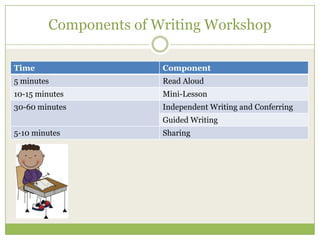
Components of Writing Workshop
Time

Component

5 minutes

Read Aloud

10-15 minutes

Mini-Lesson

30-60 minutes

Independent Writing and Conferring
Guided Writing

5-10 minutes

Sharing
Read Alouds
 When teachers use Writing Workshop, they generally

focus on a specific genre (personal narratives,
informational writing, procedural writing, etc.).
 Read alouds allows teachers to use authors as models
for specific writing styles and genres.
 Teachers are not required to read the entire text.
Instead, choose important excerpts to read aloud.
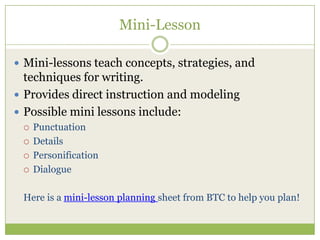
Mini-Lesson
 Mini-lessons teach concepts, strategies, and

techniques for writing.
 Provides direct instruction and modeling
 Possible mini lessons include:






Punctuation
Details
Personification
Dialogue

Here is a mini-lesson planning sheet from BTC to help you plan!
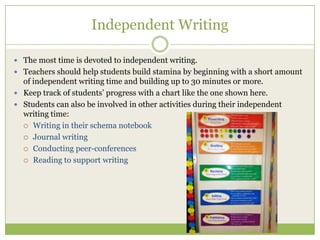
Independent Writing
 The most time is devoted to independent writing.
 Teachers should help students build stamina by beginning with a short amount

of independent writing time and building up to 30 minutes or more.
 Keep track of students’ progress with a chart like the one shown here.
 Students can also be involved in other activities during their independent
writing time:
 Writing in their schema notebook
 Journal writing
 Conducting peer-conferences
 Reading to support writing
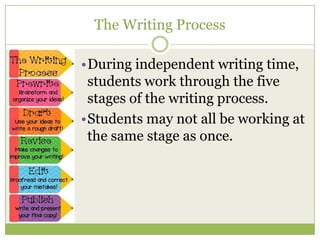
The Writing Process
•During independent writing time,
students work through the five
stages of the writing process.
•Students may not all be working at
the same stage as once.
Conferring
 During independent writing time, the teacher meets

with either individual students or small groups to
provide suggestions and feedback.
 The teacher should keep anecdotal records which
include:




Date of conference
Observations
Discussion dialogue

Watch an example of a writing conference between a student and
teacher.
Guided Writing
 During independent writing time, students can meet

in a small group with the teacher to work on guided
writing.
 Similar to guided reading, the teacher forms groups
based on students’ needs.
 Guided writing is especially helpful when a group of
students are struggling with the same concept.
Watch an example of a guided writing session.
Sharing
 Many teachers dismiss this component due to lack of

time, but allowing students to share their writing is
CRITICAL!
 The sharing component allows students to share
what they did during independent writing time with
either the entire class or with a peer.
 Sharing enables students to learn from one another.
Helpful Tips
 Have writing folders with students’ names on them to store






writing resources, rough drafts, and final copies.
Make sure there is a World Wall available for student use.
Provide each student with a composition notebook to use as
a writer’s notebook.
Decide how you will organize your informal student data,
such as anecdotal records.
Establish a “writing area” for children to write
independently.
Inform parents of the writing program through newsletters,
parent night, etc.
Questions?
 Helpful Resources
 http://busyteacherscafe.com/literacy/writing_workshop.html
 http://www.tips-for-teachers.com/writersworkshop.htm
 http://www.davidson.k12.nc.us/education/components/scrap
book/default.php?sectiondetailid=28162

Writing workshop presentation

  • 1.
    The Basics WOLF LAKEELEMENTARY REBECA GRYSKO PRESENTER
  • 2.
    What is WritingWorkshop?  Method of teaching writing using a workshop method  Students are given opportunities to write independently and helps foster a love of writing  Allows teachers to meet students’ needs by differentiating instruction based on information gathered throughout the workshop
  • 3.
    Why Implement WritingWorkshop?  Recently, a needs assessment survey was administered to classroom teachers and specialists at Wolf Lake Elementary School.  The purpose of the survey was to examine teachers’ perspective of the reading/language arts instructional program.  Only 44% of participants feel that their students have adequate opportunities to write independently.  Goal : Teachers will effectively implement Writing Workshop to provide students with increased opportunities to write independently.
  • 4.
    Components of WritingWorkshop Time Component 5 minutes Read Aloud 10-15 minutes Mini-Lesson 30-60 minutes Independent Writing and Conferring Guided Writing 5-10 minutes Sharing
  • 5.
    Read Alouds  Whenteachers use Writing Workshop, they generally focus on a specific genre (personal narratives, informational writing, procedural writing, etc.).  Read alouds allows teachers to use authors as models for specific writing styles and genres.  Teachers are not required to read the entire text. Instead, choose important excerpts to read aloud.
  • 6.
    Mini-Lesson  Mini-lessons teachconcepts, strategies, and techniques for writing.  Provides direct instruction and modeling  Possible mini lessons include:     Punctuation Details Personification Dialogue Here is a mini-lesson planning sheet from BTC to help you plan!
  • 7.
    Independent Writing  Themost time is devoted to independent writing.  Teachers should help students build stamina by beginning with a short amount of independent writing time and building up to 30 minutes or more.  Keep track of students’ progress with a chart like the one shown here.  Students can also be involved in other activities during their independent writing time:  Writing in their schema notebook  Journal writing  Conducting peer-conferences  Reading to support writing
  • 8.
    The Writing Process •Duringindependent writing time, students work through the five stages of the writing process. •Students may not all be working at the same stage as once.
  • 9.
    Conferring  During independentwriting time, the teacher meets with either individual students or small groups to provide suggestions and feedback.  The teacher should keep anecdotal records which include:    Date of conference Observations Discussion dialogue Watch an example of a writing conference between a student and teacher.
  • 10.
    Guided Writing  Duringindependent writing time, students can meet in a small group with the teacher to work on guided writing.  Similar to guided reading, the teacher forms groups based on students’ needs.  Guided writing is especially helpful when a group of students are struggling with the same concept. Watch an example of a guided writing session.
  • 11.
    Sharing  Many teachersdismiss this component due to lack of time, but allowing students to share their writing is CRITICAL!  The sharing component allows students to share what they did during independent writing time with either the entire class or with a peer.  Sharing enables students to learn from one another.
  • 12.
    Helpful Tips  Havewriting folders with students’ names on them to store      writing resources, rough drafts, and final copies. Make sure there is a World Wall available for student use. Provide each student with a composition notebook to use as a writer’s notebook. Decide how you will organize your informal student data, such as anecdotal records. Establish a “writing area” for children to write independently. Inform parents of the writing program through newsletters, parent night, etc.
  • 13.
    Questions?  Helpful Resources http://busyteacherscafe.com/literacy/writing_workshop.html  http://www.tips-for-teachers.com/writersworkshop.htm  http://www.davidson.k12.nc.us/education/components/scrap book/default.php?sectiondetailid=28162