Copyright © 2014 Cengage Learning. All Rights Reserved. May not be scanned, copied or duplicated, or posted to a publicly accessible website, in whole or in part.
6
C H A P T E R
Communicating in
Writing
COM 620 MODULE
with
Walter Ratliff
4
Copyright © 2014 Cengage Learning. All Rights Reserved. May not be scanned, copied or duplicated, or posted to a publicly accessible website, in whole or in part. 2
Tactical Elements for Written
Communication
Planning and
developing
the message
Selecting and
incorporating
visual
elements
Revising for
coherence
and flow
Revising for
style and
tone
Copyright © 2014 Cengage Learning. All Rights Reserved. May not be scanned, copied or duplicated, or posted to a publicly accessible website, in whole or in part. 3
Planning and Developing the
Message
Introduction
CloseBody
Parts of a
Message
Intro and Body:
• Direct approach
• Indirect approach Conclusions:
• Goodwill
• Summary
• Sales
Copyright © 2014 Cengage Learning. All Rights Reserved. May not be scanned, copied or duplicated, or posted to a publicly accessible website, in whole or in part. 4
Planning and Developing the
Message Persuasive
Messages
1. How will my
audience initially
react to my
proposal
2. How does my
audience feel about
me, my company, or
my product or service?
3. What are your
audience’s needs? In
what ways does your
idea or proposal fulfill
those needs?
4. What benefits
does your proposal
provide to your
audience?
5. What obstacles
or objections must
you overcome?
6. Is this a sales proposal
or a competitive
message? If so, what do
my competitors offer?
How might I distinguish
myself or my ideas
favorably from my
competitors?
Copyright © 2014 Cengage Learning. All Rights Reserved. May not be scanned, copied or duplicated, or posted to a publicly accessible website, in whole or in part. 5
Planning and Developing the
Message Persuasive
Messages
TYPES OF APPEALS
COMPONENTS
Quality of the evidence
Copyright © 2014 Cengage Learning. All Rights Reserved. May not be scanned, copied or duplicated, or posted to a publicly accessible website, in whole or in part. 6
Planning and Developing the
Message Persuasive
Messages
Attention
Interest
Desire
Action
The AIDA Approach
Copyright © 2014 Cengage Learning. All Rights Reserved. May not be scanned, copied or duplicated, or posted to a publicly accessible website, in whole or in part. 7
How Do I Deal with a Resistant
Audience?
1. Open with statement of common ground
2. Explain need for change
3. Eliminate objections
4. Provide specific solution or
recommendations
5. Explain implementation of plan if
appropriate
Copyright © 2014 Cengage Learning. All Rights Reserved. May not be scanned, copied or duplicated, or posted to a publicly accessible website, in whole or in part. 8
Planning and Developing the
Message Reports and
Proposals
• Define a problem
• Gather data
• Develop recommendations
• Can be formal or informal
Reports
• Serve as sales documents
recommending changes or
purchases internally or offering
services externally
• Can be formal or informal
Proposals
Copyright © 2014 Cengage Learning. All Rights Reserved. May not be scanned, copied or duplicated, or posted to a publicly accessible website, in whole or in part. 9
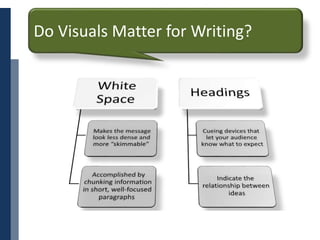
Do Visuals Matter for Writing?
Copyright © 2014 Cengage Learning. All Rights Reserved. May not be scanned, copied or duplicated, or posted to a publicly accessible website, in whole or in part. 10
Do Visuals Matter for Writing?
Copyright © 2014 Cengage Learning. All Rights Reserved. May not be scanned, copied or duplicated, or posted to a publicly accessible website, in whole or in part. 11
Revising: Coherence and Flow
When revising:
 Check for accurate topic sentences
 Check for paragraph coherence
 Include transitions and forecasting where
appropriate
Copyright © 2014 Cengage Learning. All Rights Reserved. May not be scanned, copied or duplicated, or posted to a publicly accessible website, in whole or in part. 12
Revising: Style and Tone
Written business messages should use:
 Short, simple, precise words, and yet avoid
slang
 Short yet complete sentences and short
paragraphs
 Standard English
 First- and second-person pronouns
Copyright © 2014 Cengage Learning. All Rights Reserved. May not be scanned, copied or duplicated, or posted to a publicly accessible website, in whole or in part. 13
Tips for Submitting a Message
SEND!
Only send
copies to
those who
need the info
Proofread for
mechanical
correctness
Avoid using
BCC, which
may look
sneaky

COM 620 Module 4

  • 1.
    Copyright © 2014Cengage Learning. All Rights Reserved. May not be scanned, copied or duplicated, or posted to a publicly accessible website, in whole or in part. 6 C H A P T E R Communicating in Writing COM 620 MODULE with Walter Ratliff 4
  • 2.
    Copyright © 2014Cengage Learning. All Rights Reserved. May not be scanned, copied or duplicated, or posted to a publicly accessible website, in whole or in part. 2 Tactical Elements for Written Communication Planning and developing the message Selecting and incorporating visual elements Revising for coherence and flow Revising for style and tone
  • 3.
    Copyright © 2014Cengage Learning. All Rights Reserved. May not be scanned, copied or duplicated, or posted to a publicly accessible website, in whole or in part. 3 Planning and Developing the Message Introduction CloseBody Parts of a Message Intro and Body: • Direct approach • Indirect approach Conclusions: • Goodwill • Summary • Sales
  • 4.
    Copyright © 2014Cengage Learning. All Rights Reserved. May not be scanned, copied or duplicated, or posted to a publicly accessible website, in whole or in part. 4 Planning and Developing the Message Persuasive Messages 1. How will my audience initially react to my proposal 2. How does my audience feel about me, my company, or my product or service? 3. What are your audience’s needs? In what ways does your idea or proposal fulfill those needs? 4. What benefits does your proposal provide to your audience? 5. What obstacles or objections must you overcome? 6. Is this a sales proposal or a competitive message? If so, what do my competitors offer? How might I distinguish myself or my ideas favorably from my competitors?
  • 5.
    Copyright © 2014Cengage Learning. All Rights Reserved. May not be scanned, copied or duplicated, or posted to a publicly accessible website, in whole or in part. 5 Planning and Developing the Message Persuasive Messages TYPES OF APPEALS COMPONENTS Quality of the evidence
  • 6.
    Copyright © 2014Cengage Learning. All Rights Reserved. May not be scanned, copied or duplicated, or posted to a publicly accessible website, in whole or in part. 6 Planning and Developing the Message Persuasive Messages Attention Interest Desire Action The AIDA Approach
  • 7.
    Copyright © 2014Cengage Learning. All Rights Reserved. May not be scanned, copied or duplicated, or posted to a publicly accessible website, in whole or in part. 7 How Do I Deal with a Resistant Audience? 1. Open with statement of common ground 2. Explain need for change 3. Eliminate objections 4. Provide specific solution or recommendations 5. Explain implementation of plan if appropriate
  • 8.
    Copyright © 2014Cengage Learning. All Rights Reserved. May not be scanned, copied or duplicated, or posted to a publicly accessible website, in whole or in part. 8 Planning and Developing the Message Reports and Proposals • Define a problem • Gather data • Develop recommendations • Can be formal or informal Reports • Serve as sales documents recommending changes or purchases internally or offering services externally • Can be formal or informal Proposals
  • 9.
    Copyright © 2014Cengage Learning. All Rights Reserved. May not be scanned, copied or duplicated, or posted to a publicly accessible website, in whole or in part. 9 Do Visuals Matter for Writing?
  • 10.
    Copyright © 2014Cengage Learning. All Rights Reserved. May not be scanned, copied or duplicated, or posted to a publicly accessible website, in whole or in part. 10 Do Visuals Matter for Writing?
  • 11.
    Copyright © 2014Cengage Learning. All Rights Reserved. May not be scanned, copied or duplicated, or posted to a publicly accessible website, in whole or in part. 11 Revising: Coherence and Flow When revising:  Check for accurate topic sentences  Check for paragraph coherence  Include transitions and forecasting where appropriate
  • 12.
    Copyright © 2014Cengage Learning. All Rights Reserved. May not be scanned, copied or duplicated, or posted to a publicly accessible website, in whole or in part. 12 Revising: Style and Tone Written business messages should use:  Short, simple, precise words, and yet avoid slang  Short yet complete sentences and short paragraphs  Standard English  First- and second-person pronouns
  • 13.
    Copyright © 2014Cengage Learning. All Rights Reserved. May not be scanned, copied or duplicated, or posted to a publicly accessible website, in whole or in part. 13 Tips for Submitting a Message SEND! Only send copies to those who need the info Proofread for mechanical correctness Avoid using BCC, which may look sneaky