Myth and American Values
• L. Robert Kohls’
“Values Americans Live By”
THE PREMISE
Kohl presents a list of common values he says
fit most Americans. (Do they fit you?)
THE PREMISE
• “The different behaviors of a people or a culture make sense
only when seen through the basic beliefs, assumptions and
values of that particular group.”
• “A foreign anthropologist could observe Americans and
produce a list of common values that would fit most
Americans. The list of typically American values would stand
in sharp contrast to the values commonly held by the people of
many other countries.”
• Dr. L. Robert Kohls, Director of International Programs at San
Francisco State University
MYTHIC BACKGROUND
Of American Values
MYTHIC BACKGROUND:
PROTESTANT WORK ETHIC
• Max Weber: http://hirr.hartsem.edu/ency/Protestantism.htm
• Puritan belief (based principally on the Old Testament book of
Proverbs) asserted that God would reward in this life those whom
he had elected to eternal glory, who lived according to his laws.
• If people strictly followed biblical teachings and they succeeded
in their businesses, this would be a sign of their salvation.
• They were to invest all their income beyond the necessities of a
frugal lifestyle, in so doing make even more money, to invest
similarly all the days of their life.
• The Protestant “work ethic” and capitalism: not merely an
economic philosophy but a lifestyle.
MYTHIC BACKGROUND:
PROTESTANT WORK ETHIC
• Protestant Work Ethic:
• The individual is religiously compelled to
follow a secular vocation with as much
zeal as possible.
• A person practicing this worldview was
more likely to accumulate money.
• It effectively forbade
wastefully using hard earned money
• Identified purchasing luxuries as a sin.
MYTHIC BACKGROUND:
• Frontier Thesis (Frederick Jackson Turner)
• The advance of American settlement westward
through “free land” was the central story of
American history.
• This idea continually renewed American ideas of
democracy and individualism.
• It shaped not just the West but the nation as a whole.
MYTHIC BACKGROUND:
FRONTIER THESIS
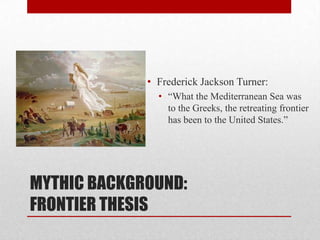
• Frederick Jackson Turner:
• “What the Mediterranean Sea was
to the Greeks, the retreating frontier
has been to the United States.”
MYTHIC BACKGROUND:
FRONTIER THESIS
• Turner’s key features of the frontier:
• Breaking the bonds of custom
• Offering new experiences
• Calling out new institutions and activities
MYTHIC BACKGROUND
• Key “myths” like the Protestant Work Ethic, and the
defining narratives of America’s frontier have influenced
many common American values
AMERICAN VALUES
Kohl’s list of defining American features
PERSONAL CONTROL OVER THE ENVIRONMENT
Most Americans find it impossible to accept that there are some things that lie
beyond the power of humans to achieve. And Americans have literally gone to the
moon, because they refused to accept earthly limitations.
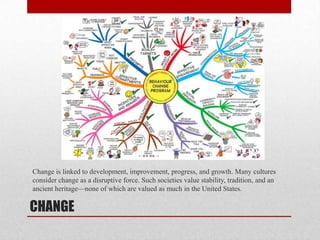
CHANGE
Change is linked to development, improvement, progress, and growth. Many cultures
consider change as a disruptive force. Such societies value stability, tradition, and an
ancient heritage—none of which are valued as much in the United States.
TIME AND ITS CONTROL
To a foreign visitor, Americans seem to be more concerned with getting things
accomplished on time than they are with developing deep interpersonal relations.
Schedules, for the American, are meant to be planned and then followed in detail.
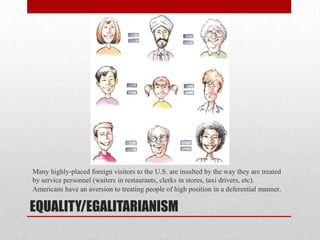
EQUALITY/EGALITARIANISM
Many highly-placed foreign visitors to the U.S. are insulted by the way they are treated
by service personnel (waiters in restaurants, clerks in stores, taxi drivers, etc).
Americans have an aversion to treating people of high position in a deferential manner.
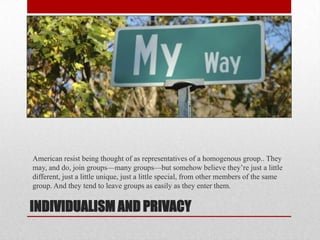
INDIVIDUALISM AND PRIVACY
American resist being thought of as representatives of a homogenous group.. They
may, and do, join groups—many groups—but somehow believe they’re just a little
different, just a little unique, just a little special, from other members of the same
group. And they tend to leave groups as easily as they enter them.
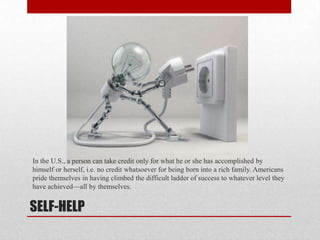
SELF-HELP
In the U.S., a person can take credit only for what he or she has accomplished by
himself or herself, i.e. no credit whatsoever for being born into a rich family. Americans
pride themselves in having climbed the difficult ladder of success to whatever level they
have achieved—all by themselves.
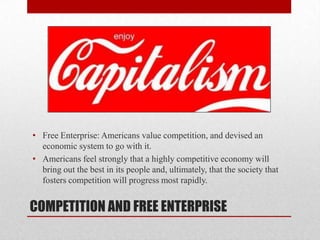
COMPETITION AND FREE ENTERPRISE
• Free Enterprise: Americans value competition, and devised an
economic system to go with it.
• Americans feel strongly that a highly competitive economy will
bring out the best in its people and, ultimately, that the society that
fosters competition will progress most rapidly.
FUTURE ORIENTATION
• Valuing the future and its promised improvements often means that
Americans devalue that past and are, to a large extent, unconscious
of the present.
• Even a happy present goes largely unnoticed because Americans
have traditionally been hopeful that the future would bring even
greater happiness.
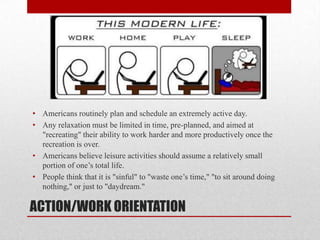
ACTION/WORK ORIENTATION
• Americans routinely plan and schedule an extremely active day.
• Any relaxation must be limited in time, pre-planned, and aimed at
"recreating" their ability to work harder and more productively once the
recreation is over.
• Americans believe leisure activities should assume a relatively small
portion of one’s total life.
• People think that it is "sinful" to "waste one’s time," "to sit around doing
nothing," or just to "daydream."
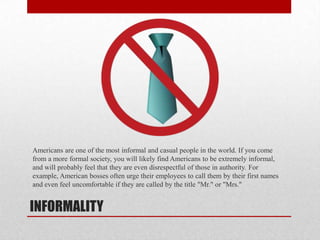
INFORMALITY
Americans are one of the most informal and casual people in the world. If you come
from a more formal society, you will likely find Americans to be extremely
informal, and will probably feel that they are even disrespectful of those in authority.
For example, American bosses often urge their employees to call them by their first
names and even feel uncomfortable if they are called by the title "Mr." or "Mrs."
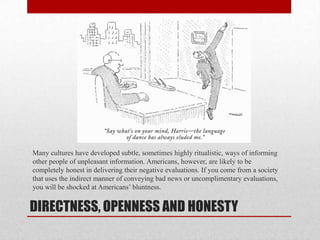
DIRECTNESS, OPENNESS AND HONESTY
Many cultures have developed subtle, sometimes highly ritualistic, ways of informing
other people of unpleasant information. Americans, however, are likely to be
completely honest in delivering their negative evaluations. If you come from a society
that uses the indirect manner of conveying bad news or uncomplimentary
evaluations, you will be shocked at Americans’ bluntness.
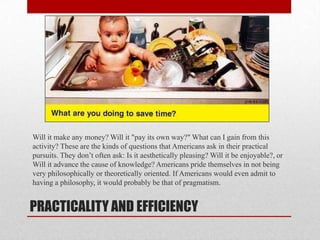
PRACTICALITY AND EFFICIENCY
Will it make any money? Will it "pay its own way?" What can I gain from this
activity? These are the kinds of questions that Americans ask in their practical
pursuits. They don’t often ask: Is it aesthetically pleasing? Will it be enjoyable?, or
Will it advance the cause of knowledge? Americans pride themselves in not being
very philosophically or theoretically oriented. If Americans would even admit to
having a philosophy, it would probably be that of pragmatism.
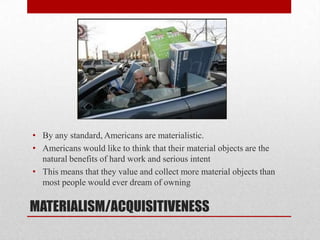
MATERIALISM/ACQUISITIVENESS
• By any standard, Americans are materialistic.
• Americans would like to think that their material objects are the
natural benefits of hard work and serious intent
• This means that they value and collect more material objects than
most people would ever dream of owning
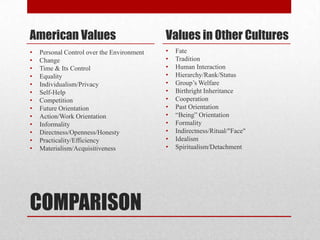
COMPARISON
American Values
• Personal Control over the Environment
• Change
• Time & Its Control
• Equality
• Individualism/Privacy
• Self-Help
• Competition
• Future Orientation
• Action/Work Orientation
• Informality
• Directness/Openness/Honesty
• Practicality/Efficiency
• Materialism/Acquisitiveness
Values in Other Cultures
• Fate
• Tradition
• Human Interaction
• Hierarchy/Rank/Status
• Group’s Welfare
• Birthright Inheritance
• Cooperation
• Past Orientation
• “Being” Orientation
• Formality
• Indirectness/Ritual/"Face"
• Idealism
• Spiritualism/Detachment
CONFERENCE QUESTIONS
• What's your take on Kohls' "The Values Americans Live
By"?
• Do you agree or disagree? Why?
• What TWO aspects of Kohls' construct were MOST
impactful to you? Why?
• What ONE aspect in Kohls' construct was the LEAST
meaningful or the LEAST clear to you? Why?
Sources
• Kohl’s essay:
http://www.claremontmckenna.edu/pages/faculty/alee/extra/American_values.html
• Images
• Man holding rock: http://www.impactlab.net/2009/11/15/top-10-photos-of-the-week-102/
• Change map: http://live-the-solution.com/mindmaps/
• Man holding clock: http://www.mindperk.com/resources/articles/32/1/157/Take-Control-of-Your-Time.html
• Equality: http://blog.pappastax.com/index.php/2010/06/19/the-equality-lie/
• My Way sign: http://www.dominican.edu/academics/osher/images/Individualism.jpg
• Light bulb: http://samingersoll.com/lifestyle/general-self-help/
• Capitalism Coke: http://standupforamerica.wordpress.com/2011/04/21/capitalism-v-communism/
• Workaholic: http://www.pollsb.com/polls/p6969-workaholic
• Language of Dance: http://www.flatworldknowledge.com/pub/1.0/organizational-behavior/28876#
• Baby in sink: http://springsrealestatenetwork.com/wp-content/uploads/2010/07/baby-in-sink.jpeg
• Materialism: http://leftwingconspiracy.com/2007/11/27/materialism/

Myth and American values

  • 1.
    Myth and AmericanValues • L. Robert Kohls’ “Values Americans Live By”
  • 2.
    THE PREMISE Kohl presentsa list of common values he says fit most Americans. (Do they fit you?)
  • 3.
    THE PREMISE • “Thedifferent behaviors of a people or a culture make sense only when seen through the basic beliefs, assumptions and values of that particular group.” • “A foreign anthropologist could observe Americans and produce a list of common values that would fit most Americans. The list of typically American values would stand in sharp contrast to the values commonly held by the people of many other countries.” • Dr. L. Robert Kohls, Director of International Programs at San Francisco State University
  • 4.
  • 5.
    MYTHIC BACKGROUND: PROTESTANT WORKETHIC • Max Weber: http://hirr.hartsem.edu/ency/Protestantism.htm • Puritan belief (based principally on the Old Testament book of Proverbs) asserted that God would reward in this life those whom he had elected to eternal glory, who lived according to his laws. • If people strictly followed biblical teachings and they succeeded in their businesses, this would be a sign of their salvation. • They were to invest all their income beyond the necessities of a frugal lifestyle, in so doing make even more money, to invest similarly all the days of their life. • The Protestant “work ethic” and capitalism: not merely an economic philosophy but a lifestyle.
  • 6.
    MYTHIC BACKGROUND: PROTESTANT WORKETHIC • Protestant Work Ethic: • The individual is religiously compelled to follow a secular vocation with as much zeal as possible. • A person practicing this worldview was more likely to accumulate money. • It effectively forbade wastefully using hard earned money • Identified purchasing luxuries as a sin.
  • 7.
    MYTHIC BACKGROUND: • FrontierThesis (Frederick Jackson Turner) • The advance of American settlement westward through “free land” was the central story of American history. • This idea continually renewed American ideas of democracy and individualism. • It shaped not just the West but the nation as a whole.
  • 8.
    MYTHIC BACKGROUND: FRONTIER THESIS •Frederick Jackson Turner: • “What the Mediterranean Sea was to the Greeks, the retreating frontier has been to the United States.”
  • 9.
    MYTHIC BACKGROUND: FRONTIER THESIS •Turner’s key features of the frontier: • Breaking the bonds of custom • Offering new experiences • Calling out new institutions and activities
  • 10.
    MYTHIC BACKGROUND • Key“myths” like the Protestant Work Ethic, and the defining narratives of America’s frontier have influenced many common American values
  • 11.
    AMERICAN VALUES Kohl’s listof defining American features
  • 12.
    PERSONAL CONTROL OVERTHE ENVIRONMENT Most Americans find it impossible to accept that there are some things that lie beyond the power of humans to achieve. And Americans have literally gone to the moon, because they refused to accept earthly limitations.
  • 13.
    CHANGE Change is linkedto development, improvement, progress, and growth. Many cultures consider change as a disruptive force. Such societies value stability, tradition, and an ancient heritage—none of which are valued as much in the United States.
  • 14.
    TIME AND ITSCONTROL To a foreign visitor, Americans seem to be more concerned with getting things accomplished on time than they are with developing deep interpersonal relations. Schedules, for the American, are meant to be planned and then followed in detail.
  • 15.
    EQUALITY/EGALITARIANISM Many highly-placed foreignvisitors to the U.S. are insulted by the way they are treated by service personnel (waiters in restaurants, clerks in stores, taxi drivers, etc). Americans have an aversion to treating people of high position in a deferential manner.
  • 16.
    INDIVIDUALISM AND PRIVACY Americanresist being thought of as representatives of a homogenous group.. They may, and do, join groups—many groups—but somehow believe they’re just a little different, just a little unique, just a little special, from other members of the same group. And they tend to leave groups as easily as they enter them.
  • 17.
    SELF-HELP In the U.S.,a person can take credit only for what he or she has accomplished by himself or herself, i.e. no credit whatsoever for being born into a rich family. Americans pride themselves in having climbed the difficult ladder of success to whatever level they have achieved—all by themselves.
  • 18.
    COMPETITION AND FREEENTERPRISE • Free Enterprise: Americans value competition, and devised an economic system to go with it. • Americans feel strongly that a highly competitive economy will bring out the best in its people and, ultimately, that the society that fosters competition will progress most rapidly.
  • 19.
    FUTURE ORIENTATION • Valuingthe future and its promised improvements often means that Americans devalue that past and are, to a large extent, unconscious of the present. • Even a happy present goes largely unnoticed because Americans have traditionally been hopeful that the future would bring even greater happiness.
  • 20.
    ACTION/WORK ORIENTATION • Americansroutinely plan and schedule an extremely active day. • Any relaxation must be limited in time, pre-planned, and aimed at "recreating" their ability to work harder and more productively once the recreation is over. • Americans believe leisure activities should assume a relatively small portion of one’s total life. • People think that it is "sinful" to "waste one’s time," "to sit around doing nothing," or just to "daydream."
  • 21.
    INFORMALITY Americans are oneof the most informal and casual people in the world. If you come from a more formal society, you will likely find Americans to be extremely informal, and will probably feel that they are even disrespectful of those in authority. For example, American bosses often urge their employees to call them by their first names and even feel uncomfortable if they are called by the title "Mr." or "Mrs."
  • 22.
    DIRECTNESS, OPENNESS ANDHONESTY Many cultures have developed subtle, sometimes highly ritualistic, ways of informing other people of unpleasant information. Americans, however, are likely to be completely honest in delivering their negative evaluations. If you come from a society that uses the indirect manner of conveying bad news or uncomplimentary evaluations, you will be shocked at Americans’ bluntness.
  • 23.
    PRACTICALITY AND EFFICIENCY Willit make any money? Will it "pay its own way?" What can I gain from this activity? These are the kinds of questions that Americans ask in their practical pursuits. They don’t often ask: Is it aesthetically pleasing? Will it be enjoyable?, or Will it advance the cause of knowledge? Americans pride themselves in not being very philosophically or theoretically oriented. If Americans would even admit to having a philosophy, it would probably be that of pragmatism.
  • 24.
    MATERIALISM/ACQUISITIVENESS • By anystandard, Americans are materialistic. • Americans would like to think that their material objects are the natural benefits of hard work and serious intent • This means that they value and collect more material objects than most people would ever dream of owning
  • 25.
    COMPARISON American Values • PersonalControl over the Environment • Change • Time & Its Control • Equality • Individualism/Privacy • Self-Help • Competition • Future Orientation • Action/Work Orientation • Informality • Directness/Openness/Honesty • Practicality/Efficiency • Materialism/Acquisitiveness Values in Other Cultures • Fate • Tradition • Human Interaction • Hierarchy/Rank/Status • Group’s Welfare • Birthright Inheritance • Cooperation • Past Orientation • “Being” Orientation • Formality • Indirectness/Ritual/"Face" • Idealism • Spiritualism/Detachment
  • 26.
    CONFERENCE QUESTIONS • What'syour take on Kohls' "The Values Americans Live By"? • Do you agree or disagree? Why? • What TWO aspects of Kohls' construct were MOST impactful to you? Why? • What ONE aspect in Kohls' construct was the LEAST meaningful or the LEAST clear to you? Why?
  • 27.
    Sources • Kohl’s essay: http://www.claremontmckenna.edu/pages/faculty/alee/extra/American_values.html •Images • Man holding rock: http://www.impactlab.net/2009/11/15/top-10-photos-of-the-week-102/ • Change map: http://live-the-solution.com/mindmaps/ • Man holding clock: http://www.mindperk.com/resources/articles/32/1/157/Take-Control-of-Your-Time.html • Equality: http://blog.pappastax.com/index.php/2010/06/19/the-equality-lie/ • My Way sign: http://www.dominican.edu/academics/osher/images/Individualism.jpg • Light bulb: http://samingersoll.com/lifestyle/general-self-help/ • Capitalism Coke: http://standupforamerica.wordpress.com/2011/04/21/capitalism-v-communism/ • Workaholic: http://www.pollsb.com/polls/p6969-workaholic • Language of Dance: http://www.flatworldknowledge.com/pub/1.0/organizational-behavior/28876# • Baby in sink: http://springsrealestatenetwork.com/wp-content/uploads/2010/07/baby-in-sink.jpeg • Materialism: http://leftwingconspiracy.com/2007/11/27/materialism/