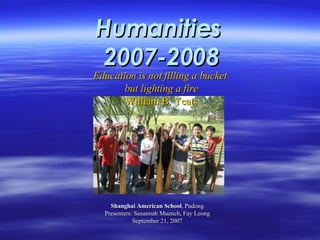
Shanghai American School , Pudong Presenters: Susannah Muench, Fay Leong September 21, 2007 Humanities  2007-2008 Education is not filling a bucket  but lighting a fire William B. Yeats
What is Humanities? history literature philosophy and ethics different cultures linguistics law archaeology comparative religion the history, theory, and criticism of the arts aspects of the social sciences (anthropology, sociology, psychology, political science, government, and economics)  Definition used by the U.S. Congress when the National Endowment for the Humanities was established in 1964
Why is it important? It encourages students to discuss, explore and reflect upon the following in an inter-disciplinary manner: The nature of basic values Issues that confront us as citizens and as human beings in life and in society
Why is it important? The various policies and practices that are proposed to address these issues The experiences and perceptions of others,  The ways in which time, place and culture affect attitudes and perceptions
It is the core of human values and experiences Without it we have no context for understanding our past, present or future, as individuals or as nations
Why combine SS and LA ? The needs of a new generation of students and thinkers The new requirements of the ever changing globalized workforce Subject integration is a key component of  life long learning
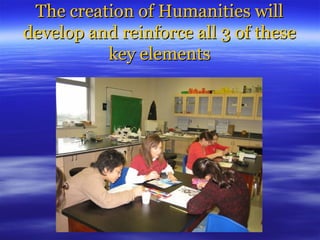
The creation of Humanities will develop and reinforce all 3 of these key elements
Overview of Grade 6 Curriculum Comprised of five themes that are linked together and reflect the learning process, a cycle of exploration, development, and growth.  The  program culminates with a final challenge for students to see themselves not just in their specific time and place, but in a broader global context.
Theme 3:  Foundations and Formations Theme 5:  This is Who We Are/  Here We Are Now Theme 2:  Stages of Development/ Rites of Passage Theme 1:  Where Are We From/  Where Are We Now? Theme 4:  Establishing Values, Beliefs  and Traditions  Grade 6 Humnities Curriculum Overview
Overview of Grade 7 Curriculum THEMES The Development of Identity The influence of religion on the development of cultures and society Trade and its impact on human development The connection between community and conflict and the role institutions play
7 th  Grade Texts “ Literature and Integrated Studies” by Scott Foresman Dragon Keeper, Carole Wilkinson (novel study) Catherine Called Birdy, (novel study) The Merchant of Venice (f ilm as text) Cry freedom (film as text) The Outsiders, S.E. Hinton (novel study)
What will Humanities at SAS Pudong look like? Grade 8 Quarterly breakdown
Theme 1: What is Evidence (2 weeks) Enduring Understandings: Problem-solving requires a systematic approach Information exists in a variety of forms All evidence has limitations Argument requires evidence Quarter  1  (9 weeks)
Students will be introduced and exposed to: the definition, categories and limitations of evidence.  a variety of written and visual forms of evidence.  They will engage with evidence through: a historical case study  a field trip investigation of the Shanghai streetscape.
Pi Day
Theme 2: Journeys (7 weeks) Enduring Understandings:  There are many types of journeys Everything we do has an impact on ourselves and on our environment Systems within an environment are interdependent Humans continually seek knowledge
Literature Study:  The Journal of Augustus Pelletier: The Lewis and Clark Expedition  by Kathryn Laskey Students will  investigate the concepts of journeys, exploration, challenges and courage  discuss the structural elements of plot and the use of figurative language  be introduced to basic economic concepts and systems through the study of imperialism between 1500 - 1900
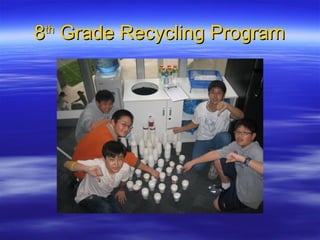
8 th  Grade Recycling Program
Quarter  2  (8 weeks) Theme 3: The Environment and Society Enduring Understandings: Everything we do has an impact on ourselves and on our environment Systems within an environment are interdependent Change is continual Human needs depend upon available resources
A multi-disciplinary Unit Students will explore the concepts of global issues consolidate research and writing skills develop areas of speech and debate be involved in real life connections between science, math, language arts and social studies.
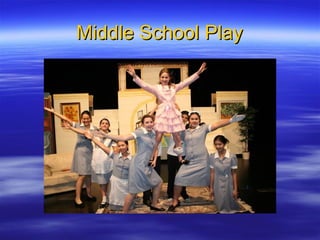
Middle School Play
Quarter 3  (9 weeks) Theme 4: Culture   Enduring Understandings:  Cultural Misconceptions are part of our past and present Cultural values and beliefs affect relations among individuals, groups, institutions, and political states. Cultural identity is determined by many factors
Literature Study: Rabbit Proof Fence  (Film as text) House on Mango Street Students will  analyze the impact of contact on indigenous civilizations investigate the themes  of family, personal identity, cultural identity and displacement  compare and contrast the effects of major colonizing movements across time experience the reality of the ‘melting pot’ and investigate the meaning of  E Pluribus Unum  (Out of the Many, One).
Model United Nations
Quarter 4  ( 9 weeks)   Theme 5: Human Rights   Enduring Understandings:  Change is continual Democracy is a process Democracy is not inherent
Literature Study:  The Giver Diary of Anne Frank Students will understand the rights of individuals compare and contrast the power of government vs the responsibility of the individual Analyze responsibility versus indifference and the impact of discrimination  engage in a a journey of self discovery
Encourages connections Allows for more authentic learning Can be designed to specifically meet the needs of our students, at this school, in this country Why integrate? Integration allows a theme based curriculum
Connections Fast connections : the mark of the ‘thinking’ learner Allow the learner to adapt and evolve within an every-changing environment “ Increasing proper connections among the brain’s neurons results in a better functioning brain…Without such connections, bits of information are isolated from the prior knowledge and are forgotten .”  Lowery, L. F., (2001)The biological basis for thinking. In Costa, A. L. (ed.) (2001).  Developing Minds: A Resource Book for Thinking . Virginia: ASCD. (p. 179)
Connections: A new focus on creative thinking “ In any self-organizing system there is an absolute mathematical necessity for creativity……. evidence suggests that the mind behaves as a self-organizing neural network ” De Bono, E (1994).  Teach your child how to think . New York: Penguin. (p. 16) Learning approaches need to focus on developing activities that focus on creative thinking in order to improve the efficiency of that network  Increased connections = a more efficient learner
Authentic learning The students of today need to be: responsible global citizens  skilled in decision making,  able to anticipate and find solutions for problems adaptable in a continuously changing environment compassionate,  mindful of ethical considerations and service to the community, and  self-directing.
Authentic learning: How can we create  a learning community ?   Primary motivators: curiosity  excitement of discovery  ownership
The SAS Humanities design: Connecting to authentic learning “ The challenge for educators is to link what we want to teach to what really matters to students ” Caine, G., Caine, R. N., & McClintic, C. (2002). Guiding the innate constructivist.  Educational Leadership .  September , (p.73). “ Nobody works harder at learning than a curious kid ”  Friedman, T. L. (2006).  The world is flat: The globalized world in the twenty-first century . London: Penguin (p.304).
The SAS Humanities design:  tailored to meet student needs Relevant curriculum allows: students to pursue answers to questions they have about themselves, content, and the world.  recognition of the holistic nature of all knowledge through the connections between subjects  National Middle School Association. (2003) . This we believe: Successful schools for young adolescents. Westerville, Ohio: NMSA  (p. 20)
So why integrate? Without personal meaning, effective learning cannot take place An integrated theme- based approach enhances connections and personal meaning
The Big Question Will my child have less of a foundation in SS and LA because of the integration of these disciplines? Reading lists – an example of an ancillary reading list Writing across the curriculum Reading across the curriculum Literacy block
Reading List  (an example from Theme 1) The Woman in White,  Wilkie Collins The Fall of the House of Usher,  Edgar Allan Poe  The Game of Sunken Places,  M.T. Anderson The Ghost in the Tokaido Inn,  Dorothy Hoobler The Hound of the Baskervilles,  Sir Arthur Conan Doyle I Know What You Did Last Summer,  Lois Duncan Paint by Magic: A time travel mystery,  Kathryn Reiss A Murder is Announced,  Agatha Christie Search for the Shadowman,  Joan Lowery Nixon The Square Root of Murder,  Paul Zindel A Study in Scarlet  (Sherlock Holmes),  Sir Arthur Conan Doyle
Writing across the curriculum The writing process Common rubrics based on the 6+1 Traits Reflections Research papers Essays
Reading across the curriculum Exposure to: Literature across the globe Journals Print media (newspapers, magazines) Critical analysis Reading methods (scanning, skimming)
Literacy block (Advisory Program) 1 day out of the 4 in the Advisory rotation schedule: The D.E.A.R (drop everything and read) program The Individual Project (grade 8) Written reflections
The great aim of education is not knowledge, but action.   Herbert Spencer

Humanities

  • 1.
    Shanghai American School, Pudong Presenters: Susannah Muench, Fay Leong September 21, 2007 Humanities 2007-2008 Education is not filling a bucket but lighting a fire William B. Yeats
  • 2.
    What is Humanities?history literature philosophy and ethics different cultures linguistics law archaeology comparative religion the history, theory, and criticism of the arts aspects of the social sciences (anthropology, sociology, psychology, political science, government, and economics) Definition used by the U.S. Congress when the National Endowment for the Humanities was established in 1964
  • 3.
    Why is itimportant? It encourages students to discuss, explore and reflect upon the following in an inter-disciplinary manner: The nature of basic values Issues that confront us as citizens and as human beings in life and in society
  • 4.
    Why is itimportant? The various policies and practices that are proposed to address these issues The experiences and perceptions of others, The ways in which time, place and culture affect attitudes and perceptions
  • 5.
    It is thecore of human values and experiences Without it we have no context for understanding our past, present or future, as individuals or as nations
  • 6.
    Why combine SSand LA ? The needs of a new generation of students and thinkers The new requirements of the ever changing globalized workforce Subject integration is a key component of life long learning
  • 7.
    The creation ofHumanities will develop and reinforce all 3 of these key elements
  • 8.
    Overview of Grade6 Curriculum Comprised of five themes that are linked together and reflect the learning process, a cycle of exploration, development, and growth. The program culminates with a final challenge for students to see themselves not just in their specific time and place, but in a broader global context.
  • 9.
    Theme 3: Foundations and Formations Theme 5: This is Who We Are/ Here We Are Now Theme 2: Stages of Development/ Rites of Passage Theme 1: Where Are We From/ Where Are We Now? Theme 4: Establishing Values, Beliefs and Traditions Grade 6 Humnities Curriculum Overview
  • 10.
    Overview of Grade7 Curriculum THEMES The Development of Identity The influence of religion on the development of cultures and society Trade and its impact on human development The connection between community and conflict and the role institutions play
  • 11.
    7 th Grade Texts “ Literature and Integrated Studies” by Scott Foresman Dragon Keeper, Carole Wilkinson (novel study) Catherine Called Birdy, (novel study) The Merchant of Venice (f ilm as text) Cry freedom (film as text) The Outsiders, S.E. Hinton (novel study)
  • 12.
    What will Humanitiesat SAS Pudong look like? Grade 8 Quarterly breakdown
  • 13.
    Theme 1: Whatis Evidence (2 weeks) Enduring Understandings: Problem-solving requires a systematic approach Information exists in a variety of forms All evidence has limitations Argument requires evidence Quarter 1 (9 weeks)
  • 14.
    Students will beintroduced and exposed to: the definition, categories and limitations of evidence. a variety of written and visual forms of evidence. They will engage with evidence through: a historical case study a field trip investigation of the Shanghai streetscape.
  • 15.
  • 16.
    Theme 2: Journeys(7 weeks) Enduring Understandings: There are many types of journeys Everything we do has an impact on ourselves and on our environment Systems within an environment are interdependent Humans continually seek knowledge
  • 17.
    Literature Study: The Journal of Augustus Pelletier: The Lewis and Clark Expedition by Kathryn Laskey Students will investigate the concepts of journeys, exploration, challenges and courage discuss the structural elements of plot and the use of figurative language be introduced to basic economic concepts and systems through the study of imperialism between 1500 - 1900
  • 18.
    8 th Grade Recycling Program
  • 19.
    Quarter 2 (8 weeks) Theme 3: The Environment and Society Enduring Understandings: Everything we do has an impact on ourselves and on our environment Systems within an environment are interdependent Change is continual Human needs depend upon available resources
  • 20.
    A multi-disciplinary UnitStudents will explore the concepts of global issues consolidate research and writing skills develop areas of speech and debate be involved in real life connections between science, math, language arts and social studies.
  • 21.
  • 22.
    Quarter 3 (9 weeks) Theme 4: Culture Enduring Understandings: Cultural Misconceptions are part of our past and present Cultural values and beliefs affect relations among individuals, groups, institutions, and political states. Cultural identity is determined by many factors
  • 23.
    Literature Study: RabbitProof Fence (Film as text) House on Mango Street Students will analyze the impact of contact on indigenous civilizations investigate the themes of family, personal identity, cultural identity and displacement compare and contrast the effects of major colonizing movements across time experience the reality of the ‘melting pot’ and investigate the meaning of E Pluribus Unum (Out of the Many, One).
  • 24.
  • 25.
    Quarter 4 ( 9 weeks) Theme 5: Human Rights Enduring Understandings: Change is continual Democracy is a process Democracy is not inherent
  • 26.
    Literature Study: The Giver Diary of Anne Frank Students will understand the rights of individuals compare and contrast the power of government vs the responsibility of the individual Analyze responsibility versus indifference and the impact of discrimination engage in a a journey of self discovery
  • 27.
    Encourages connections Allowsfor more authentic learning Can be designed to specifically meet the needs of our students, at this school, in this country Why integrate? Integration allows a theme based curriculum
  • 28.
    Connections Fast connections: the mark of the ‘thinking’ learner Allow the learner to adapt and evolve within an every-changing environment “ Increasing proper connections among the brain’s neurons results in a better functioning brain…Without such connections, bits of information are isolated from the prior knowledge and are forgotten .” Lowery, L. F., (2001)The biological basis for thinking. In Costa, A. L. (ed.) (2001). Developing Minds: A Resource Book for Thinking . Virginia: ASCD. (p. 179)
  • 29.
    Connections: A newfocus on creative thinking “ In any self-organizing system there is an absolute mathematical necessity for creativity……. evidence suggests that the mind behaves as a self-organizing neural network ” De Bono, E (1994). Teach your child how to think . New York: Penguin. (p. 16) Learning approaches need to focus on developing activities that focus on creative thinking in order to improve the efficiency of that network Increased connections = a more efficient learner
  • 30.
    Authentic learning Thestudents of today need to be: responsible global citizens skilled in decision making, able to anticipate and find solutions for problems adaptable in a continuously changing environment compassionate, mindful of ethical considerations and service to the community, and self-directing.
  • 31.
    Authentic learning: Howcan we create a learning community ? Primary motivators: curiosity excitement of discovery ownership
  • 32.
    The SAS Humanitiesdesign: Connecting to authentic learning “ The challenge for educators is to link what we want to teach to what really matters to students ” Caine, G., Caine, R. N., & McClintic, C. (2002). Guiding the innate constructivist. Educational Leadership . September , (p.73). “ Nobody works harder at learning than a curious kid ” Friedman, T. L. (2006). The world is flat: The globalized world in the twenty-first century . London: Penguin (p.304).
  • 33.
    The SAS Humanitiesdesign: tailored to meet student needs Relevant curriculum allows: students to pursue answers to questions they have about themselves, content, and the world. recognition of the holistic nature of all knowledge through the connections between subjects National Middle School Association. (2003) . This we believe: Successful schools for young adolescents. Westerville, Ohio: NMSA (p. 20)
  • 34.
    So why integrate?Without personal meaning, effective learning cannot take place An integrated theme- based approach enhances connections and personal meaning
  • 35.
    The Big QuestionWill my child have less of a foundation in SS and LA because of the integration of these disciplines? Reading lists – an example of an ancillary reading list Writing across the curriculum Reading across the curriculum Literacy block
  • 36.
    Reading List (an example from Theme 1) The Woman in White, Wilkie Collins The Fall of the House of Usher, Edgar Allan Poe The Game of Sunken Places, M.T. Anderson The Ghost in the Tokaido Inn, Dorothy Hoobler The Hound of the Baskervilles, Sir Arthur Conan Doyle I Know What You Did Last Summer, Lois Duncan Paint by Magic: A time travel mystery, Kathryn Reiss A Murder is Announced, Agatha Christie Search for the Shadowman, Joan Lowery Nixon The Square Root of Murder, Paul Zindel A Study in Scarlet (Sherlock Holmes), Sir Arthur Conan Doyle
  • 37.
    Writing across thecurriculum The writing process Common rubrics based on the 6+1 Traits Reflections Research papers Essays
  • 38.
    Reading across thecurriculum Exposure to: Literature across the globe Journals Print media (newspapers, magazines) Critical analysis Reading methods (scanning, skimming)
  • 39.
    Literacy block (AdvisoryProgram) 1 day out of the 4 in the Advisory rotation schedule: The D.E.A.R (drop everything and read) program The Individual Project (grade 8) Written reflections
  • 40.
    The great aimof education is not knowledge, but action. Herbert Spencer