 Academic disciplines that study the human condition, using
  methods that are primarily analytical, critical, or speculative, as
  distinguished from the mainly empirical approaches of the natural
  sciences.
 The humanities include…
      Ancient and Modern Languages
      Literature
      History
      Philosophy
      Religion
      Visual and Performing Arts
 The humanities that are also regarded
  as social sciences include…
      History
      Anthropology
      Area Studies
      Communication Studies
      Cultural Studies
      Law
 The word "humanities" is derived from the Renaissance
  Latin expression studia humanitatis, or "study of
  humanitas” (a classical Latin word meaning
  “humanity, culture, refinement, education"
  and, specifically, an "education befitting a cultivated
  man").
 Early 15th century, the studia
  humanitatis was a course of studies
  consisting of
  grammar, poetry,                           rhetoric, history
  , and moral
  philosophy, primarily derived                     from the
  study of Latin and Greek                         classics.
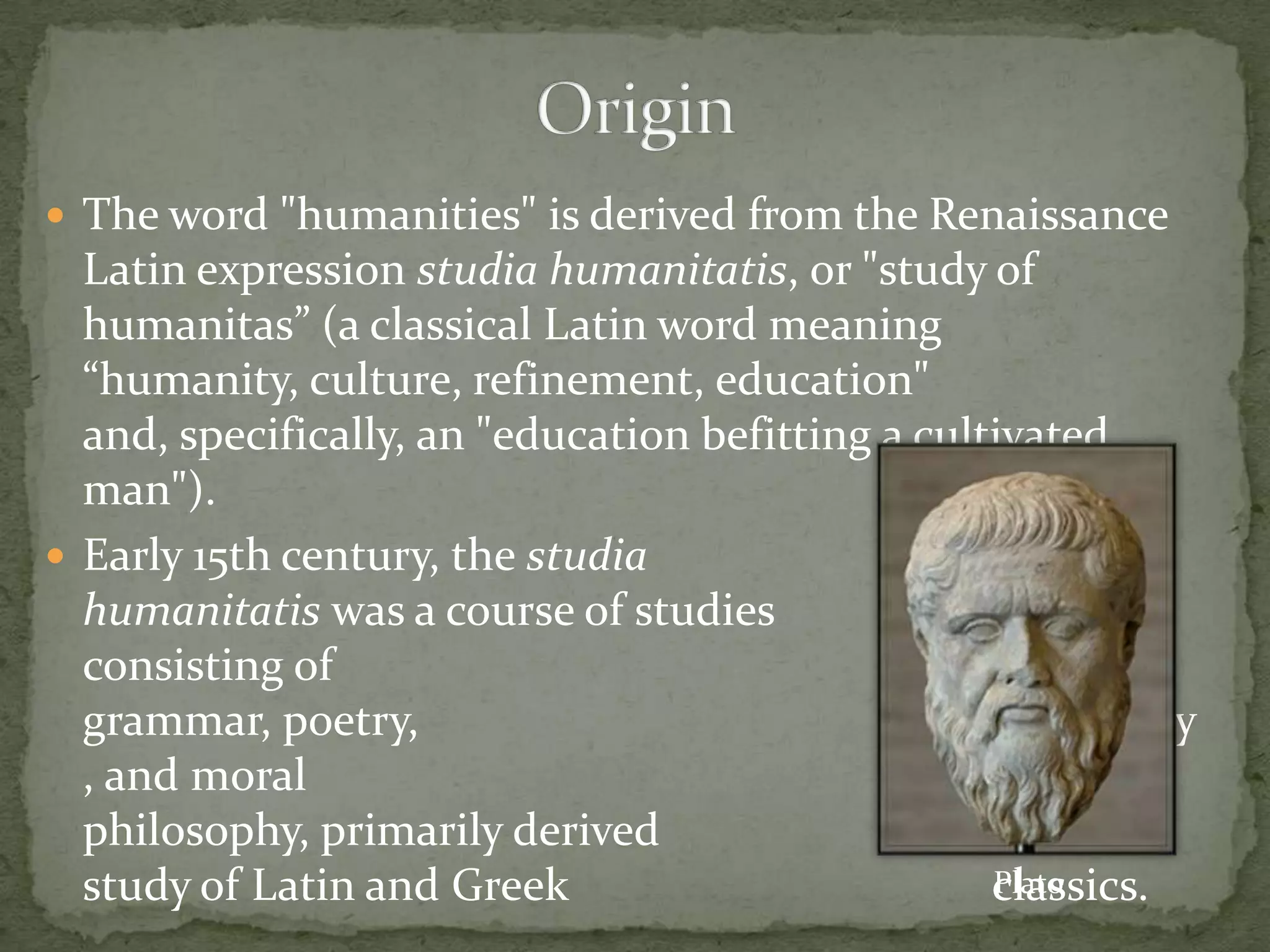
                                                   Plato
 The humanities can be traced to ancient Greece, as the
    basis of a broad education for citizens.
   During Roman times, the concept of                    the
    seven liberal arts evolved, including…
   Grammar, Rhetoric and Logic (the
    Trivium)
   Arithmetic, Geometry, Astronomy and
    Music (the Quadrivium)
   These subjects formed the bulk of
    medieval education
   A major shift occurred with the
    Renaissance when the humanities began to be regarded as
    subjects to be studied rather than practiced, with a
    corresponding shift away from the traditional fields into
    areas such as literature and history.
 Humanities as a field of study deals with questions for
  which there are no definitive answers.
 Ex: What is justice? The nature of friendship? The
  essence of God? The properties of truth?

 While scholars in this field certainly hope
  to address these questions in ways that are compelling
  and authoritative, they don't write first
  and foremost to establish consensus among
  their peers. In other words, they do not
  expect to create in their work a
  reliable,          scientific truth. (Dartmouth)
 Purpose - to explore the human condition through
 critical analysis of written and visual texts

 Evidence – is textual with
 close critical reading and
 interpretation of texts

 Pattern of Discourse - a writer makes a claim, supports
 that claim with textual evidence, and then discusses
 the significance of the passage he has just quoted. This
 pattern of claim / textual support / discussion is
 repeated again and again until the writer feels that the
 argument has been successfully made. (Dartmouth)
 Every discipline has a preferred writing style.
 In the Humanities…
   Paragraphs are longer.
   Sentences are longer, too - and
      more eloquent.
     Parallel structure is used to
      navigate long, complex thoughts.
     Imagery and metaphors are
      abundant.
     Active, not passive, voice is most often employed.
     Language and the way it is used in a paper is nearly as
      important as that paper's content. (Dartmouth)

The humanities

  • 2.
     Academic disciplinesthat study the human condition, using methods that are primarily analytical, critical, or speculative, as distinguished from the mainly empirical approaches of the natural sciences.  The humanities include…  Ancient and Modern Languages  Literature  History  Philosophy  Religion  Visual and Performing Arts  The humanities that are also regarded as social sciences include…  History  Anthropology  Area Studies  Communication Studies  Cultural Studies  Law
  • 3.
     The word"humanities" is derived from the Renaissance Latin expression studia humanitatis, or "study of humanitas” (a classical Latin word meaning “humanity, culture, refinement, education" and, specifically, an "education befitting a cultivated man").  Early 15th century, the studia humanitatis was a course of studies consisting of grammar, poetry, rhetoric, history , and moral philosophy, primarily derived from the study of Latin and Greek classics. Plato
  • 4.
     The humanitiescan be traced to ancient Greece, as the basis of a broad education for citizens.  During Roman times, the concept of the seven liberal arts evolved, including…  Grammar, Rhetoric and Logic (the Trivium)  Arithmetic, Geometry, Astronomy and Music (the Quadrivium)  These subjects formed the bulk of medieval education  A major shift occurred with the Renaissance when the humanities began to be regarded as subjects to be studied rather than practiced, with a corresponding shift away from the traditional fields into areas such as literature and history.
  • 5.
     Humanities asa field of study deals with questions for which there are no definitive answers.  Ex: What is justice? The nature of friendship? The essence of God? The properties of truth?  While scholars in this field certainly hope to address these questions in ways that are compelling and authoritative, they don't write first and foremost to establish consensus among their peers. In other words, they do not expect to create in their work a reliable, scientific truth. (Dartmouth)
  • 6.
     Purpose -to explore the human condition through critical analysis of written and visual texts  Evidence – is textual with close critical reading and interpretation of texts  Pattern of Discourse - a writer makes a claim, supports that claim with textual evidence, and then discusses the significance of the passage he has just quoted. This pattern of claim / textual support / discussion is repeated again and again until the writer feels that the argument has been successfully made. (Dartmouth)
  • 7.
     Every disciplinehas a preferred writing style.  In the Humanities…  Paragraphs are longer.  Sentences are longer, too - and more eloquent.  Parallel structure is used to navigate long, complex thoughts.  Imagery and metaphors are abundant.  Active, not passive, voice is most often employed.  Language and the way it is used in a paper is nearly as important as that paper's content. (Dartmouth)