Why Graphics is Fast,
and what it can teach us about
    parallel programming
      Jonathan Ragan-Kelley, MIT
 7 December 2009, University College London
       13 November 2009, Harvard
(me)
PhD student at MIT
with Frédo Durand, Saman Amarasinghe

Previously
Stanford
Industrial Light + Magic
The Lightspeed Automatic Interactive Lighting Preview System
(SIGGRAPH 2007)
NVIDIA, ATI
Decoupled Sampling for Real-Time Graphics Pipelines
(ACM Transactions on Graphics 2010)
Intel
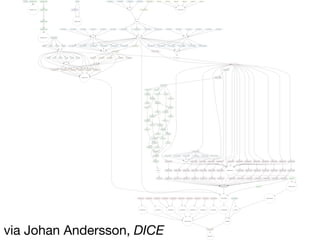
1 game frame
via Johan Andersson, DICE
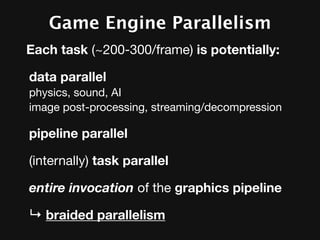
Game Engine Parallelism
Each task (~200-300/frame) is potentially:

data parallel
physics, sound, AI
image post-processing, streaming/decompression

pipeline parallel

(internally) task parallel

entire invocation of the graphics pipeline

↳ braided parallelism
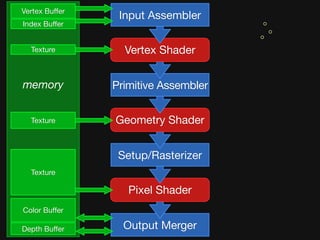
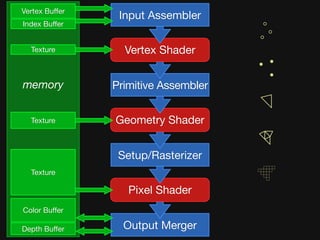
The Graphics Pipeline
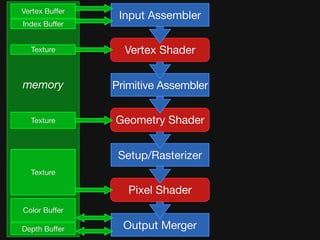
Vertex Buffer
                 Input Assembler
Index Buffer


  Texture         Vertex Shader


memory          Primitive Assembler


  Texture       Geometry Shader


                 Setup/Rasterizer
  Texture

                   Pixel Shader
Color Buffer

Depth Buffer      Output Merger
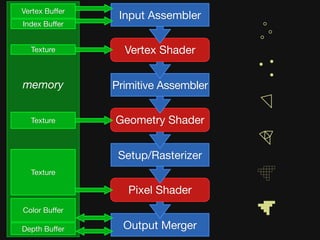
Vertex Buffer
                 Input Assembler
Index Buffer


  Texture         Vertex Shader


memory          Primitive Assembler


  Texture       Geometry Shader


                 Setup/Rasterizer
  Texture

                   Pixel Shader
Color Buffer

Depth Buffer      Output Merger
Vertex Buffer
                 Input Assembler
Index Buffer


  Texture         Vertex Shader


memory          Primitive Assembler


  Texture       Geometry Shader


                 Setup/Rasterizer
  Texture

                   Pixel Shader
Color Buffer

Depth Buffer      Output Merger
Vertex Buffer
                 Input Assembler
Index Buffer


  Texture         Vertex Shader


memory          Primitive Assembler


  Texture       Geometry Shader


                 Setup/Rasterizer
  Texture

                   Pixel Shader
Color Buffer

Depth Buffer      Output Merger
Vertex Buffer
                 Input Assembler
Index Buffer


  Texture         Vertex Shader


memory          Primitive Assembler


  Texture       Geometry Shader


                 Setup/Rasterizer
  Texture

                   Pixel Shader
Color Buffer

Depth Buffer      Output Merger
Vertex Buffer
                 Input Assembler
Index Buffer


  Texture         Vertex Shader


memory          Primitive Assembler


  Texture       Geometry Shader


                 Setup/Rasterizer
  Texture

                   Pixel Shader
Color Buffer

Depth Buffer      Output Merger
Vertex Buffer
                 Input Assembler
Index Buffer


  Texture         Vertex Shader


memory          Primitive Assembler


  Texture       Geometry Shader


                 Setup/Rasterizer
  Texture

                   Pixel Shader
Color Buffer

Depth Buffer      Output Merger
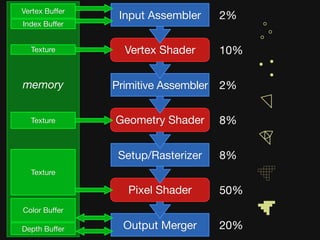
Vertex Buffer
                 Input Assembler      2%
Index Buffer


  Texture         Vertex Shader       10%


memory          Primitive Assembler   2%


  Texture       Geometry Shader       8%


                 Setup/Rasterizer     8%
  Texture

                   Pixel Shader       50%
Color Buffer

Depth Buffer      Output Merger       20%
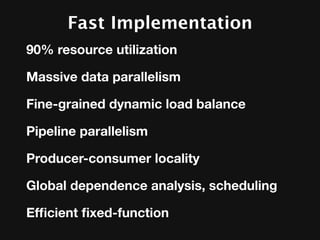
Fast Implementation
90% resource utilization

Massive data parallelism

Fine-grained dynamic load balance

Pipeline parallelism

Producer-consumer locality

Global dependence analysis, scheduling

Efficient fixed-function
Local Parallelism
Shader Execution Model
Highly data-parallel
vertices, primitives, fragments, pixels

Hierarchical parallelism
Instruction bandwidth: SIMD ALUs
Pipeline latency: vector execution/software pipelining
Unpredictable latency: hardware multithreading
Memory latency: dynamic threading/fibering
Task independence: multicore

Regular input, output
Marshaling/unmarshaling from data structures
handled in “fixed-function” for efficiency
Shader Implementation
Hardware shader architecture (GPU)
static SIMD warps
many dynamic hardware threads, tens of cores
fine-grained dynamic load balance
many kernels, types simultaneously
heuristic knowledge of specific pipeline

Software shader architecture (Larrabee)
similar static SIMD, inside dynamic latency-hiding,
inside many-core
threading via software fibering (microthreads),
software scheduling
Shader Stage-specific Variation
Vertex
less latency hiding needed,
so use less local memory,
[perhaps] no dynamic fibering (simpler schedule).

Geometry
variable output.
more state = less parallelism,
but (hopefully) need less latency hiding.

Fragment
derivatives → neighborhood communication.
texture intensive → more (dynamic) latency hiding.
Fixed-function Stages
[Input,Primitive] Assembly
Hairy finite state machine
Indirect indexing

Rasterization
Locally data-parallel (~16xSIMD), No memory access
Globally branchy, incremental, hierarchical

Output Merge
Really data-parallel, but ordered read-modify-write
Implicit data amplification (for antialiasing)
Pipeline Implementation
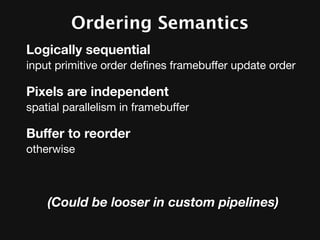
Ordering Semantics
Logically sequential
input primitive order defines framebuffer update order

Pixels are independent
spatial parallelism in framebuffer

Buffer to reorder
otherwise


    (Could be looser in custom pipelines)
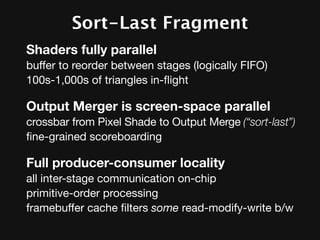
Sort-Last Fragment
Shaders fully parallel
buffer to reorder between stages (logically FIFO)
100s-1,000s of triangles in-flight

Output Merger is screen-space parallel
crossbar from Pixel Shade to Output Merge (“sort-last”)
fine-grained scoreboarding

Full producer-consumer locality
all inter-stage communication on-chip
primitive-order processing
framebuffer cache filters some read-modify-write b/w
Sort-Middle
Front-end: transform/vertex processing
Scatter all geometry to screen-space tiles

Merge sort (through memory)
Maintain primitive order

Back-end: pixel processing
In-order (per-pixel)
scoreboard per-pixel → screen-space parallelism
One tile per-core
framebuffer data in local store
one scheduler, several worker [hardware] threads collaborating
Pixel Shader + Output Merge together
lower scheduling overhead
return to task system
        to put back in
        context.

        reinforce braided
        nature.


Game Frame
Existing Models
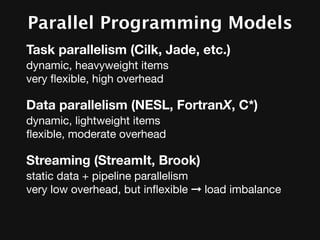
Parallel Programming Models
Task parallelism (Cilk, Jade, etc.)
dynamic, heavyweight items
very flexible, high overhead

Data parallelism (NESL, FortranX, C*)
dynamic, lightweight items
flexible, moderate overhead

Streaming (StreamIt, Brook)
static data + pipeline parallelism
very low overhead, but inflexible ➞ load imbalance
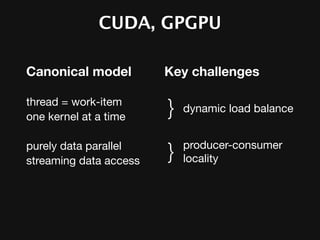
CUDA, GPGPU

Canonical model         Key challenges

thread = work-item
one kernel at a time
                        }   dynamic load balance


purely data parallel
streaming data access
                        }   producer-consumer
                            locality
Future directions
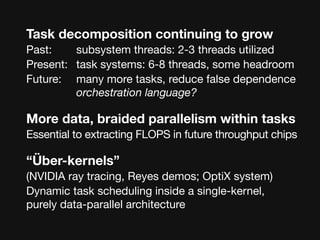
Task decomposition continuing to grow
Past:	 	 subsystem threads: 2-3 threads utilized
Present: 	 task systems: 6-8 threads, some headroom
Future: 

 many more tasks, reduce false dependence

        
 orchestration language?

More data, braided parallelism within tasks
Essential to extracting FLOPS in future throughput chips

“Über-kernels”
(NVIDIA ray tracing, Reyes demos; OptiX system)
Dynamic task scheduling inside a single-kernel,
purely data-parallel architecture
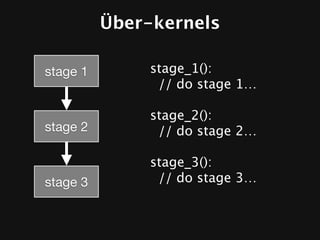
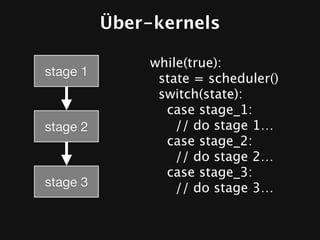
Über-kernels

stage 1       stage_1():
               // do stage 1…

              stage_2():
stage 2        // do stage 2…

              stage_3():
stage 3        // do stage 3…
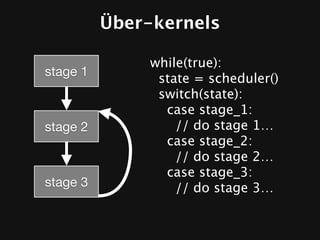
Über-kernels

              while(true):
stage 1
               state = scheduler()
               switch(state):
                case stage_1:
stage 2           // do stage 1…
                case stage_2:
                  // do stage 2…
                case stage_3:
stage 3           // do stage 3…
Über-kernels

              while(true):
stage 1
               state = scheduler()
               switch(state):
                case stage_1:
stage 2           // do stage 1…
                case stage_2:
                  // do stage 2…
                case stage_3:
stage 3           // do stage 3…
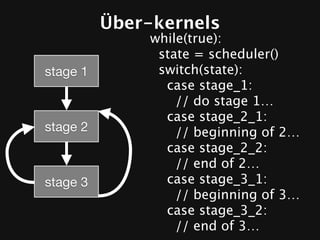
Über-kernels
              while(true):
               state = scheduler()
stage 1        switch(state):
                case stage_1:
                  // do stage 1…
                case stage_2_1:
stage 2           // beginning of 2…
                case stage_2_2:
                  // end of 2…
stage 3         case stage_3_1:
                  // beginning of 3…
                case stage_3_2:
                  // end of 3…
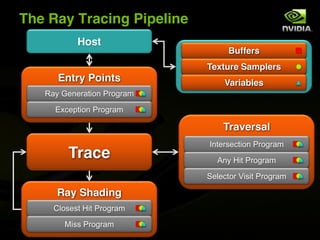
The Ray Tracing Pipeline
           Host
                                 Buffers
                            Texture Samplers
      Entry Points              Variables
   Ray Generation Program

     Exception Program

                                Traversal
                            Intersection Program
        Trace                 Any Hit Program

                            Selector Visit Program

     Ray Shading
     Closest Hit Program

       Miss Program
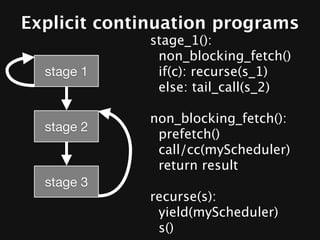
Explicit continuation programs
             stage_1():
              non_blocking_fetch()
 stage 1      if(c): recurse(s_1)
              else: tail_call(s_2)

             non_blocking_fetch():
 stage 2
              prefetch()
              call/cc(myScheduler)
              return result
 stage 3
             recurse(s):
              yield(myScheduler)
              s()
Acknowledgements
CPS ideas
Tim Foley, Mark Lacey, Mark Leone - Intel

General Discussion
Saman Amarasinghe, Frédo Durand - MIT
Solomon Boulos, Kurt Akeley - Stanford/MSR

OptiX details, slides
Austin Robison, Steve Parker - NVIDIA

Current game-engine details, figures
Johan Andersson - DICE
extras
Need
Locality
across many (potentially competing) axes
application-specific scheduling knowledge
autotuning for complex optimization space?

Braids of parallelism
data-parallelism
static - SIMD, extreme arithmetic intensity
dynamic - latency hiding
task parallelism
static - pipelines)
dynamic - to add dynamism to data-parallel layer
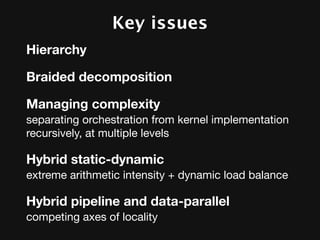
Key issues
Hierarchy

Braided decomposition

Managing complexity
separating orchestration from kernel implementation
recursively, at multiple levels

Hybrid static-dynamic
extreme arithmetic intensity + dynamic load balance

Hybrid pipeline and data-parallel
competing axes of locality
Task Optimization
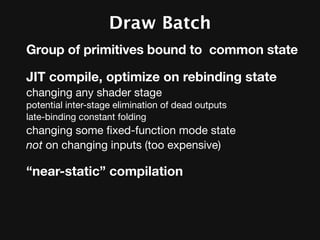
Draw Batch
Group of primitives bound to common state

JIT compile, optimize on rebinding state
changing any shader stage
potential inter-stage elimination of dead outputs
late-binding constant folding
changing some fixed-function mode state
not on changing inputs (too expensive)

“near-static” compilation
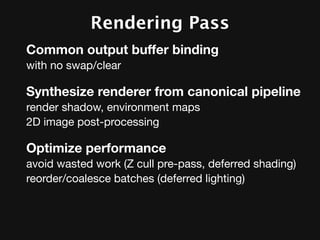
Rendering Pass
Common output buffer binding
with no swap/clear

Synthesize renderer from canonical pipeline
render shadow, environment maps
2D image post-processing

Optimize performance
avoid wasted work (Z cull pre-pass, deferred shading)
reorder/coalesce batches (deferred lighting)
Inter-pass Optimization
Buffers never consumed
keep in scratchpad
“fast clear”
use optimized/native formats
resolve antialiasing before write-out

Passes overlapped
no startup/wind-down bubbles

Pass folding
e.g. merge 2D post-processing into back-end stage,
on local tile memory
Control vs. Data-Dependence
Simple task graph has control dependence
between stages

D3D scheduling based on resource (data)
dependence, not control dependence
‣Finer-grained scheduling
‣Fewer false hazards
Generalize to whole engine core?
AI, sound
Physics: rigid, soft, IK, cloth, particles, fracture
Core principles
                                     TODO: update

Hierarchical parallelism
Shader-style data-parallel kernels
Kernel fusion/global optimization

Separate kernel and orchestration
Separate-but-connected languages/runtime models

Resource-based scheduling

Application-specific/user-controlled
scheduling and memory management

Why Graphics Is Fast, and What It Can Teach Us About Parallel Programming

  • 1.
    Why Graphics isFast, and what it can teach us about parallel programming Jonathan Ragan-Kelley, MIT 7 December 2009, University College London 13 November 2009, Harvard
  • 2.
    (me) PhD student atMIT with Frédo Durand, Saman Amarasinghe Previously Stanford Industrial Light + Magic The Lightspeed Automatic Interactive Lighting Preview System (SIGGRAPH 2007) NVIDIA, ATI Decoupled Sampling for Real-Time Graphics Pipelines (ACM Transactions on Graphics 2010) Intel
  • 3.
  • 4.
  • 5.
  • 6.
    Game Engine Parallelism Eachtask (~200-300/frame) is potentially: data parallel physics, sound, AI image post-processing, streaming/decompression pipeline parallel (internally) task parallel entire invocation of the graphics pipeline ↳ braided parallelism
  • 7.
  • 8.
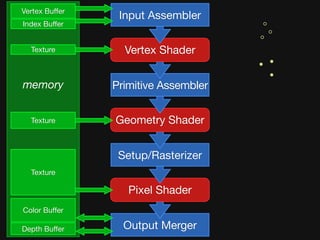
    Vertex Buffer Input Assembler Index Buffer Texture Vertex Shader memory Primitive Assembler Texture Geometry Shader Setup/Rasterizer Texture Pixel Shader Color Buffer Depth Buffer Output Merger
  • 9.
    Vertex Buffer Input Assembler Index Buffer Texture Vertex Shader memory Primitive Assembler Texture Geometry Shader Setup/Rasterizer Texture Pixel Shader Color Buffer Depth Buffer Output Merger
  • 10.
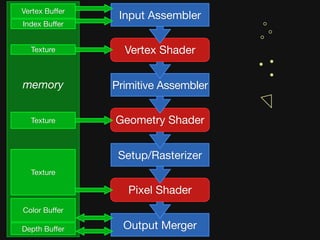
    Vertex Buffer Input Assembler Index Buffer Texture Vertex Shader memory Primitive Assembler Texture Geometry Shader Setup/Rasterizer Texture Pixel Shader Color Buffer Depth Buffer Output Merger
  • 11.
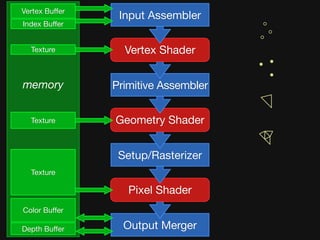
    Vertex Buffer Input Assembler Index Buffer Texture Vertex Shader memory Primitive Assembler Texture Geometry Shader Setup/Rasterizer Texture Pixel Shader Color Buffer Depth Buffer Output Merger
  • 12.
    Vertex Buffer Input Assembler Index Buffer Texture Vertex Shader memory Primitive Assembler Texture Geometry Shader Setup/Rasterizer Texture Pixel Shader Color Buffer Depth Buffer Output Merger
  • 13.
    Vertex Buffer Input Assembler Index Buffer Texture Vertex Shader memory Primitive Assembler Texture Geometry Shader Setup/Rasterizer Texture Pixel Shader Color Buffer Depth Buffer Output Merger
  • 14.
    Vertex Buffer Input Assembler Index Buffer Texture Vertex Shader memory Primitive Assembler Texture Geometry Shader Setup/Rasterizer Texture Pixel Shader Color Buffer Depth Buffer Output Merger
  • 15.
    Vertex Buffer Input Assembler 2% Index Buffer Texture Vertex Shader 10% memory Primitive Assembler 2% Texture Geometry Shader 8% Setup/Rasterizer 8% Texture Pixel Shader 50% Color Buffer Depth Buffer Output Merger 20%
  • 16.
    Fast Implementation 90% resourceutilization Massive data parallelism Fine-grained dynamic load balance Pipeline parallelism Producer-consumer locality Global dependence analysis, scheduling Efficient fixed-function
  • 17.
  • 18.
    Shader Execution Model Highlydata-parallel vertices, primitives, fragments, pixels Hierarchical parallelism Instruction bandwidth: SIMD ALUs Pipeline latency: vector execution/software pipelining Unpredictable latency: hardware multithreading Memory latency: dynamic threading/fibering Task independence: multicore Regular input, output Marshaling/unmarshaling from data structures handled in “fixed-function” for efficiency
  • 19.
    Shader Implementation Hardware shaderarchitecture (GPU) static SIMD warps many dynamic hardware threads, tens of cores fine-grained dynamic load balance many kernels, types simultaneously heuristic knowledge of specific pipeline Software shader architecture (Larrabee) similar static SIMD, inside dynamic latency-hiding, inside many-core threading via software fibering (microthreads), software scheduling
  • 20.
    Shader Stage-specific Variation Vertex lesslatency hiding needed, so use less local memory, [perhaps] no dynamic fibering (simpler schedule). Geometry variable output. more state = less parallelism, but (hopefully) need less latency hiding. Fragment derivatives → neighborhood communication. texture intensive → more (dynamic) latency hiding.
  • 21.
    Fixed-function Stages [Input,Primitive] Assembly Hairyfinite state machine Indirect indexing Rasterization Locally data-parallel (~16xSIMD), No memory access Globally branchy, incremental, hierarchical Output Merge Really data-parallel, but ordered read-modify-write Implicit data amplification (for antialiasing)
  • 22.
  • 23.
    Ordering Semantics Logically sequential inputprimitive order defines framebuffer update order Pixels are independent spatial parallelism in framebuffer Buffer to reorder otherwise (Could be looser in custom pipelines)
  • 24.
    Sort-Last Fragment Shaders fullyparallel buffer to reorder between stages (logically FIFO) 100s-1,000s of triangles in-flight Output Merger is screen-space parallel crossbar from Pixel Shade to Output Merge (“sort-last”) fine-grained scoreboarding Full producer-consumer locality all inter-stage communication on-chip primitive-order processing framebuffer cache filters some read-modify-write b/w
  • 25.
    Sort-Middle Front-end: transform/vertex processing Scatterall geometry to screen-space tiles Merge sort (through memory) Maintain primitive order Back-end: pixel processing In-order (per-pixel) scoreboard per-pixel → screen-space parallelism One tile per-core framebuffer data in local store one scheduler, several worker [hardware] threads collaborating Pixel Shader + Output Merge together lower scheduling overhead
  • 26.
    return to tasksystem to put back in context. reinforce braided nature. Game Frame
  • 28.
  • 29.
    Parallel Programming Models Taskparallelism (Cilk, Jade, etc.) dynamic, heavyweight items very flexible, high overhead Data parallelism (NESL, FortranX, C*) dynamic, lightweight items flexible, moderate overhead Streaming (StreamIt, Brook) static data + pipeline parallelism very low overhead, but inflexible ➞ load imbalance
  • 30.
    CUDA, GPGPU Canonical model Key challenges thread = work-item one kernel at a time } dynamic load balance purely data parallel streaming data access } producer-consumer locality
  • 31.
  • 32.
    Task decomposition continuingto grow Past: subsystem threads: 2-3 threads utilized Present: task systems: 6-8 threads, some headroom Future: many more tasks, reduce false dependence orchestration language? More data, braided parallelism within tasks Essential to extracting FLOPS in future throughput chips “Über-kernels” (NVIDIA ray tracing, Reyes demos; OptiX system) Dynamic task scheduling inside a single-kernel, purely data-parallel architecture
  • 33.
    Über-kernels stage 1 stage_1(): // do stage 1… stage_2(): stage 2 // do stage 2… stage_3(): stage 3 // do stage 3…
  • 34.
    Über-kernels while(true): stage 1 state = scheduler() switch(state): case stage_1: stage 2 // do stage 1… case stage_2: // do stage 2… case stage_3: stage 3 // do stage 3…
  • 35.
    Über-kernels while(true): stage 1 state = scheduler() switch(state): case stage_1: stage 2 // do stage 1… case stage_2: // do stage 2… case stage_3: stage 3 // do stage 3…
  • 36.
    Über-kernels while(true): state = scheduler() stage 1 switch(state): case stage_1: // do stage 1… case stage_2_1: stage 2 // beginning of 2… case stage_2_2: // end of 2… stage 3 case stage_3_1: // beginning of 3… case stage_3_2: // end of 3…
  • 37.
    The Ray TracingPipeline Host Buffers Texture Samplers Entry Points Variables Ray Generation Program Exception Program Traversal Intersection Program Trace Any Hit Program Selector Visit Program Ray Shading Closest Hit Program Miss Program
  • 38.
    Explicit continuation programs stage_1(): non_blocking_fetch() stage 1 if(c): recurse(s_1) else: tail_call(s_2) non_blocking_fetch(): stage 2 prefetch() call/cc(myScheduler) return result stage 3 recurse(s): yield(myScheduler) s()
  • 39.
    Acknowledgements CPS ideas Tim Foley,Mark Lacey, Mark Leone - Intel General Discussion Saman Amarasinghe, Frédo Durand - MIT Solomon Boulos, Kurt Akeley - Stanford/MSR OptiX details, slides Austin Robison, Steve Parker - NVIDIA Current game-engine details, figures Johan Andersson - DICE
  • 40.
  • 41.
    Need Locality across many (potentiallycompeting) axes application-specific scheduling knowledge autotuning for complex optimization space? Braids of parallelism data-parallelism static - SIMD, extreme arithmetic intensity dynamic - latency hiding task parallelism static - pipelines) dynamic - to add dynamism to data-parallel layer
  • 42.
    Key issues Hierarchy Braided decomposition Managingcomplexity separating orchestration from kernel implementation recursively, at multiple levels Hybrid static-dynamic extreme arithmetic intensity + dynamic load balance Hybrid pipeline and data-parallel competing axes of locality
  • 43.
  • 44.
    Draw Batch Group ofprimitives bound to common state JIT compile, optimize on rebinding state changing any shader stage potential inter-stage elimination of dead outputs late-binding constant folding changing some fixed-function mode state not on changing inputs (too expensive) “near-static” compilation
  • 45.
    Rendering Pass Common outputbuffer binding with no swap/clear Synthesize renderer from canonical pipeline render shadow, environment maps 2D image post-processing Optimize performance avoid wasted work (Z cull pre-pass, deferred shading) reorder/coalesce batches (deferred lighting)
  • 46.
    Inter-pass Optimization Buffers neverconsumed keep in scratchpad “fast clear” use optimized/native formats resolve antialiasing before write-out Passes overlapped no startup/wind-down bubbles Pass folding e.g. merge 2D post-processing into back-end stage, on local tile memory
  • 47.
    Control vs. Data-Dependence Simpletask graph has control dependence between stages D3D scheduling based on resource (data) dependence, not control dependence ‣Finer-grained scheduling ‣Fewer false hazards Generalize to whole engine core? AI, sound Physics: rigid, soft, IK, cloth, particles, fracture
  • 48.
    Core principles TODO: update Hierarchical parallelism Shader-style data-parallel kernels Kernel fusion/global optimization Separate kernel and orchestration Separate-but-connected languages/runtime models Resource-based scheduling Application-specific/user-controlled scheduling and memory management

Editor's Notes

  • #2 Graphics and games among the most successful mainstream applications of highly parallel computing: - multi-million-line code bases, many real subsystems - not 50-line kernel expressed in 100k lines for performance, like SciComp - tight real-time budgets, memory constraints, … - Consoles look like mini Computers of the Future: - manycore, multithreaded - SIMD, in-order/throughput-oriented - heterogeneous: GPU + CPU + SPU - Portable across platforms: PC, PS3, Xbox - SIMD, threading, task systems Philosophy: if we can get graphics right—complex, heterogeneous, dynamic, but also well-understood—then good start to generalize So here I’m going to focus on explaining some key design patterns that have emerged from current graphics pipelines, to set the stage for the sorts of things future systems-programming tools need to support/express. --- What I’m hoping to do: parallel programming system good enough for graphics and games on next-generation (software+throughput processor) systems. That is: not just after graphics—whole game engine core, plus other complex/heterogeneous systems programming applications
  • #3 I’m an Nth year PhD student at MIT, where I work with Fredo Durand, and more recently also Saman Amarasinghe I’ve been in graphics and graphics systems for a while: Stanford: lucky to spend 4 years with Pat Hanrahan ILM: offline rendering, compilers - Lightspeed, at SIGGRAPH 2007 NVIDIA, ATI - graphics architecture - Decoupled Sampling, in revision for Trans. Graph., presented at next SIGGRAPH Intel: graphics architecture (now software - Larrabee!), data-parallel compilers, some chip architecture
  • #4 as a motivating example, look at 1 modern game frame
  • #5 1000s of independent entities: - characters - vehicles - projectiles explosions, physics destruction many lights, changing occlusion/visibility In all: 10s of GFLOPS, 100s of thousands of lines of code executed
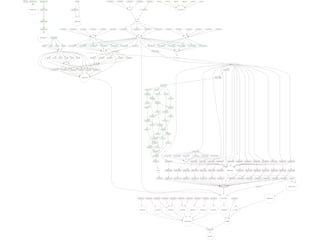
  • #6 This is the task graph for a single frame from the engine used to make that image. To render that: hundreds of (heterogeneous) tasks locally task, data, and pipeline parallel (point at graph) Task = 10k-100k lines/each—fairly large
  • #7 and even within those tasks data, pipeline, task parallel entire invocations of graphics pipeline many levels => braided parallelism
  • #9 Logical Direct3D 10 pipeline. Red = programmable. Blue = fixed-function. “Fixed-function” still configured by programmable state (and implied by shader input/output). - Inter-stage data = always fixed flow/non-programmable IA: reads from pointer to index, vertex buffers and pulls in vertex data (indirectly/complex traversal). Finite State Machine. VS: user program. Can read (only) from textures PrimAsm: indexes vertex stream and groups together whole triangles. Finite State Machine. GS: . Variable output (filter/amplify) NOTE: programmable stages delineated by common one-to-one data stream. Any time there is reordering or complex stream amplification/filtering, we split stages. THIS IS LOGICAL PIPELINE, but in reality, fast implementation is
  • #10 Logical Direct3D 10 pipeline. Red = programmable. Blue = fixed-function. “Fixed-function” still configured by programmable state (and implied by shader input/output). - Inter-stage data = always fixed flow/non-programmable IA: reads from pointer to index, vertex buffers and pulls in vertex data (indirectly/complex traversal). Finite State Machine. VS: user program. Can read (only) from textures PrimAsm: indexes vertex stream and groups together whole triangles. Finite State Machine. GS: . Variable output (filter/amplify) NOTE: programmable stages delineated by common one-to-one data stream. Any time there is reordering or complex stream amplification/filtering, we split stages. THIS IS LOGICAL PIPELINE, but in reality, fast implementation is
  • #11 Logical Direct3D 10 pipeline. Red = programmable. Blue = fixed-function. “Fixed-function” still configured by programmable state (and implied by shader input/output). - Inter-stage data = always fixed flow/non-programmable IA: reads from pointer to index, vertex buffers and pulls in vertex data (indirectly/complex traversal). Finite State Machine. VS: user program. Can read (only) from textures PrimAsm: indexes vertex stream and groups together whole triangles. Finite State Machine. GS: . Variable output (filter/amplify) NOTE: programmable stages delineated by common one-to-one data stream. Any time there is reordering or complex stream amplification/filtering, we split stages. THIS IS LOGICAL PIPELINE, but in reality, fast implementation is
  • #12 Logical Direct3D 10 pipeline. Red = programmable. Blue = fixed-function. “Fixed-function” still configured by programmable state (and implied by shader input/output). - Inter-stage data = always fixed flow/non-programmable IA: reads from pointer to index, vertex buffers and pulls in vertex data (indirectly/complex traversal). Finite State Machine. VS: user program. Can read (only) from textures PrimAsm: indexes vertex stream and groups together whole triangles. Finite State Machine. GS: . Variable output (filter/amplify) NOTE: programmable stages delineated by common one-to-one data stream. Any time there is reordering or complex stream amplification/filtering, we split stages. THIS IS LOGICAL PIPELINE, but in reality, fast implementation is
  • #13 Logical Direct3D 10 pipeline. Red = programmable. Blue = fixed-function. “Fixed-function” still configured by programmable state (and implied by shader input/output). - Inter-stage data = always fixed flow/non-programmable IA: reads from pointer to index, vertex buffers and pulls in vertex data (indirectly/complex traversal). Finite State Machine. VS: user program. Can read (only) from textures PrimAsm: indexes vertex stream and groups together whole triangles. Finite State Machine. GS: . Variable output (filter/amplify) NOTE: programmable stages delineated by common one-to-one data stream. Any time there is reordering or complex stream amplification/filtering, we split stages. THIS IS LOGICAL PIPELINE, but in reality, fast implementation is
  • #14 Logical Direct3D 10 pipeline. Red = programmable. Blue = fixed-function. “Fixed-function” still configured by programmable state (and implied by shader input/output). - Inter-stage data = always fixed flow/non-programmable IA: reads from pointer to index, vertex buffers and pulls in vertex data (indirectly/complex traversal). Finite State Machine. VS: user program. Can read (only) from textures PrimAsm: indexes vertex stream and groups together whole triangles. Finite State Machine. GS: . Variable output (filter/amplify) NOTE: programmable stages delineated by common one-to-one data stream. Any time there is reordering or complex stream amplification/filtering, we split stages. THIS IS LOGICAL PIPELINE, but in reality, fast implementation is
  • #15 Logical Direct3D 10 pipeline. Red = programmable. Blue = fixed-function. “Fixed-function” still configured by programmable state (and implied by shader input/output). - Inter-stage data = always fixed flow/non-programmable IA: reads from pointer to index, vertex buffers and pulls in vertex data (indirectly/complex traversal). Finite State Machine. VS: user program. Can read (only) from textures PrimAsm: indexes vertex stream and groups together whole triangles. Finite State Machine. GS: . Variable output (filter/amplify) NOTE: programmable stages delineated by common one-to-one data stream. Any time there is reordering or complex stream amplification/filtering, we split stages. THIS IS LOGICAL PIPELINE, but in reality, fast implementation is
  • #16 Logical Direct3D 10 pipeline. Red = programmable. Blue = fixed-function. “Fixed-function” still configured by programmable state (and implied by shader input/output). - Inter-stage data = always fixed flow/non-programmable IA: reads from pointer to index, vertex buffers and pulls in vertex data (indirectly/complex traversal). Finite State Machine. VS: user program. Can read (only) from textures PrimAsm: indexes vertex stream and groups together whole triangles. Finite State Machine. GS: . Variable output (filter/amplify) NOTE: programmable stages delineated by common one-to-one data stream. Any time there is reordering or complex stream amplification/filtering, we split stages. THIS IS LOGICAL PIPELINE, but in reality, fast implementation is
  • #17 Logical Direct3D 10 pipeline. Red = programmable. Blue = fixed-function. “Fixed-function” still configured by programmable state (and implied by shader input/output). - Inter-stage data = always fixed flow/non-programmable IA: reads from pointer to index, vertex buffers and pulls in vertex data (indirectly/complex traversal). Finite State Machine. VS: user program. Can read (only) from textures PrimAsm: indexes vertex stream and groups together whole triangles. Finite State Machine. GS: . Variable output (filter/amplify) NOTE: programmable stages delineated by common one-to-one data stream. Any time there is reordering or complex stream amplification/filtering, we split stages. THIS IS LOGICAL PIPELINE, but in reality, fast implementation is
  • #18 Logical Direct3D 10 pipeline. Red = programmable. Blue = fixed-function. “Fixed-function” still configured by programmable state (and implied by shader input/output). - Inter-stage data = always fixed flow/non-programmable IA: reads from pointer to index, vertex buffers and pulls in vertex data (indirectly/complex traversal). Finite State Machine. VS: user program. Can read (only) from textures PrimAsm: indexes vertex stream and groups together whole triangles. Finite State Machine. GS: . Variable output (filter/amplify) NOTE: programmable stages delineated by common one-to-one data stream. Any time there is reordering or complex stream amplification/filtering, we split stages. THIS IS LOGICAL PIPELINE, but in reality, fast implementation is
  • #19 Logical Direct3D 10 pipeline. Red = programmable. Blue = fixed-function. “Fixed-function” still configured by programmable state (and implied by shader input/output). - Inter-stage data = always fixed flow/non-programmable IA: reads from pointer to index, vertex buffers and pulls in vertex data (indirectly/complex traversal). Finite State Machine. VS: user program. Can read (only) from textures PrimAsm: indexes vertex stream and groups together whole triangles. Finite State Machine. GS: . Variable output (filter/amplify) NOTE: programmable stages delineated by common one-to-one data stream. Any time there is reordering or complex stream amplification/filtering, we split stages. THIS IS LOGICAL PIPELINE, but in reality, fast implementation is
  • #20 Logical Direct3D 10 pipeline. Red = programmable. Blue = fixed-function. “Fixed-function” still configured by programmable state (and implied by shader input/output). - Inter-stage data = always fixed flow/non-programmable IA: reads from pointer to index, vertex buffers and pulls in vertex data (indirectly/complex traversal). Finite State Machine. VS: user program. Can read (only) from textures PrimAsm: indexes vertex stream and groups together whole triangles. Finite State Machine. GS: . Variable output (filter/amplify) NOTE: programmable stages delineated by common one-to-one data stream. Any time there is reordering or complex stream amplification/filtering, we split stages. THIS IS LOGICAL PIPELINE, but in reality, fast implementation is
  • #21 Logical Direct3D 10 pipeline. Red = programmable. Blue = fixed-function. “Fixed-function” still configured by programmable state (and implied by shader input/output). - Inter-stage data = always fixed flow/non-programmable IA: reads from pointer to index, vertex buffers and pulls in vertex data (indirectly/complex traversal). Finite State Machine. VS: user program. Can read (only) from textures PrimAsm: indexes vertex stream and groups together whole triangles. Finite State Machine. GS: . Variable output (filter/amplify) NOTE: programmable stages delineated by common one-to-one data stream. Any time there is reordering or complex stream amplification/filtering, we split stages. THIS IS LOGICAL PIPELINE, but in reality, fast implementation is
  • #23 New shader stages with new semantics, characteristics. (Unordered) read-write memory from the pixel shader
  • #24 Future: Programmable output blending? Ordered read-modify-write buffers. Also: the more that becomes software-controlled, the more expensive synchronization becomes. As we’ll see: biggest difference between pipeline choice for LRB vs. GPU is based on cost→granularity of synchronization.
  • #25 Needs to be able to drive essentially maximum resource utilization, sustained. Dynamic load balance: load balance between stages shifts not just across apps or frames, but at very fine granularity within frame. (Triangles are different size. Shaders are different length.) Pipeline parallelism: has to overlap operations, passes to avoid bubbles. Producer-consumer locality is essential: way too much intermediate data to spill to memory Task parallelism and producer-consumer are why (ironically) you can’t do a fast graphics pipeline in “GPGPU”/CUDA.
  • #26 First, how parallelism is exploited and how the different stages work.
  • #27 Parallelism across all data types: vertices, primitives, fragments, pixels. Hierarchical application of parallelism mirrors a hierarchical application of most major ideas from parallel, latency-tolerant (i.e. “throughput”) processor architecture. To maintain high regularity within shaders, Marshaling of data to/from complex or irregular structures is factored apart from the core programmable data-parallel shaders, in logically fixed-function stages.
  • #28 There are two major schools of implementation today: - In a hardware (NVIDIA) GPU, - In a software graphics pipeline (Larrabee) but the core hierarchical approach to exploiting parallelism and hiding latency is essentially the same, only the constants are shifted by the given implementation. So the high-order bit: - SIMD+vector+thread+core hierarchy to exploit parallelism Balance very high arithmetic intensity with retaining dynamic load balance - same basic model in software or hardware - schedulers are application/pipeline-specific, so software has potential advantage
  • #29 data-parallelism over different data types is subtly different, but in ways which necessitate different implementation and optimization tradeoffs for peak efficiency. a fast graphics pipeline implementation must optimize for all of these stage specific characteristics, and this is just in the “simple data-parallel kernels” parts of the pipeline. Clearly: triviality of embarrassing parallelism is over-stated.
  • #30 The fixed-function stages introduce even more workload variation. - IA - Rast - ROP Ordered read-modify-write buffers. (As always, order is the enemy of parallelism.) Also: the more that becomes software-controlled, the more expensive synchronization becomes. As we’ll see: biggest difference between pipeline choice for LRB vs. GPU is based on cost→granularity of synchronization.
  • #31 Popping up a level, to the pipeline as a whole:
  • #32 All this talk of parallelism and asynchrony, but the logical pipeline was scalar. API-defined ordering is that all pixel updates must happen in exactly the order defined by the input primitive sequence. This synchronization is a key reason why graphics is not trivially parallel. Many operations are order-dependent. There still is parallelism: - screen-space - reorder buffer for asynchronous completion I’ll also point out as an aside that these strict semantics exist to make the API highly predictable and usable for many applications. In practice, could often be much looser, given application-specific semantics, so I’ll speculate that application-defined software rendering pipelines will exploit optimization here
  • #33 Here’s how those semantics are exploited in 2 kinds of modern pipelines… Most Hardware GPUs. Looks like logical pipeline -- because directly implemented to run API -- but highly parallel at most stages
  • #34 Tradeoff in memory spill: stream vs. cache/buffer intra-pipeline data. - Stream over intra-pipeline data (post-transformed primitives), cache framebuffer, vs: - Stream over framebuffer, buffer intra-pipeline data. Also critical: lower scheduling overhead, coarser-grained synchronization
  • #35 To tie back to the whole, in a single frame this pipeline as a whole is driven by sequences of passes made up of many draw batches the app’s logical rendering pipeline != D3D pipeline both for core algorithm reasons and for performance optimization reasons
  • #36 an entire one of those passes of the pipeline is just one node in this graph (large circles, I think) And there are many other task stages: - physics simulations, sound - culling - streaming, decompression - AI, agent updates Others are going to become *more* data-parallel, *more* like graphics pipeline, to utilize future processors. (Biggest current barrier to full-on GPGPU for these is latency/communication overhead, but devs want to)
  • #38 People have obviously built parallel programming models before. Task-centric systems: - dynamic+ - high overhead- - can’t achieve sufficient compute density (real work) Data-parallel systems: I’ve divided into more dynamic and more static ones. Many historical DP systems had dynamic runtimes - targeted dynamically independent processors - overhead still too high Streaming as in StreamIt is extreme end point of static data parallel optimization: - very low overhead, but struggles with variable/dynamic loads. Graphics on StreamIt: too static, load imbalance - obvious: triangles vary in size! this is by no means all, just represents a sampling of systems covering major individual models I’ve talked about but biggest key: focus has traditionally been on single-model parallel programming systems. large systems like graphics and games require all of the above
  • #39 Consider CUDA, because on massively parallel throughput machines, this is the leading candidate model actually available today. Canonical model: - thread per-work-item - purely data-parallel, streaming data accesses Challenges: - struggle with dynamic load balance, like any semi-static - producer-consumer locality Ironically, these are two key things graphics pipelines have to do very well: - dynamic load balance within and between tasks, data elements - producer-consumer locality for bandwidth savings on huge streams
  • #40 promising directions are emerging, and challenges for the future are starting to become clear
  • #41 Going forward, it’s interesting to look at how things might change. Dynamic task decompositions will become even more important: - first: just put each subsystem on a thread. doesn’t scale far. - now: several hundred jobs/frame, goes somewhere. - next: many more jobs. Key issue in the future will be continuing to radically increase the number of independent tasks which can be extracted. Problem with traditional “task systems” is false control dependence. Graphics Pipeline already shows how this can be overcome. Pure data-flow? Orchestration, complexity, dynamism in general will be challenging - language, tools? ------ Individual tasks will become internally more complex. Hierarchical decomposition, low-level data parallelism important for efficiency. Data-centric tasks will become More like graphics/rendering. ------ At the data-parallel level, one Interesting idea/trend emerged at SIGGRAPH this year: dynamic scheduling between multiple in-flight logical kernels on their one-kernel-at-a-time GPUs. every interesting demo from NVIDIA breaking the CUDA model demonstrated many alternative rendering systems on GPUs, entirely in software, but breaking the pure data-parallel, streaming model to achieve essential performance and flexibility
  • #42 Idea is: take what is logically a series of pipeline stages, which would
  • #44 you can use them for recursive code and cyclic graphs, not just trivial pipelines.
  • #45 and you can even use them for dynamic branching between arbitrary points in the flow, by logically decomposing stages and entry/exit points into sub-states. or if stages are internally fanning out to go data parallel, dynamically --- NVIDIA OptiX uses this pattern
  • #46 NVIDIA’s OptiX system uses this pattern to implement an entirely different rendering “pipeline,” entirely in software, and with recursion (which isn’t formally supported in the CUDA model). Uses a just-in-time “pipeline compiler” to generate the CUDA über-kernel for a given pipeline configuration and shader binding. Effectively, a special-purpose continuation compiler. This is the idea of one place I’d like to go next: explicit continuations as a low-level primitive. Static compiler transform
  • #47 One thing I’m playing with doing next: General-purpose abstraction of this idea could be much simpler than domain-specific compilers like: - Larrabee shader JIT - OptiX pipeline JIT Lesson: those systems are complex because they fuse proven need for application-specific scheduling with compiler transform to support it. Separation of concerns: Contain application-specific complexity to *code in system*, while keeping compiler transform totally agnostic. Useful for many things: - texture fetches with software latency hiding, as in Larrabee - recursive ray tracing - dynamically coalescing work items - lower-level task and pipeline parallelism (producer-consumer) within generally data-parallel, arithmetically-intense jobs --- Are there good references for prior work in this area? *Static* continuation, state machine transform - not *dynamic*, heavy-weight mechanisms like from Lisp world.
  • #52 Popping up another level, this pipeline as a whole is driven by sequences of passes made up of many draw batches
  • #54 the app’s logical rendering pipeline != D3D pipeline both for core algorithm reasons and for performance optimization reasons THIS IS PART OF THE MOTIVATION FOR PROGRAMMABLE PIPELINES
  • #55 pass folding is further motivation for programmable pipelines