Five Rendering Ideas from Battlefield 3 & Need For Speed: The Run
The document outlines advancements in real-time rendering techniques from games like Battlefield 3 and Need for Speed: The Run, focusing on methods such as separable bokeh depth-of-field, hi-z culling, and tiled-based deferred shading. It discusses how these techniques enhance performance and optimize resource usage on gaming consoles like Xbox 360. Various algorithms and their implementations are explored to improve lighting, shadow mapping, and image processing efficiency.
Five Rendering Ideas from Battlefield 3 & Need For Speed: The Run
1.
More Performance!Five RenderingIdeas from Battlefield 3 and Need For Speed: The RunJohn White (NFS)Colin Barré-Brisebois (BF3)Advances in Real-Time Rendering in Games
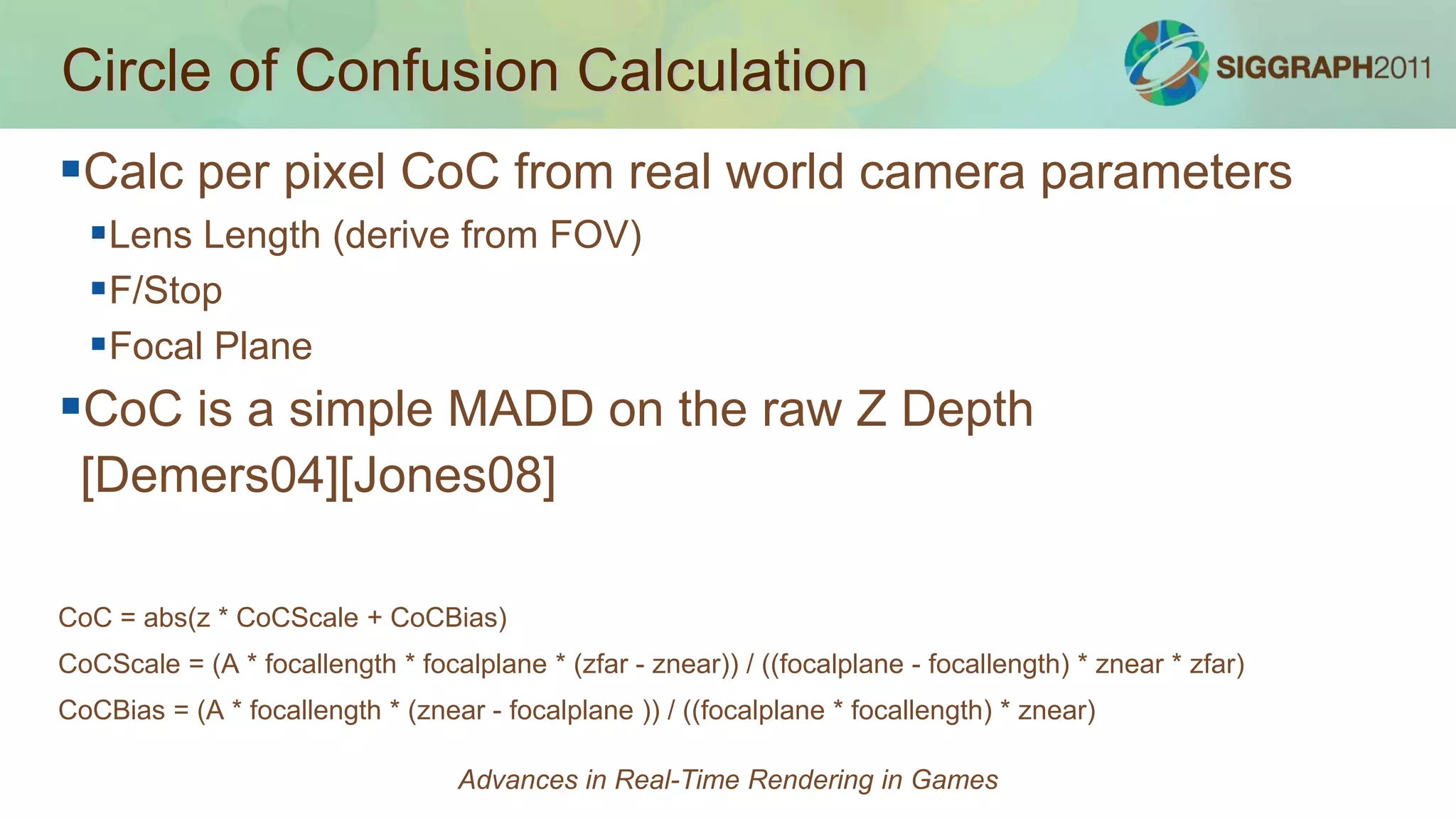
Instead, default tobig CoC and reject based on the sampled texelCoCExtra method to stop bleeding artifacts and can sharpen up smooth gradientsAdvances in Real-Time Rendering in Games
76.
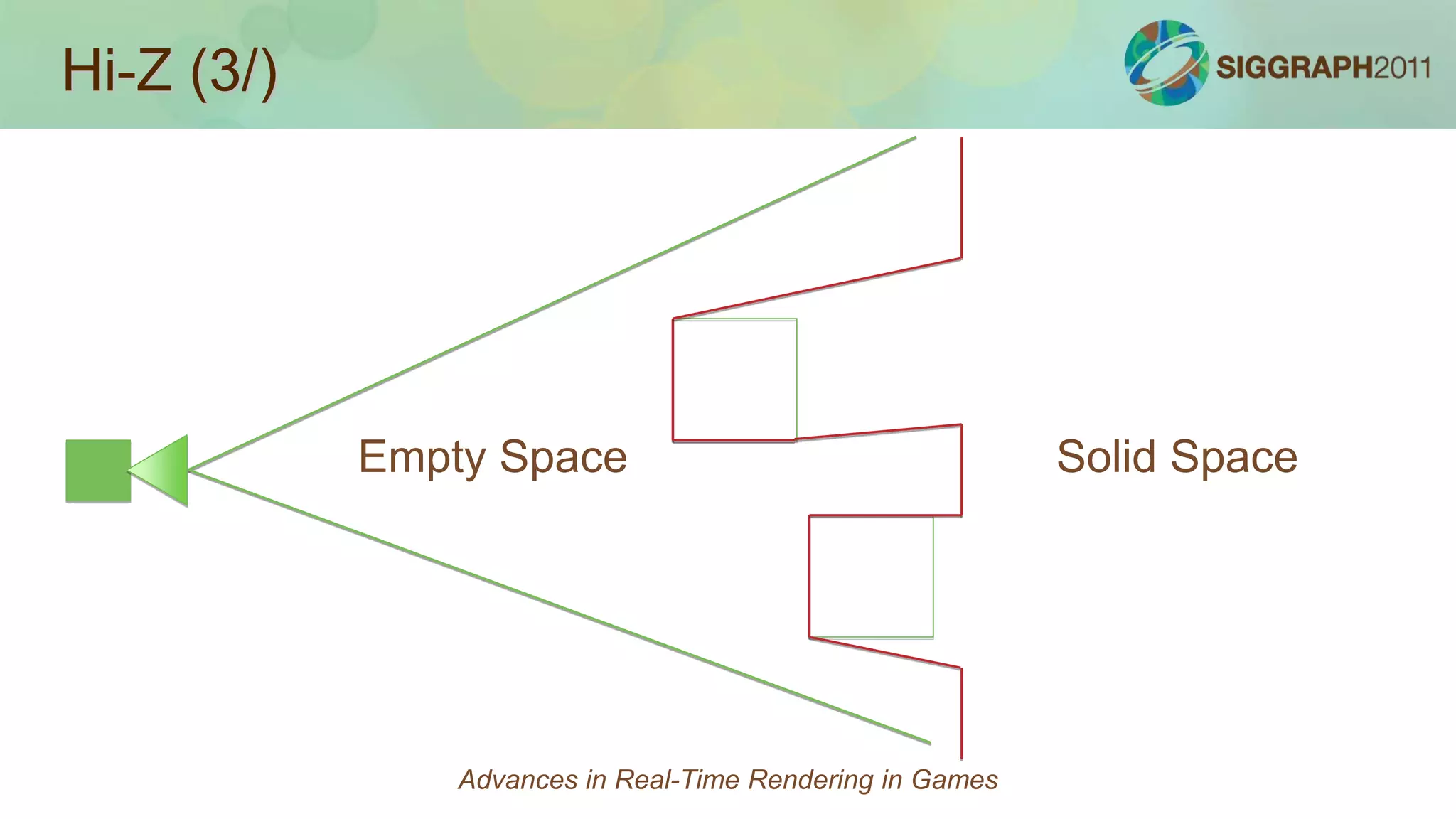
Hi Z cullingWhendownsampling the premultipliedCoC buffer output the computed CoC as depth
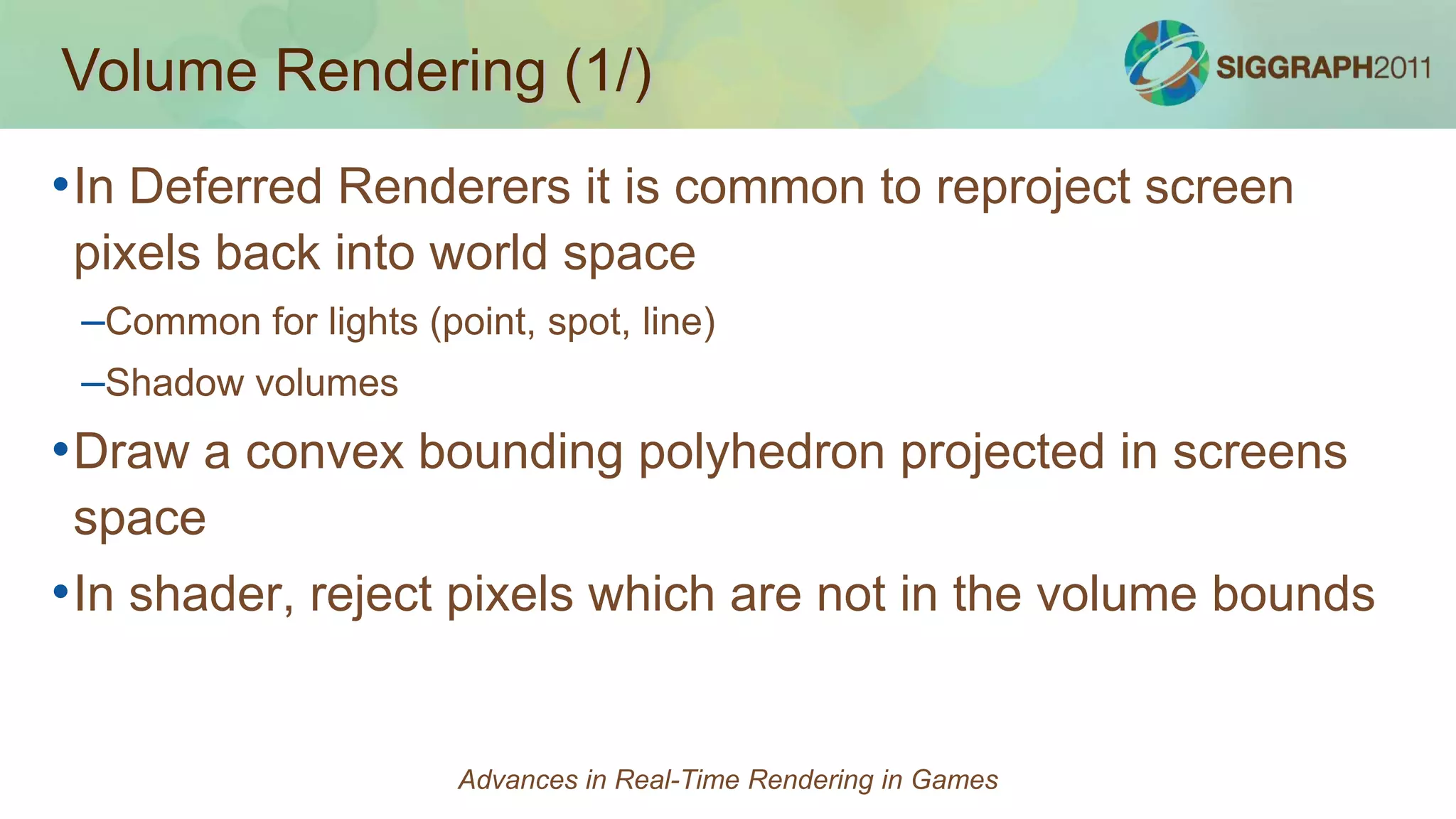
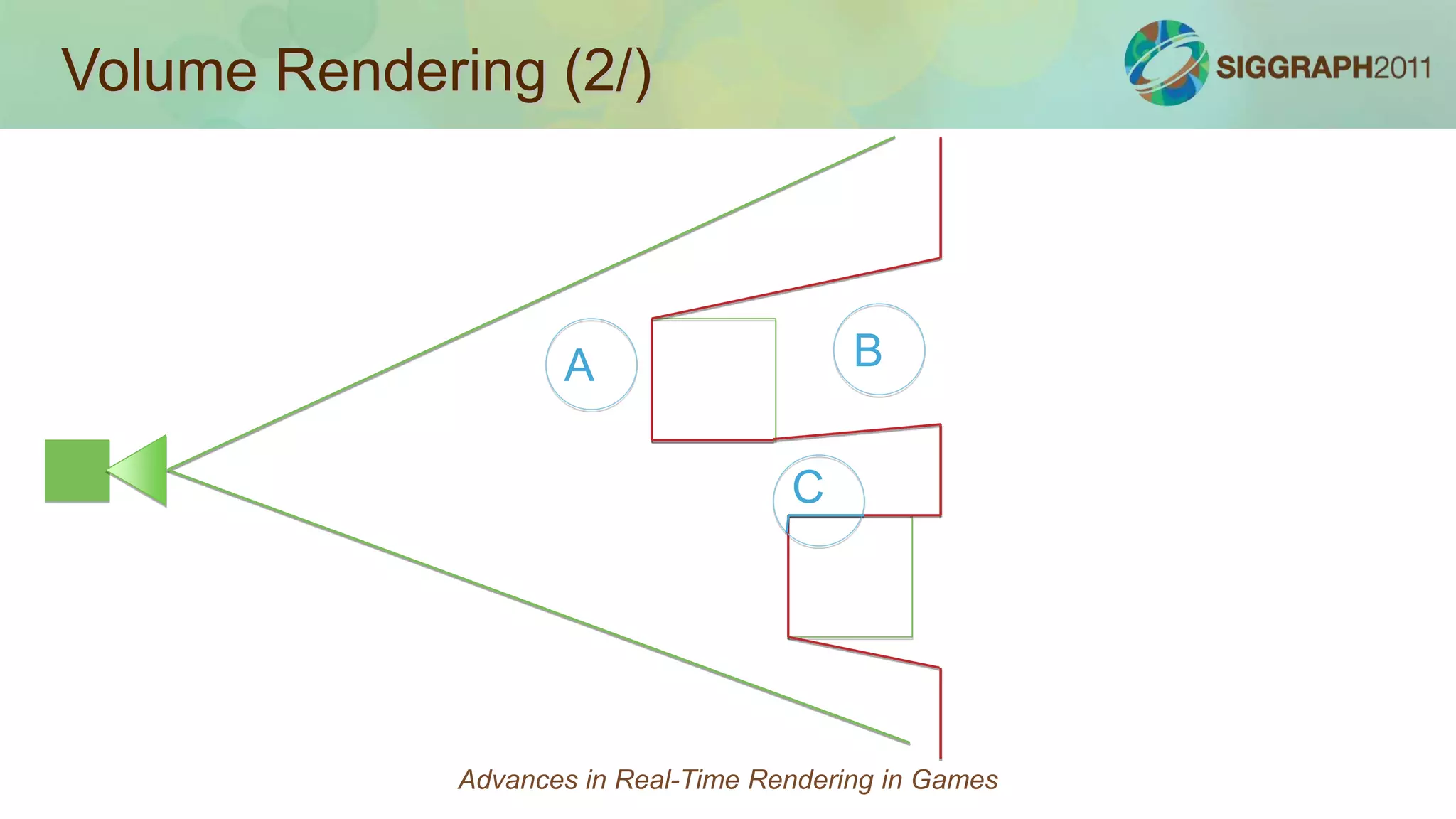
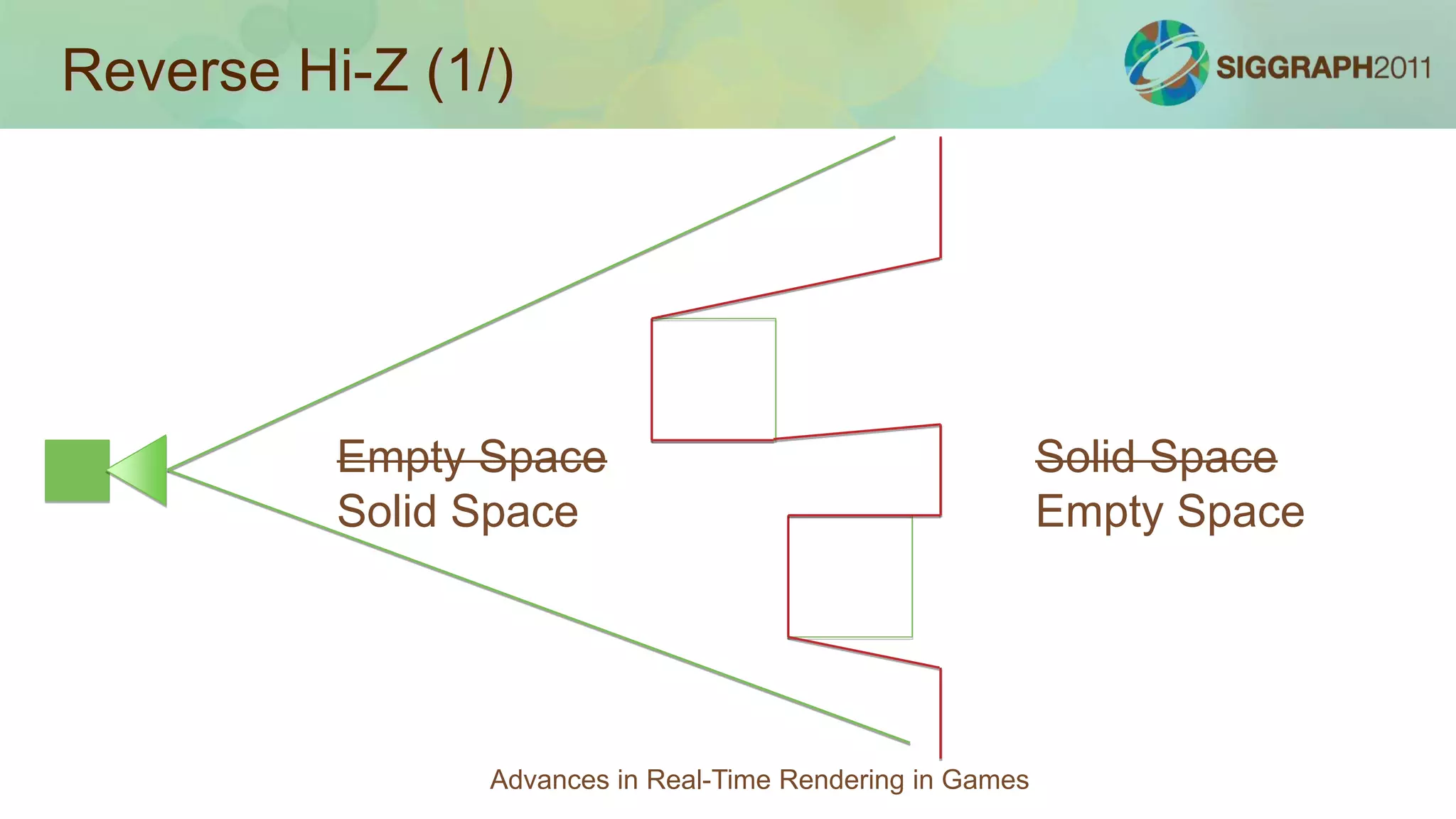
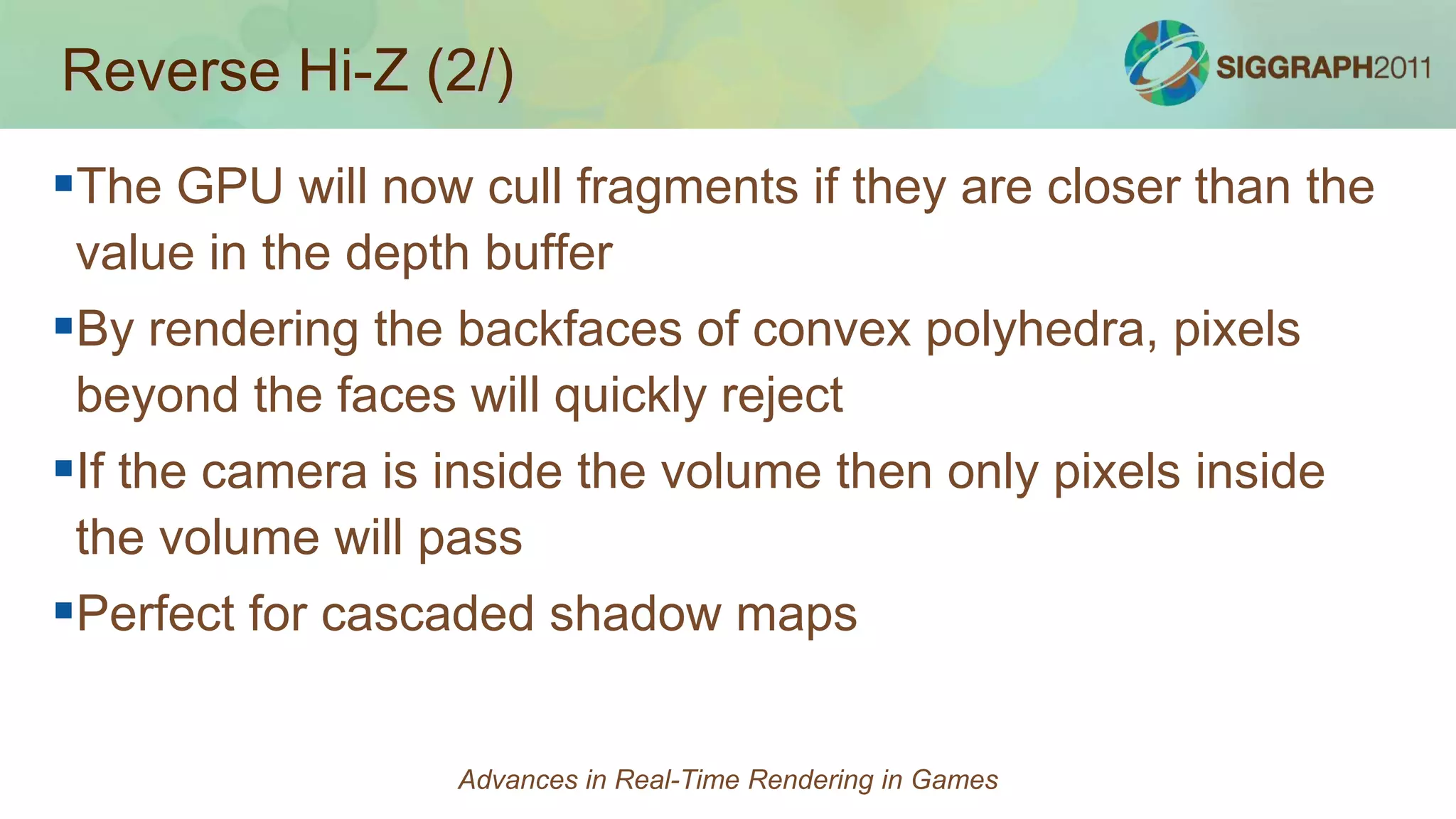
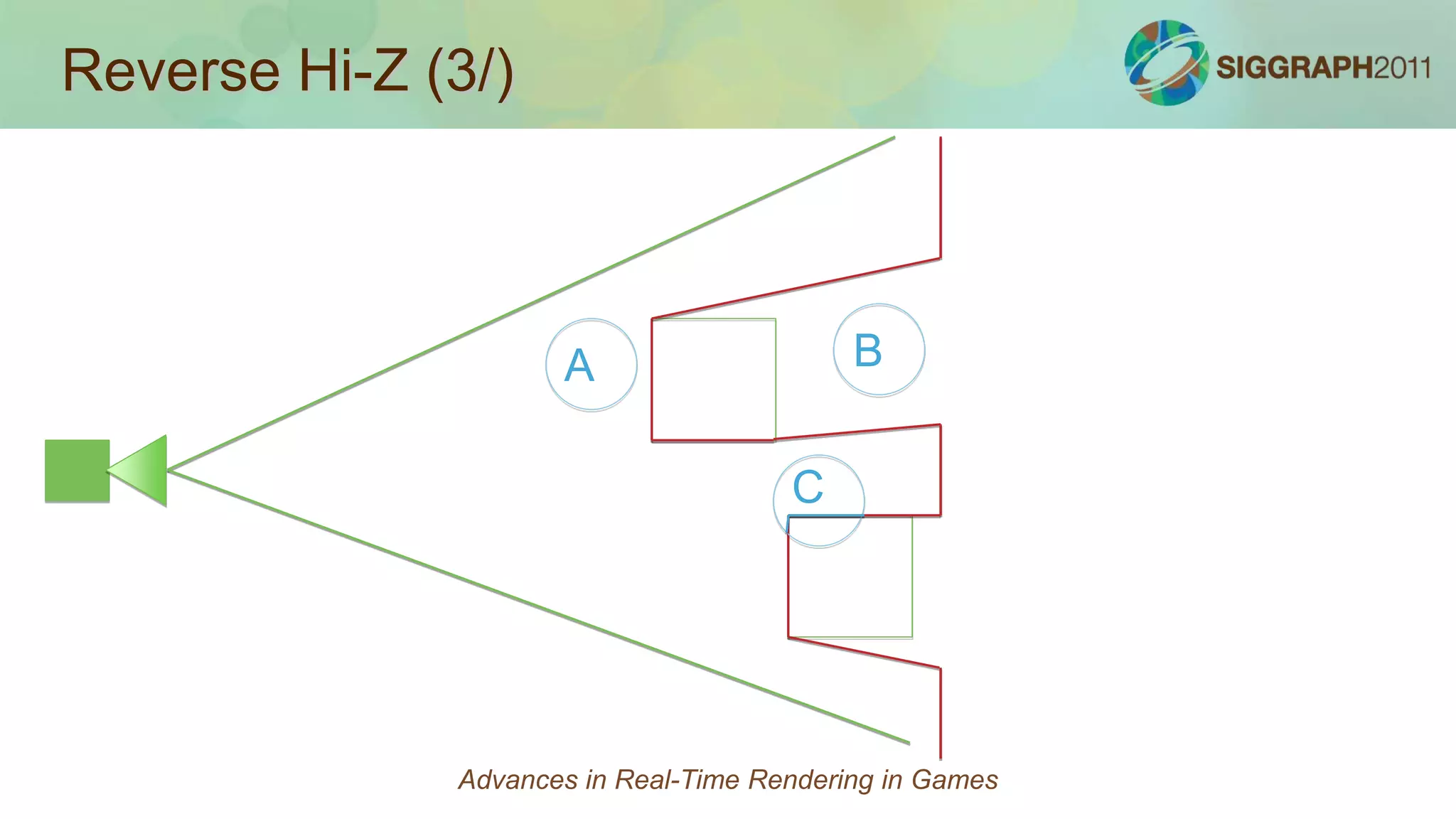
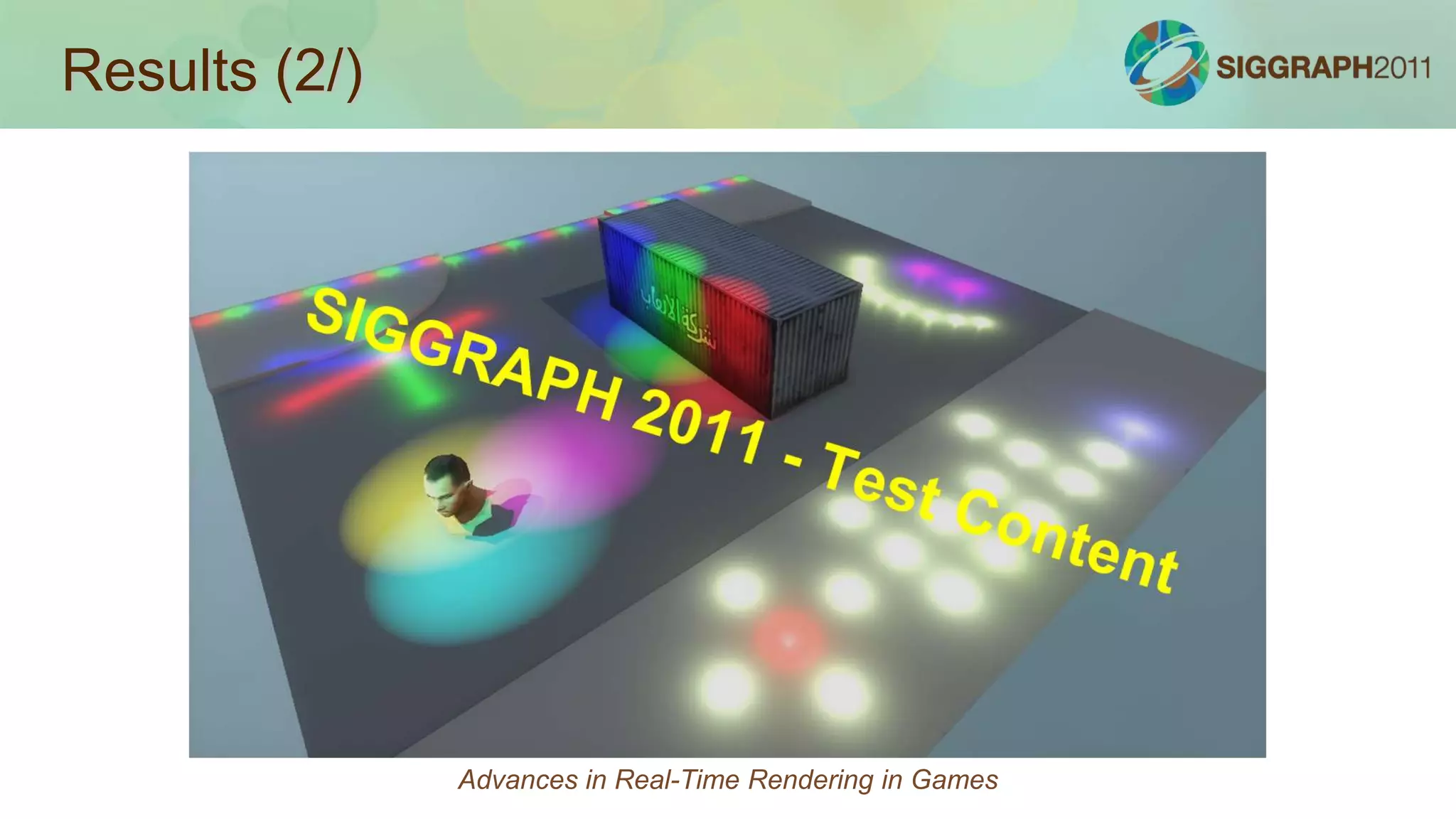
Volume Rendering (1/)InDeferred Renderers it is common to reproject screen pixels back into world spaceCommon for lights (point, spot, line)Shadow volumesDraw a convex bounding polyhedron projected in screens spaceIn shader, reject pixels which are not in the volume boundsAdvances in Real-Time Rendering in Games
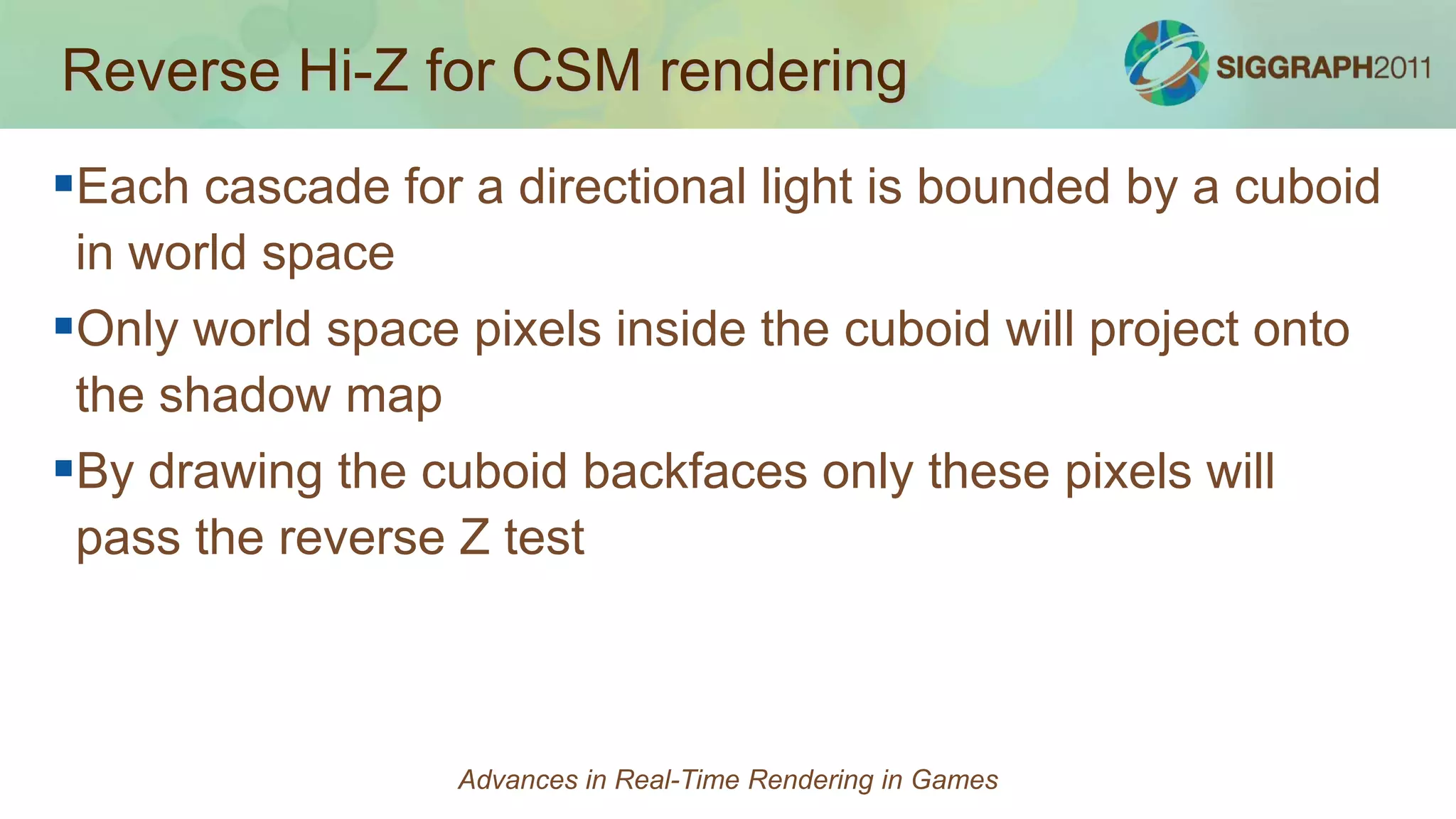
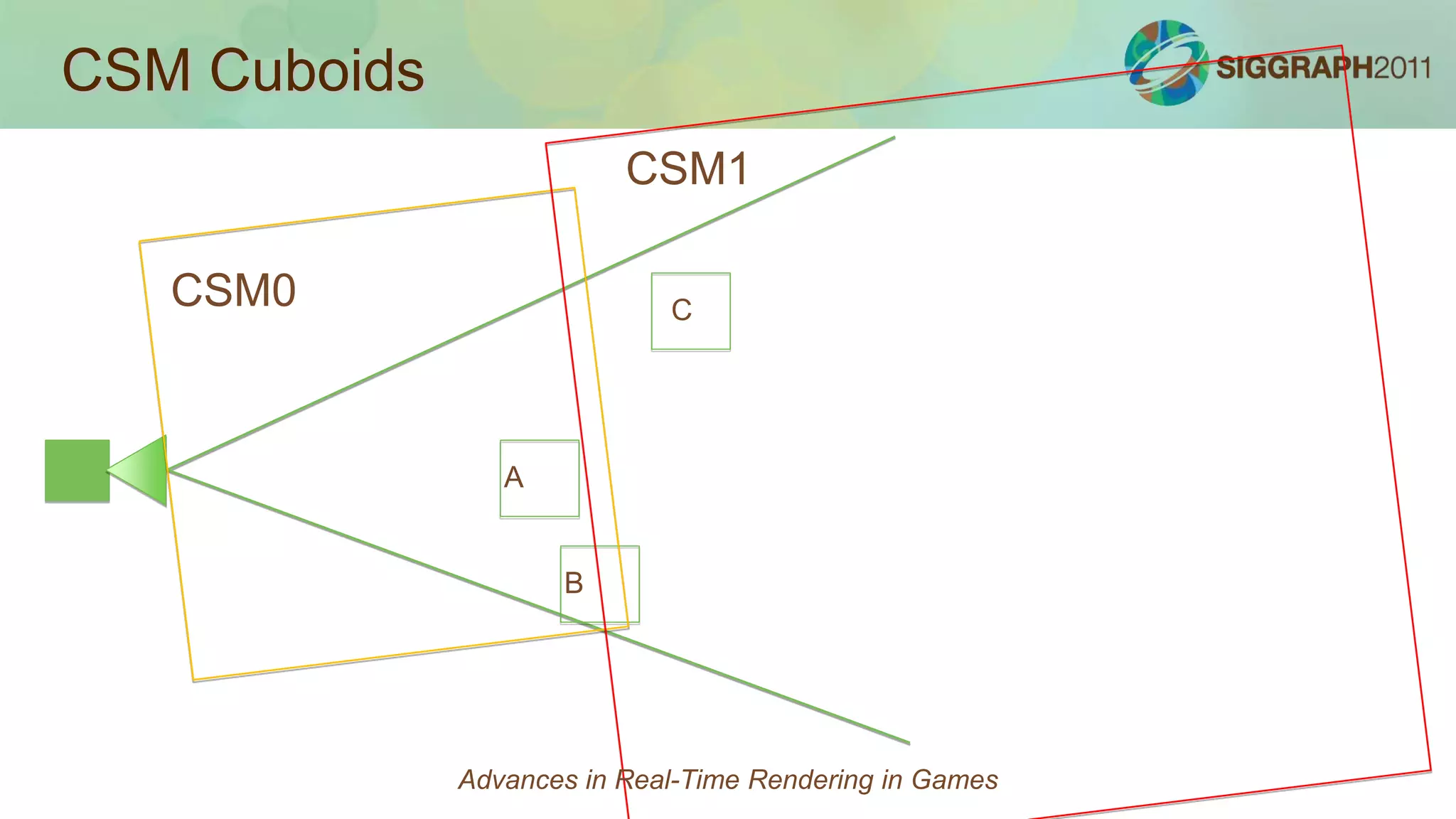
CSM CuboidsEvaluate asa separate pass [Sousa08]Input is depth bufferCreates a L8 mask texture input into directional light passCan do a prior full screen pass to tag back facing pixels wrt to light source in stencilHeuristic on sun angle with cameraPotential for ¼ res with bilateral upsample
105.
Stencil is updatedto denote already processed pixelsAdvances in Real-Time Rendering in Games
106.
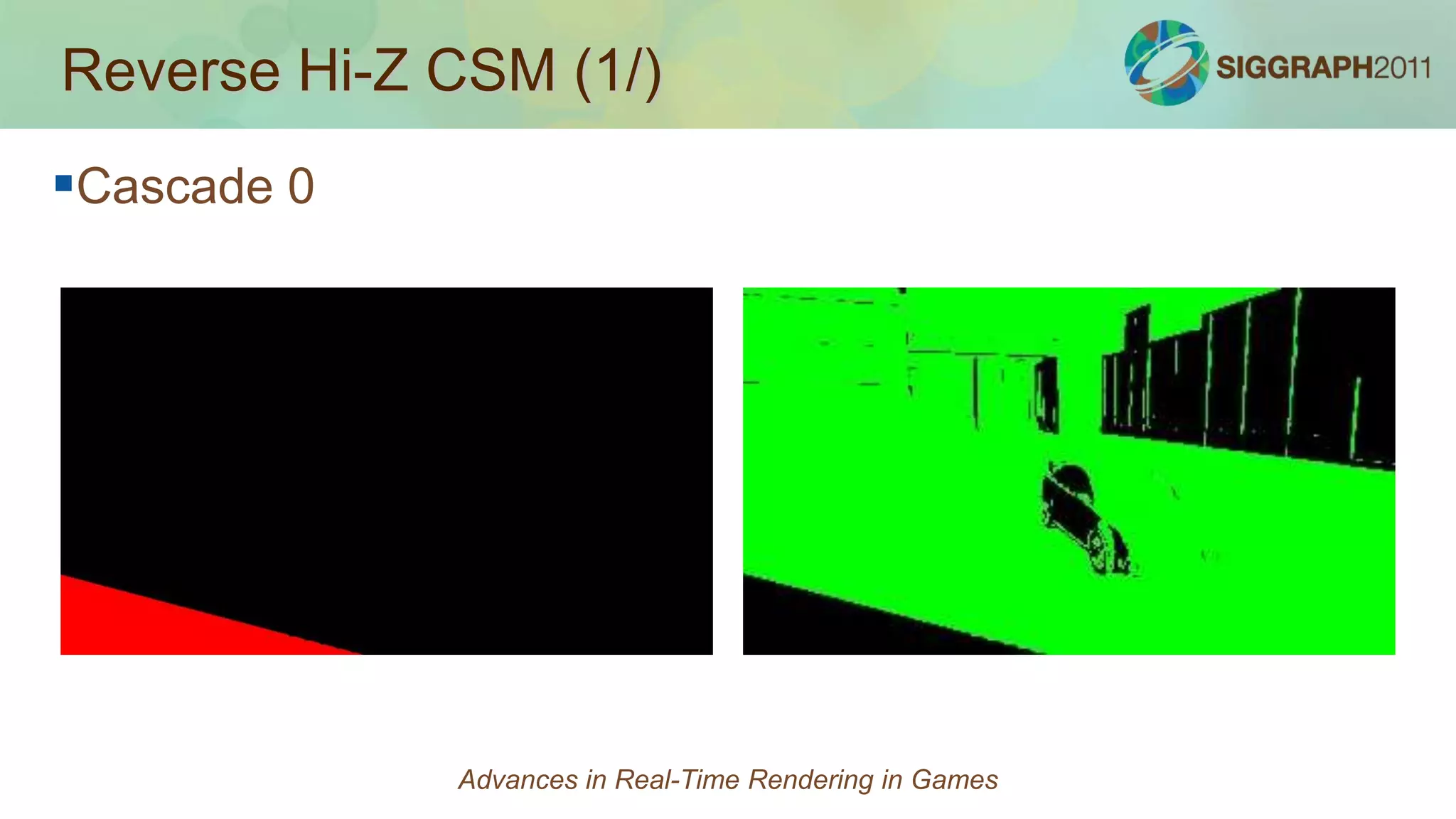
Reverse Hi-Z CSM(1/)Cascade 0Advances in Real-Time Rendering in Games
107.
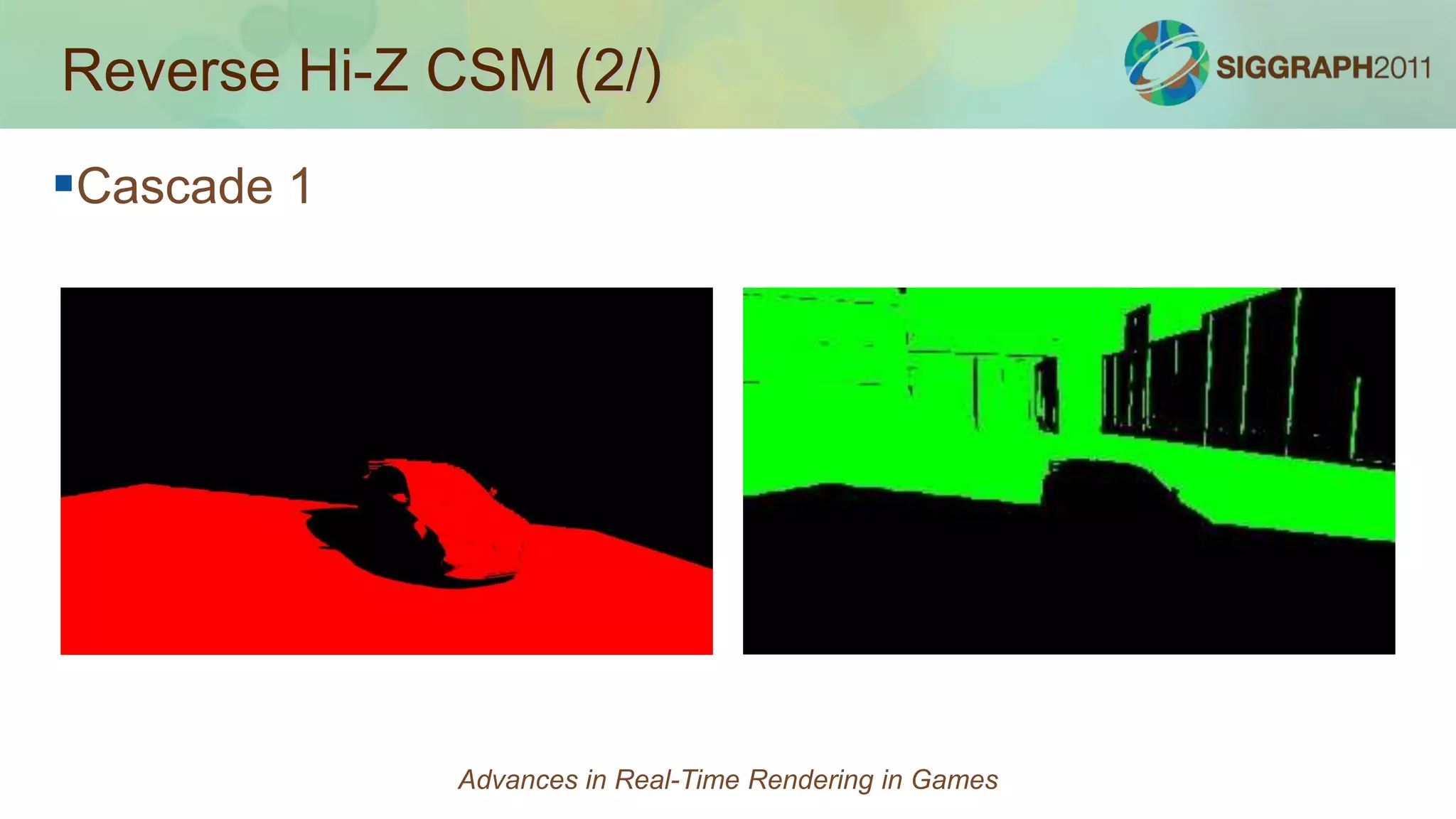
Reverse Hi-Z CSM(2/)Cascade 1Advances in Real-Time Rendering in Games
108.
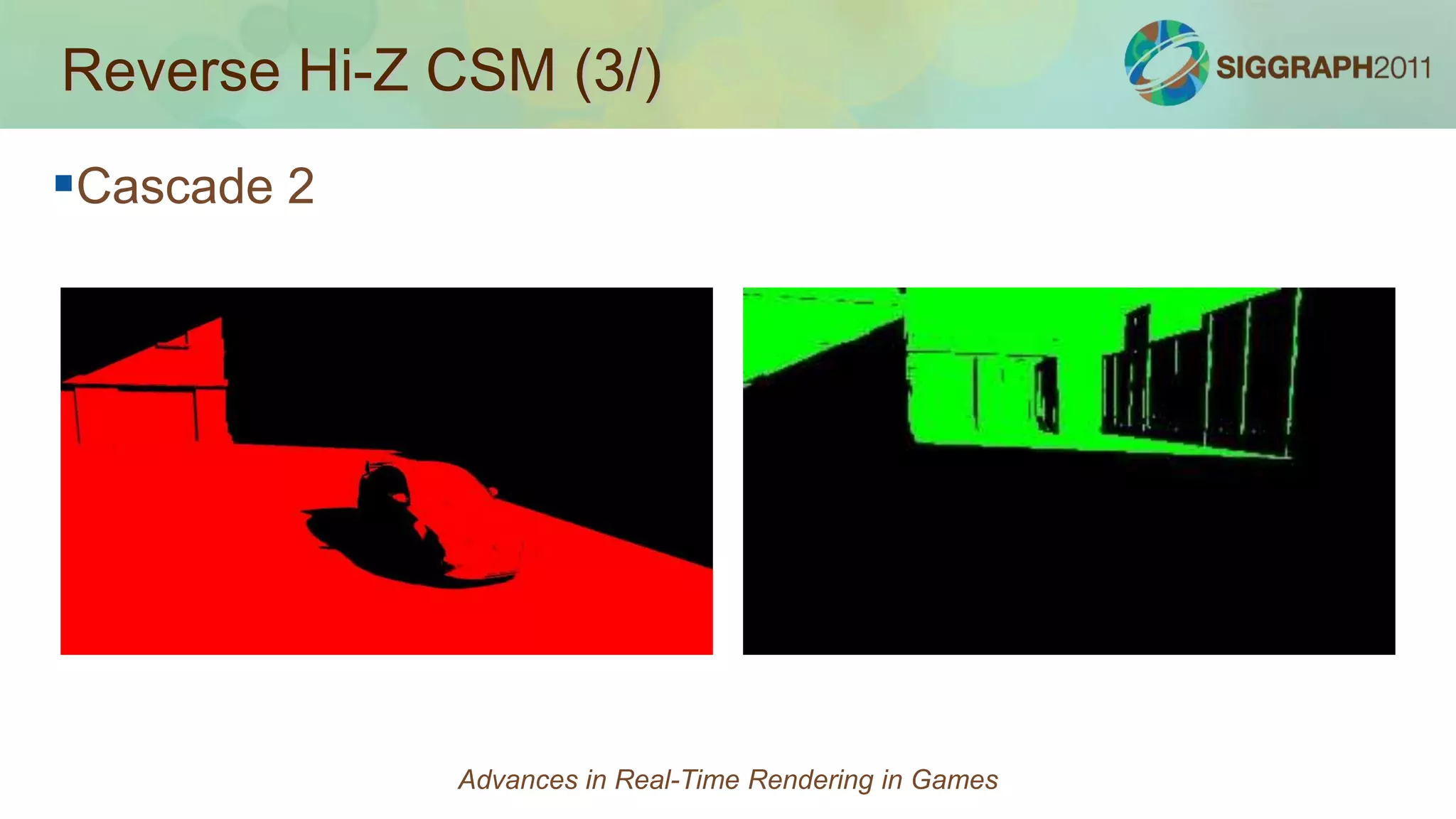
Reverse Hi-Z CSM(3/)Cascade 2Advances in Real-Time Rendering in Games
109.
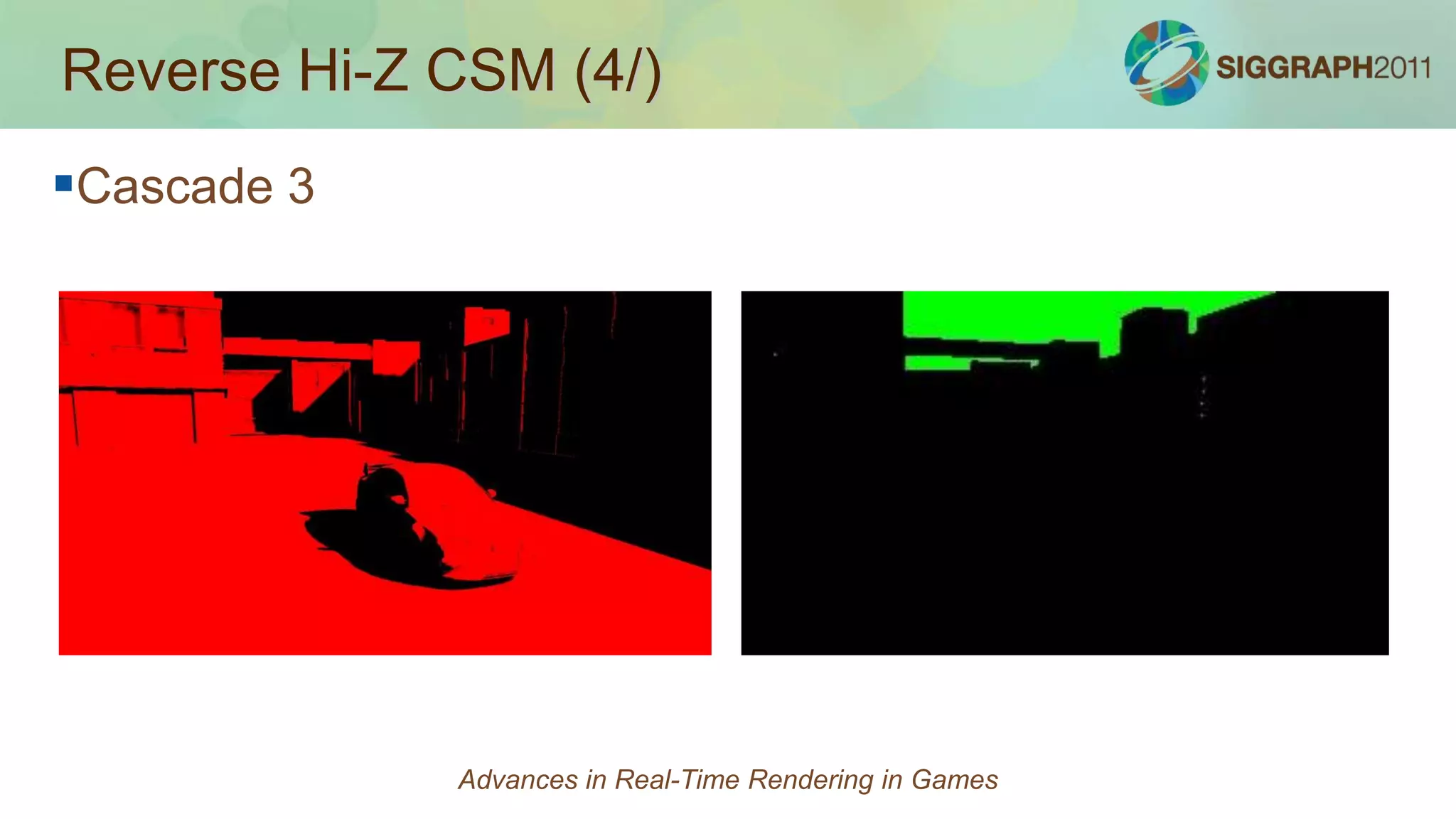
Reverse Hi-Z CSM(4/)Cascade 3Advances in Real-Time Rendering in Games
110.
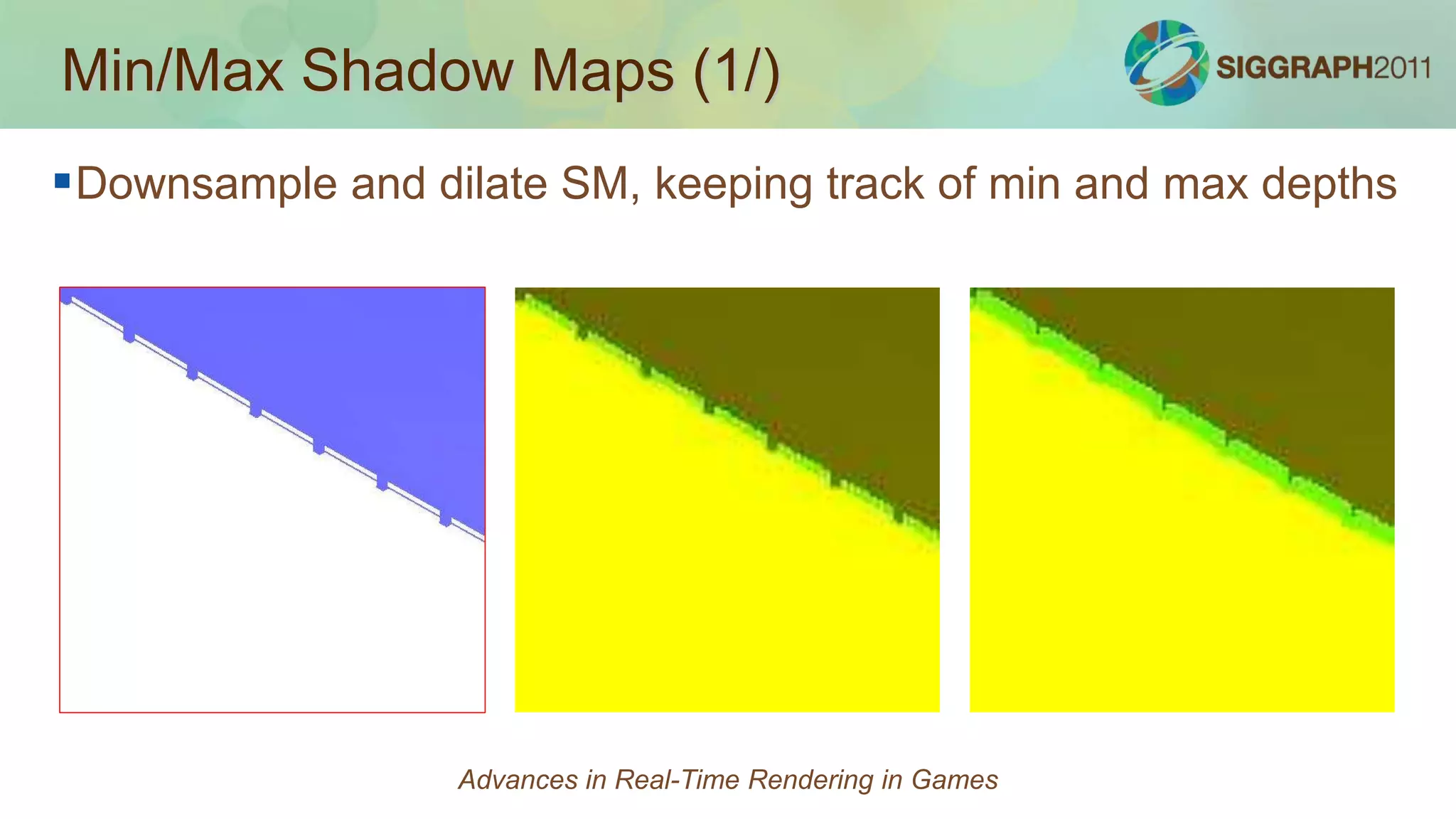
Min/Max Shadow Maps(1/)Downsample and dilate SM, keeping track of min and max depthsAdvances in Real-Time Rendering in Games
111.
Min/Max Shadow Maps(2/)Dilated min/max SM allow us to know if a pixel is ...Fully In shadowFully out of shadowPartially in shadow (conservatively)Draw each cuboid twice
112.
First PassSingle simpletap shaderSecond PassHigh quality PCF shaderAdvances in Real-Time Rendering in Games
113.
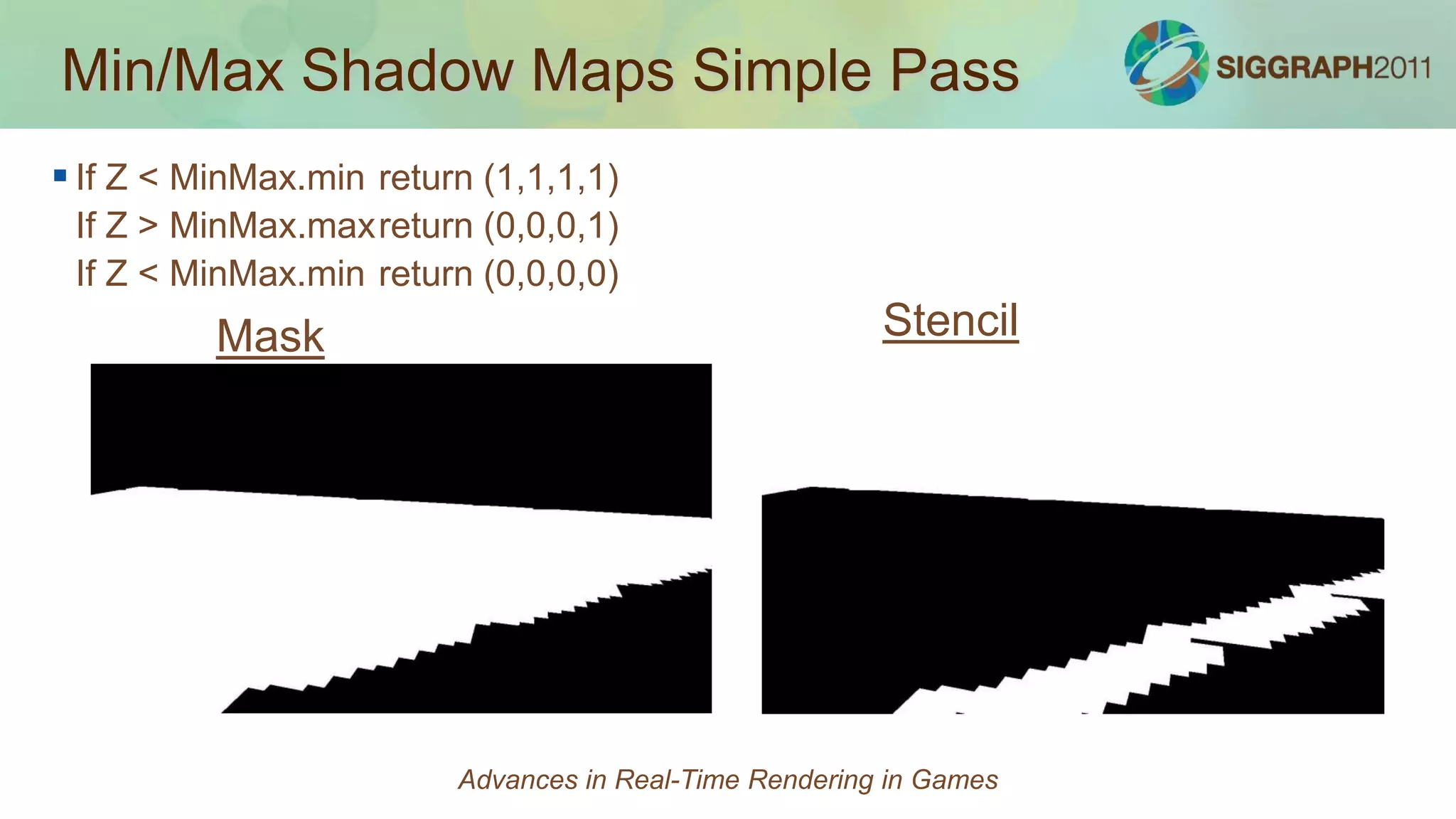
Min/Max Shadow MapsSimple Pass If Z < MinMax.minreturn (1,1,1,1)If Z > MinMax.max return (0,0,0,1)If Z < MinMax.min return (0,0,0,0) StencilMaskAdvances in Real-Time Rendering in Games
114.
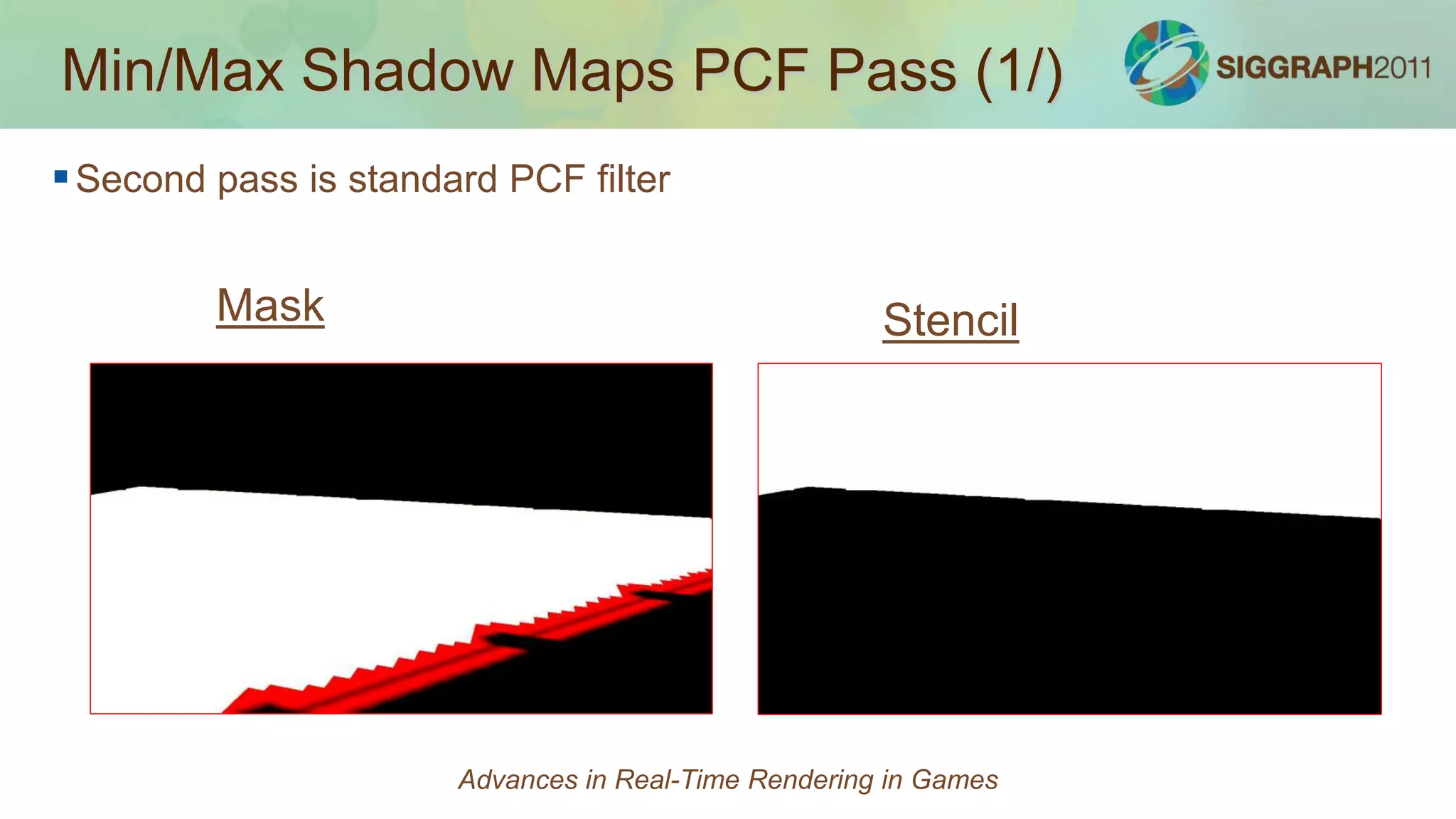
Min/Max Shadow MapsPCF Pass (1/)Second pass is standard PCF filterMaskStencilAdvances in Real-Time Rendering in Games
115.
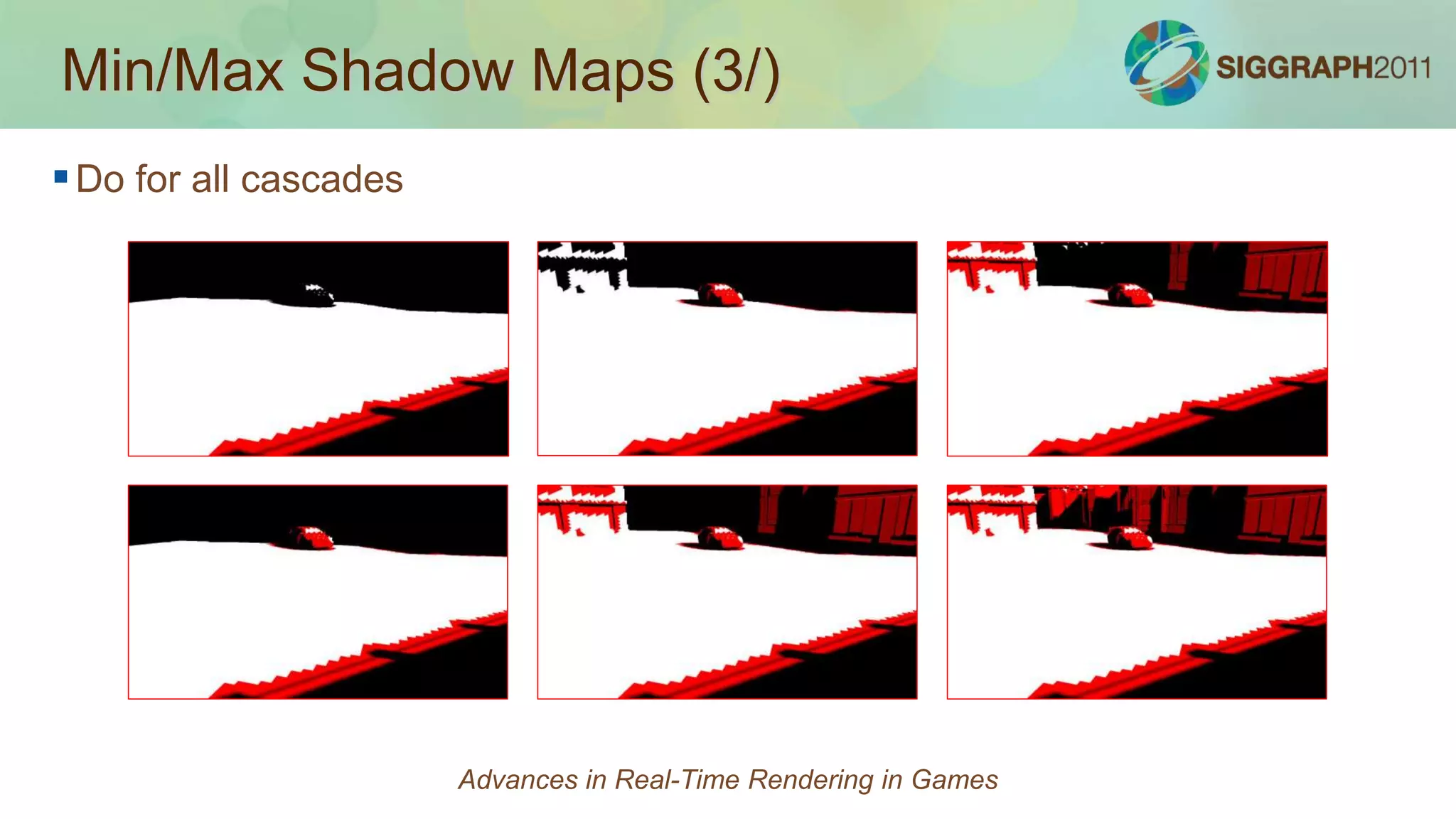
Min/Max Shadow Maps(3/)Do for all cascadesAdvances in Real-Time Rendering in Games
116.
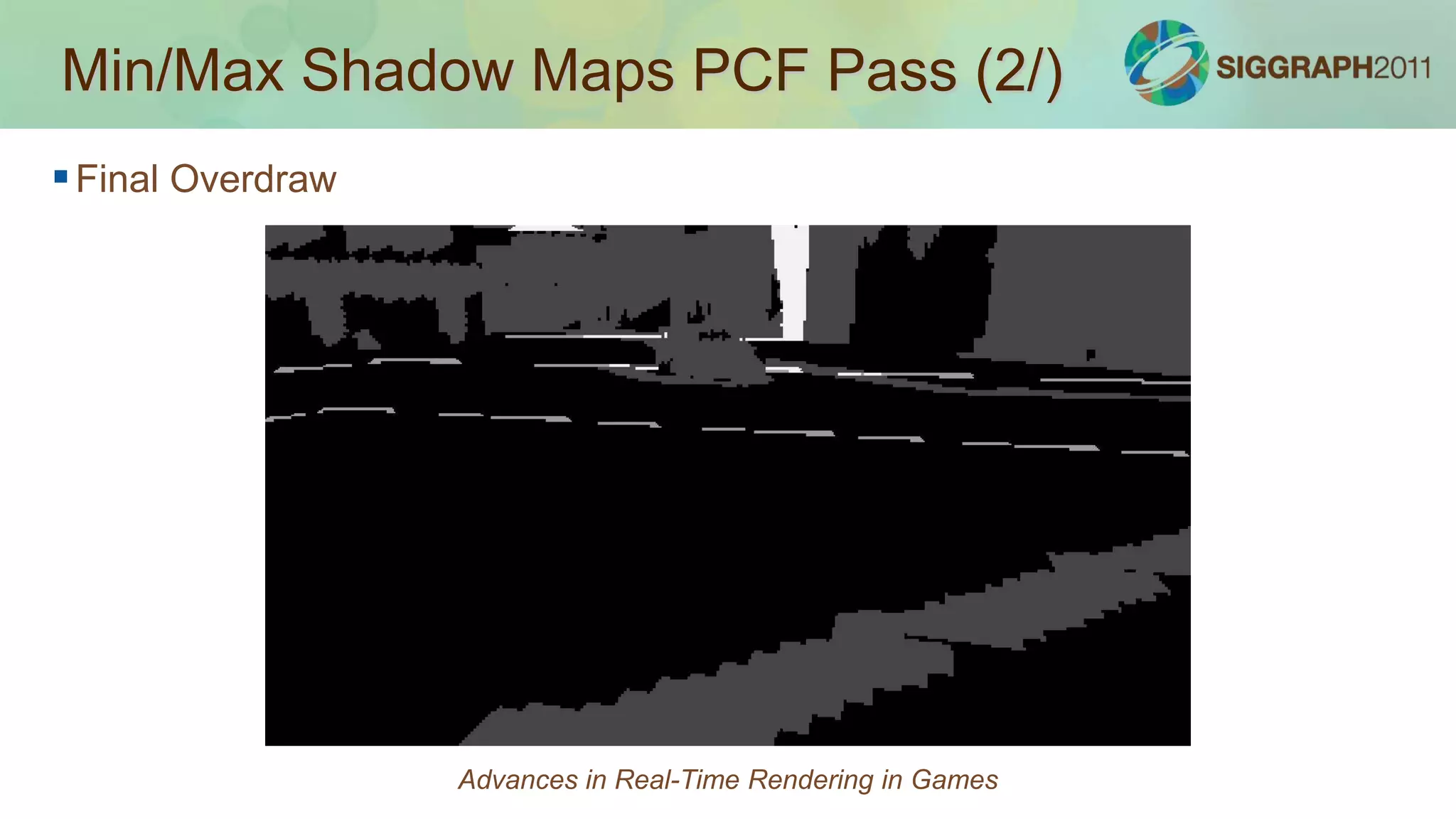
Min/Max Shadow MapsPCF Pass (2/)Final OverdrawAdvances in Real-Time Rendering in Games
If Zero thenno pixels will sample from the shadow mapSo why even render the shadow map!Draw the cuboid first and only if pixels pass draw the actual shadow mapZero passed pixels occur for two reasonsAll pixels are further awayAll pixels have been touched by a closer cascade (stencil cleared)Advances in Real-Time Rendering in Games
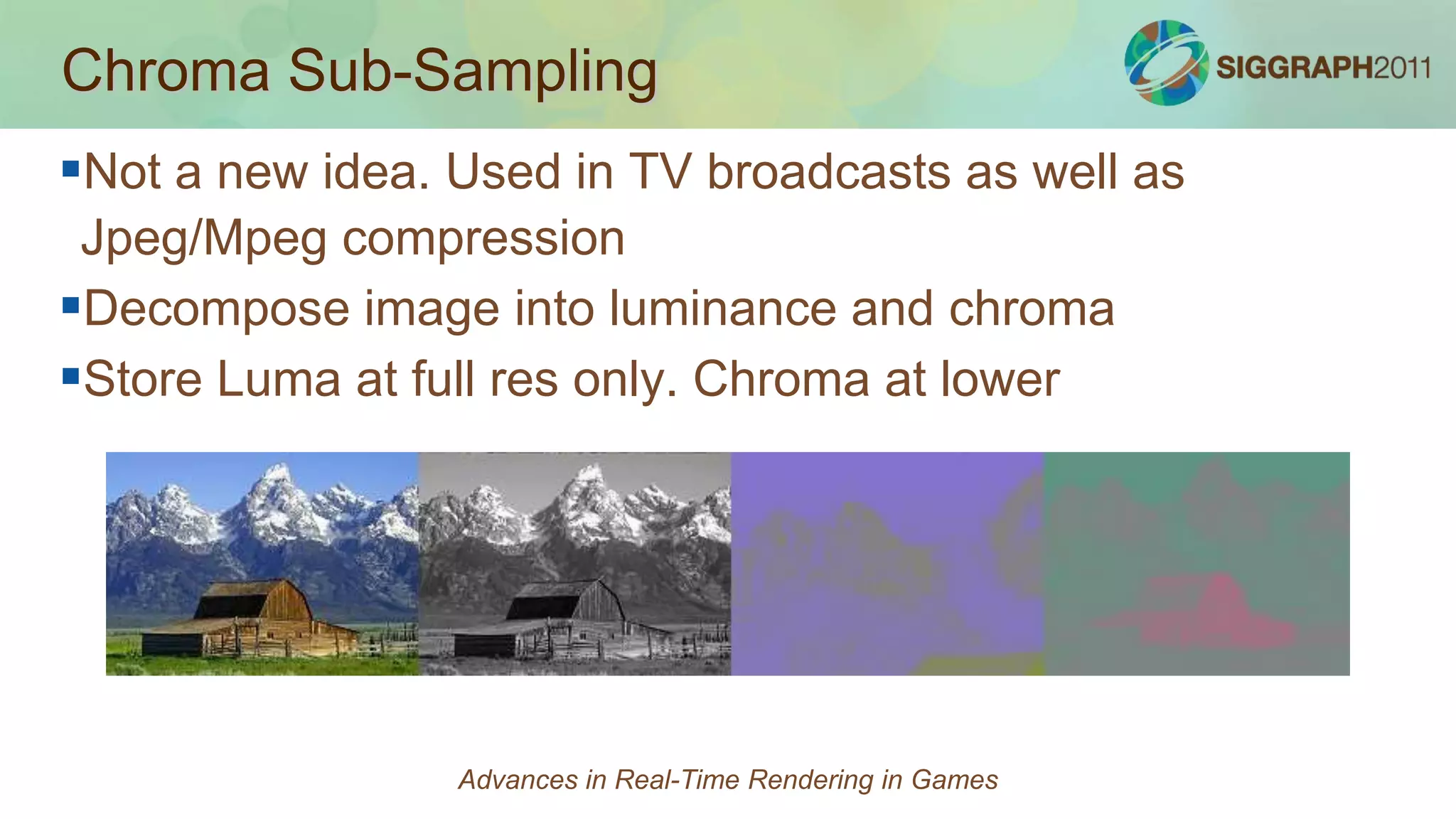
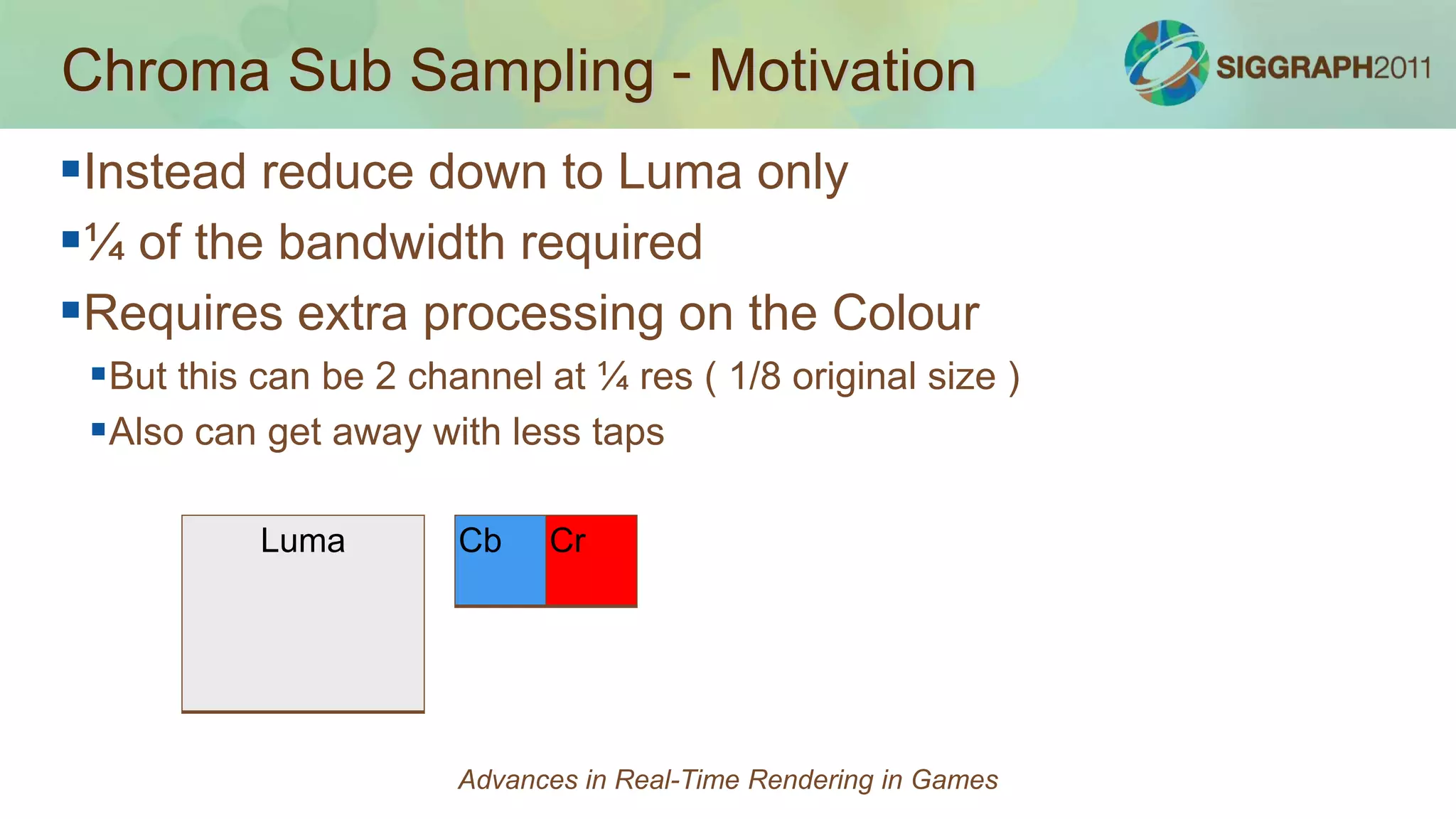
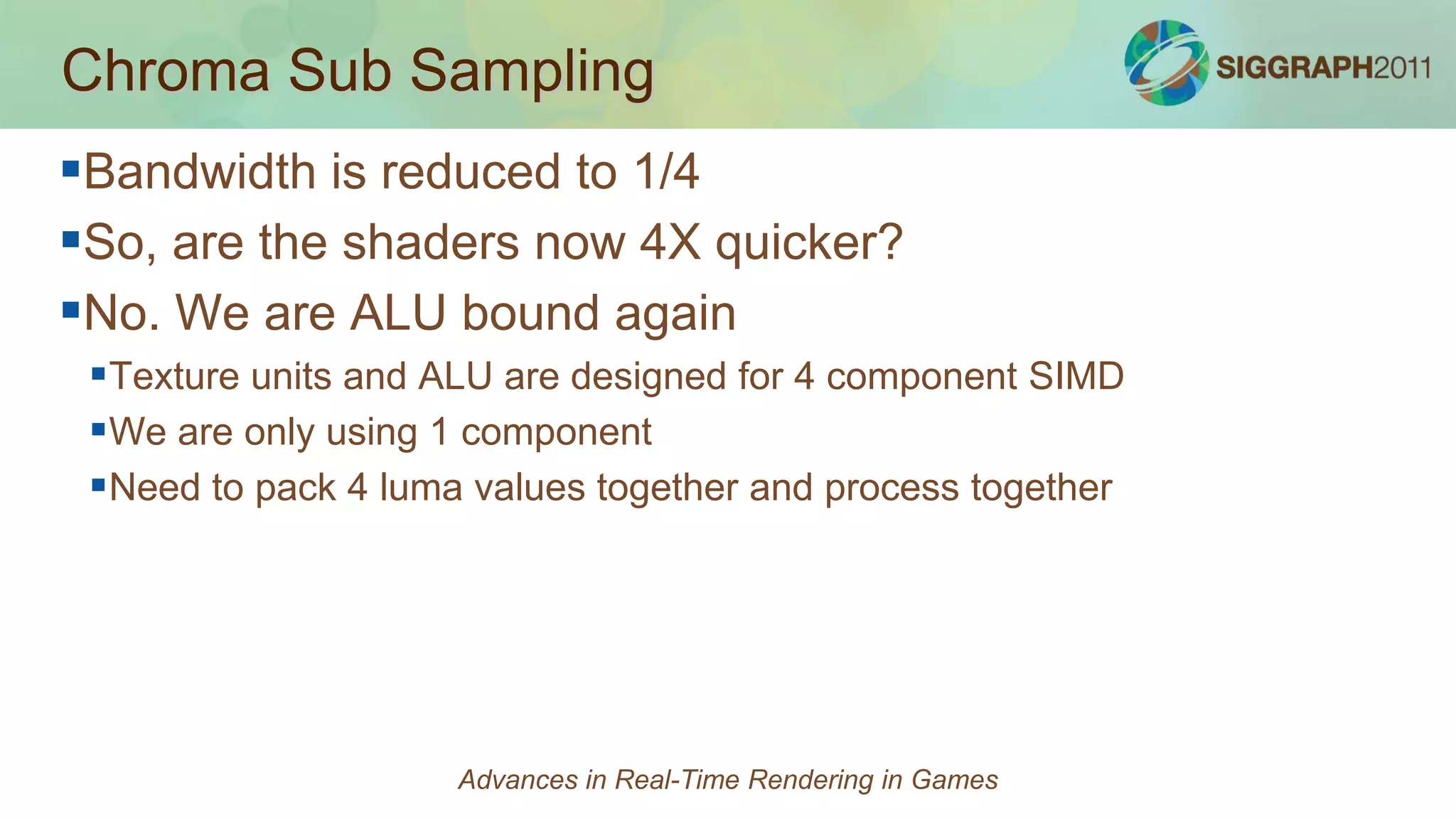
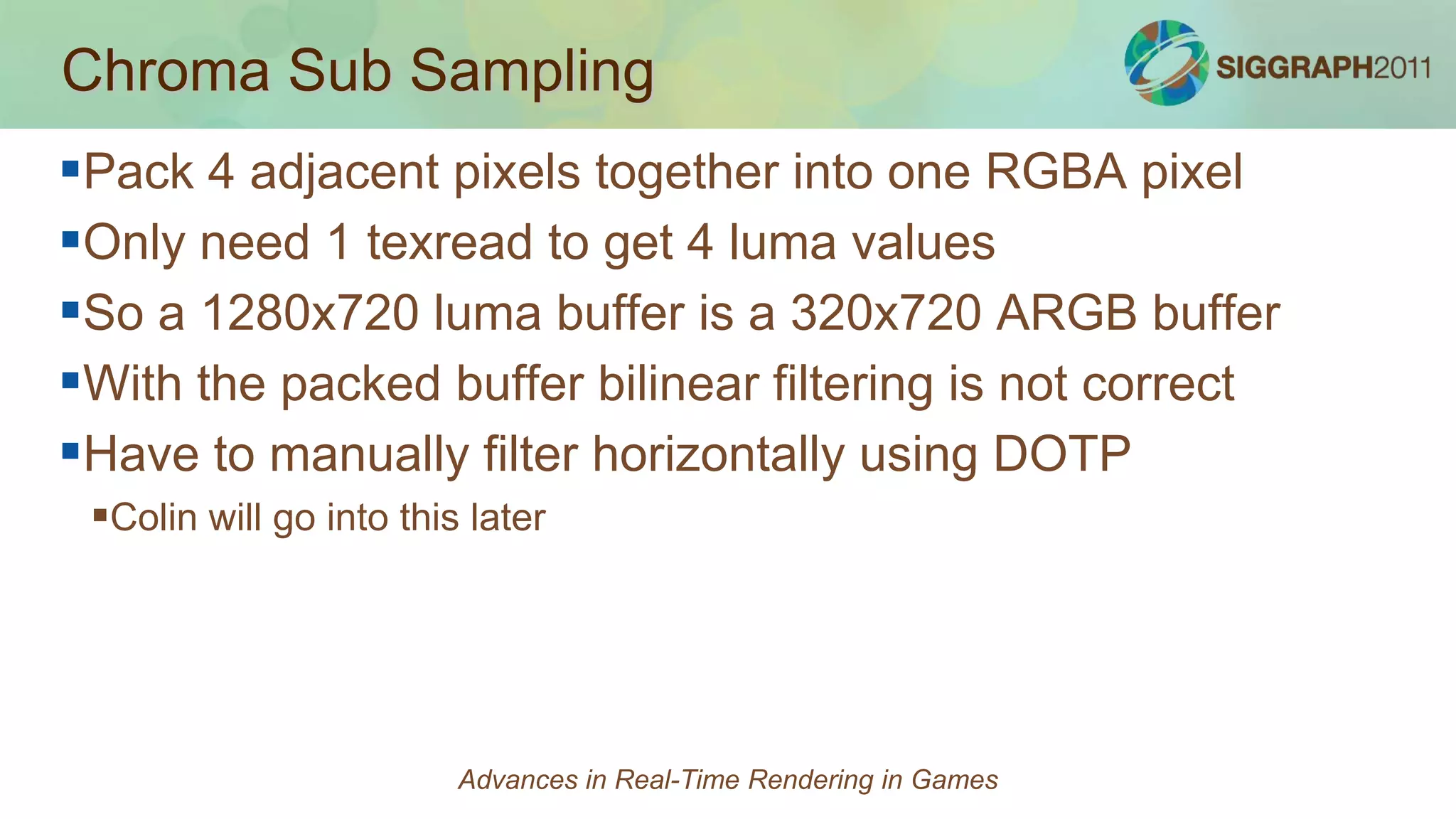
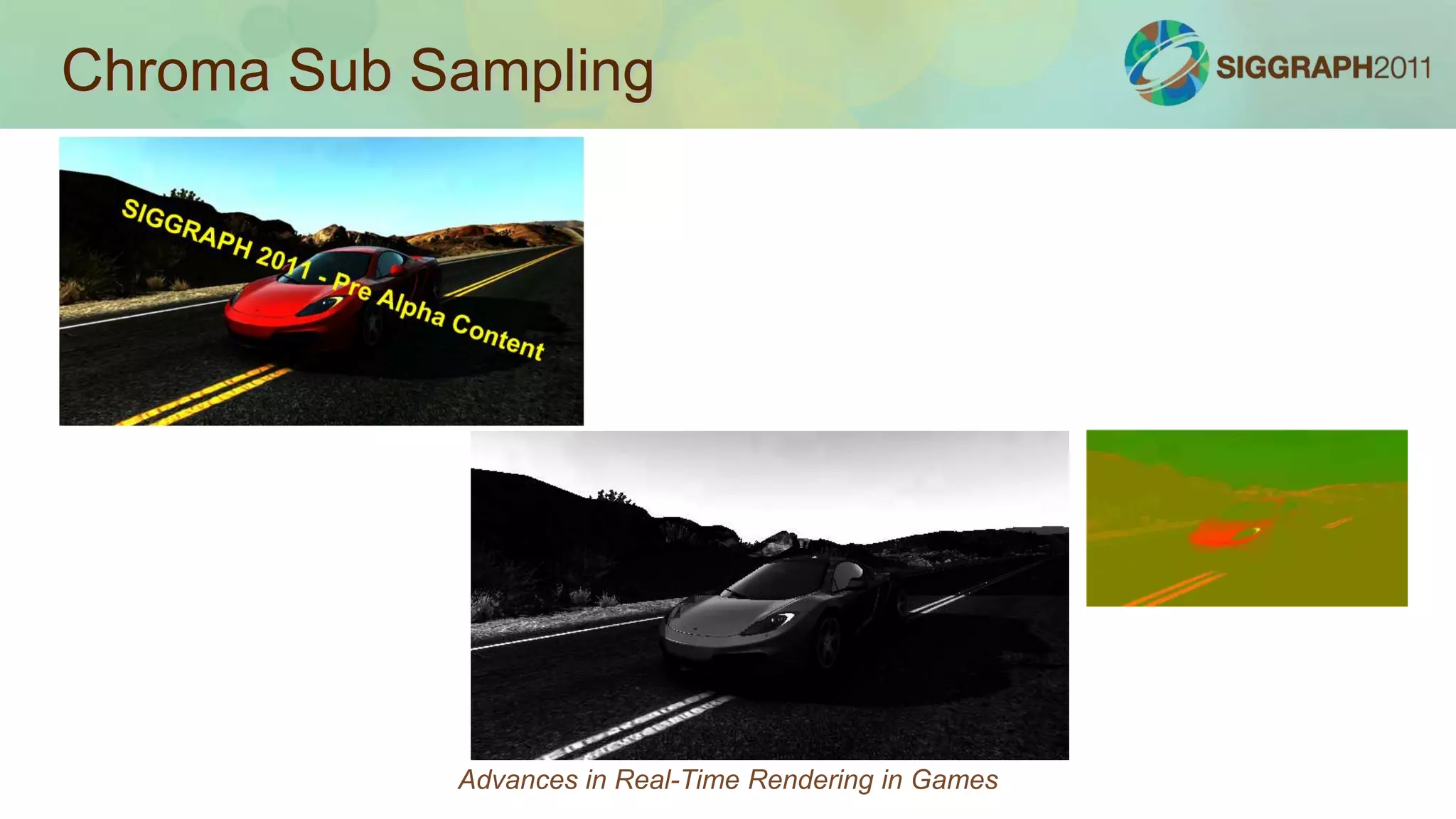
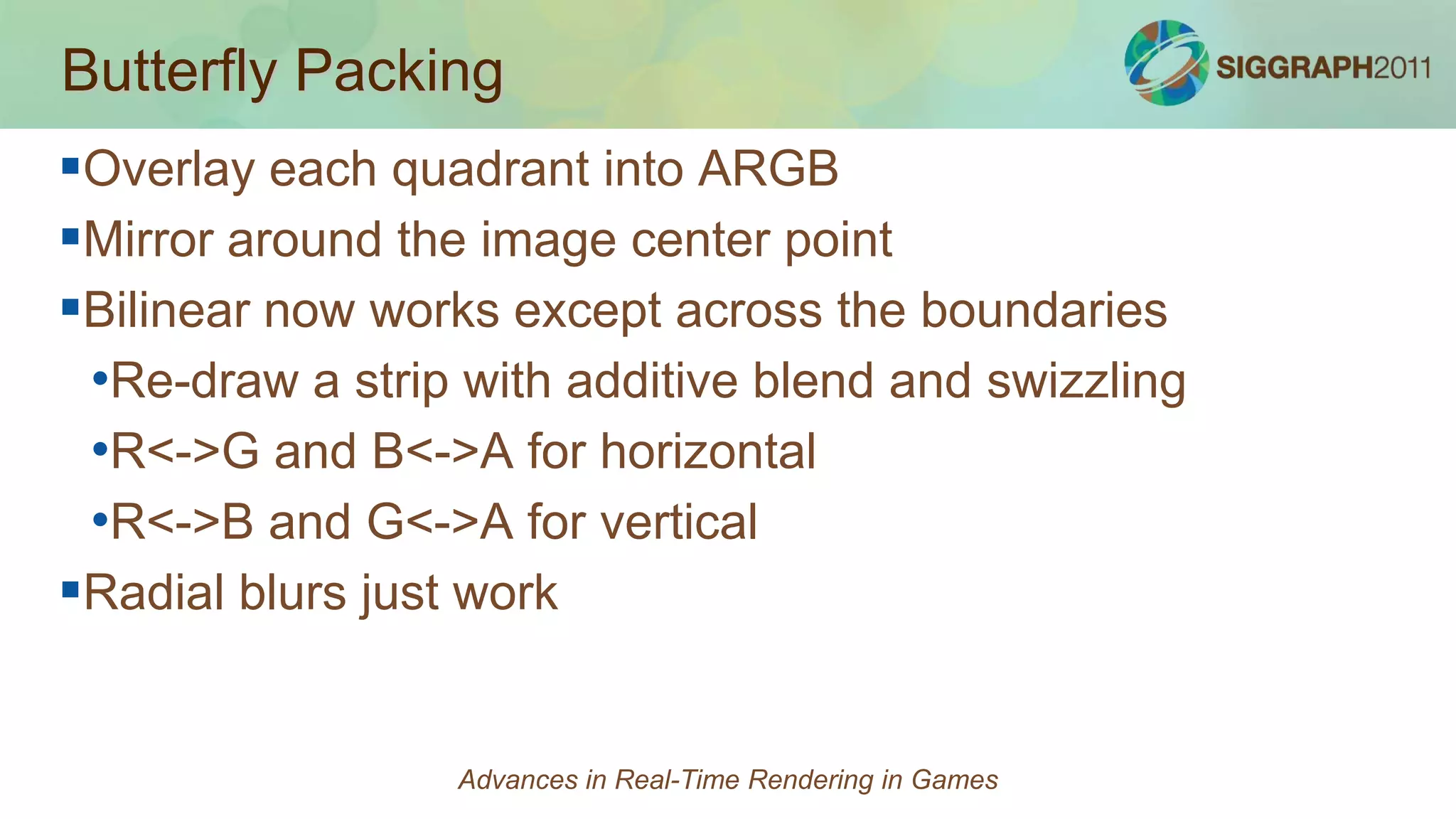
Bilinear now worksexcept across the boundaries Re-draw a strip with additive blend and swizzlingR<->G and B<->A for horizontal R<->B and G<->A for verticalRadial blurs just workAdvances in Real-Time Rendering in Games
150.
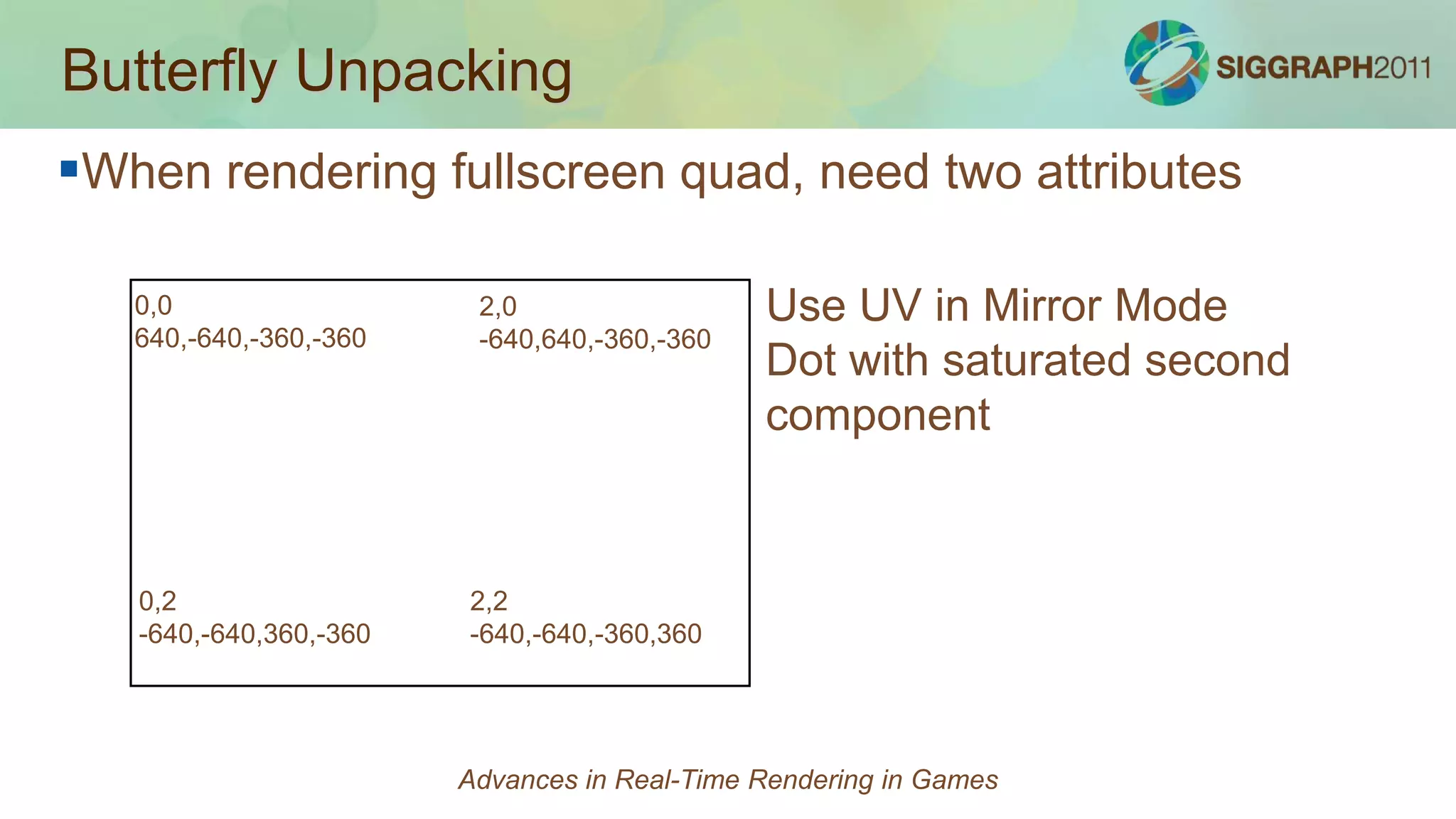
Butterfly UnpackingWhen renderingfullscreen quad, need two attributesUse UV in Mirror ModeDot with saturated second component0,0640,-640,-360,-3602,0-640,640,-360,-3600,2-640,-640,360,-3602,2-640,-640,-360,360Advances in Real-Time Rendering in Games
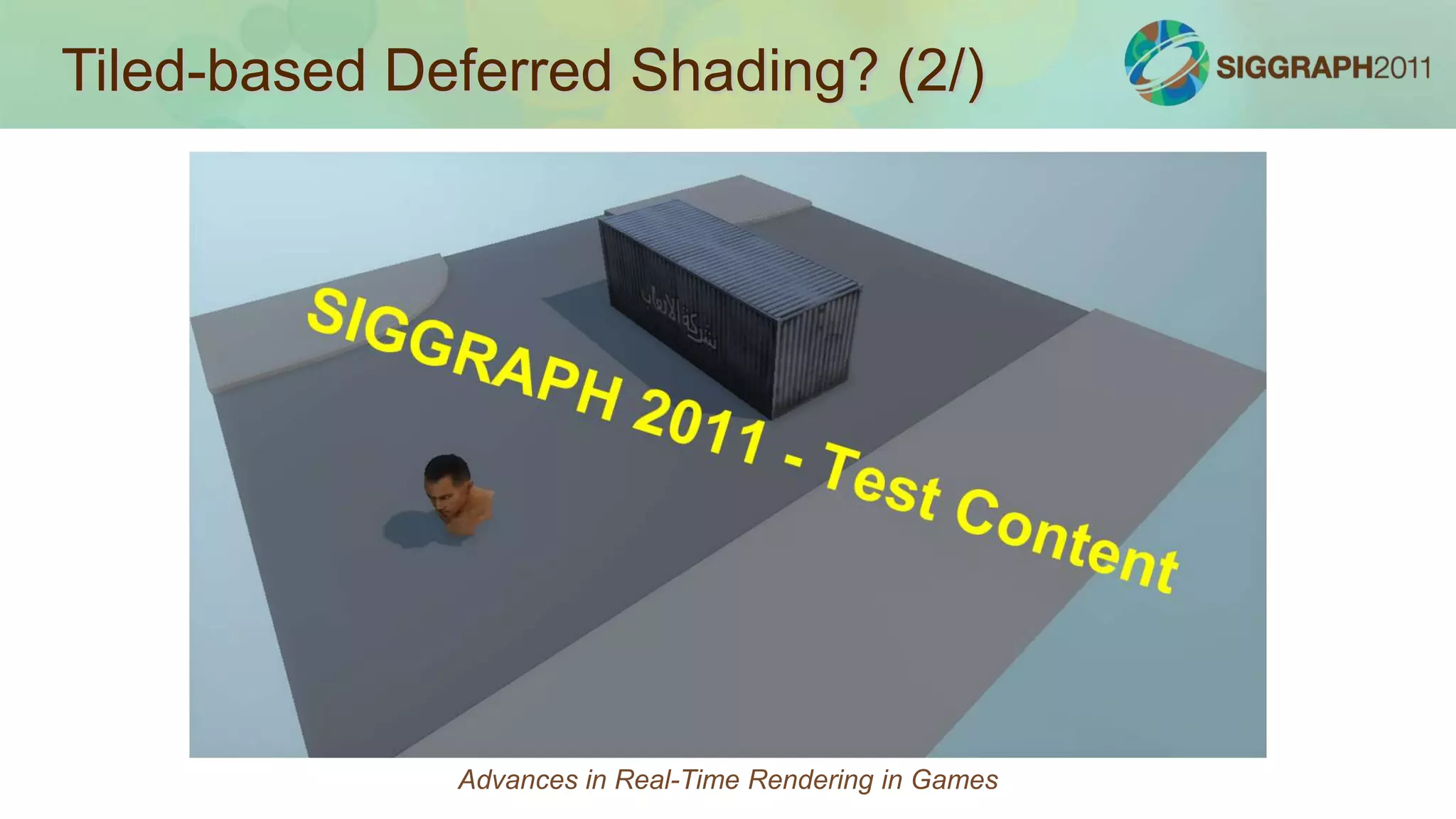
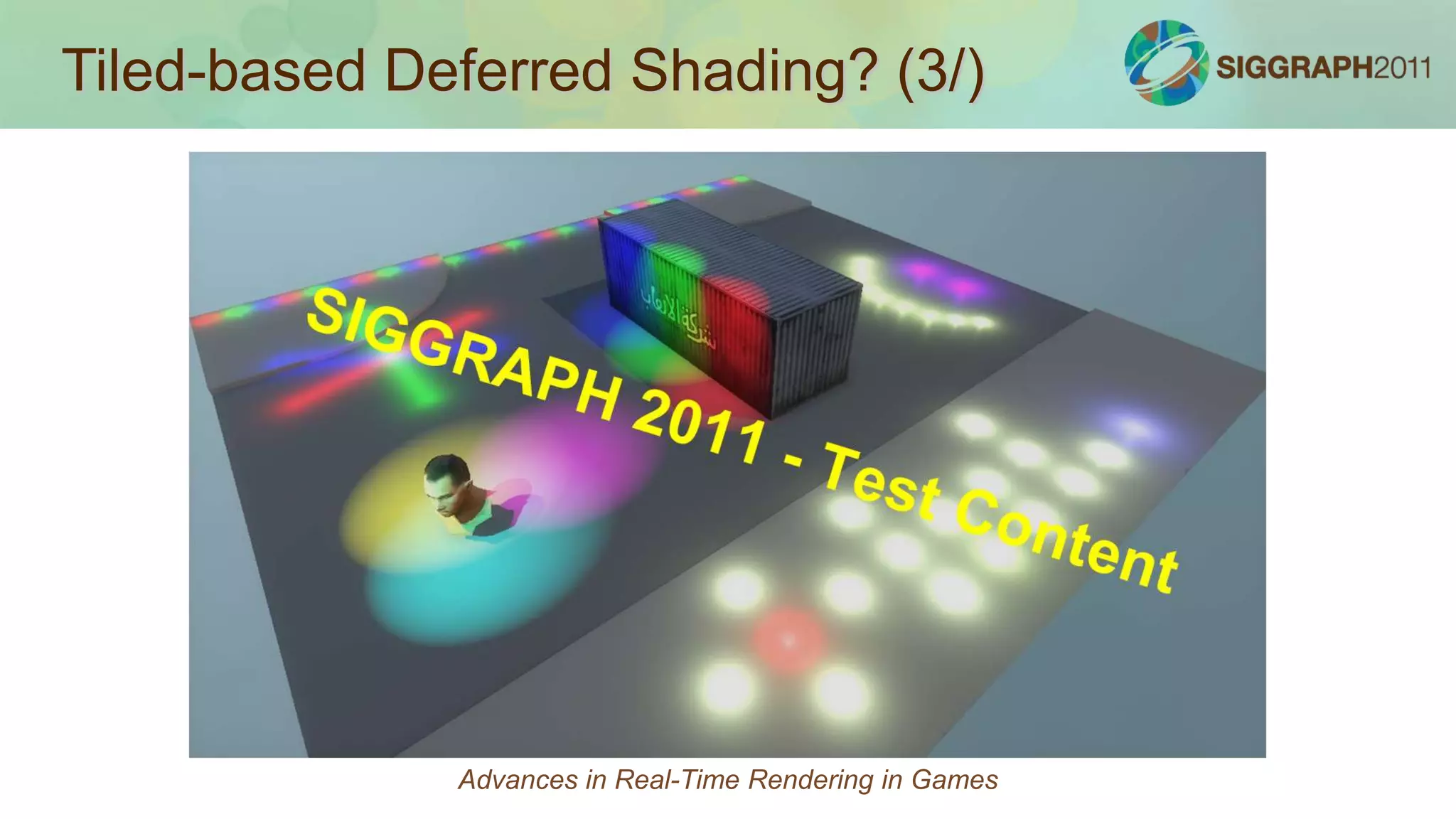
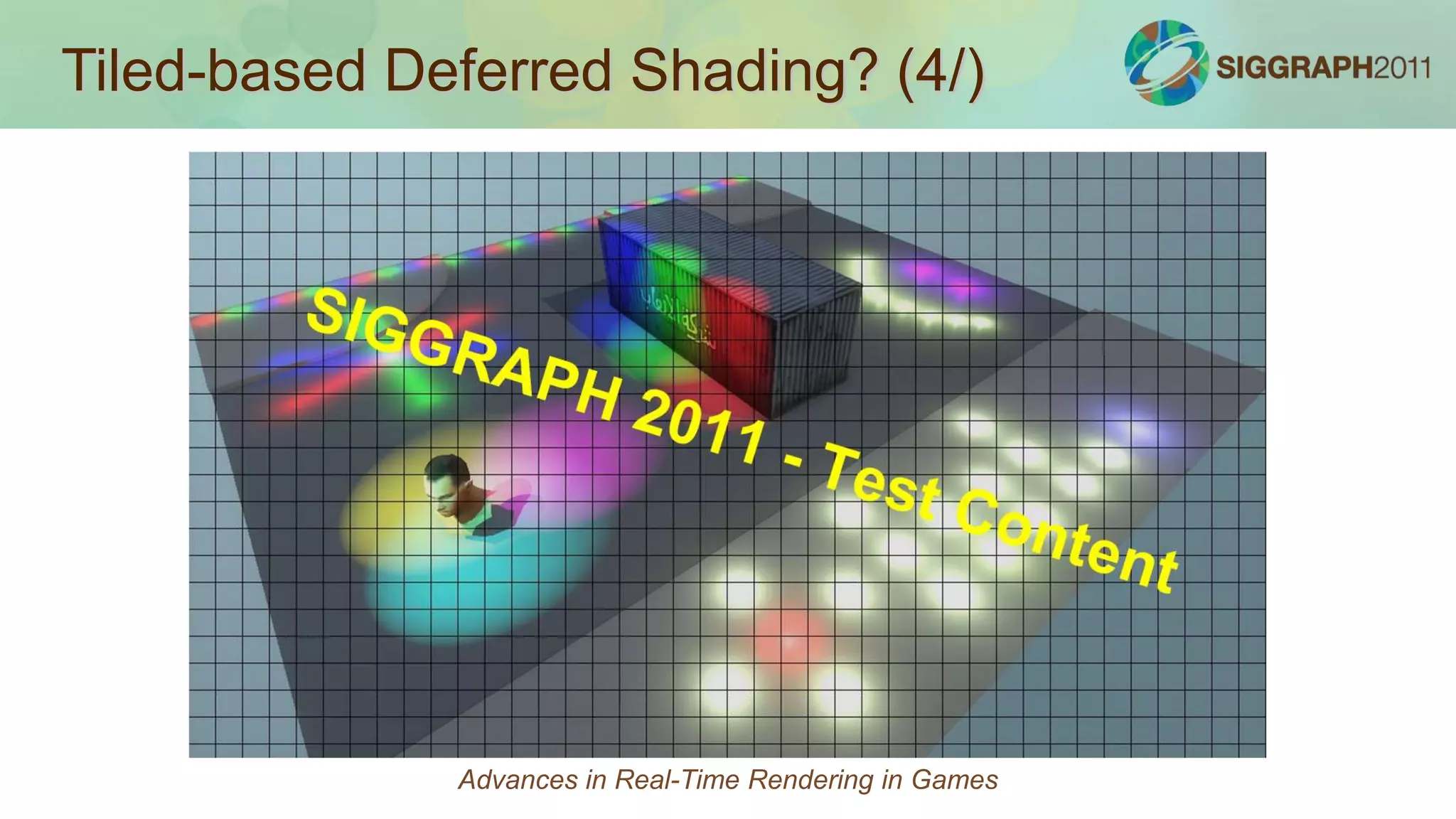
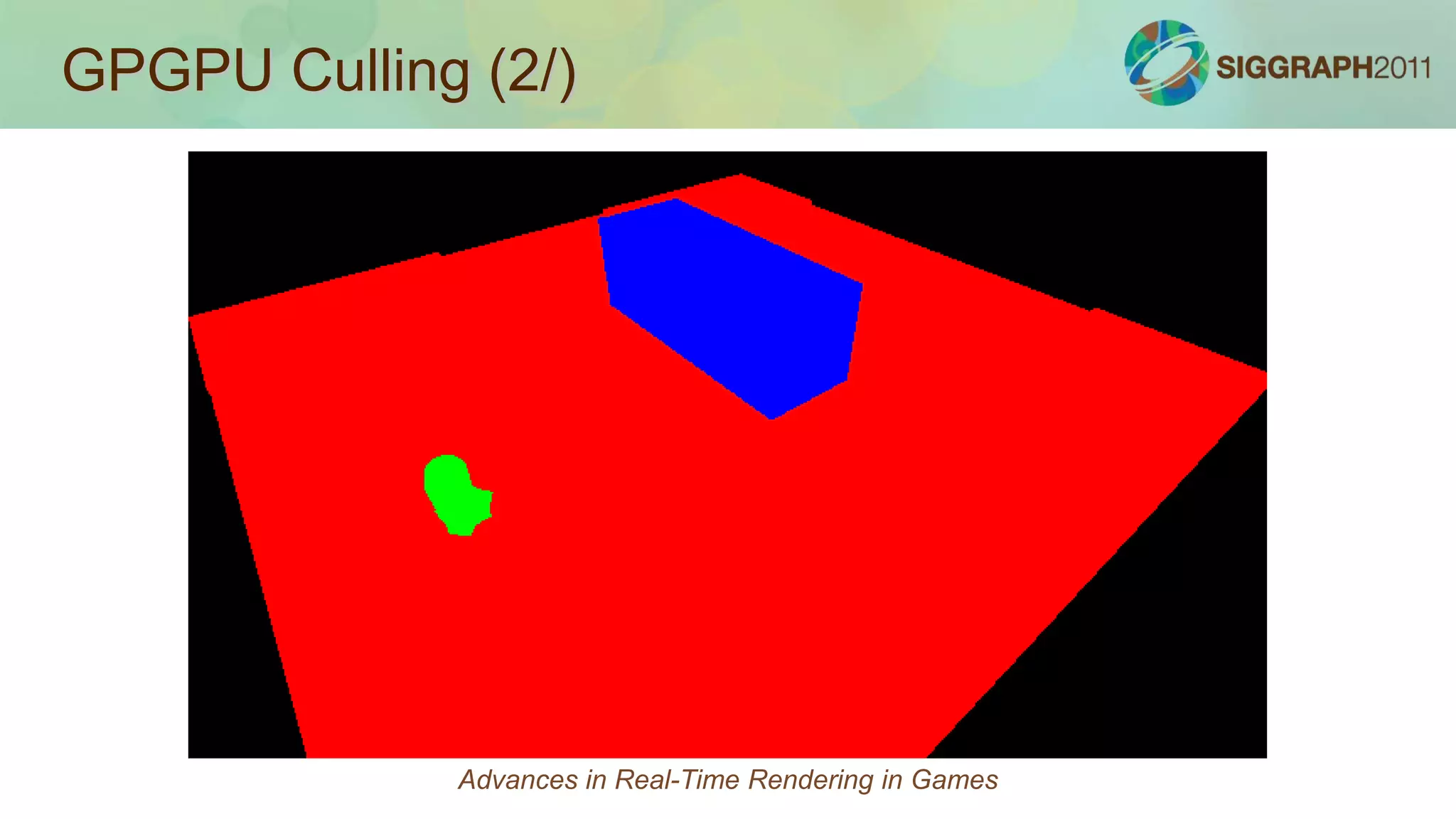
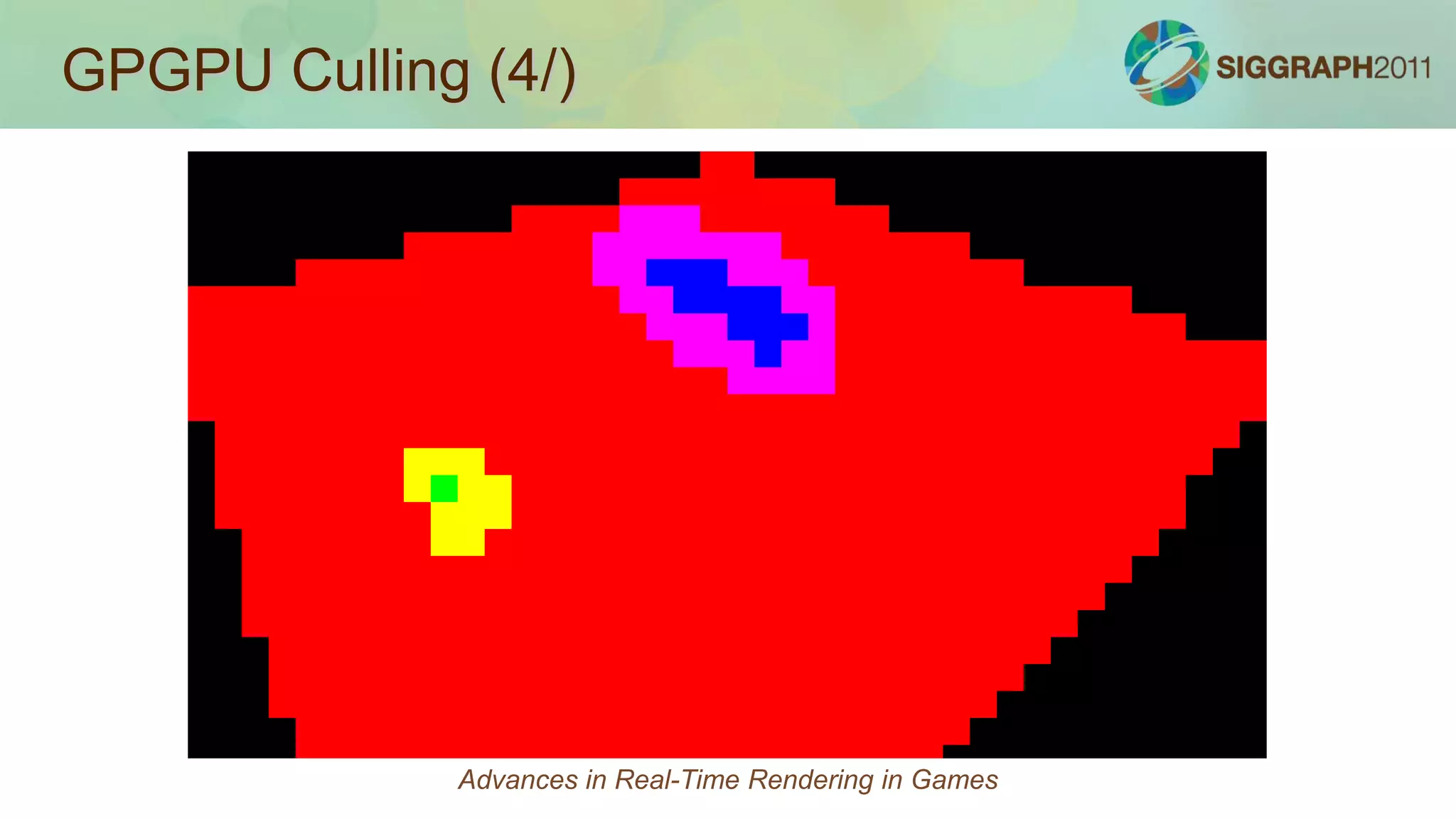
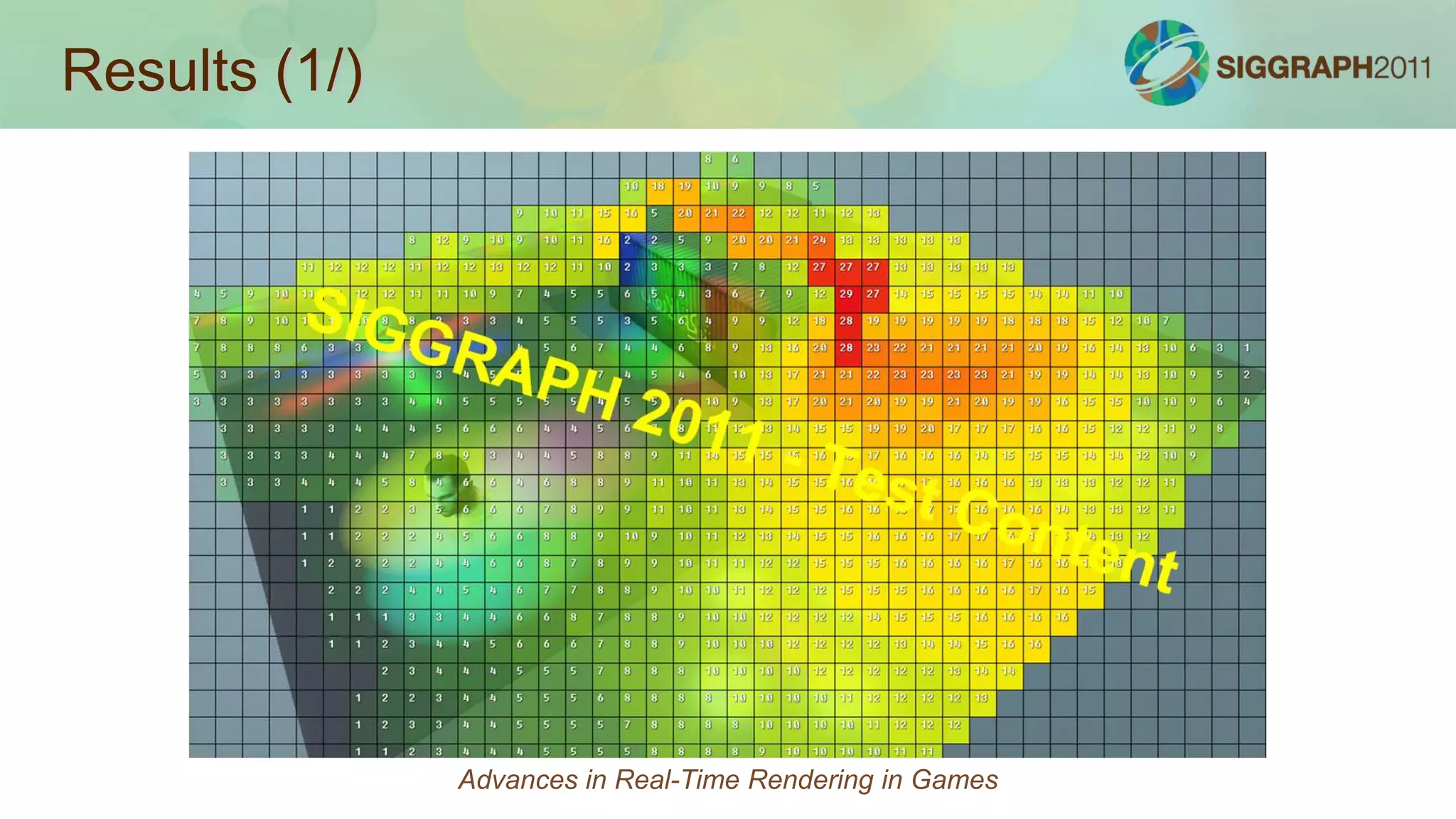
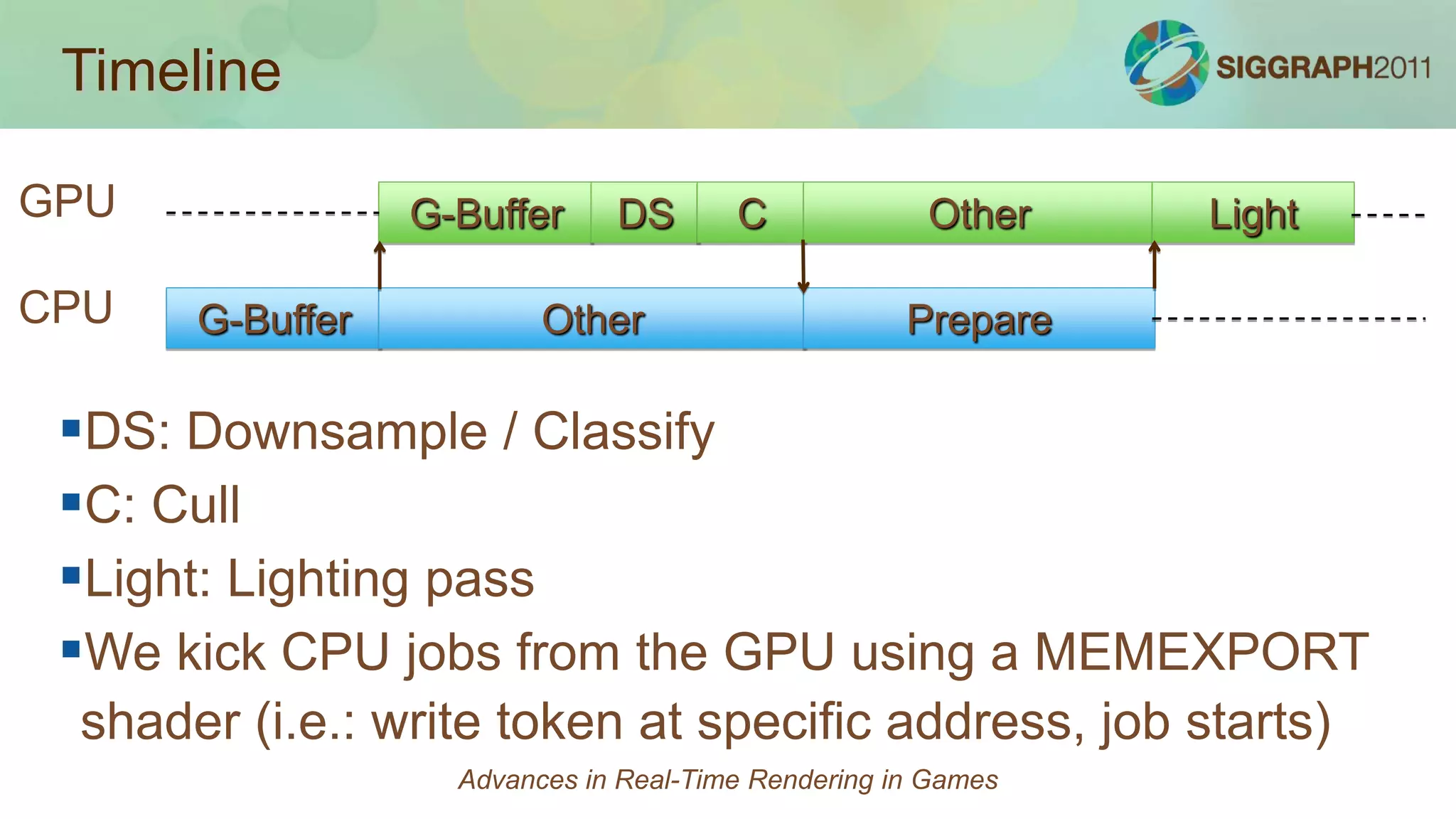
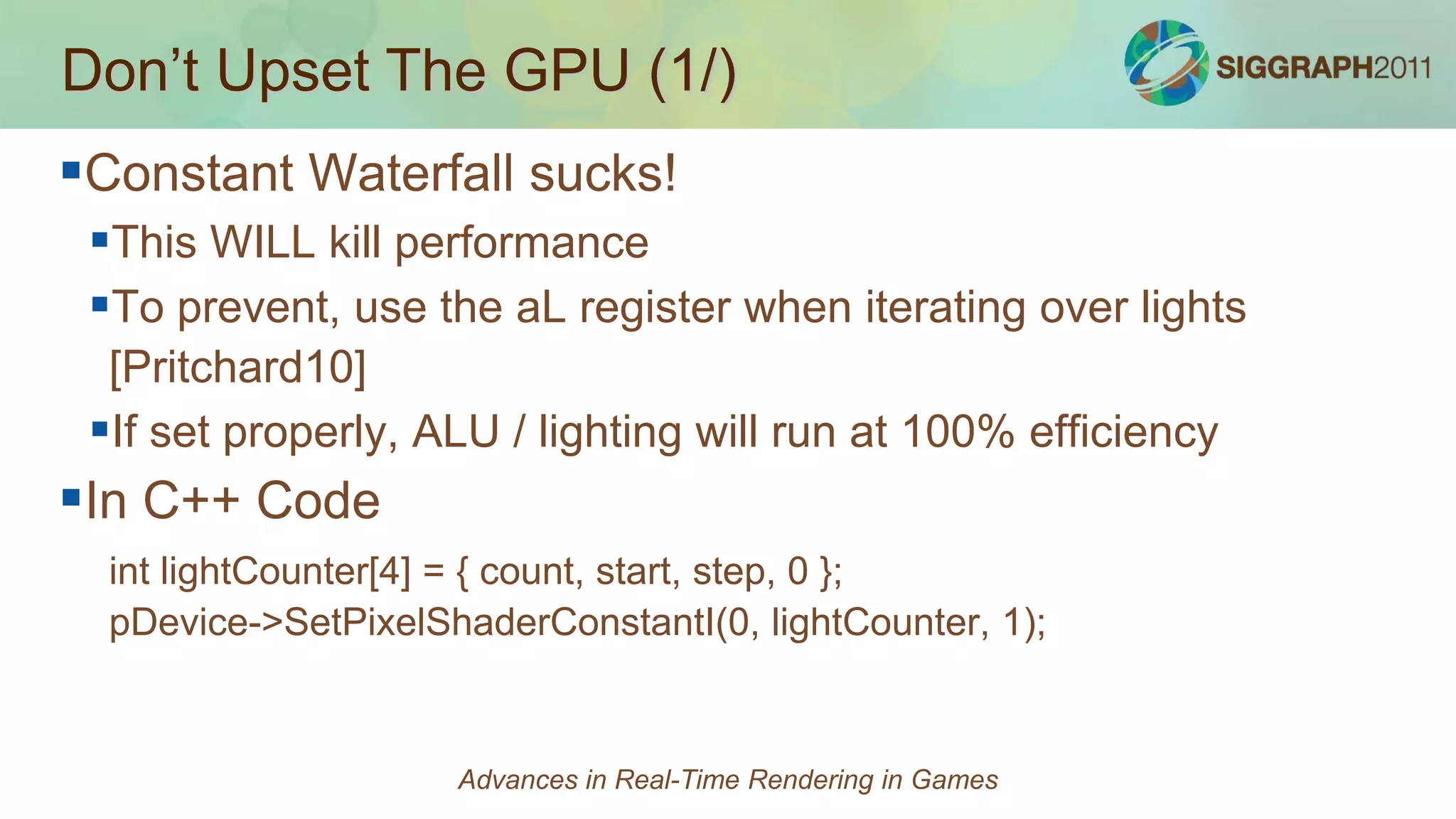
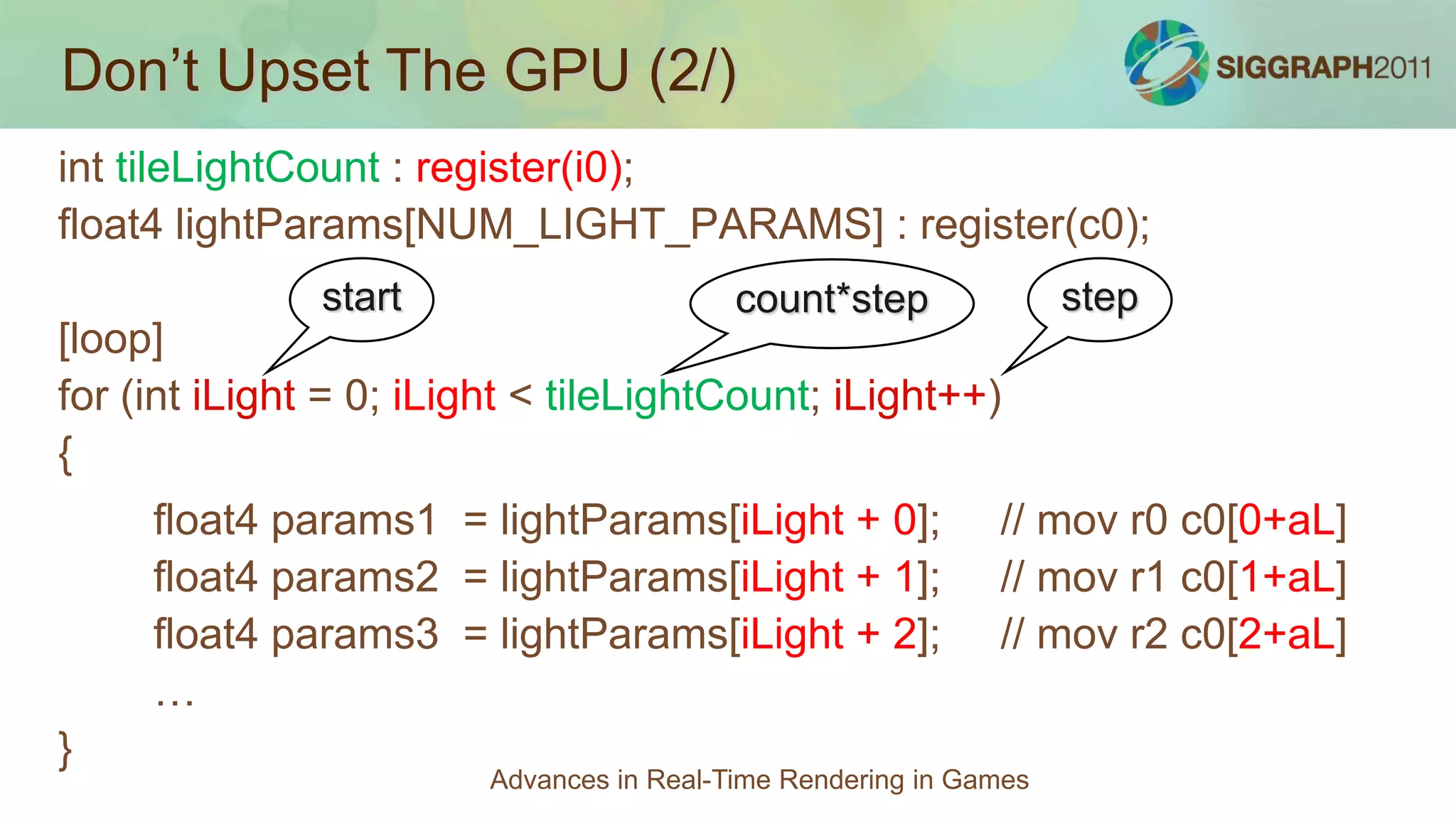
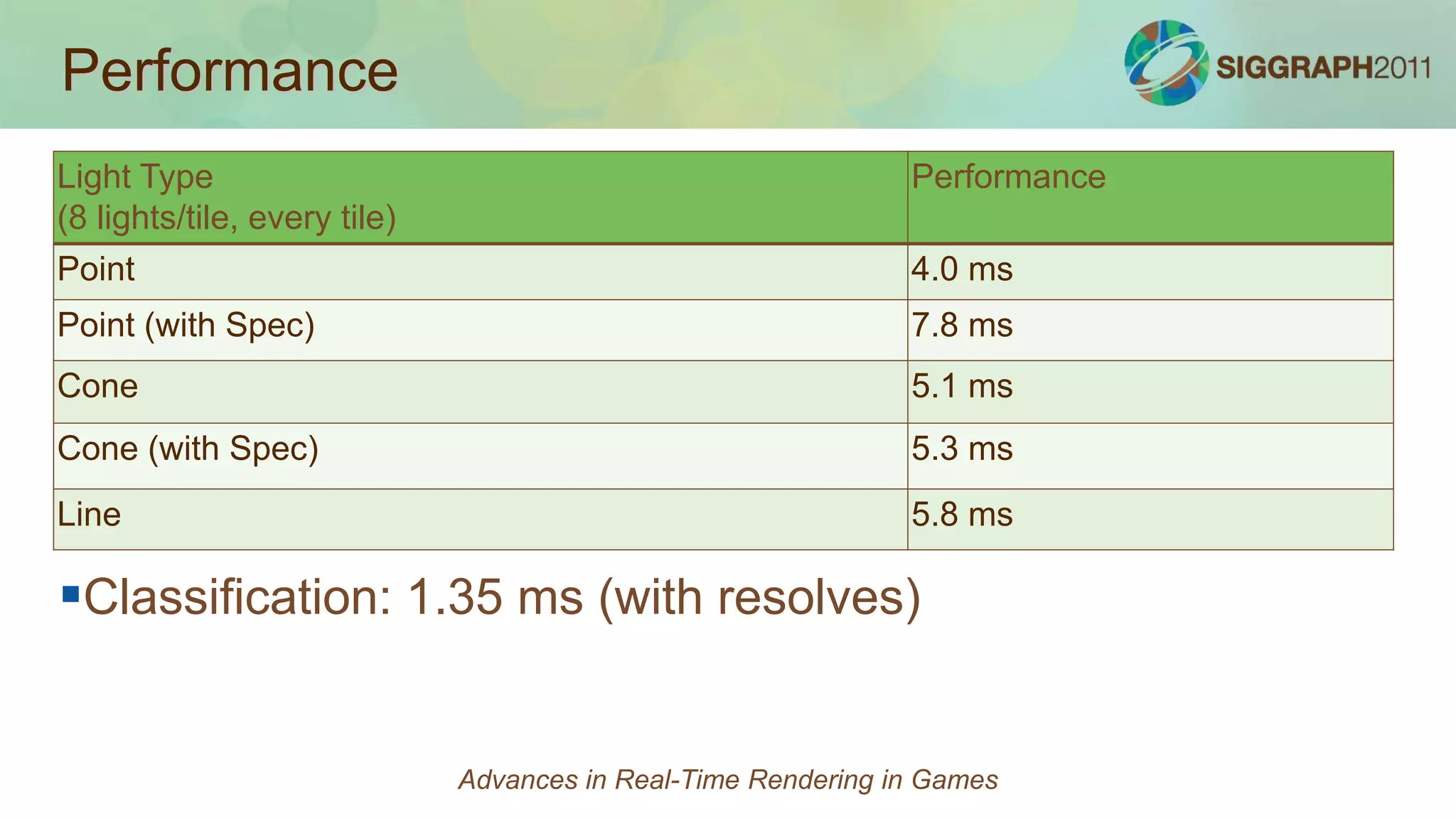
Load-balance and computelighting where it matters:Divide the screen in screen-space tilesCull analytical lights (point, cone, line), per tile Compute lighting for all contributing lights, per tileAdvances in Real-Time Rendering in Games
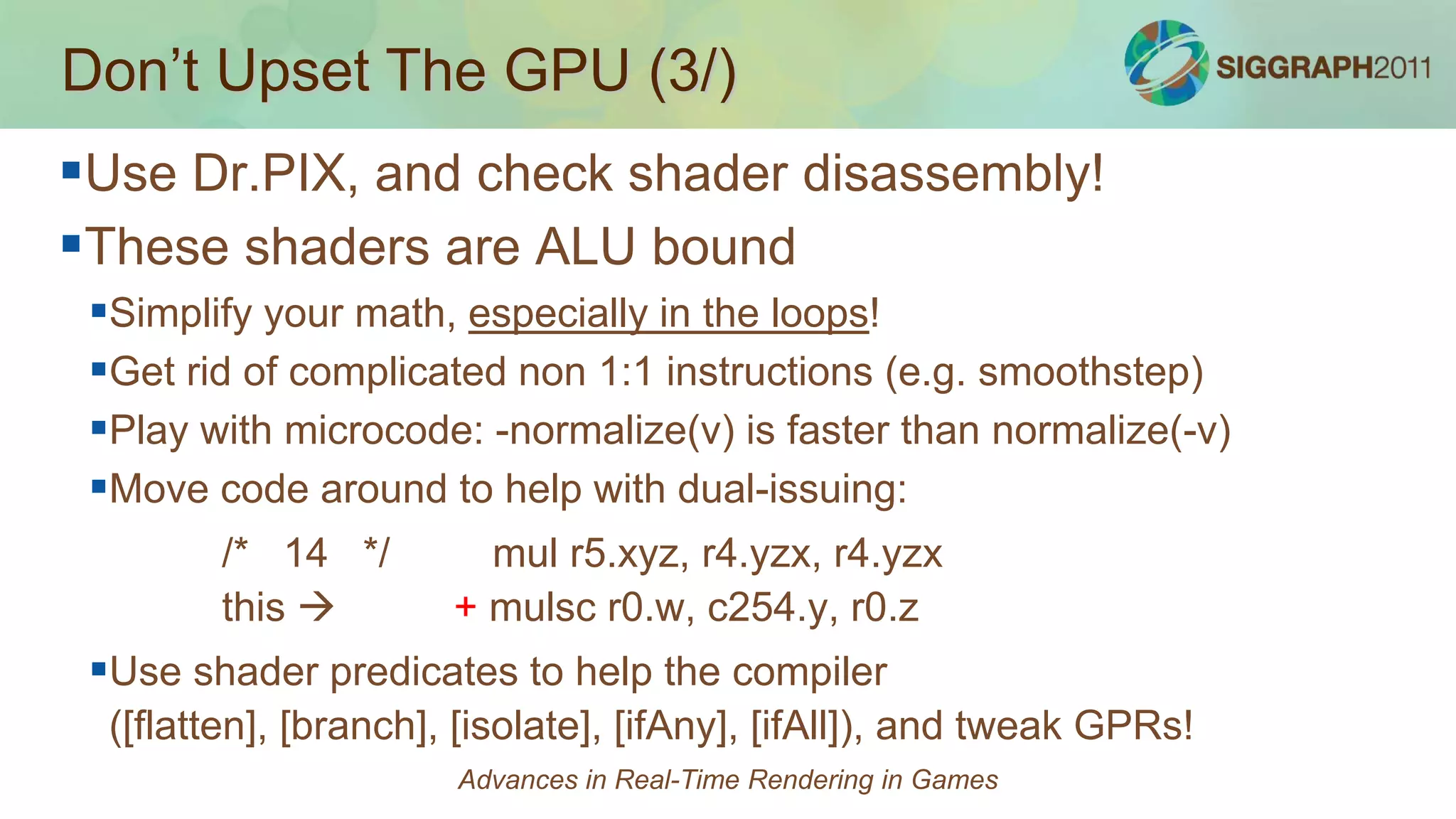
Move code aroundto help with dual-issuing: /* 14 */ mul r5.xyz, r4.yzx, r4.yzx this + mulsc r0.w, c254.y, r0.zUse shader predicates to help the compiler ([flatten], [branch], [isolate], [ifAny], [ifAll]), and tweak GPRs!Advances in Real-Time Rendering in Games
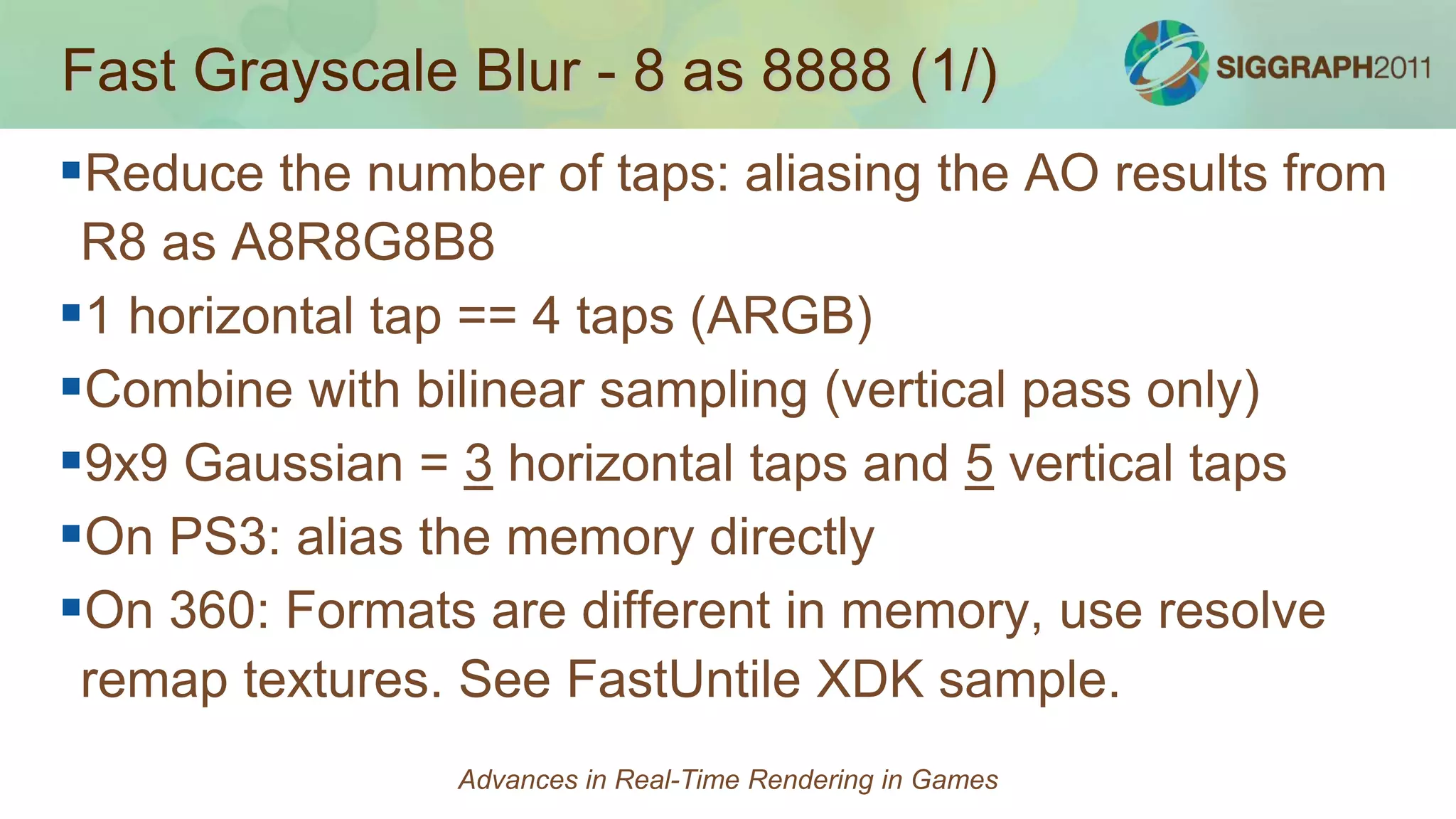
On 360: Formatsare different in memory, use resolve remap textures. See FastUntile XDK sample.Advances in Real-Time Rendering in Games
238.
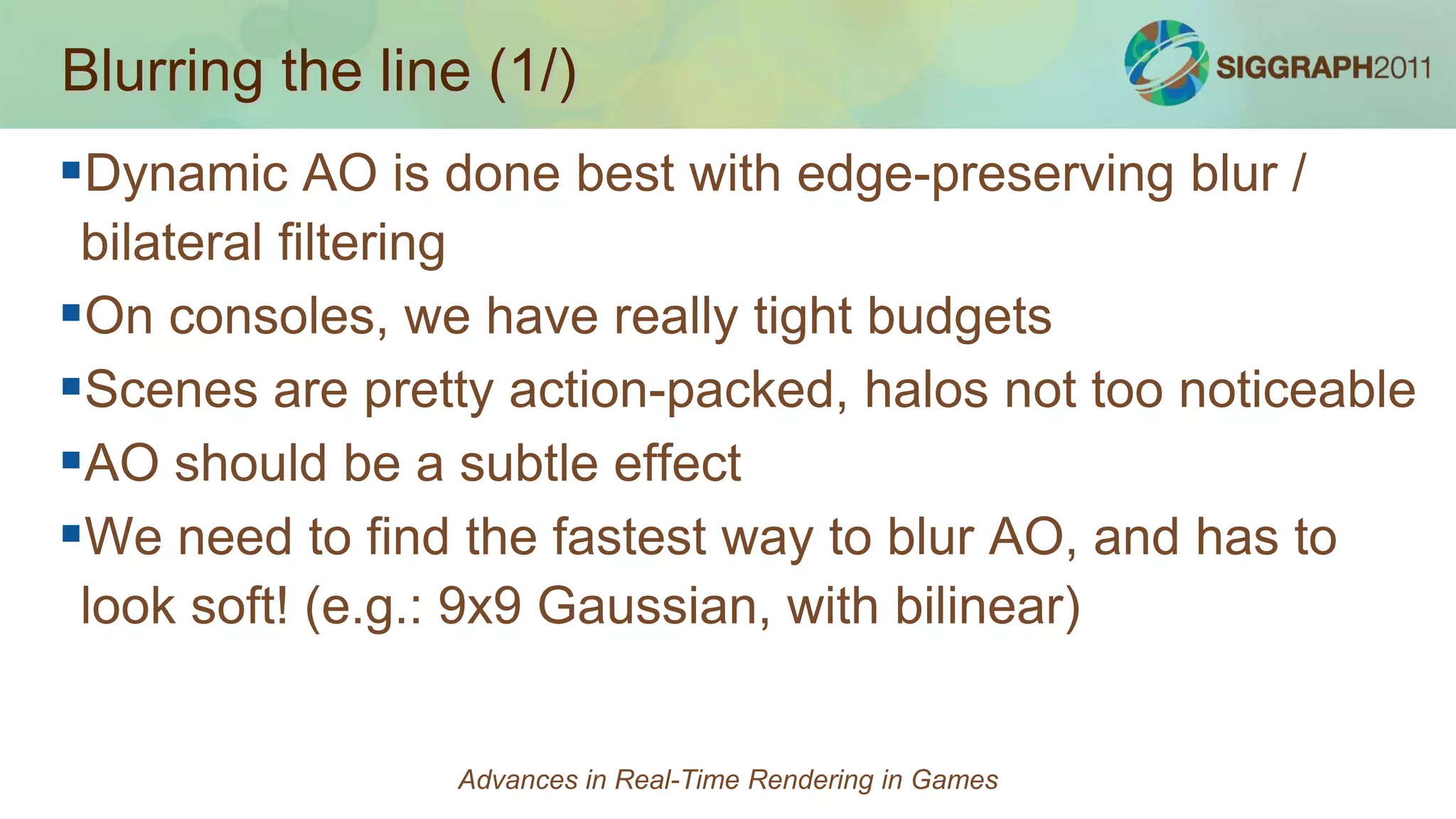
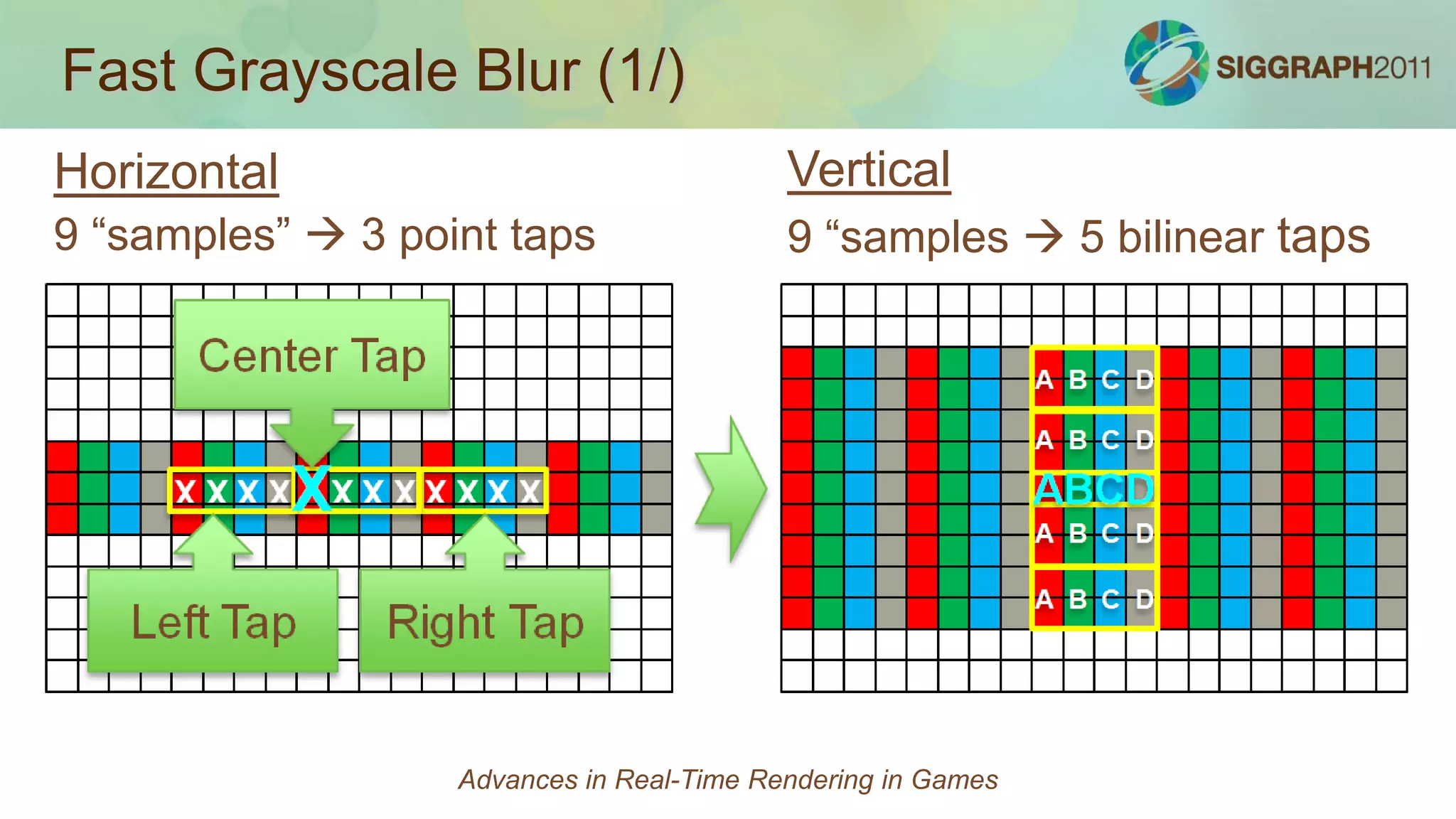
Fast Grayscale Blur(1/)Vertical9 “samples 5 bilinear tapsHorizontal9 “samples” 3 point tapsAdvances in Real-Time Rendering in Games
239.
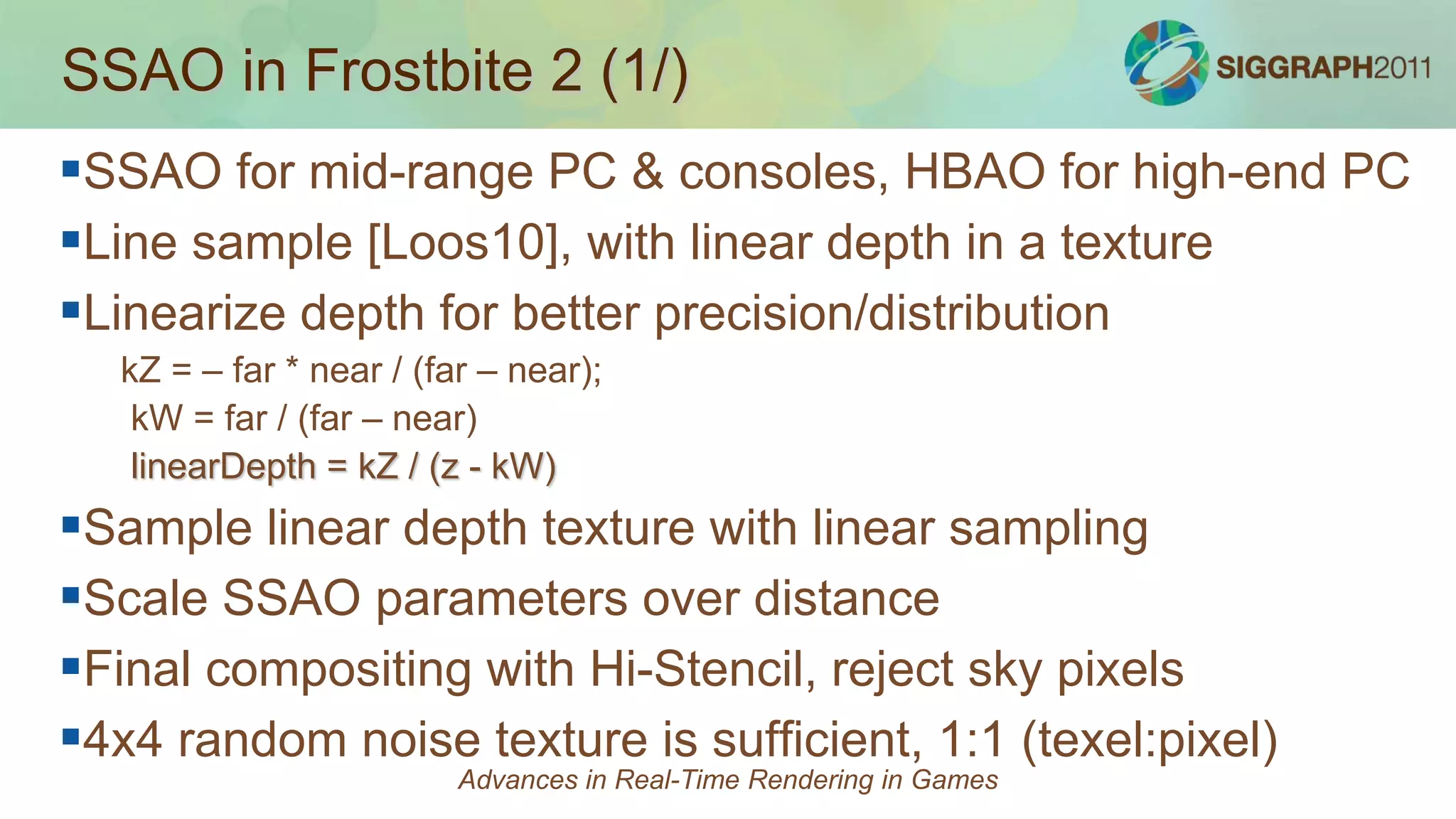
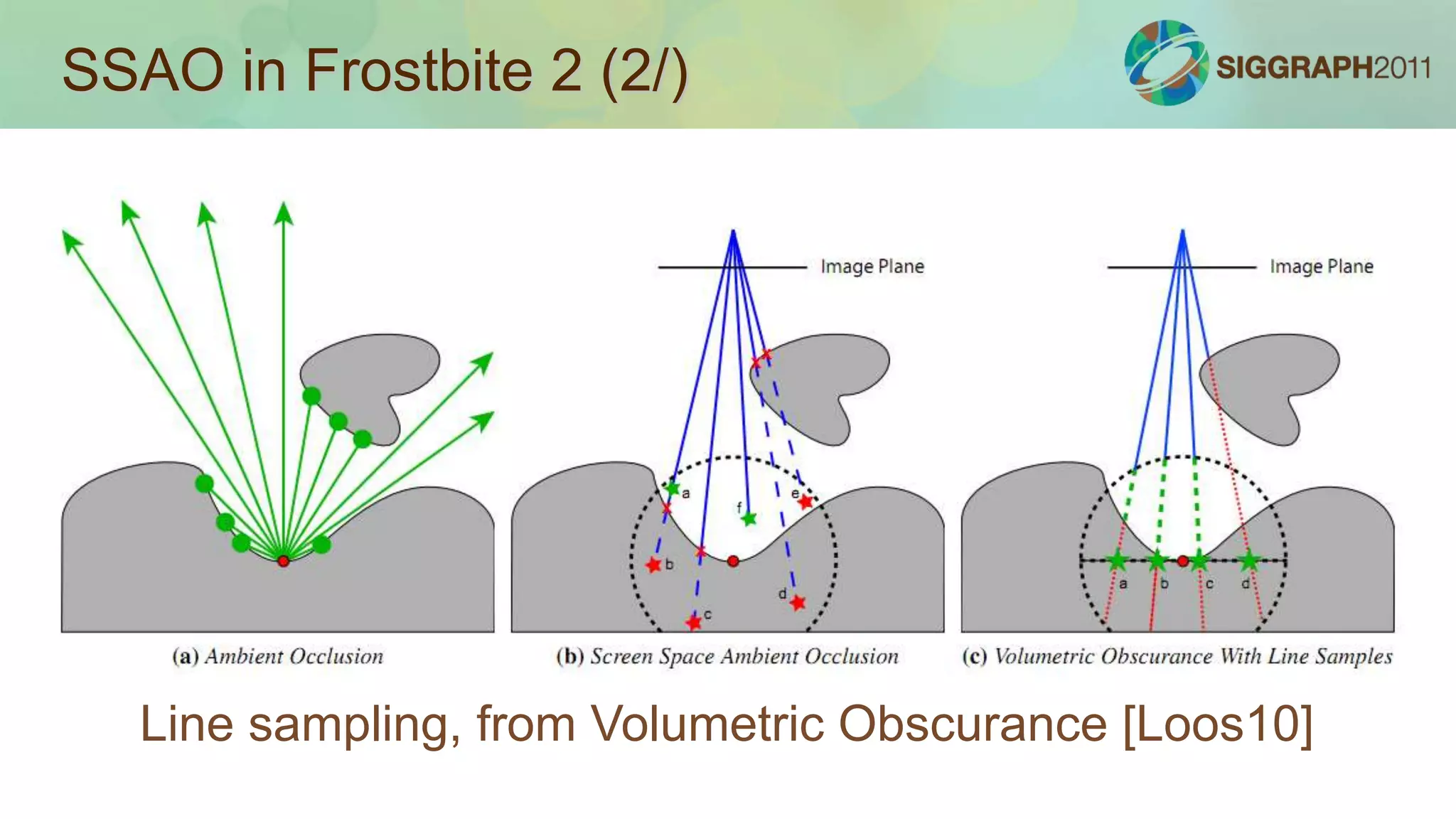
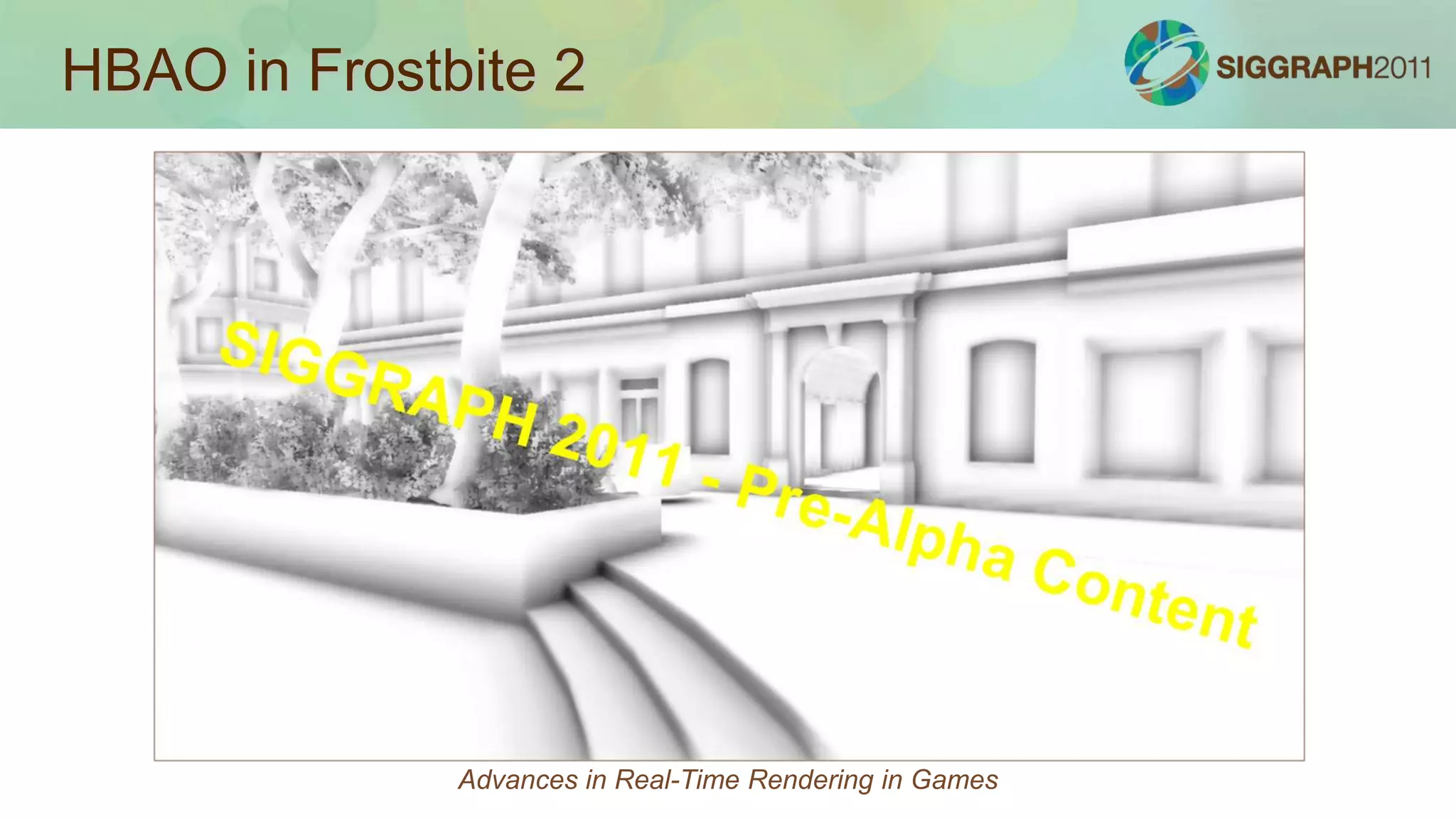
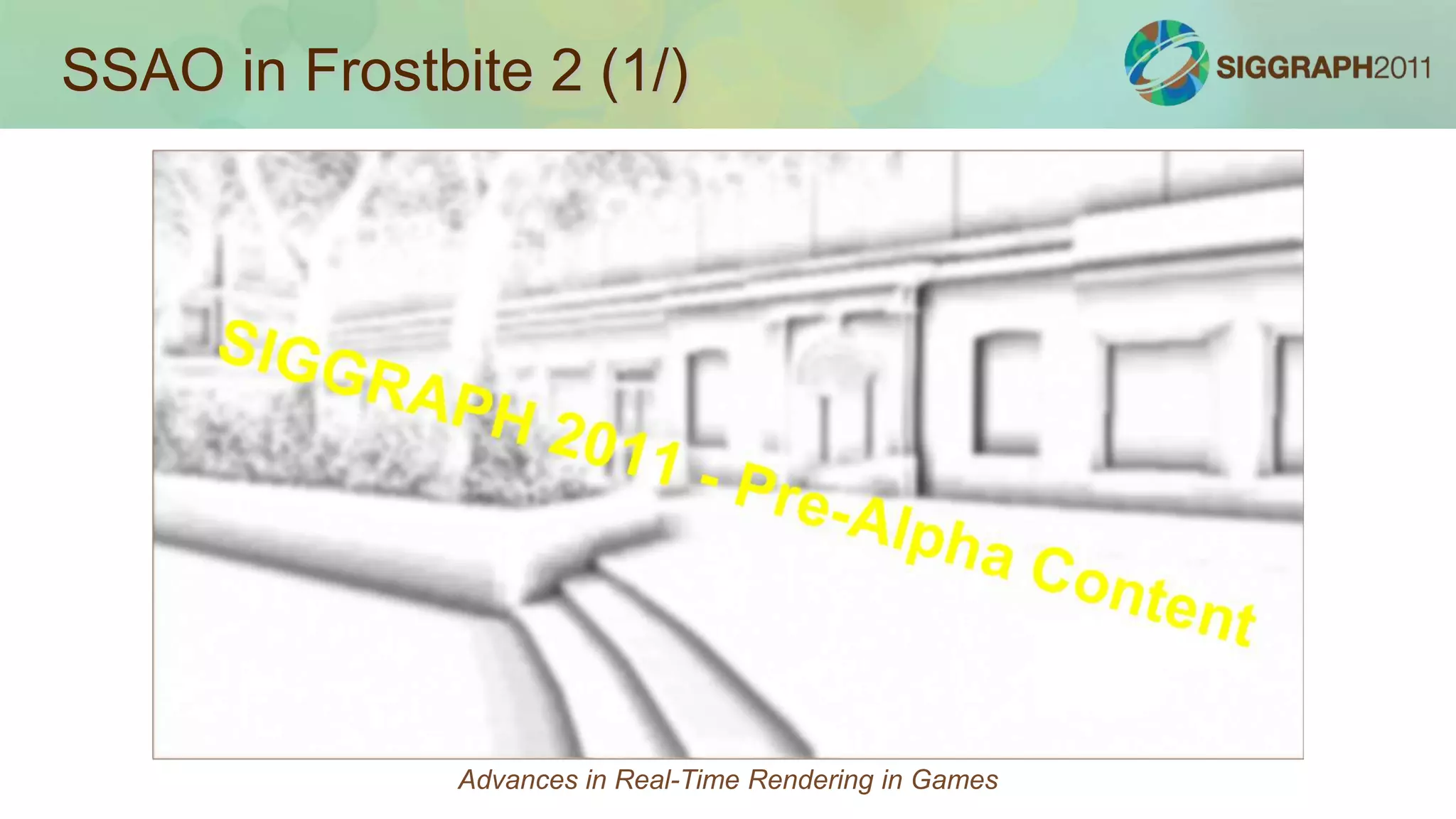
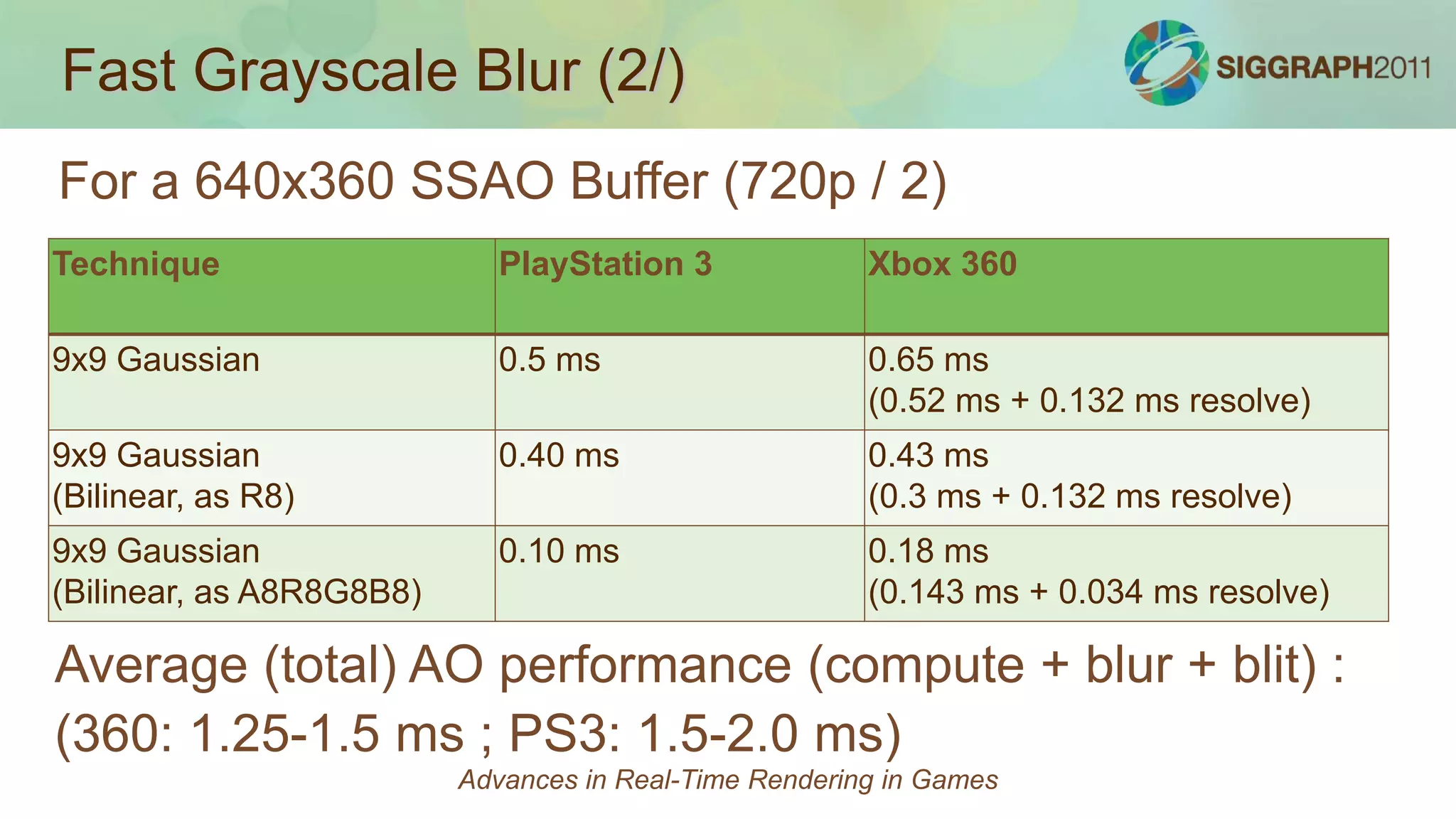
Fast Grayscale Blur(2/)For a 640x360 SSAO Buffer (720p / 2)Average (total) AO performance (compute + blur + blit) : (360: 1.25-1.5 ms ; PS3: 1.5-2.0 ms)Advances in Real-Time Rendering in Games
QuestionsJohn White –Bokeh, Z Cull Reverse Reload, Chroma SubsamplingColin Barré-Brisebois – Tile-based Deferred Shading, SSAOAdvances in Real-Time Rendering in Games
254.
References (1/)ANDERSSON, J.,“Parallel Graphics in Frostbite - Current & Future”, Beyond Programmable Shading, SIGGRAPH 2009.BAVOIL, L., SAINZ, M., and DIMITROV, R., “Image-space horizon-based ambient occlusion”, SIGGRAPH 2008.COFFIN, C., “SPU Based Deferred Shading for Battlefield 3 on Playstation 3”, GDC 2011.DEMERS, J., “Depth of Field : A Survey of Techniques”, GPU Gems, Ch.23.HUTCHINSON, N. et al., “Screen Space Classification for Efficient Deferred Shading”, SIGGRAPH 2010.JONES, M., Optimal CoC Calculation, Rendering @ EA internal mail, 2008.Advances in Real-Time Rendering in Games
255.
References (2/)LOOS, B.J., and SLOAN, P-P., “Volumetric Obscurance”, 2010.NEVRAEV, I., “Xbox 360 Precompiled Command Buffers”, Microsoft Gamefest London 2011.PRITCHARD, C., “Xbox 360 Shaders and Performance: How Not to Upset the GPU”, Microsoft Gamefest Seattle 2010.SOUSA, T., “Crysis Next Gen Effects”, GDC 2008.SWOBODA, M., “Deferred Lighting and Post-Processing on PLAYSTATION®3”, GDC 2009.KAWASE, M., “Frame Buffer Postprocessing Effects in DOUBLE-S.T.E.A.L (Wreckless), GDC 2003.Advances in Real-Time Rendering in Games
Editor's Notes
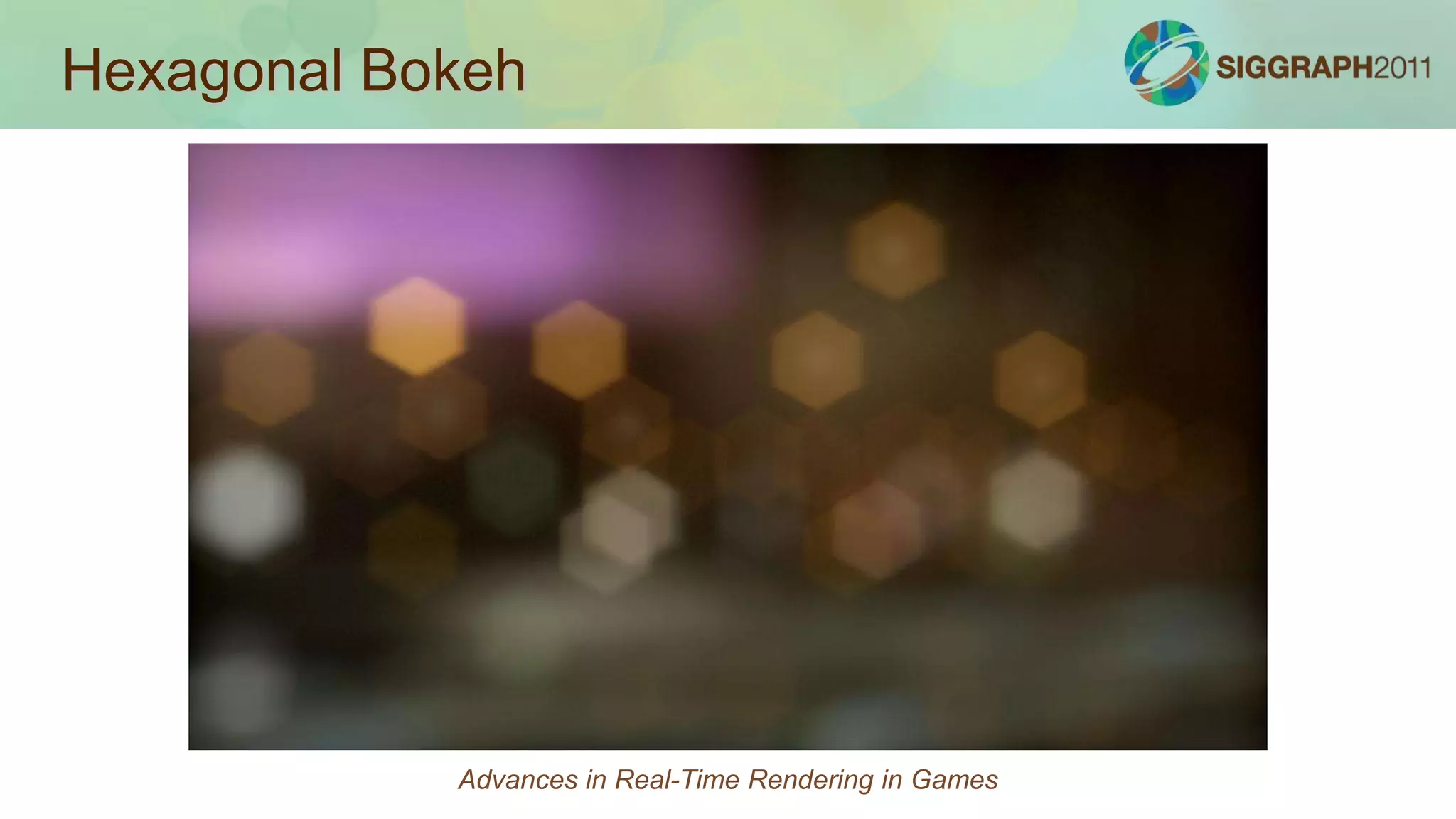
#23 Example with extreme filter kernel.Note there are some blight blobs in some of the hexagons. This is an artifact of a later pass to composite the coronal particles and not of the hexagonal blur process.
#62 Also need a half texel offset before saturate. Omitted for clarity.